This past weekend I installed a very simple solar-powered water system at a friend’s house. Until now, it was normal for her to pull 15 buckets of water every day from a 59-foot well, using only a rope. She also has back problems from an old injury, so the real objective of this project was very clear: She should never have to pull water by hand from that well again.
Not “build a perfect solar system.”
Not “install a big off-grid power plant.”
Not “buy an expensive kit.”
Just this: water should come out of the well by itself. And now it does.
Before explaining the system, I want to point out a few mistakes I often see when people start using solar power for simple rural tasks:
- Using panels that are too small. People often calculate the exact theoretical wattage they need and then buy a tiny panel. But real life is not a catalogue. Clouds, angle, dirt, cable losses, startup current, winter sun… all of that exists.
- Adding an inverter when DC would do the job. Many pumps, lights, USB chargers, routers, fans, and small tools can work directly from 12V or 24V DC. Turning solar DC into AC, only to turn it back into DC inside a device, is often just expensive theatre.
- Buying too much battery. Batteries are useful when you need electricity at night or when you need to store energy for later. A fridge, a washing machine, or evening lighting may justify batteries. But water is different.
Do I need to pump water at night? No!. So in this case, the “battery” is not a lithium battery. It is a 500-liter water tank. If what I consume is water, why not store water? That is cheaper, simpler, safer, and easier to understand.
The panel
I did not use a small “12V battery charging panel.”
Here in Europe, a theoretical 200W panel sold for small battery systems can easily cost around 350€. But large panels used for house or industrial installations are much cheaper per watt. I found a large panel of around 650W for 92€.
It works at a higher DC voltage, in the 40–50V range depending on conditions, which is perfect for reducing cable losses and getting useful production even with less-than-perfect sun.
So the logic was simple:
more power,
lower cost,
better performance in weak light,
no need to push the panel close to its limit.
That is a good deal. Sometimes the boring industrial option is the clever permaculture option.
The battery: a tank, not a battery bank
This system does not need to pump water at night.
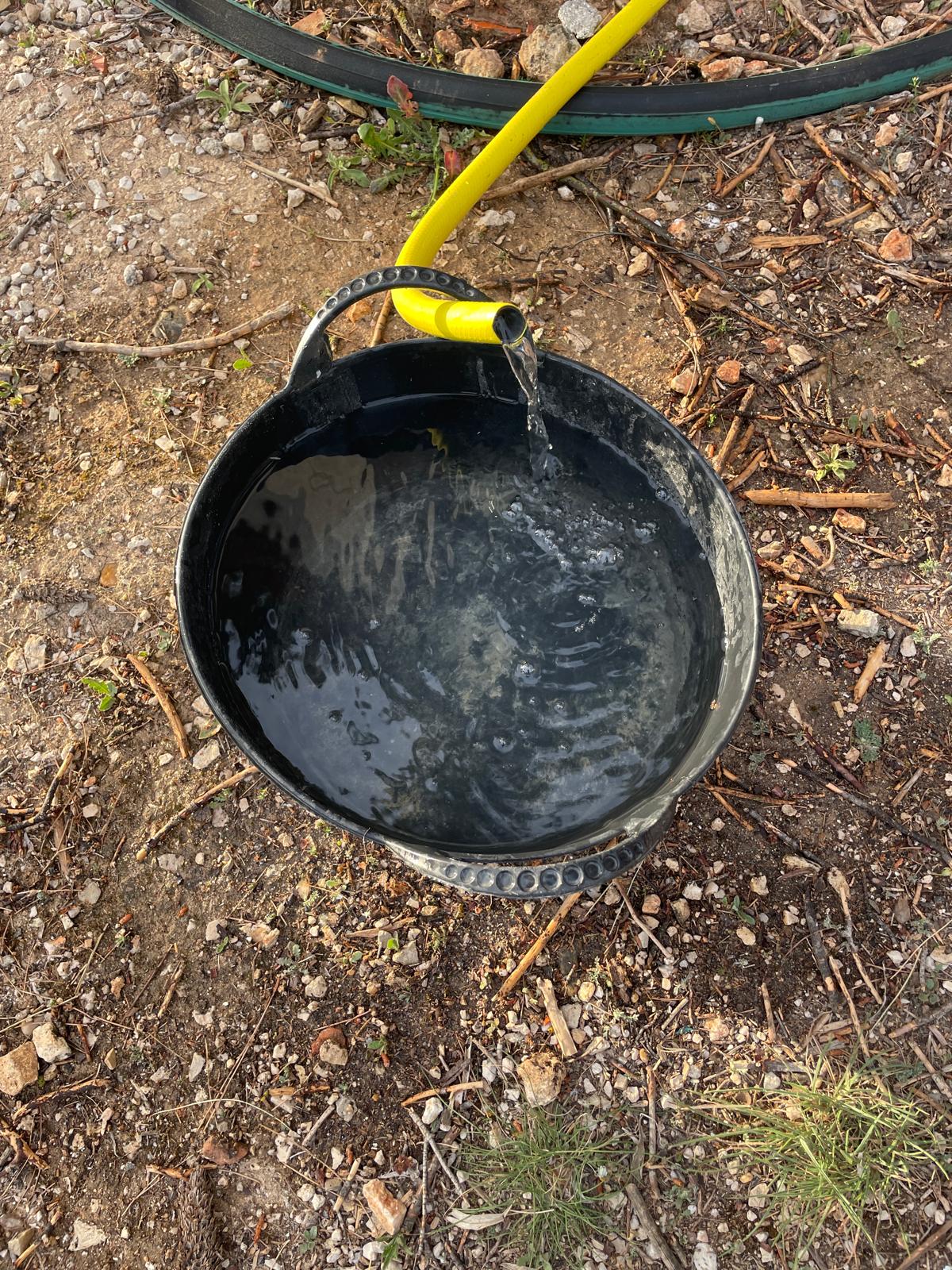
During the day, the panel runs the pump and fills a 500-liter tank. That gives enough water for several days of basic use: washing, the sink, and the bathroom.
So instead of buying a large battery bank, I used the cheapest and most appropriate storage system for this task:
a water tank.
This is important. When designing an off-grid system, first ask:
What am I really trying to store?
If the answer is electricity, use a battery.
If the answer is cold, maybe use insulation.
If the answer is water, use a tank.
The regulator: DC-DC converter instead of inverter
The pump is a 12V DC pump of about 100W.
So I did not need an AC inverter.
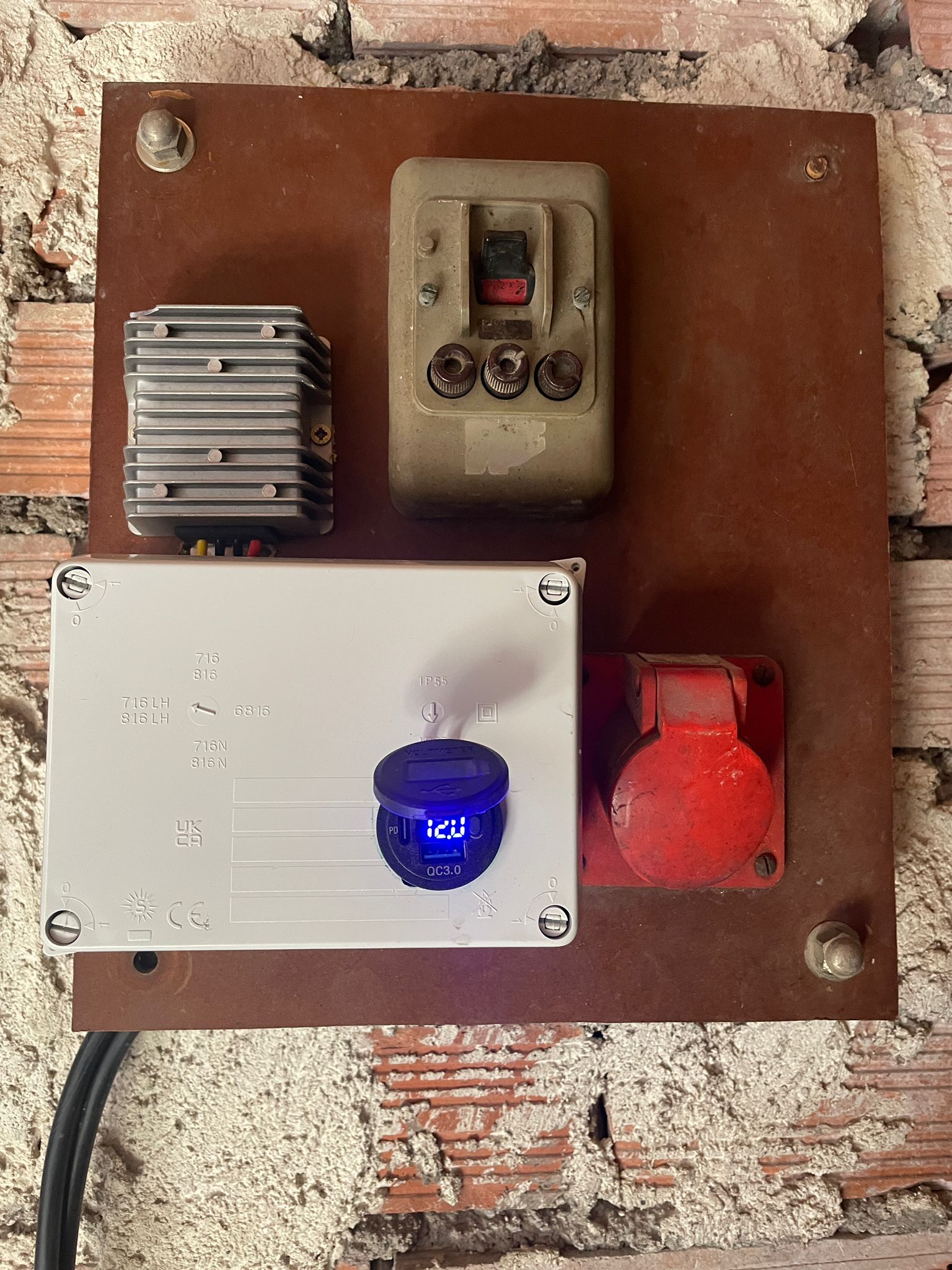
Instead, I used a DC-DC converter, similar in concept to what is used in camper vans and vehicles. These devices take one DC voltage and convert it into another stable DC voltage.
In this case, the converter accepts a solar input between 30V and 96V DC and provides a stable 12V DC output, rated at 15A.
That means:
12V × 15A = 180W
The pump is around 100W, so the converter is oversized enough to deal better with motor startup current. Small motors often draw more current when starting than when running, so designing only for the nominal wattage is a good way to be disappointed.
A battery charge controller would not have been the right tool here. Charge controllers are designed mainly to charge batteries. In this system, I wanted to power a 12V DC load directly from a larger solar panel.
So the chain is:
solar panel → DC-DC converter → 12V pump
Simple.
The water pump
The pump is a small 12V DC water pump, rated for the lift I needed.
It does not have a huge flow rate, and that is fine. This is not an irrigation system that needs a high flow in a short time. It only needs to fill a tank slowly during the day while the sun is available.
That changes everything.
A slow pump running for several hours is often better than a powerful pump that needs a big inverter, large batteries, and thicker cables.
The question is not:
How fast can I pump?
The question is:
Can I fill the tank during the day?
In this case, yes.
Extra: USB charging
I also installed a small USB charger with a voltmeter, the kind sold for cars and camper vans.
This lets my friend charge her phone and other small devices during the day. She already uses motion-sensor lights with internal batteries for nighttime lighting, so now those can also be charged from the same solar setup.
That was not the main goal, but it is a useful bonus.
Basic layout
The system is very simple:
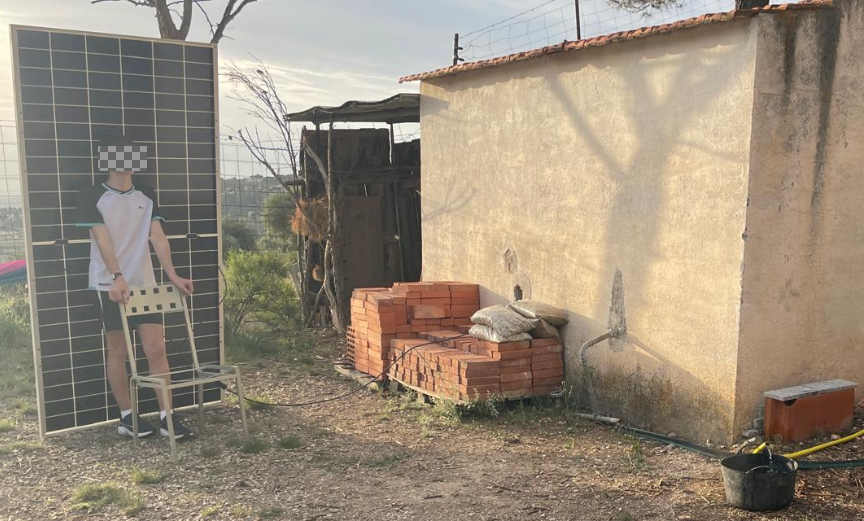
Large solar panel on the roof
Cable from the panel to the DC-DC converter
12V output from the converter
One output to a USB charger
One output through a switch to the pump
Pump fills the water tank during the day
I also reused an old switch from an electrical box that was already in the shed. It now looks like a proper fused switch panel, which made me smile. Reusing old material is not always elegant, but sometimes it has character.
The result is very simple: a home that now has water without daily physical effort, without an inverter, without a large battery bank, and without buying one of the expensive ready-made kits. This little project made me feel very good. It is a small system, but it solved a real problem. A person who used to pull bucket after bucket from a deep well now turns on a switch and water comes out. That is appropriate technology.
Care for the earth: solar power, low waste, simple design.
Care for people: less pain, less daily burden, more dignity.
Return of surplus: using knowledge and work to make someone’s life easier.
And perhaps the most amazing part: It works!!!.
WhatsApp-Image-2026-04-27-at-22.44.50.jpeg
controls
44973f50-d5d4-477f-a7dc-ea4ba83d1698.jpeg
water!!!
Captura-desde-2026-04-27-22-50-39.png
first test - I love this panel support
Roble (Spain)
We can leave the world a little better than we found it, right?
I could suggest some alterations. There are lots of DC water pumps that work on DC current at variable voltage, usually from 30V up to 300V. With a solar pump controller, you could position a higher-voltage pump down the well, and then pump water out of the well, and up the hill to a relocated storage tank. As you mentioned, high-voltage residential panels are dirt-cheap right now. Here in the US, I'm getting 250W panels for <50USD. With a higher voltage pump, you could position your storage tank ~30 meters above the well's location, pump during the day, and then feed the water to any nearby location by gravity any time of the day. A one-way valve will keep the water from flowing back into the well.
For my own water system, I have two 20,000 liter tanks positioned about 50 meters above the well-head. With the one-way valve positioned just downstream of my main water tap, I have pressurized water flowing 24/7.
Can you tell us more about the pump and motor you installed? Some air-cooled DC motors will overheat their windings and burn out prematurely if there is not enough wattage to start rotation (such as on a very cloudy/rainy day or at dusk/dawn). Without rotation for cooling, they essentially turn into a toaster. A submersible pump would be water-cooled and less likely to suffer damage.
I also wonder if the repurposed switch is rated for DC at the rated aperage? Switches designed for AC can only handle continuous DC at about 10% of the AC rating.
Nice project and solution, Juan! I've thought about a similar approach for watering our garden that would replace a petrol-driven pump next to a pond. My favored solution for water transfer and storage would be what you described here so nicely: Why use a bank of electricity when a bank of water is really what is desired? Aside from the fact that deep winter would mean draining the tank completely before the freezing month arrive, it would make so much sense to us to have the water pumped up to a tank that is positioned on an elevated support system. The higher the tank above ground level, the better the pressure in a fixed hose diameter. Even with the trade-off I would be willing to sacrifice water pressure for ease of use and reduced energy consumption. We are in a very flat location so placing the tank on a hill to gain height is not an option. If the tank is placed too high off the ground, it is nearly certain that high winds in summer storms would blow the structure to the ground. Fortunately, I've been seeing used 500W+ -sized solar PV panels for cheap around our location which would make ideal power sources for mid-day pumping and a 250 gal tank is already here unused. Thanks for this description and I may try this out during the coming summer.
“The most important decision we make is whether we believe we live in a friendly or hostile universe.”― Albert Einstein
I do like a dc only solution. You are 100 percent correct that for irrigation using a tank as a battery is a great low cost solution. I to wonder about that switch but it looks like a good old fashioned type with heavy duty contactors. Some of them were built for ac or dc so it might work out. Keep an eye on it for carbon build up and arcking
Cheers!
David
Juan Roble
Posts: 51
Location: I am building a life project in the Spanish Pyrenees.
Hello everyone, thank you for reading and for your replies — together we really make “the water” flow.
The goal of what I built was not to make it perfect, but to make it cheap and functional. That said, all of your inputs are valid, and I’m taking away quite a few good ideas.
Yes, a higher-voltage pump could eliminate the need for the converter, but in this case the converter actually helps prevent some problems. It includes short-circuit protection, and that becomes important when the panel is at around 52V but early in the morning there isn’t enough power to get the pump spinning. In that situation, something close to a short-circuit condition can occur, and the converter drops the voltage instead of letting something burn.
The house tank is about 2 meters (around 6.5 feet) above ground, which is enough to provide water flow inside the house. For the intended use, that is more than sufficient. We don’t need high pressure or high flow.
Regarding clouds or low-sun conditions, that was exactly why I chose a large panel. It’s a 650W bifacial panel with about 23% efficiency. In the test photo we had to orient it toward the sun because it was late in the day and somewhat cloudy — but it still worked. The system is quite tolerant: partial shading from plants is not a big issue because the panel is oversized, but either the sun is present, or there simply isn’t enough energy.
I did consider adding a relay with voltage hysteresis to control pump start/stop, but in practice the converter already provides a kind of built-in protection, so I stayed with that. The pump is switched manually, which also helps avoid those marginal low-power moments.
The switch and DC arcing is probably the most critical point. You’re right — standard AC switches are not ideal for DC. In this case, it’s a heavy-duty power switch (older, but robust), with good insulation and large contacts. I’m not too concerned, but I fully understand the point and will keep an eye on it. I’ll check for carbon buildup or arcing, and replace it if needed.
There are fuses inside the box, both at the input of the converter and at the output to the pump. All connections going into the well are sealed using proper cable glands.
For those who asked: the pump is submersible, with a float switch for low water level protection. It’s a 12V, 95W pump, with about 27 feet of head. I believe it’s from Vevor. Honestly, I expect this to be the first component to fail, but it only costs around 75 USD.
Once again, thank you all. It’s a real pleasure to be able to share this with the community.
Roble (Spain)
We can leave the world a little better than we found it, right?
Live ordinary life in an extraordinary way. Details embedded in this tiny ad:






 18
18