
• Post Reply Bookmark Topic Watch Topic
  • New Topic
permaculture forums growies critters building homesteading energy monies kitchen purity ungarbage community wilderness fiber arts art permaculture artisans regional education skip experiences global resources cider press projects digital market permies.com pie forums private forums all forums
this forum made possible by our volunteer staff, including ...
master stewards:
  • Carla Burke
  • Nancy Reading
  • John F Dean
  • r ransom
  • Jay Angler
  • Timothy Norton
stewards:
  • paul wheaton
  • Tereza Okava
  • Nicole Alderman
master gardeners:
  • M Ljin
  • Christopher Weeks
gardeners:
  • Jeremy VanGelder
  • thomas rubino
  • Megan Palmer

The wool problem is the solution... I hope

 
Rusticator
Posts: 9733
Location: Missouri Ozarks
5351
7
personal care gear foraging hunting rabbit chicken cooking food preservation fiber arts medical herbs homestead
  • Likes 4
  • Mark post as helpful
  • send pies
    Number of slices to send:
    Optional 'thank-you' note:
  • Quote
  • Report post to moderator
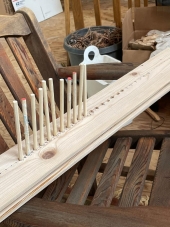
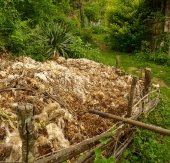
I have several raw (whole, unprocessed, unwashed - straight from the sheep) fleeces that are so heavily vm-filled (vm = vegetation matter,i.e. hay, straw, twigs, etc) that it will take more work than I have spoons to pick through. The friend I got them from thought I was crazy for wanting them - and shortly after their delivery, I wasn't so sure she was wrong. So, I stuffed them into my old car (that hasn't run innnn...5yrs?), for storage. I love felting fleece, and had been toying with the idea of making them into raw wool sleeping mats on the peg loom - but not with all that vm.

In the meantime, I've purchased a few goji plants, and of course, a couple months ago, started more tomato plants than I have pots to accommodate (nope - they can't go into the ground). So, I've been pricing out small-tree-sized pots, and oh, my! They're pricey! And, I'm going to need pots much sooner than I'll be able to save enough for the pots. But, then it occurred to me - I have those fleeces stashed in my car (that I'm dearly wanting to restore). They would not only be biodegradable, but would even offer some small amount of fertilizer, via the vm & manure still stuck in them.

I *think* if felted very densely, those fleeces ought to make decent and very permie planting pots, that will both protect and feed my green babies, for at least a few years! Depending on how I do it, it might even give me the option of eventually moving the whole thing - pot included, into the ground or even into a bigger pot. But, I'm looking for input about how to go about it. My thoughts, thus far:

Option 1: Woven densely on my peg loom, which can support a 4ft wide warp, to a length of 9 or 10 feet, then wet-felted & fulled, which would shrink it by 30 - 50%. I'd then overlap the ends by a couple inches and needle-felt it together, then do the same to the bottom, folding in the resulting corners, to square off the bottom, so it will sit up. This method would require some strong warping fiber - just? Rug warp? Sumpin' else?

Option 2: Combine it with papercrete or something similar, paper machet-style, shape it around a form (30gal trash can or something like that, cure it, seal it with something that won't hurt my land or plants, and away we go. This *seems* like the easiest way to do it, but not necessarily the cheapest or most eco-friendly way, depending on the binding material, of course.

Option 3: Straight-up wet-felting, no weaving, done on a form, the same as option 2. Much more budget friendly than the first 2 options, because there would be no need for creating a papercrete or any warp. But, I think it might also be the least stable, especially over time.

Option 4:
 
master steward
Posts: 15243
Location: Pacific Wet Coast
9590
duck books chicken cooking food preservation ungarbage
  • Likes 4
  • Mark post as helpful
  • send pies
    Number of slices to send:
    Optional 'thank-you' note:
  • Quote
  • Report post to moderator

Carla Burke wrote:...Option 3: Straight-up wet-felting, no weaving, done on a form, the same as option 2... But, I think it might also be the least stable, especially over time.


Do you have something like old metal coat hangers that you could use to sew or reinforce the felt with to make it more stable over time?

This idea in general seems like homemade grow bags. I've never used them and in my climate I'd really need a reliable way to make sure they don't dry out too much. Would you have a larger enough tank that you could drop them into a few inches of water for a few hours so they really sucked up moisture? The trick would be not letting them get so heavy that you couldn't get them back out. Water's heavy stuff!
 
Carla Burke
Rusticator
Posts: 9733
Location: Missouri Ozarks
5351
7
personal care gear foraging hunting rabbit chicken cooking food preservation fiber arts medical herbs homestead
  • Likes 3
  • Mark post as helpful
  • send pies
    Number of slices to send:
    Optional 'thank-you' note:
  • Quote
  • Report post to moderator
Great idea, about the hangers, Jay! Thank you!

My daughter's grow bags were the seeds of this idea, so it makes sense that it brings them to mind. The water loss/evaporation issue is the biggest seller on the papercrete idea, because it would be the easiest form of them to add a biodegradable sealant to. Being raw, these fleeces still have all their lanolin, so that brings a certain level of water sealant, but the spaces between the fibers are what pretty much negates it. Unless I can get it felted very, very densely... then it may be possible to only coat the outside... Maybe.
 
pollinator
Posts: 508
Location: Oz; Centre South
148
trees books cooking fiber arts writing
  • Likes 2
  • Mark post as helpful
  • send pies
    Number of slices to send:
    Optional 'thank-you' note:
  • Quote
  • Report post to moderator
A dear friend, since passed on to the felting workshop in the sky passed on this tip for felting projects gone wrong - use as a liner for a hanging basket - so you are on the right track. Wool holds at least 20% by weight of water without feeling damp - magic stuff.
Perhaps line an empty tin with the fleece, add growing medium, and then when the time is right plant out, fleece and all.  Recycle tins or re-use afterwards.  Bargain!
While I was off getting lunch - How about 2 tins - one about 1 inch smaller diameter.  Remove bottom and top from the smaller one.  Put fleece in the bottom of the larger, put the smaller tin inside and fill up the side spaces - a chop stick makes a good ram.  then fill the smaller container with growing medium, remove smaller tin and presto! ready to plant.   Perhaps I need a chocolate fix?
Edit to add:- chocolate works!  the same approach would work with a couple of plant pots with less effort.
 
Carla Burke
Rusticator
Posts: 9733
Location: Missouri Ozarks
5351
7
personal care gear foraging hunting rabbit chicken cooking food preservation fiber arts medical herbs homestead
  • Likes 1
  • Mark post as helpful
  • send pies
    Number of slices to send:
    Optional 'thank-you' note:
  • Quote
  • Report post to moderator
Jill, you *may* need a chocolate fix, but I'm pretty sure I'm right there with you! That's actually a pretty good idea! I'll need a pair of extra big tins, though. The goji need something between 18" & 24" in diameter - and taller, because their roots go deep. But, the concept makes sense, so that might be create-it option #4.
 
All of the world's problems can be solved in a garden - Geoff Lawton. Tiny ad:
List of Rocket Mass Heater Builders
https://permies.com/wiki/122347/List-Rocket-Mass-Heater-Builders
reply
    Bookmark Topic Watch Topic
  • New Topic