
• Post Reply Bookmark Topic Watch Topic
  • New Topic
permaculture forums growies critters building homesteading energy monies kitchen purity ungarbage community wilderness fiber arts art permaculture artisans regional education skip experiences global resources cider press projects digital market permies.com pie forums private forums all forums
this forum made possible by our volunteer staff, including ...
master stewards:
  • Carla Burke
  • Nancy Reading
  • paul wheaton
  • John F Dean
  • r ransom
  • Jay Angler
stewards:
  • Timothy Norton
  • Tereza Okava
  • Pearl Sutton
master gardeners:
  • Christopher Weeks
  • M Ljin
gardeners:
  • Jeremy VanGelder
  • Megan Palmer
  • Thekla McDaniels

Chance's Garden Everything Forum Blog

 
Posts: 159
Location: Payson, Utah, US of A - Zone6B/High Desert/4500' /14" Rainfall
88
  • Likes 16
  • Mark post as helpful
  • send pies
    Number of slices to send:
    Optional 'thank-you' note:
  • Quote
  • Report post to moderator
This is intended to be an ongoing thread in which I'll share ideas, updates, photos, plans, successes and failures, useful resources, and anything else that seems fitting in this context.

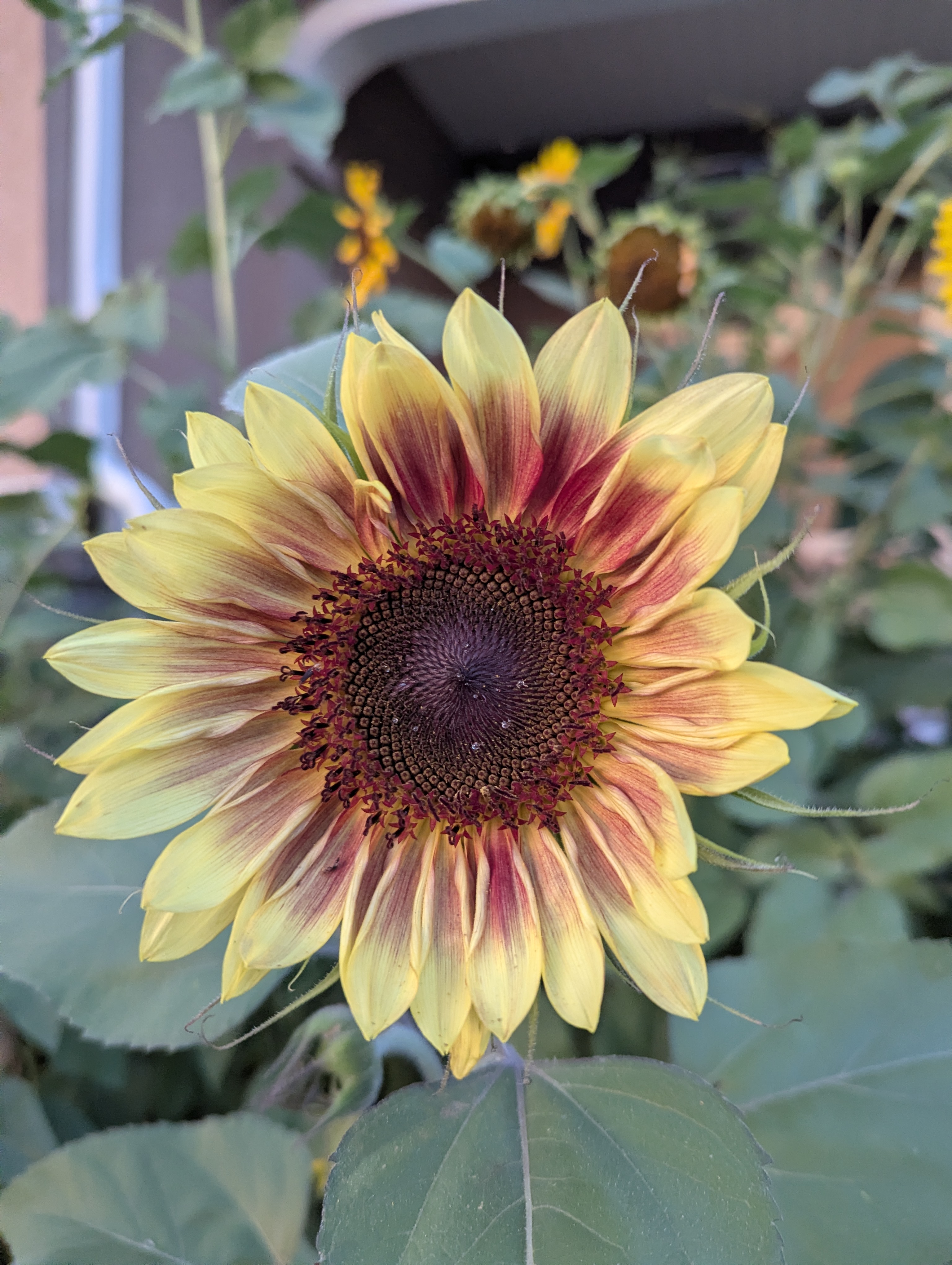
Here's a nice photo to start things off:
PXL_20260729_025300960.jpg
Blood Lemon Sunflower (I made the name up) from my yarden
 
Chance Lunceford
Posts: 159
Location: Payson, Utah, US of A - Zone6B/High Desert/4500' /14" Rainfall
88
  • Likes 10
  • Mark post as helpful
  • send pies
    Number of slices to send:
    Optional 'thank-you' note:
  • Quote
  • Report post to moderator
I started my yarden at my current home in 2021.

I don't have very good before pictures, but I'll post a few of my backyard here to start with:
PXL_20210330_131654705.jpg
[Thumbnail for PXL_20210330_131654705.jpg]
PXL_20210424_232857260.jpg
[Thumbnail for PXL_20210424_232857260.jpg]
PXL_20210424_232908853.jpg
[Thumbnail for PXL_20210424_232908853.jpg]
PXL_20220325_212503202-2.jpg
[Thumbnail for PXL_20220325_212503202-2.jpg]
PXL_20210401_021847047.NIGHT.jpg
[Thumbnail for PXL_20210401_021847047.NIGHT.jpg]
 
Chance Lunceford
Posts: 159
Location: Payson, Utah, US of A - Zone6B/High Desert/4500' /14" Rainfall
88
  • Likes 14
  • Mark post as helpful
  • send pies
    Number of slices to send:
    Optional 'thank-you' note:
  • Quote
  • Report post to moderator
Here are some recent photos (last couple of months) for comparison:
PXL_20260617_143612476.jpg
[Thumbnail for PXL_20260617_143612476.jpg]
PXL_20260618_134531727.jpg
[Thumbnail for PXL_20260618_134531727.jpg]
PXL_20260710_123448752.jpg
[Thumbnail for PXL_20260710_123448752.jpg]
PXL_20260618_134551299.jpg
[Thumbnail for PXL_20260618_134551299.jpg]
PXL_20260613_174239514.jpg
[Thumbnail for PXL_20260613_174239514.jpg]
 
Chance Lunceford
Posts: 159
Location: Payson, Utah, US of A - Zone6B/High Desert/4500' /14" Rainfall
88
  • Likes 13
  • Mark post as helpful
  • send pies
    Number of slices to send:
    Optional 'thank-you' note:
  • Quote
  • Report post to moderator
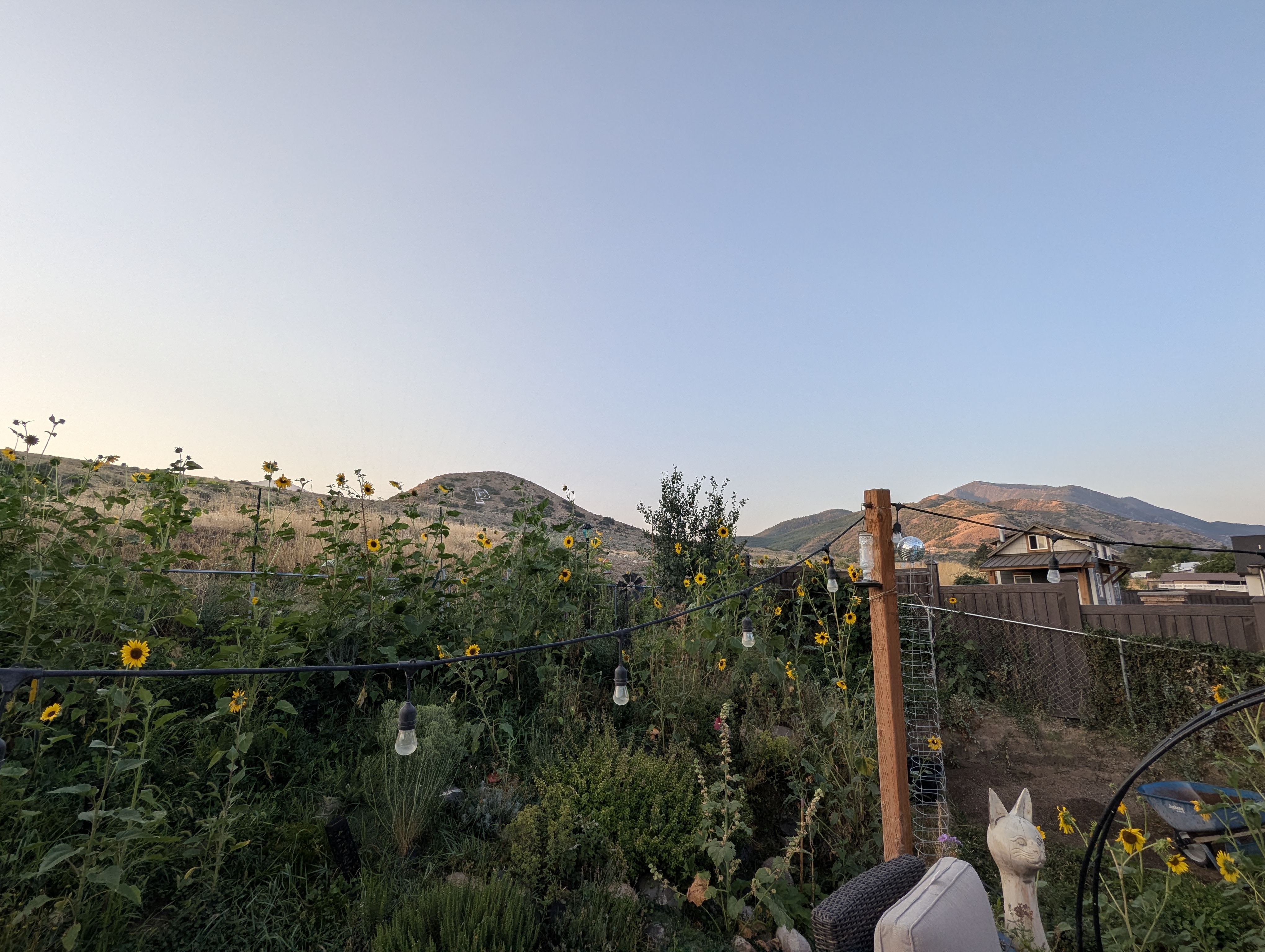
These two photos (they're in the previous two posts too) were taken approximately 5 years apart in almost the same spot.

I'll take a picture from the same spot tonight and post it so you can see how much summer growth I've experienced.

Site Stats:
- Zone 6B trending into 7
- 14" average annual rainfall
- Typically 10-20 100°+ Fahrenheit summer days
- Irrigation is 4 oscillating sprinklers which provide around 95% coverage, water via Strawberry Highline Canal system (mountain reservoirs) for 6-7 months, no irrigation otherwise (have municipal, but only use in emergency situations, which are rare in early spring and late fall)
PXL_20210330_131654705.jpg
[Thumbnail for PXL_20210330_131654705.jpg]
PXL_20260613_174239514.jpg
[Thumbnail for PXL_20260613_174239514.jpg]
 
Chance Lunceford
Posts: 159
Location: Payson, Utah, US of A - Zone6B/High Desert/4500' /14" Rainfall
88
  • Likes 8
  • Mark post as helpful
  • send pies
    Number of slices to send:
    Optional 'thank-you' note:
  • Quote
  • Report post to moderator
Here's the current photo of the same spot:
PXL_20260730_014731102.jpg
[Thumbnail for PXL_20260730_014731102.jpg]
 
Chance Lunceford
Posts: 159
Location: Payson, Utah, US of A - Zone6B/High Desert/4500' /14" Rainfall
88
  • Likes 11
  • Mark post as helpful
  • send pies
    Number of slices to send:
    Optional 'thank-you' note:
  • Quote
  • Report post to moderator
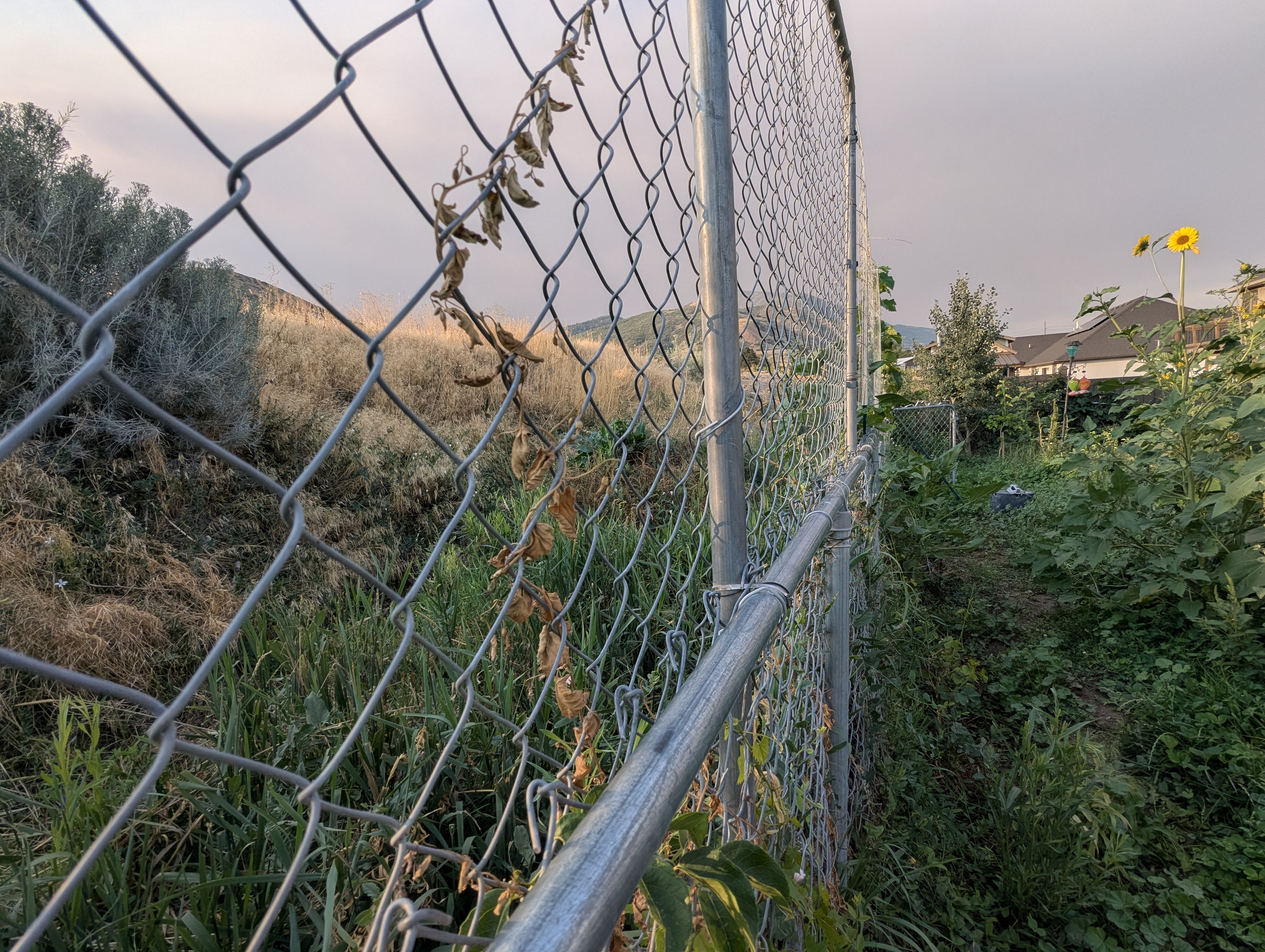
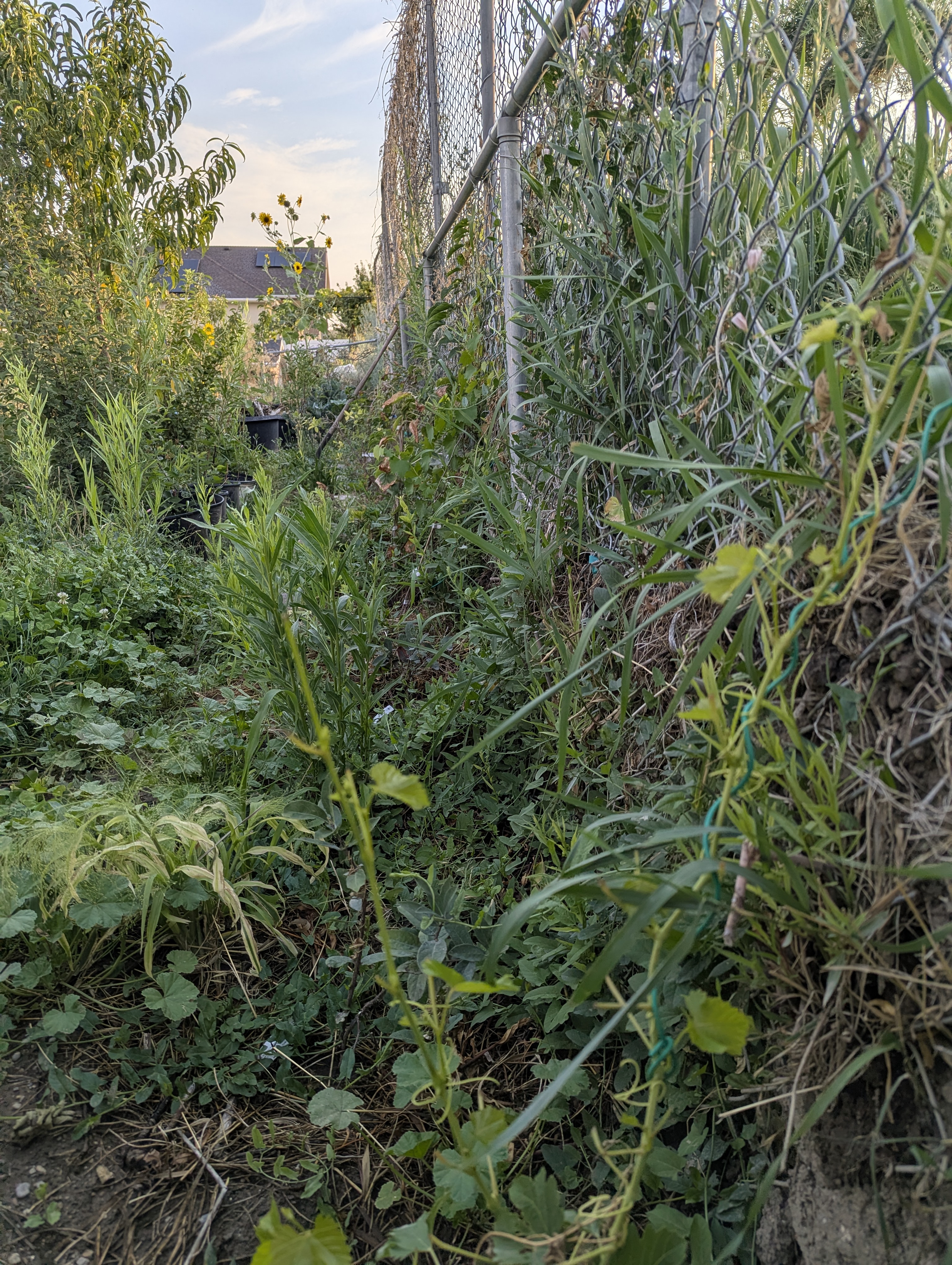
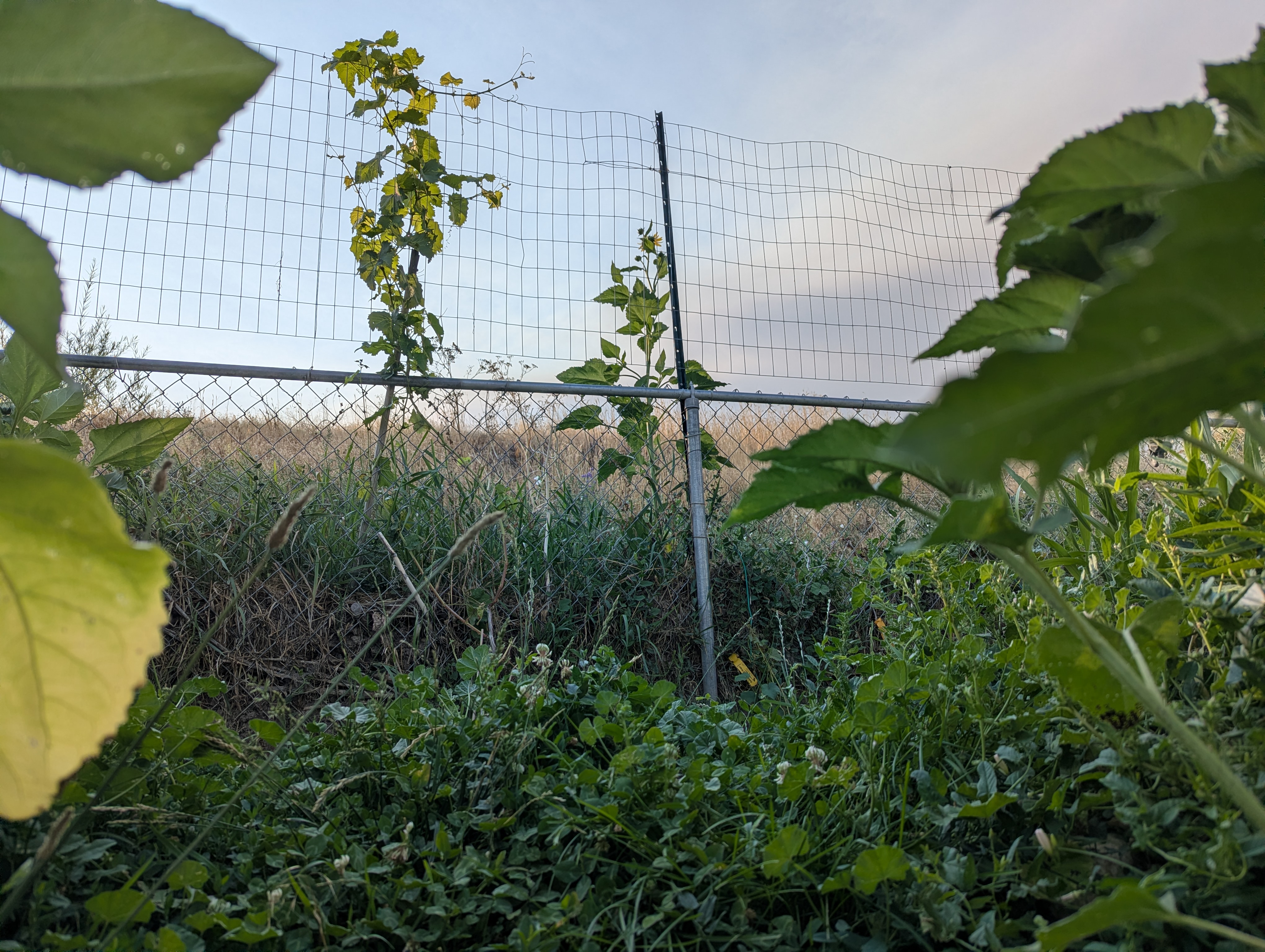
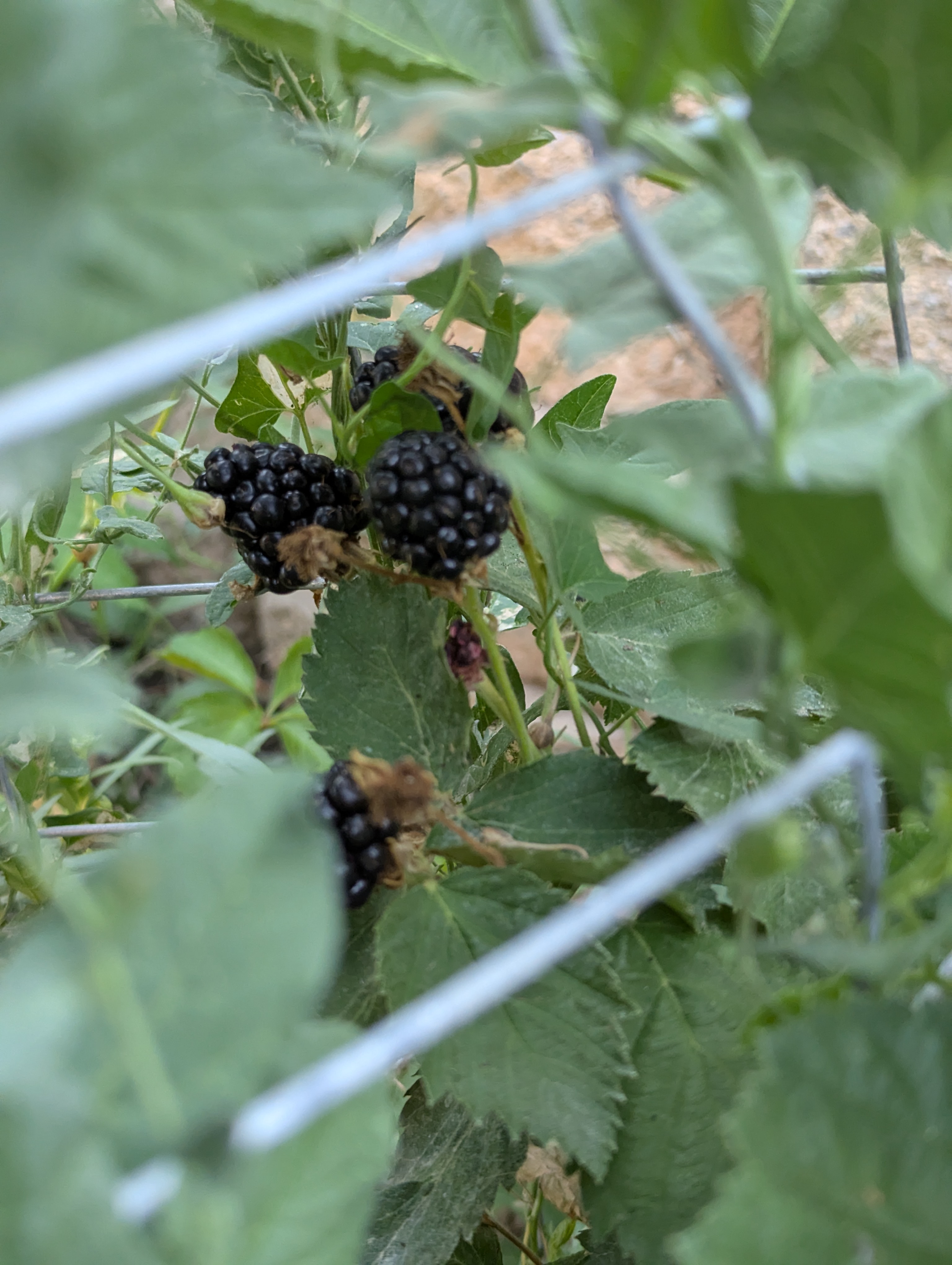
So, I put up a tall trellis along most of the backside of my yarden this year, and I've got grapes and hardy kiwis and blackberries and ornamentals I'll be growing up it (I've included some photo evidence, heh). I used some chain link panels I had left over from a dog run and then some welded wire fencing I had laying around.

I'll do a deeper dive on what's going on with the trellis later, because it's awesome and I'm eager for the future feature fully fleshed.

Next year I'm gonna add one more male kiwi, but I'm also gonna add passiflora incarnata aka hardy passion fruit or maypop.

Peaceful Heritage is doing some awesome work with the species, and Sundrop Farm has a wide selection of cold-hardy incarnata and incarnata-hybrids.

I'm going to add maybe 6-8 to my system next year, with an emphasis on the offerings from Peaceful Heritage, but with a couple selections from Sundrop Farm as well. I'll also get some extras to plant in my guerilla food forest project, and I'll do some seedling work with them over there eventually as well.

Here are the links, if you're interested in taking a gander or adding something wondrous to your system. Maypops may not be as spectacular in flower as somoof their tropical cousins, but they're still unreal in their beauty and otherworldly architecture.

https://peacefulheritage.com/collections/hardy-passionfruit-vines-for-sale

https://snowdropfarm.com/product-category/cold-hardy-passiflora/
PXL_20260617_142310354.jpg
[Thumbnail for PXL_20260617_142310354.jpg]
PXL_20260618_132620663.jpg
[Thumbnail for PXL_20260618_132620663.jpg]
 
Chance Lunceford
Posts: 159
Location: Payson, Utah, US of A - Zone6B/High Desert/4500' /14" Rainfall
88
  • Likes 7
  • Mark post as helpful
  • send pies
    Number of slices to send:
    Optional 'thank-you' note:
  • Quote
  • Report post to moderator
Okay, so, just took a walk with two of my daughters through the area I'm building my guerilla food forest project within.

I took some pictures of a couple things today, but here's the thing:

There's no fruit in Utah this year. It's been declared a state of emergency, even. We had the latest frost/snow I've seen in my lifetime, and it killed almost every blossom on almost every kind of fruiting tree or shrub across almost the whole northern 2/3 of the state. Brutal, man. The silver lining is, assuming we don't have another freaky frost, we're going to have a bumper crop next year.

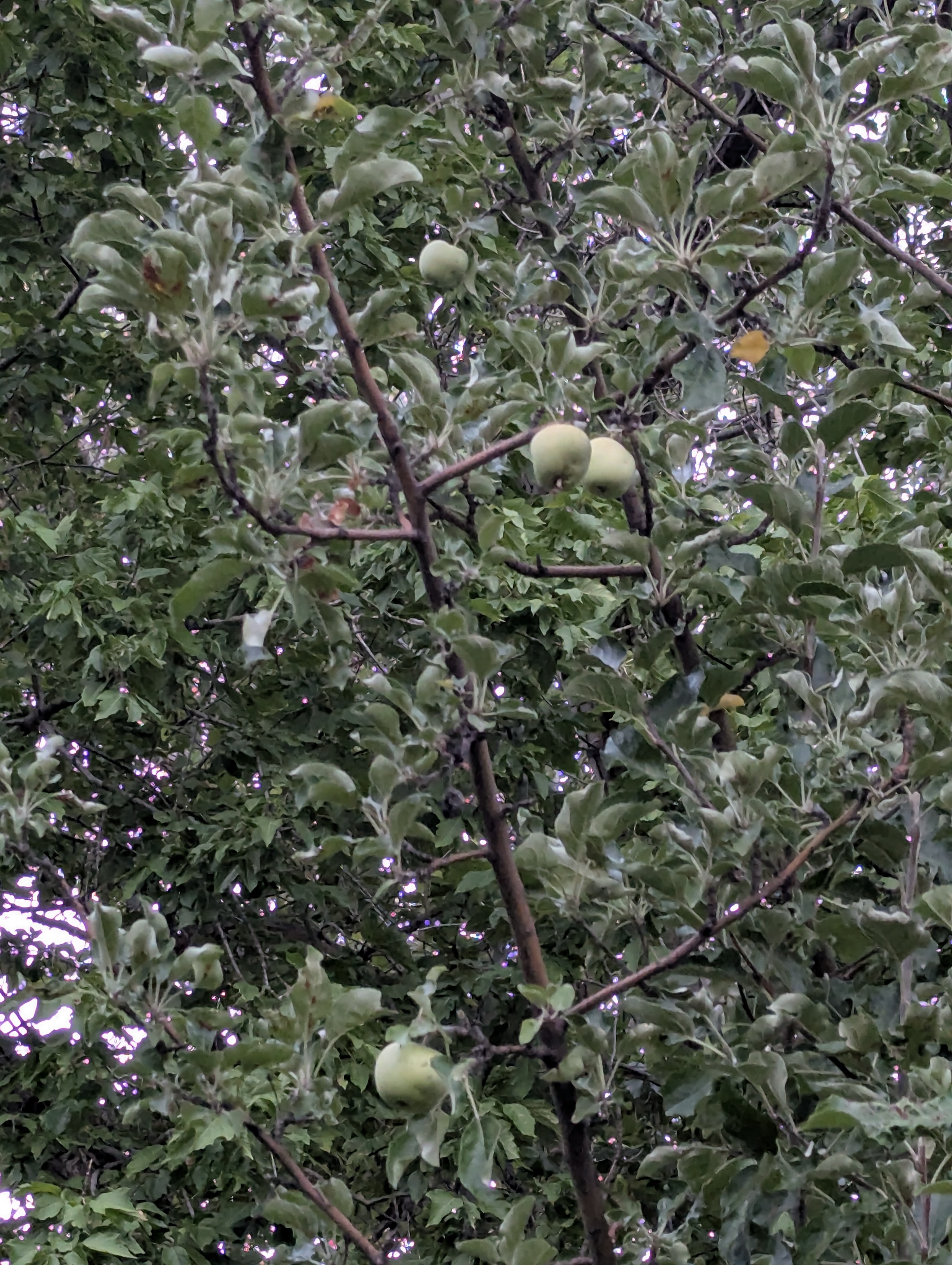
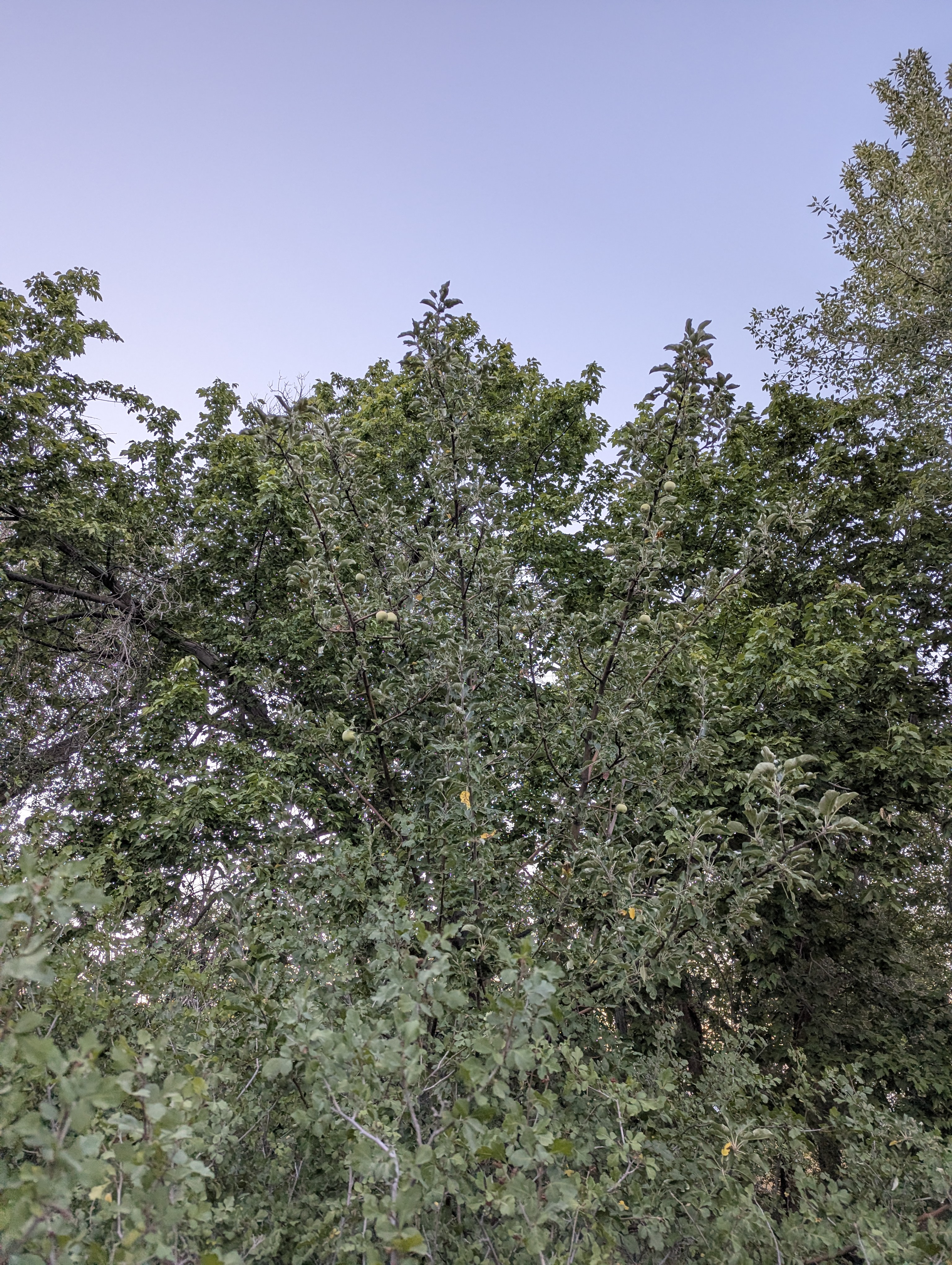
However, one of the wild apple trees has about ten fruits.

I'll post a couple pictures of some stuff now, but I'm also going to list the different fruit/but trees and bushes I've found in the area (I'll post pictures of all of them later, after I go take photos of them all), which are as follows:

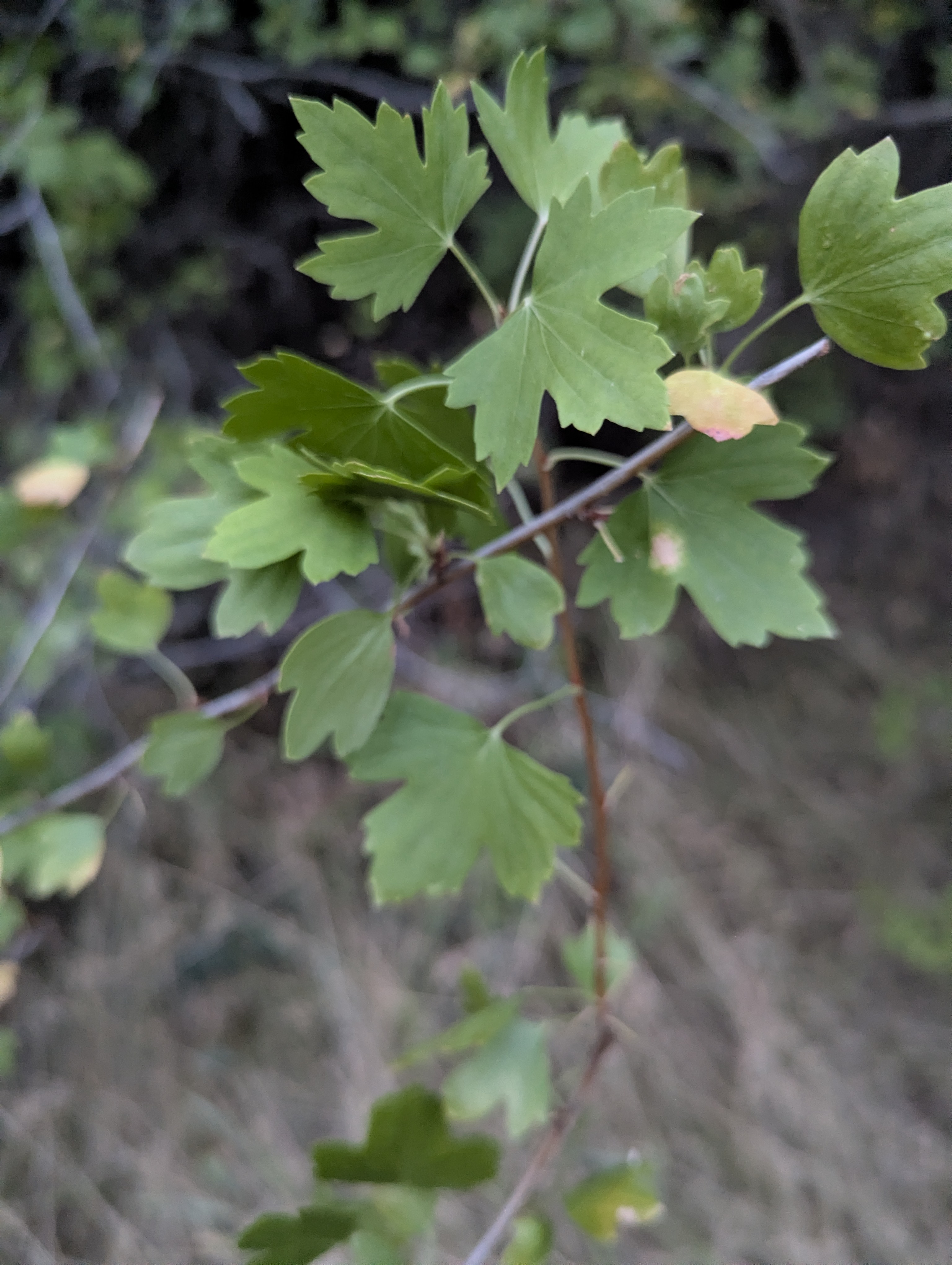
- Amber Fruited Golden Currant (I've only found one patch of these, and they're SPECIAL, because they taste like spiced apples)
- Black Fruited Golden Currant
- Crabapple
- Apple
- Cherries (Old pioneer timber cherries, one that is clearly a ranier offspring, one that is the offspring of that ranier and some other cherry growing beneath the ranier offspring, an unknown fullsize cherry with burgundy cherries, a bunch of wildling cherries that are descendants, probably, of the pioneer cherries, and maybe another half dozen distinct varieties)
- Plums (here's the real treasure, because there are at least 4 species of plums including American, Chickasaw, European, and Japanese, but there are hybrids and maybe some other species but it's hard to tell, resulting in some really unique specimens, ranging from grape to just over golfball sized fruits in every color that plums come in except for green)
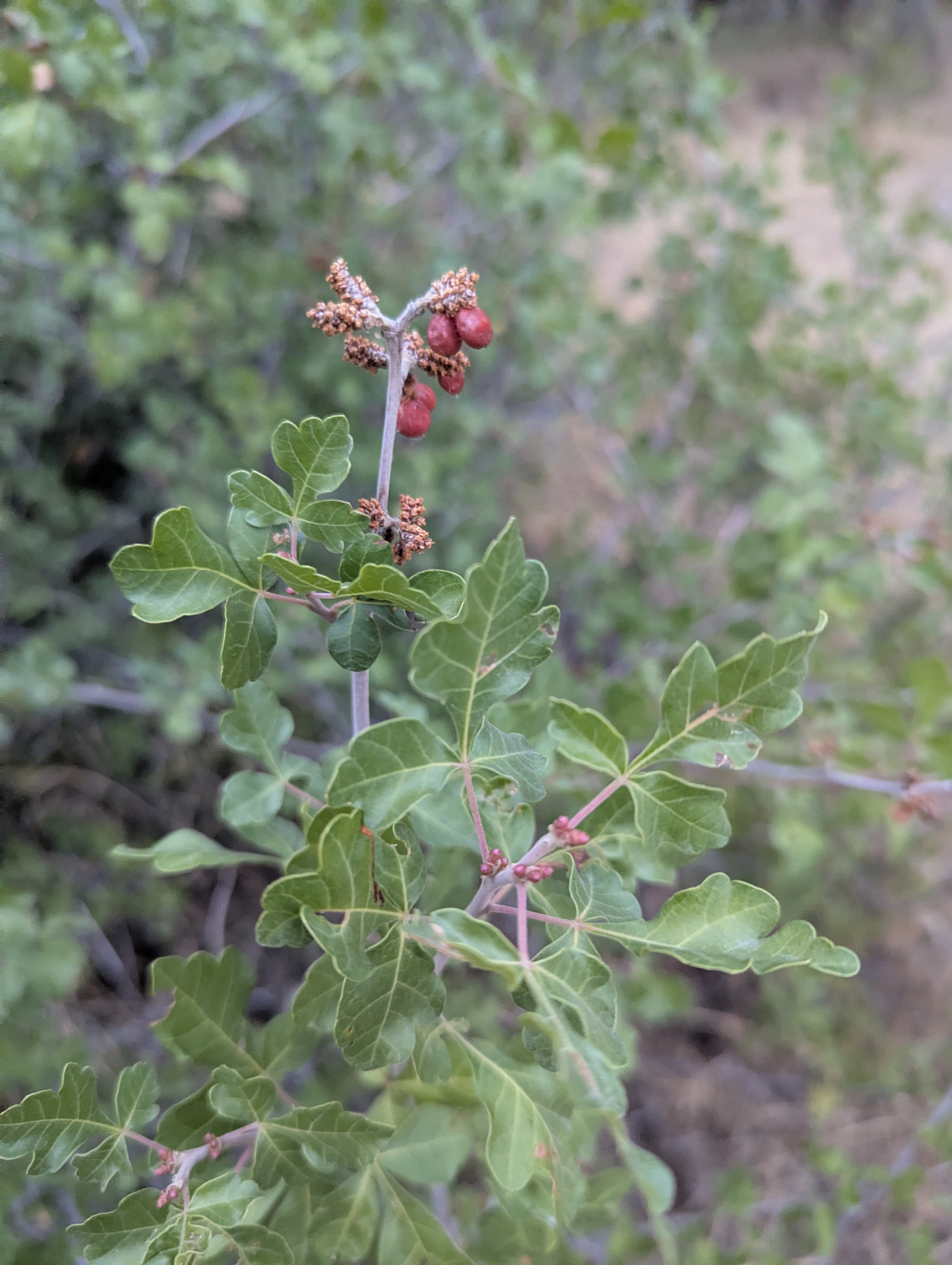
- Fragrant Sumac (not that edible, but the berries make a tasty drink or tart cooking spice)
- At least 2 white oak species producing acorns
- I feel like I'm missing some stuff, but whattayagonnado?
PXL_20260731_025130418.MP.jpg
Amber Fruited Golden Currant foliage
PXL_20260731_024824153.jpg
Fragrant Sumac
Fragrant Sumac
PXL_20260731_024756815.jpg
Immature Apples
Immature Apples
PXL_20260731_024750026.jpg
Better Apple Tree View
 
Chance Lunceford
Posts: 159
Location: Payson, Utah, US of A - Zone6B/High Desert/4500' /14" Rainfall
88
  • Likes 6
  • Mark post as helpful
  • send pies
    Number of slices to send:
    Optional 'thank-you' note:
  • Quote
  • Report post to moderator
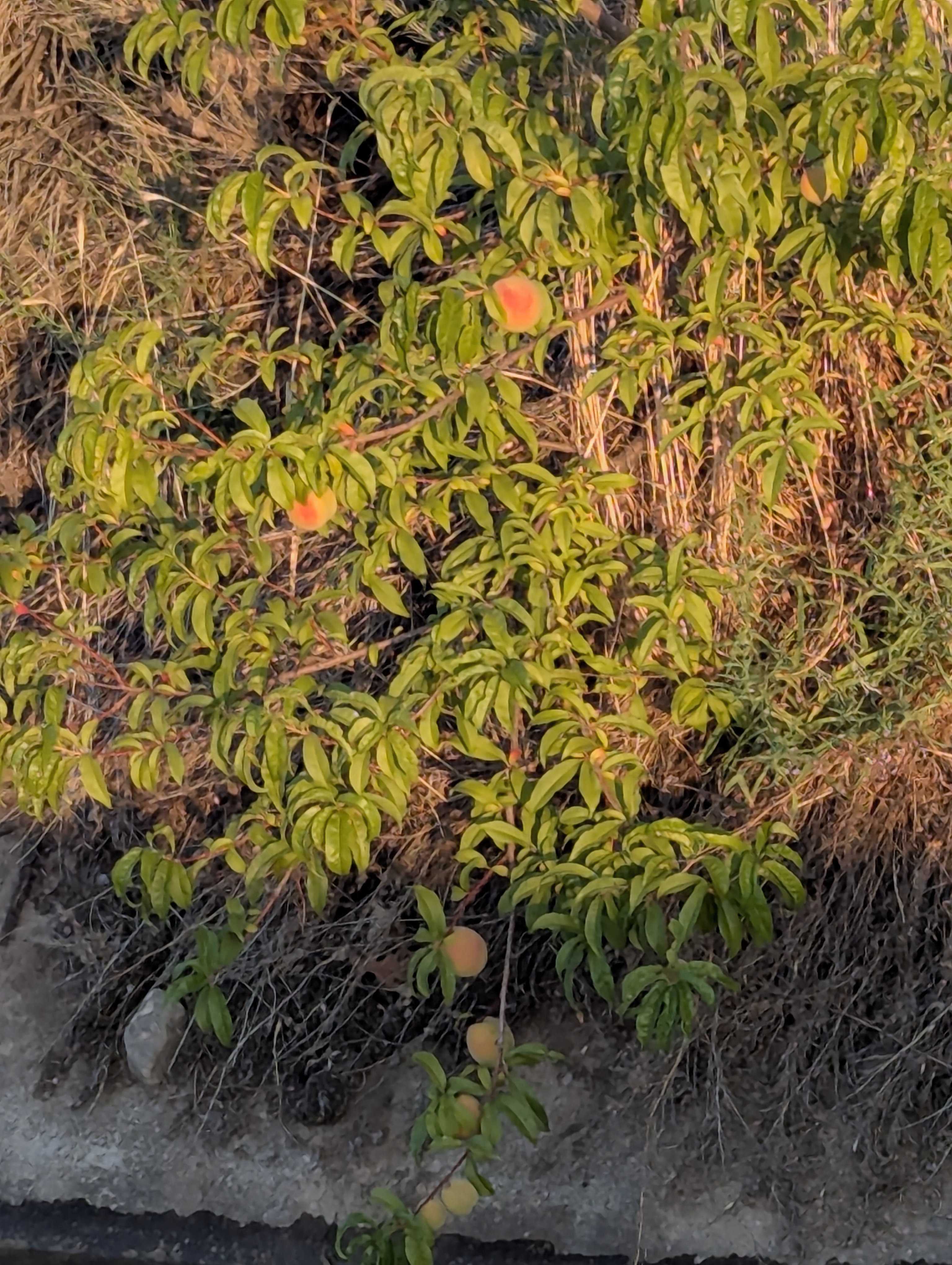
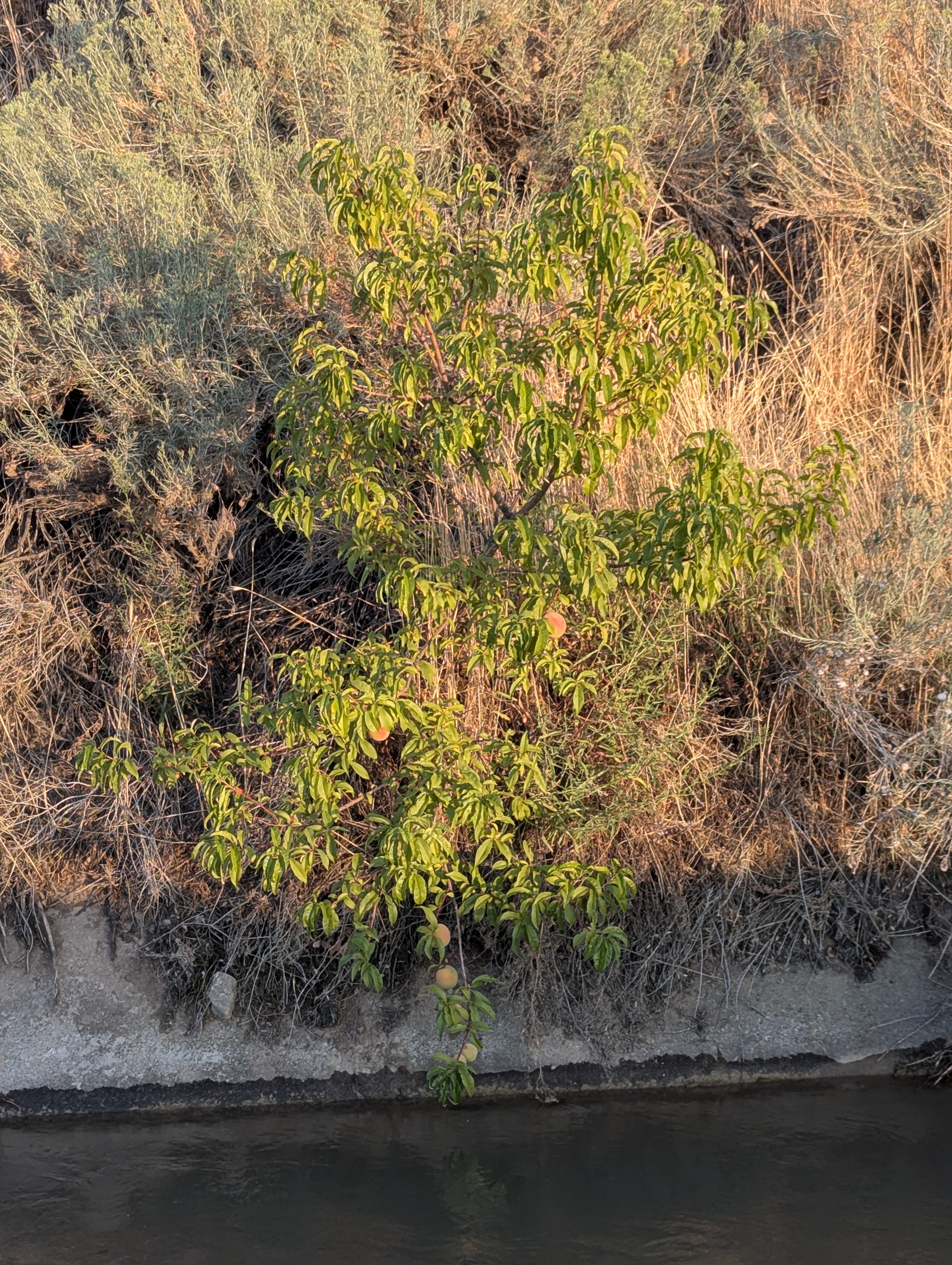
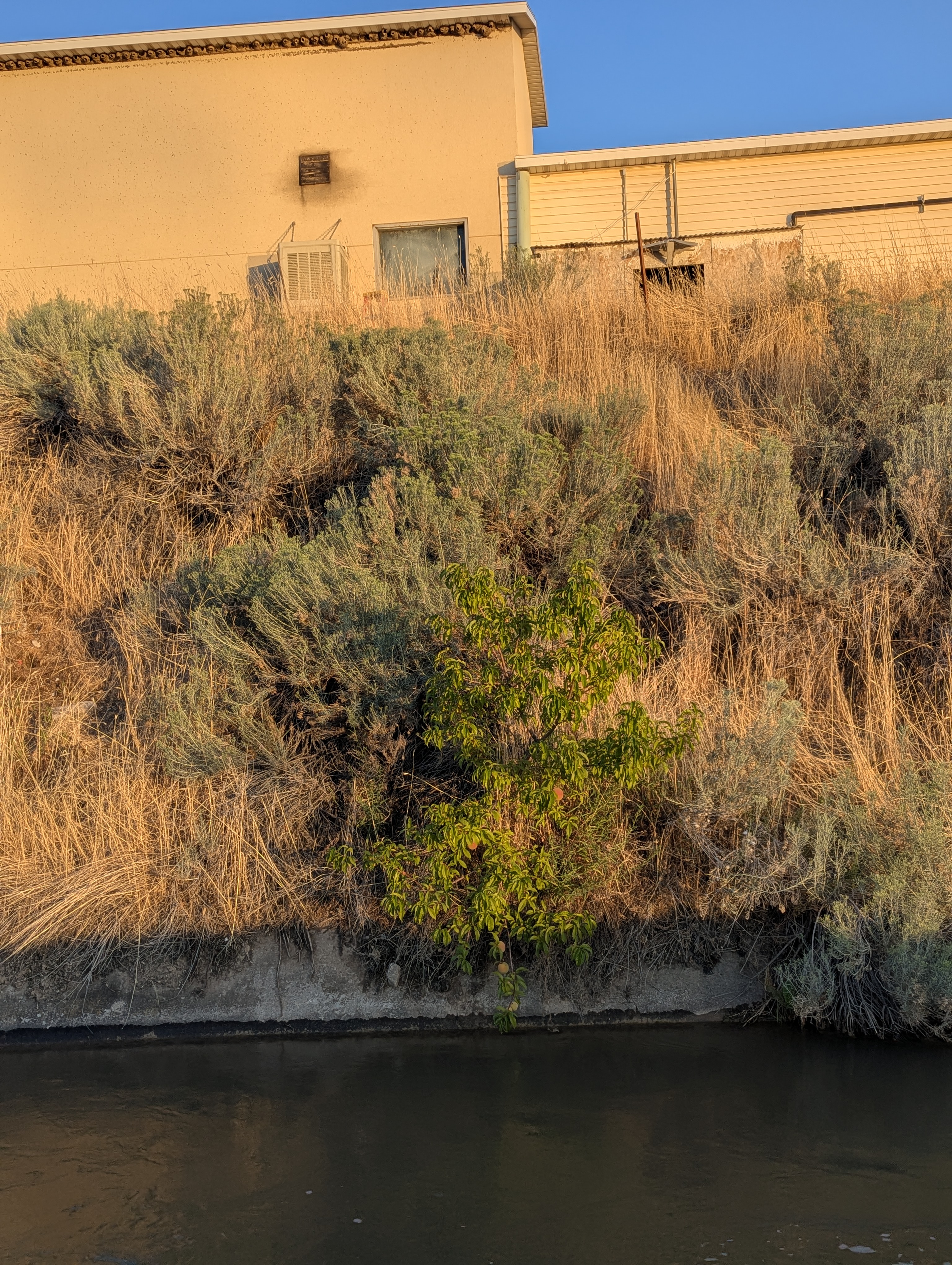
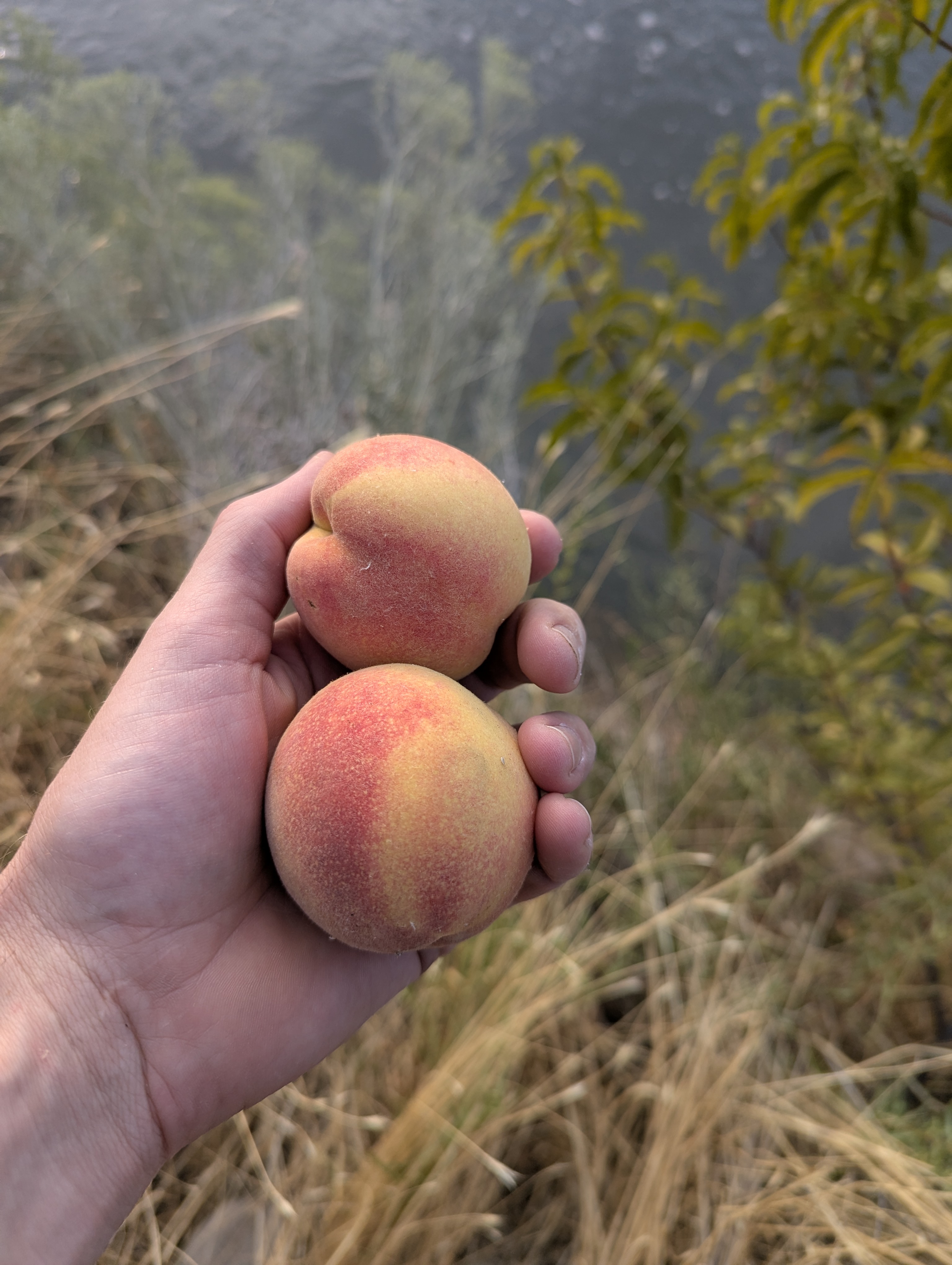
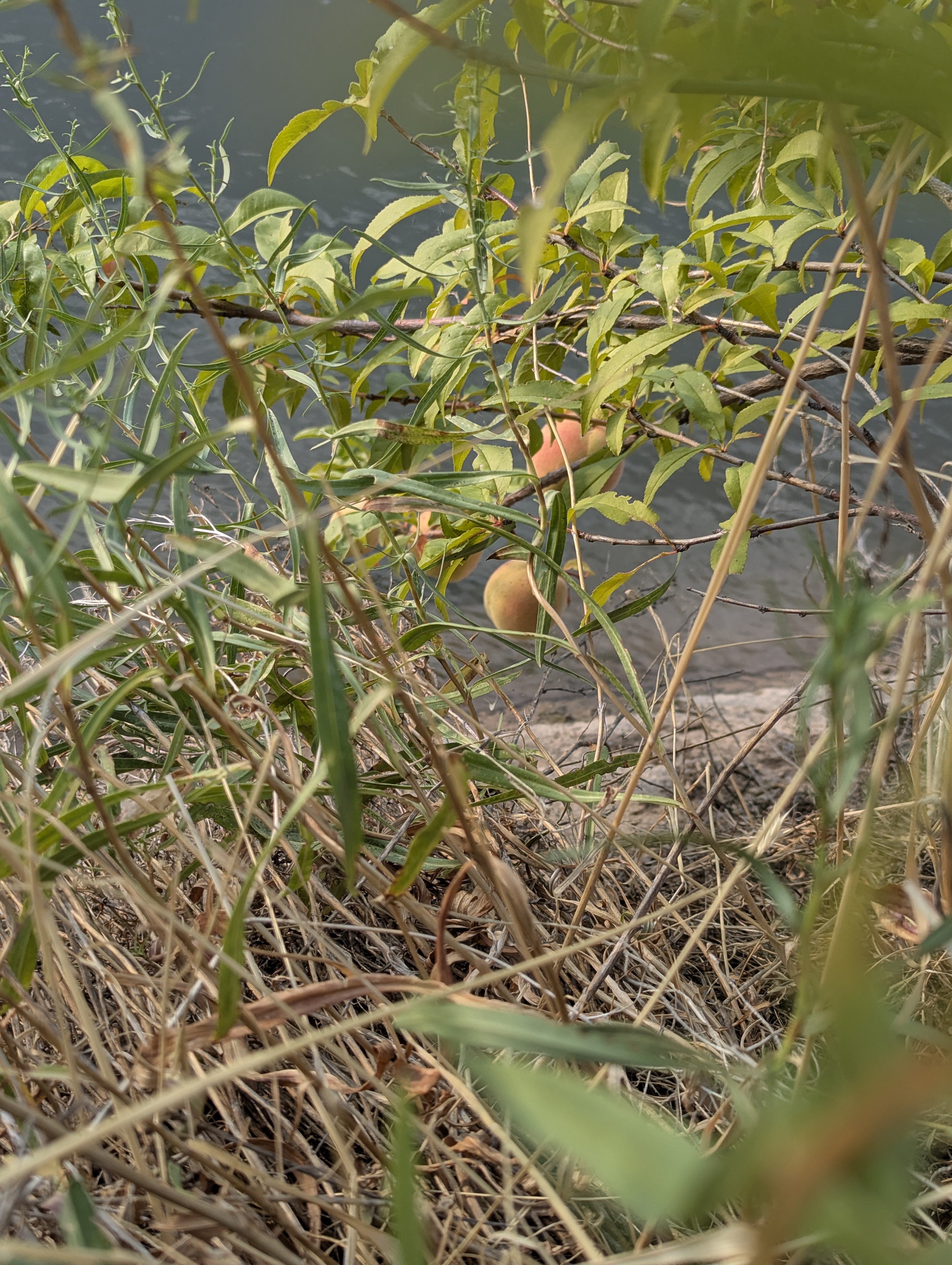
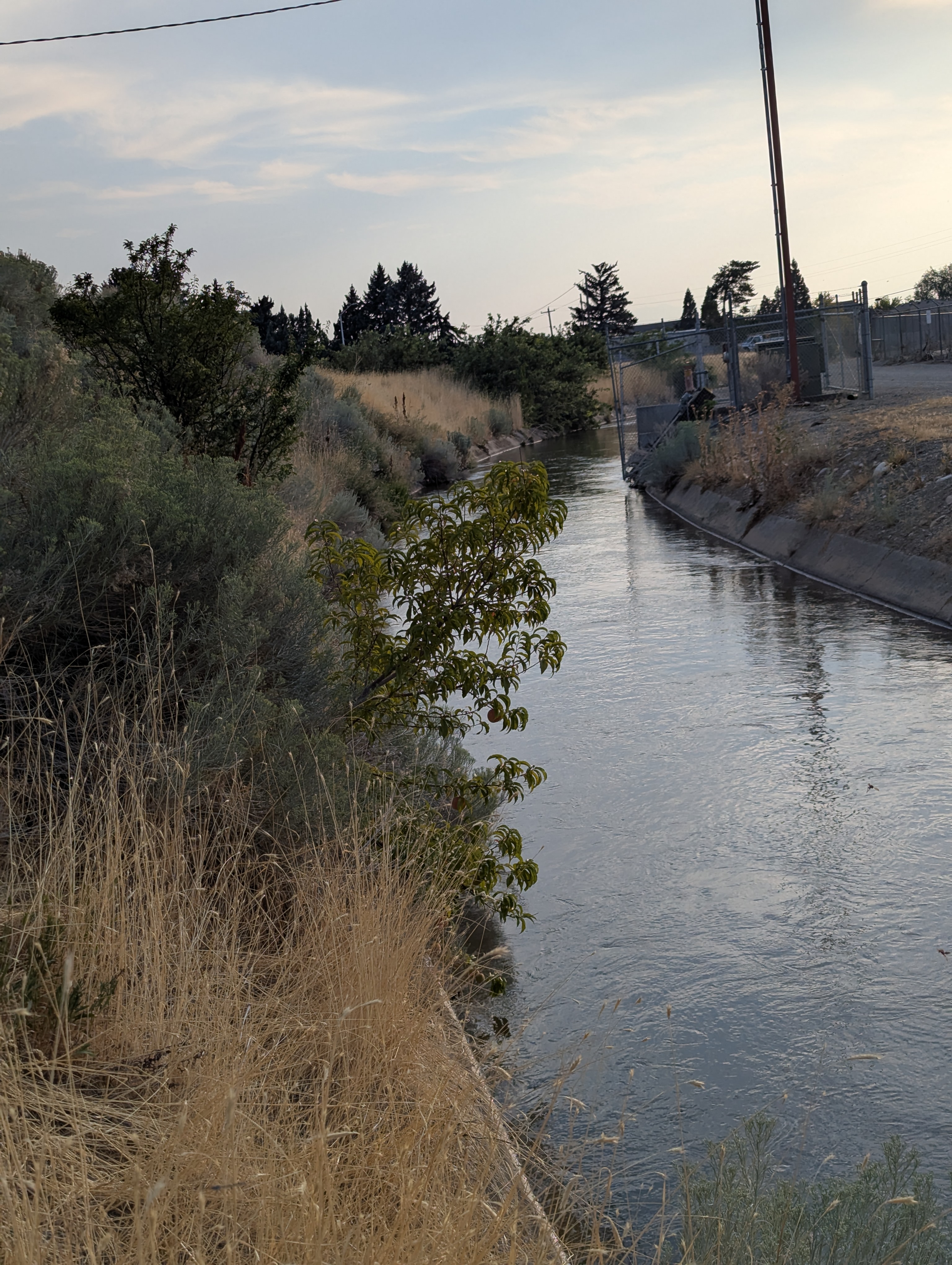
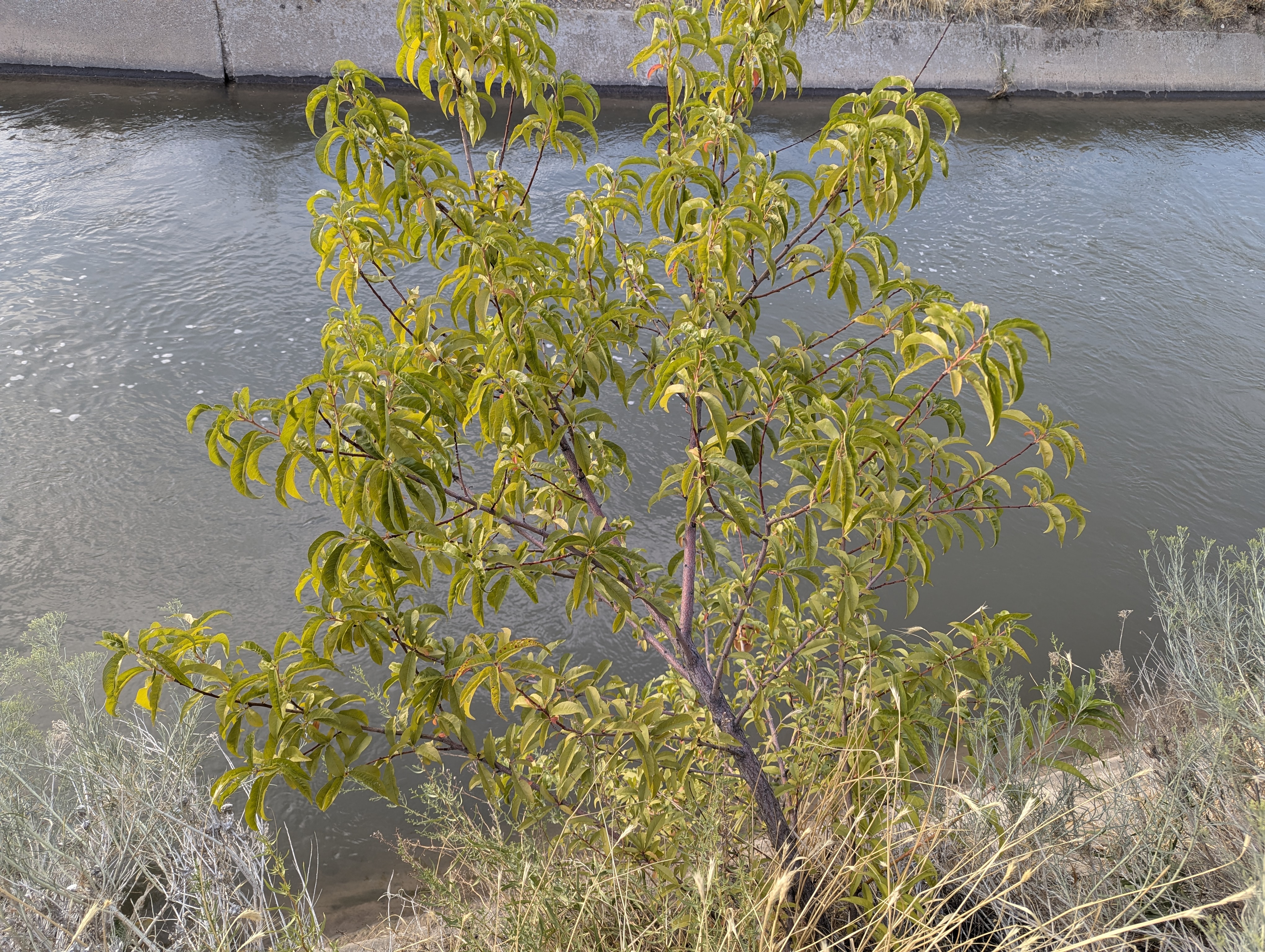
On that same walk, I took some pictures of a peach tree I'm calling the Slaughterhouse Peach (because it's growing on the hillside beneath a slaughterhouse) which I discovered yesterday.

I'm going to harvest the fruit when it's ripe. WHAT? THE FRUIT?! Yes, the only stonefruit I've seen on any tree this year, wild or domestic, on a volunteer peach.

It's growing on the bank of the Strawberry Highline Canal, which I've mentioned multiple times before (and I'll teach you about the canal project and what a miracle it was for the region in a future post), in a damned harsh environment but likely with a root or two tapping into a crack in the canal's concrete so water isn't an issue for the Slaughterhouse Peach.

Two fruit are getting ripe, and then there are a few more lower down that are not significantly further back in the ripening process. Hopefully I'll be able to harvest all of them for propagation, because it's disease free and must be late-flowering (of great use here normally, because we have late frosts in general), and is clearly well adapted to the local soil, so (if it is delicious) would make incredible starting stock for my project area and my yarden alike.

Here's a few pictures:
PXL_20260731_021406271.jpg
Slaughterhouse Peach #1
PXL_20260731_021337250.jpg
Slaughterhouse Peach #2
PXL_20260731_021330098.jpg
Slaughterhouse Peach #3
 
steward and tree herder
Posts: 14097
Location: Isle of Skye, Scotland. Nearly 70 inches rain a year
7764
6
transportation dog forest garden foraging trees books food preservation woodworking wood heat rocket stoves ungarbage
  • Likes 5
  • Mark post as helpful
  • send pies
    Number of slices to send:
    Optional 'thank-you' note:
  • Quote
  • Report post to moderator

Chance Lunceford wrote:These two photos (they're in the previous two posts too) were taken approximately 5 years apart in almost the same spot.


I love to see before and after photos! Please tell us about the stones? Are they ones you dig up? What benefit do they give you - apart from looking pretty; I've always loved pebbles!
 
Chance Lunceford
Posts: 159
Location: Payson, Utah, US of A - Zone6B/High Desert/4500' /14" Rainfall
88
  • Likes 6
  • Mark post as helpful
  • send pies
    Number of slices to send:
    Optional 'thank-you' note:
  • Quote
  • Report post to moderator

Nancy Reading wrote:

Chance Lunceford wrote:These two photos (they're in the previous two posts too) were taken approximately 5 years apart in almost the same spot.


I love to see before and after photos! Please tell us about the stones? Are they ones you dig up? What benefit do they give you - apart from looking pretty; I've always loved pebbles!


Sure, Nancy, let's explore my stones...um... let's talk about my landscape rocks.

So, my yarden started as sand poured on top of a calcereous and extremely rocky wave-winnowed Lake Bonneville lag deposit which had been neglected for years by the previous owners and was a mess of goat heads and other spiky pioneers, and was almost inert.

So, I had to give the land some shape to catch water and hold composting mulch. When I dug, I found boulder after boulder. So, I used 'em to help keep the land in shape and to help with moisture retention, and because I like the look of stone.

I've used them to create borders, paths, retaining walls, feature walls, mulch around the base of trees, and anything else you might use a ton of rocks and cobbles and boulders for.
 
Nancy Reading
steward and tree herder
Posts: 14097
Location: Isle of Skye, Scotland. Nearly 70 inches rain a year
7764
6
transportation dog forest garden foraging trees books food preservation woodworking wood heat rocket stoves ungarbage
  • Likes 3
  • Mark post as helpful
  • send pies
    Number of slices to send:
    Optional 'thank-you' note:
  • Quote
  • Report post to moderator

Chance Lunceford wrote:I've used them to create borders, paths, retaining walls, feature walls, mulch around the base of trees, and anything else you might use a ton of rocks and cobbles and boulders for.


Well it's looking great!

That peach looks wonderful. Harvesting it could be tricky though!
 
Chance Lunceford
Posts: 159
Location: Payson, Utah, US of A - Zone6B/High Desert/4500' /14" Rainfall
88
  • Likes 8
  • Mark post as helpful
  • send pies
    Number of slices to send:
    Optional 'thank-you' note:
  • Quote
  • Report post to moderator
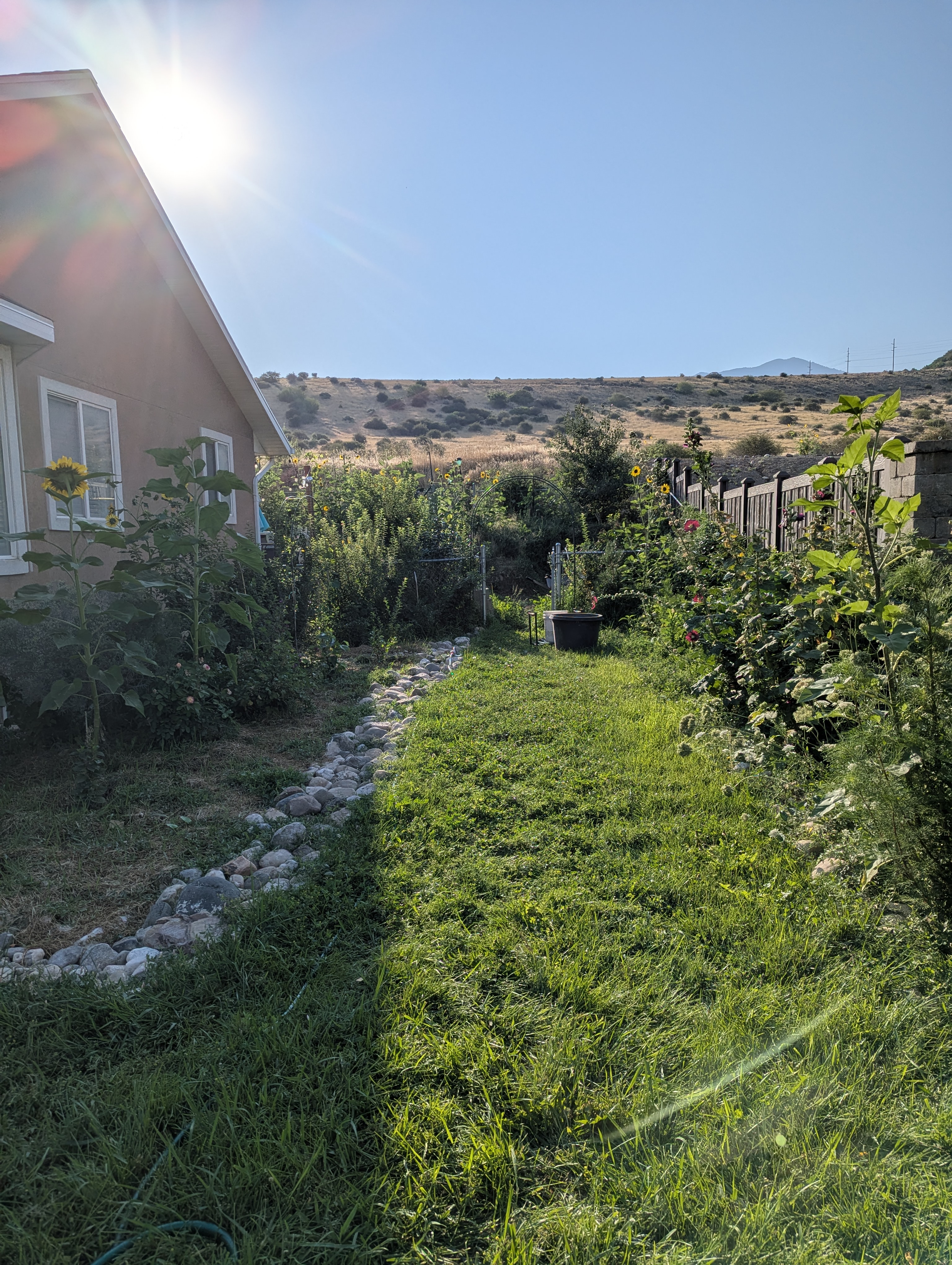
Quick snapshot of me in the yarden this evening.

Despite record-breaking heat, my system has catapulted into a higher level of happy.

This is the first year the summer hasn't put everything on a lifeline. Things have been developing each year, but to increase velocity in 108°F July is a new milestone for the system.
PXL_20260801_025740859.MP.jpg
Happy system, happy Chance.
 
Chance Lunceford
Posts: 159
Location: Payson, Utah, US of A - Zone6B/High Desert/4500' /14" Rainfall
88
  • Likes 8
  • Mark post as helpful
  • send pies
    Number of slices to send:
    Optional 'thank-you' note:
  • Quote
  • Report post to moderator
Harvested some seed from 6 asteracea species in Park City today, while I was there for some work stuff.

Also saw 6' tall rocky mountain bee plant, but it wasn't ready to harvest seed from.

Harvested some wild wheat, too, even though I'm allergic to wheat, it's still cool to find healthy wild wheat growing.
PXL_20260731_220819213.jpg
[Thumbnail for PXL_20260731_220819213.jpg]
PXL_20260731_221026028.jpg
[Thumbnail for PXL_20260731_221026028.jpg]
PXL_20260731_221034902.jpg
[Thumbnail for PXL_20260731_221034902.jpg]
PXL_20260731_224401447.jpg
[Thumbnail for PXL_20260731_224401447.jpg]
PXL_20260731_224420274.jpg
[Thumbnail for PXL_20260731_224420274.jpg]
PXL_20260801_002140780.jpg
[Thumbnail for PXL_20260801_002140780.jpg]
 
Chance Lunceford
Posts: 159
Location: Payson, Utah, US of A - Zone6B/High Desert/4500' /14" Rainfall
88
  • Likes 8
  • Mark post as helpful
  • send pies
    Number of slices to send:
    Optional 'thank-you' note:
  • Quote
  • Report post to moderator
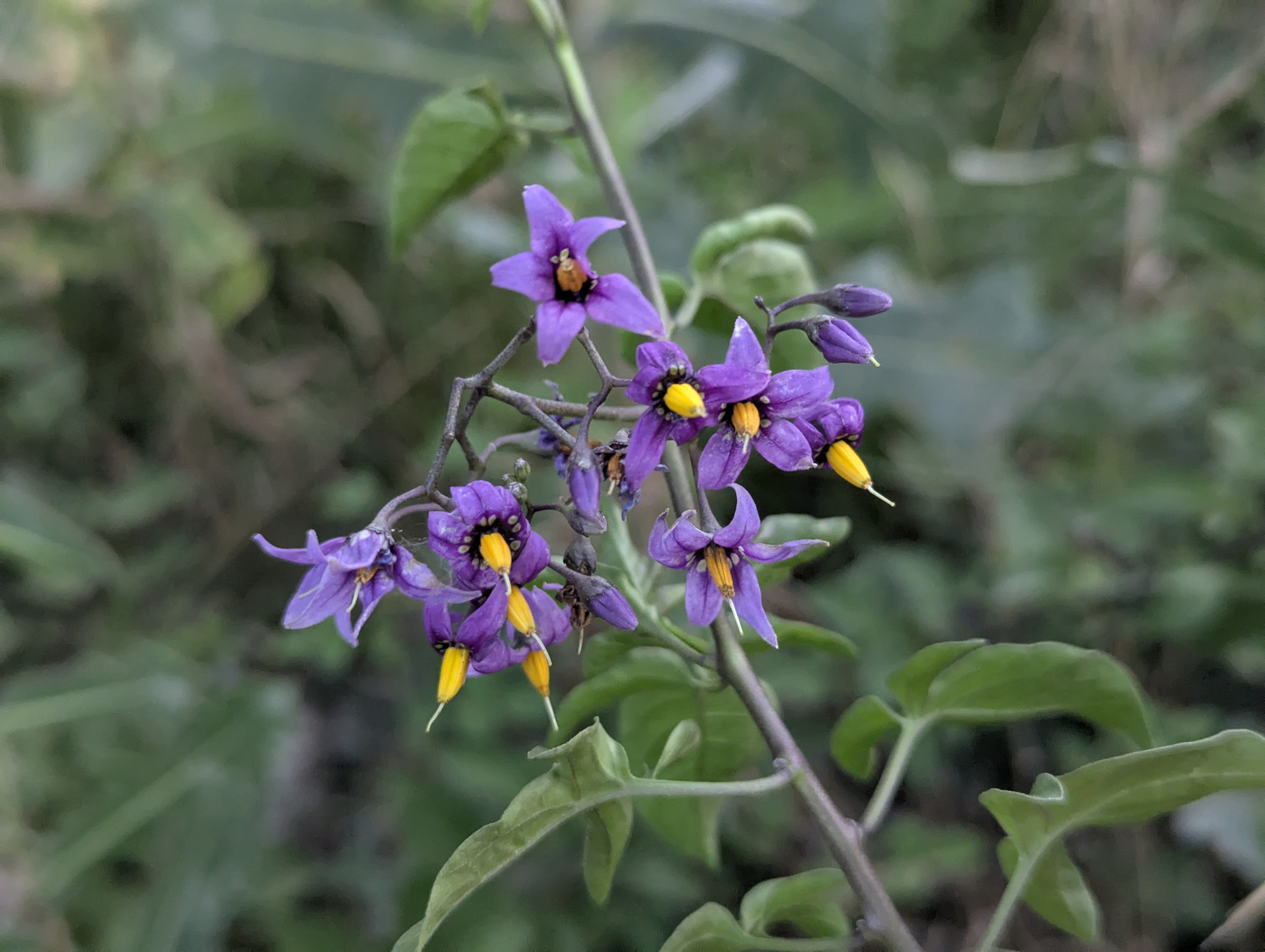
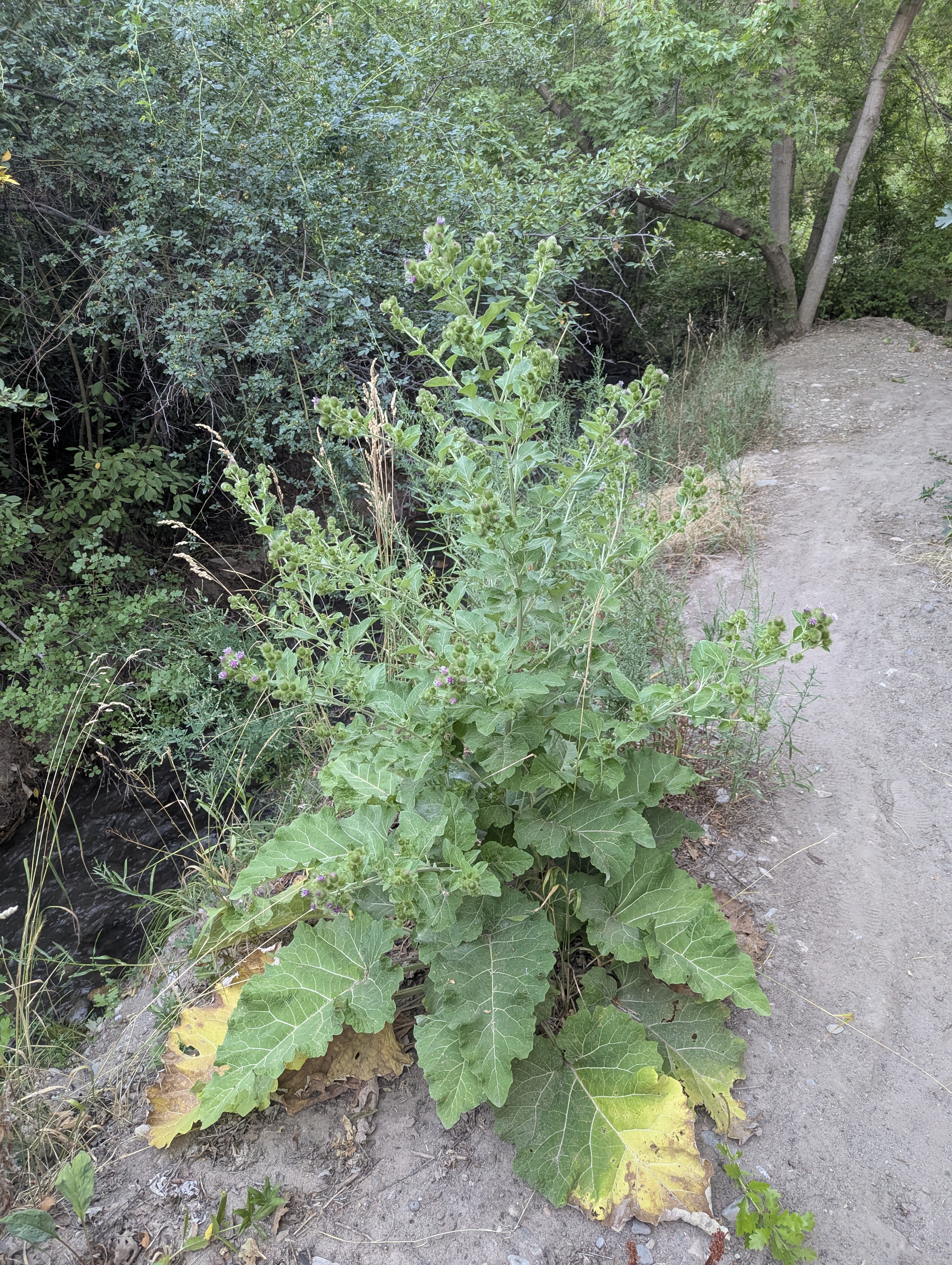
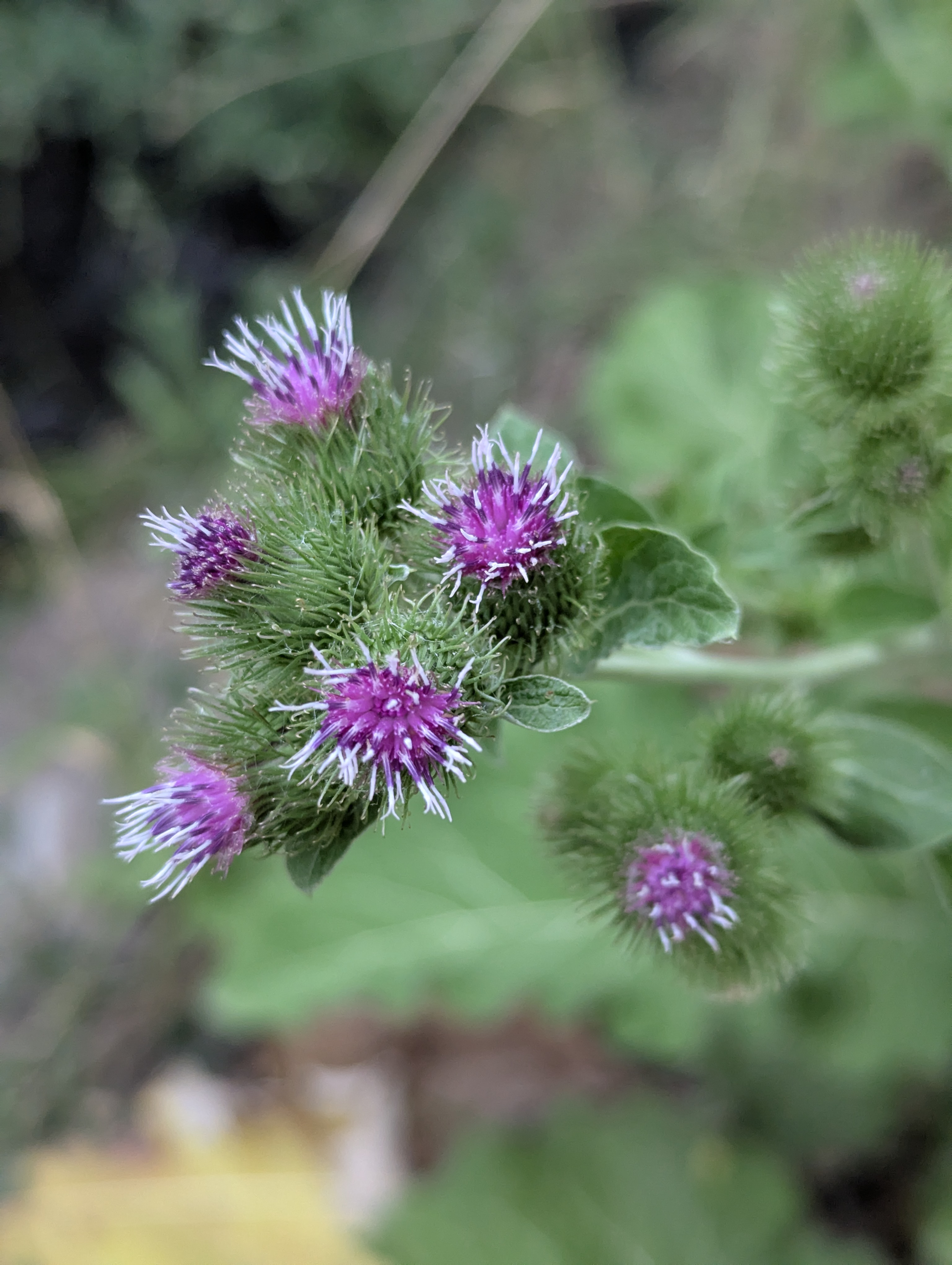
A few pretties from a recent walk.
PXL_20260731_023049998.jpg
purple nightshade
purple nightshade
PXL_20260731_022522440.MP.jpg
7' burdock
7' burdock
PXL_20260731_022531593.jpg
Burdock flower
Burdock flower
 
Chance Lunceford
Posts: 159
Location: Payson, Utah, US of A - Zone6B/High Desert/4500' /14" Rainfall
88
  • Likes 7
  • Mark post as helpful
  • send pies
    Number of slices to send:
    Optional 'thank-you' note:
  • Quote
  • Report post to moderator
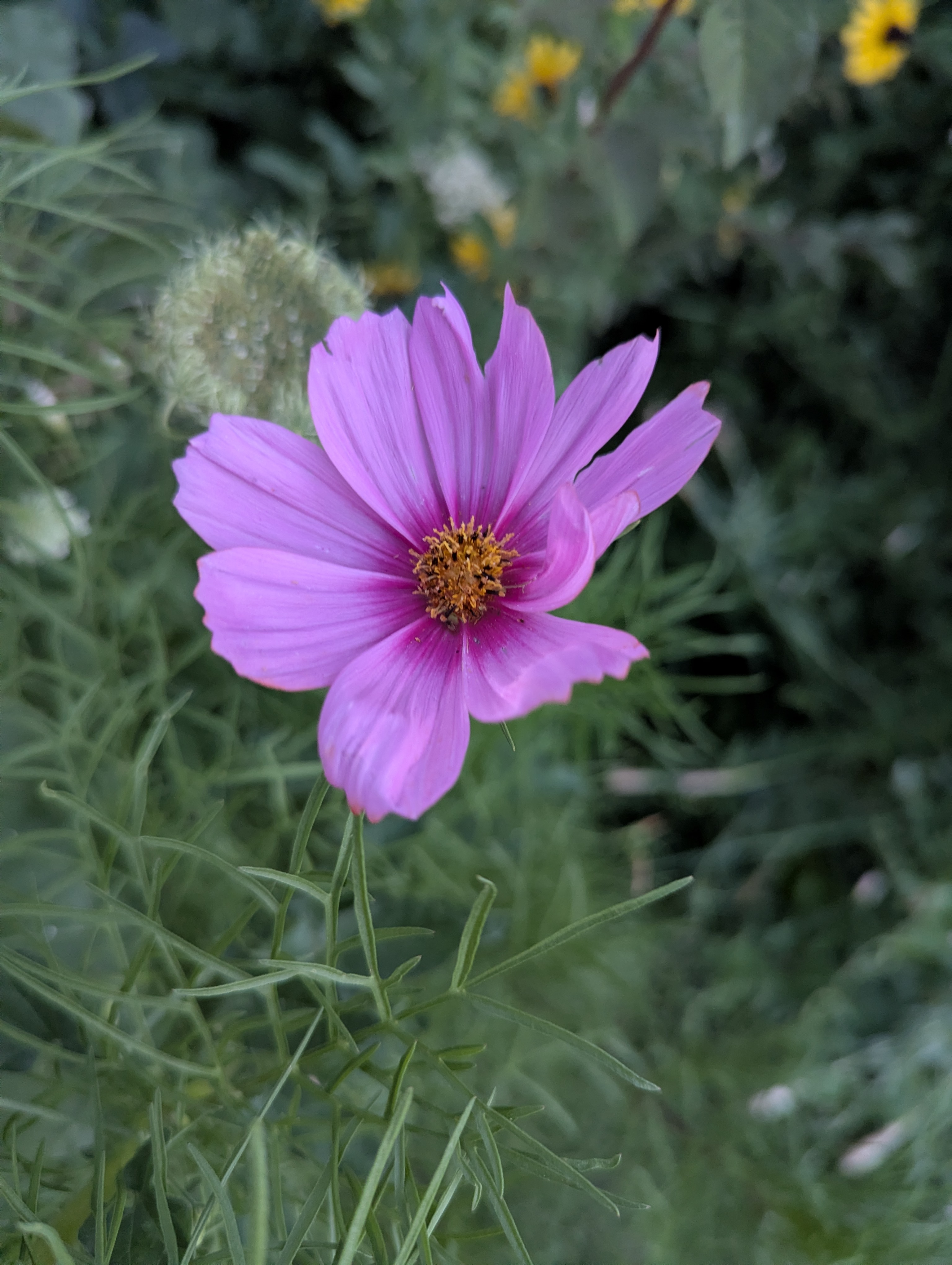
Some photos from the yarden.
PXL_20260801_025116055.jpg
1st cosmos of the year
PXL_20260801_025100544.jpg
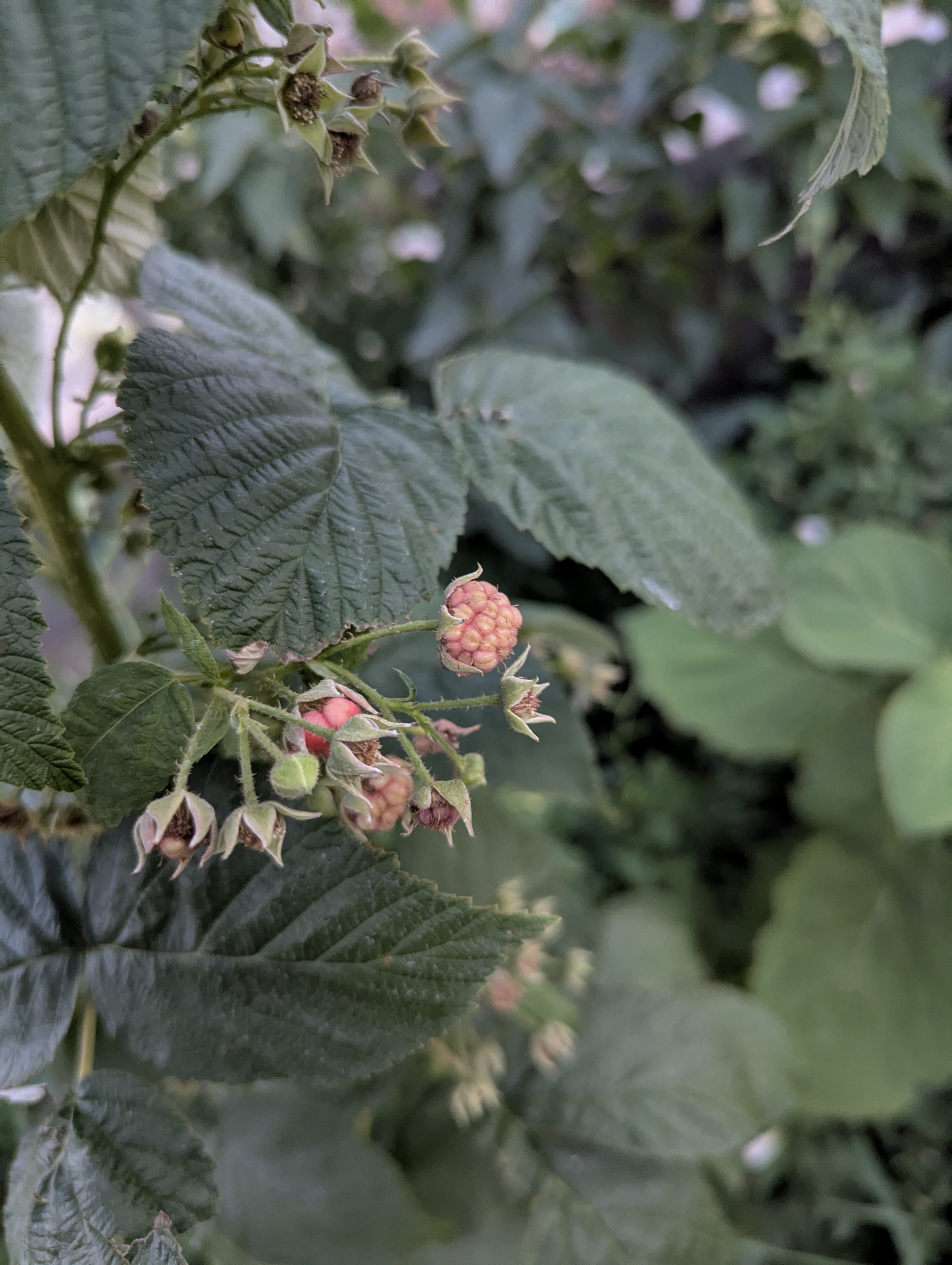
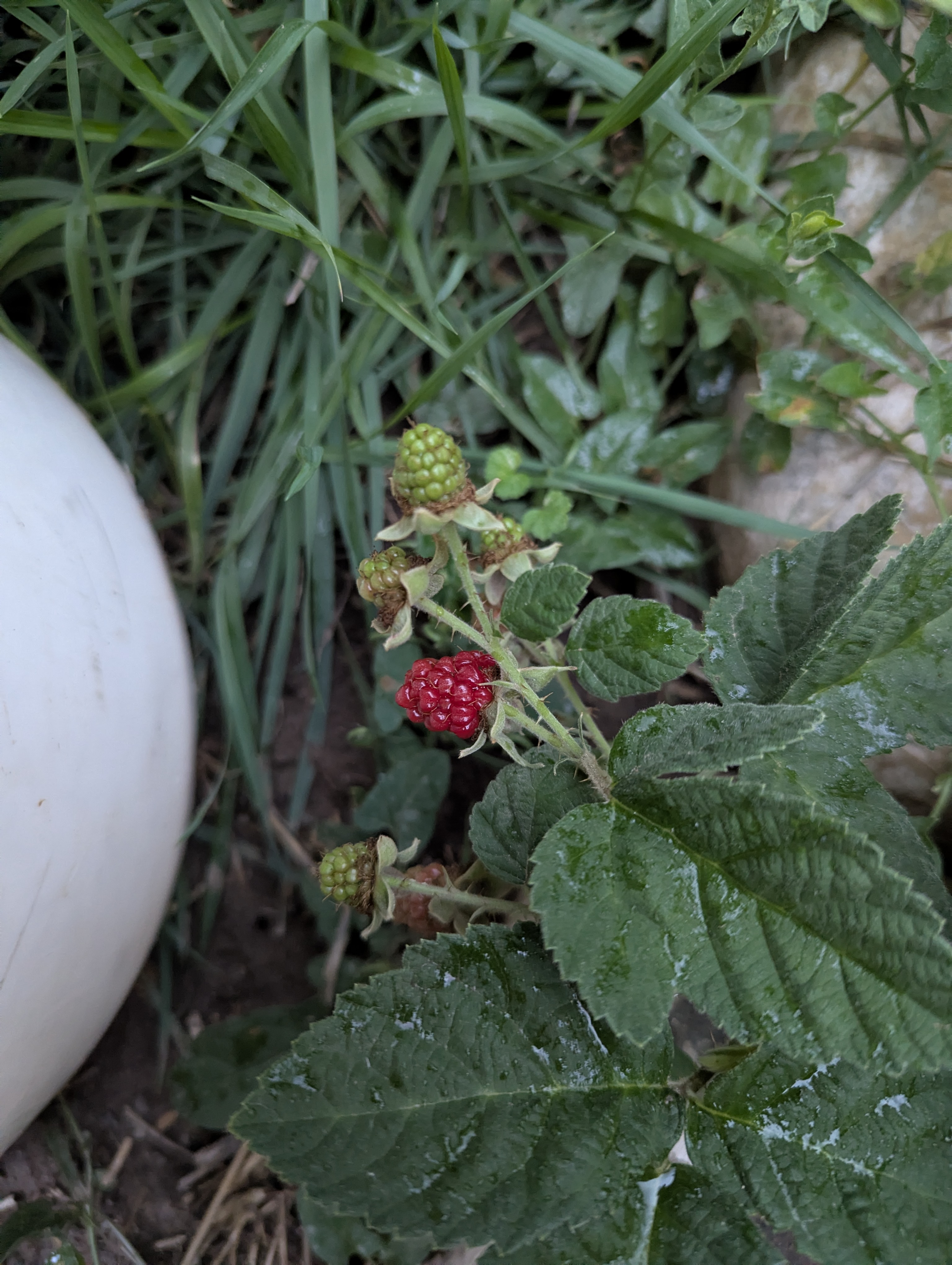
Raspberries imminent, won't be many this year, but next year is looking good
PXL_20260801_024830523.jpg
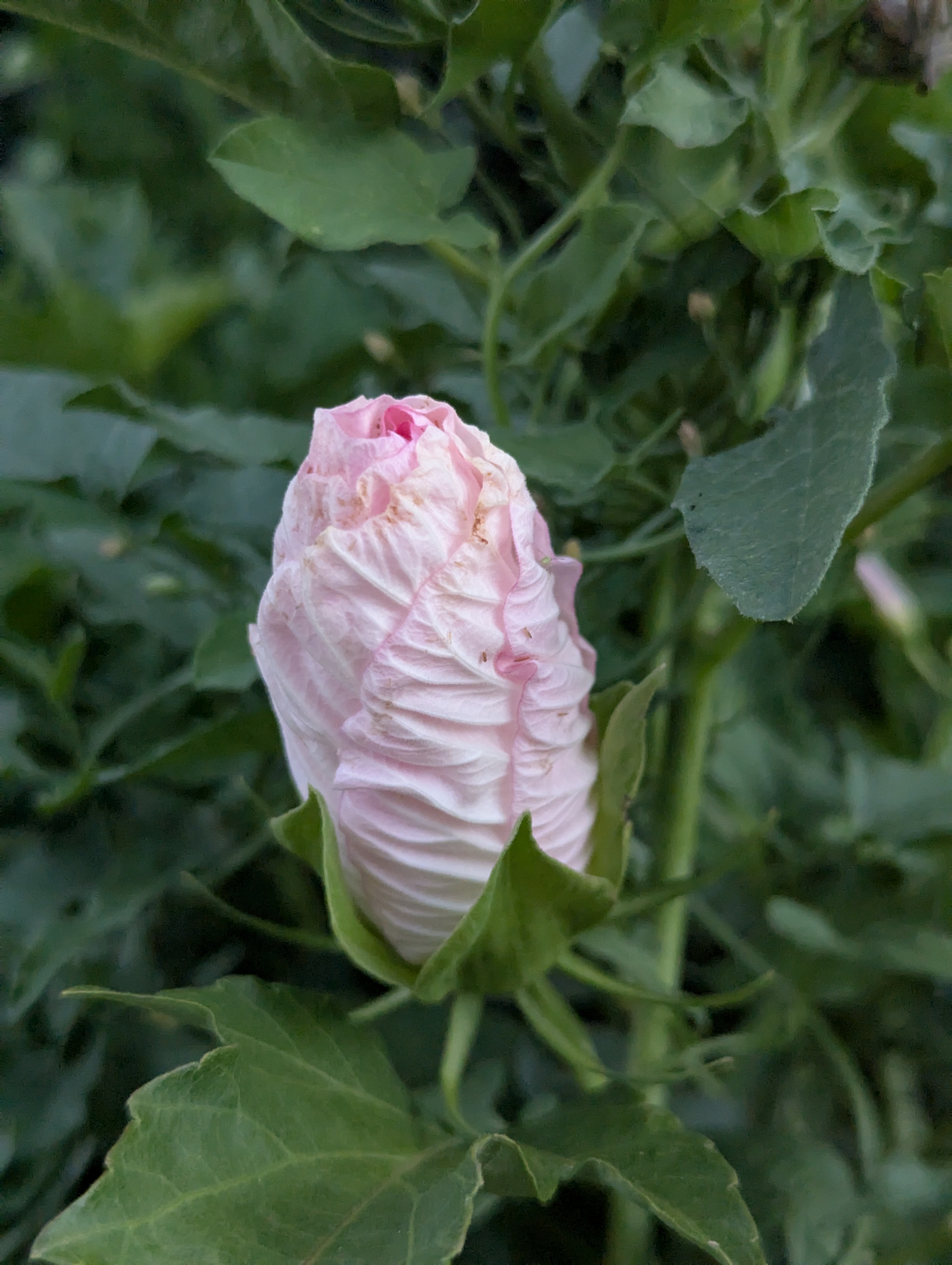
Planted this hibiscus this year, this is the first blossom
PXL_20260727_140817452.jpg
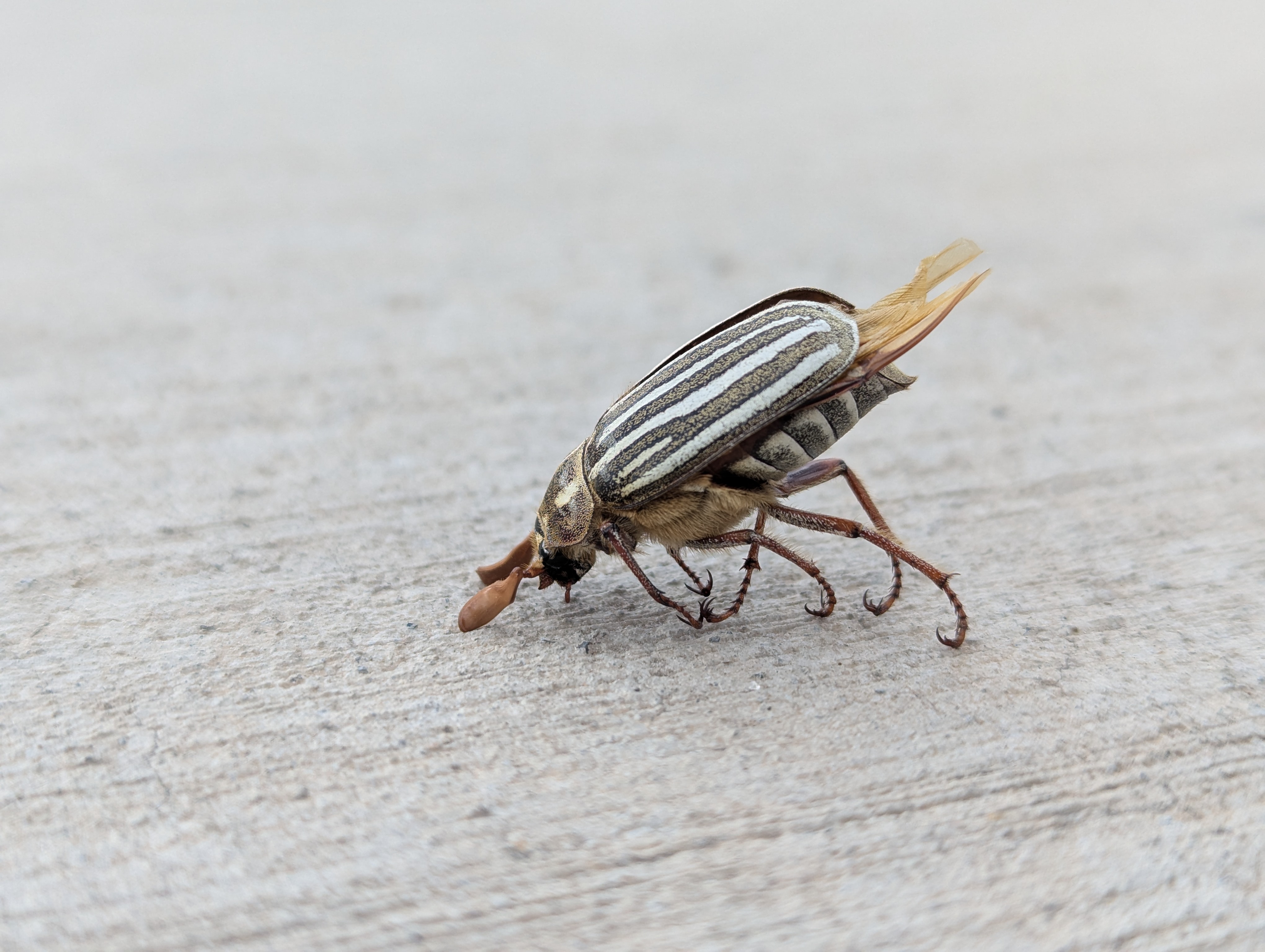
Dead June Bug
Dead June Bug
PXL_20260726_003902376.jpg
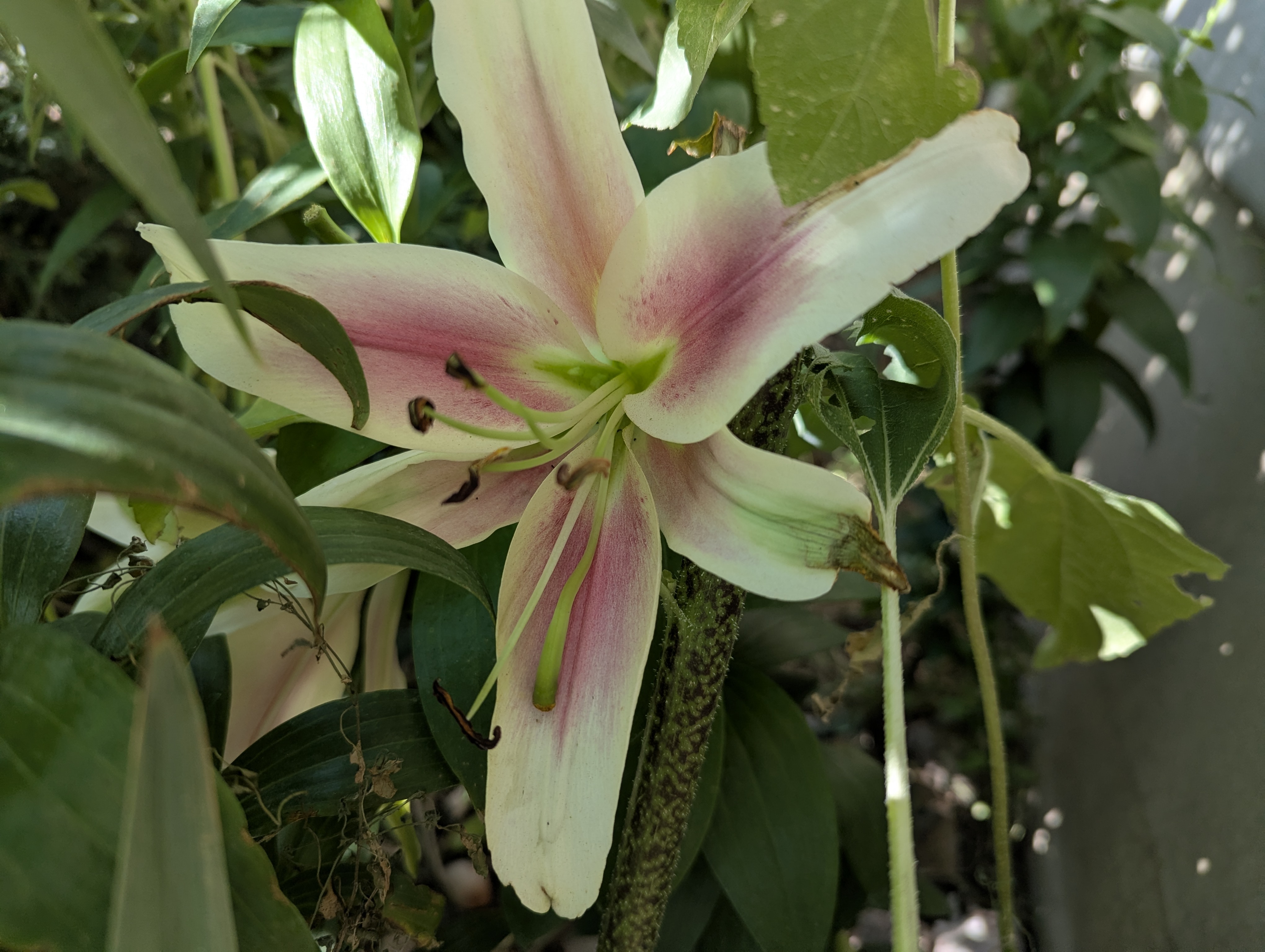
Lovely lily
Lovely lily
PXL_20260723_134249578.jpg
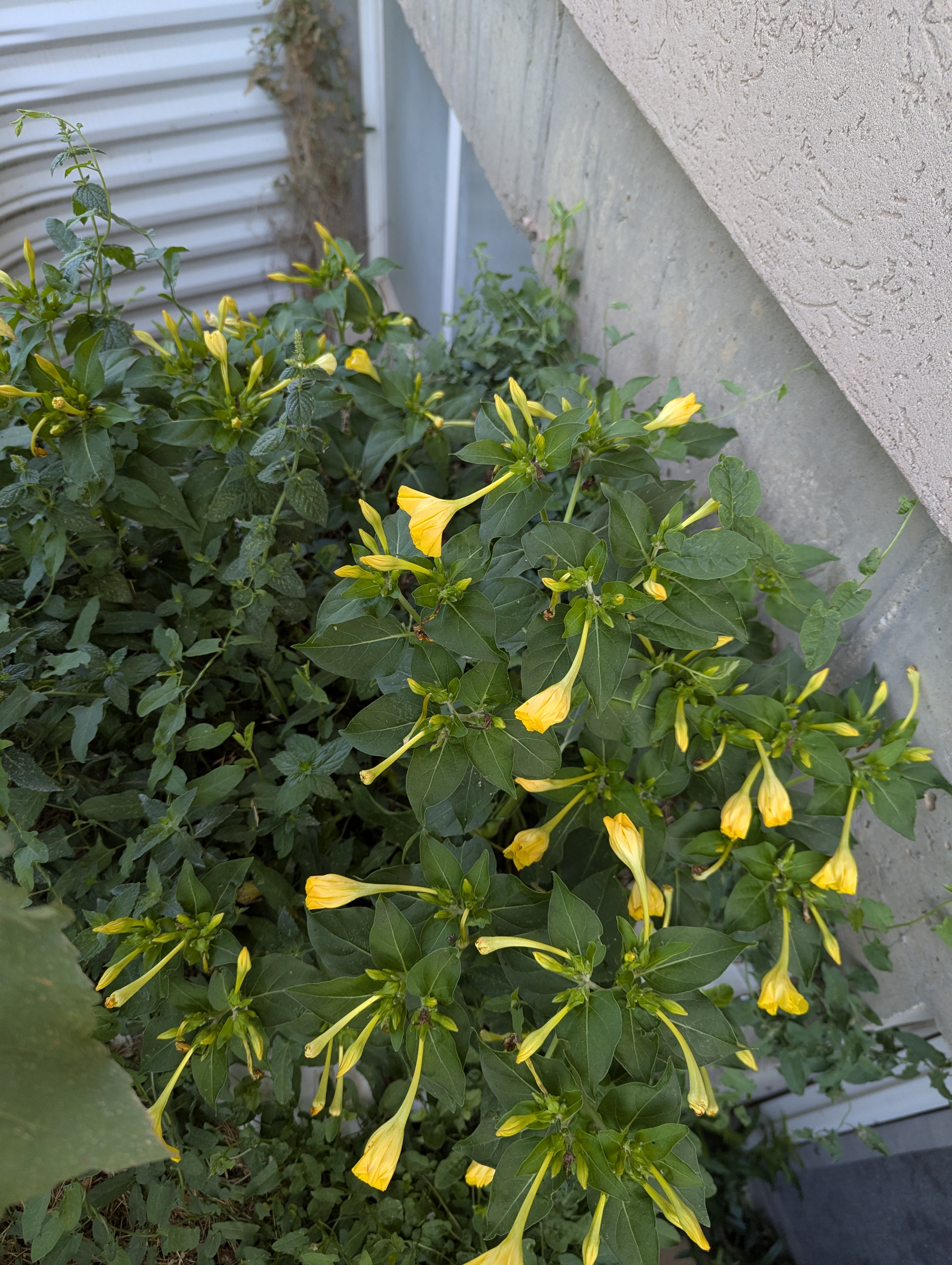
Volunteer 4 o'clocks
PXL_20260701_140322570.jpg
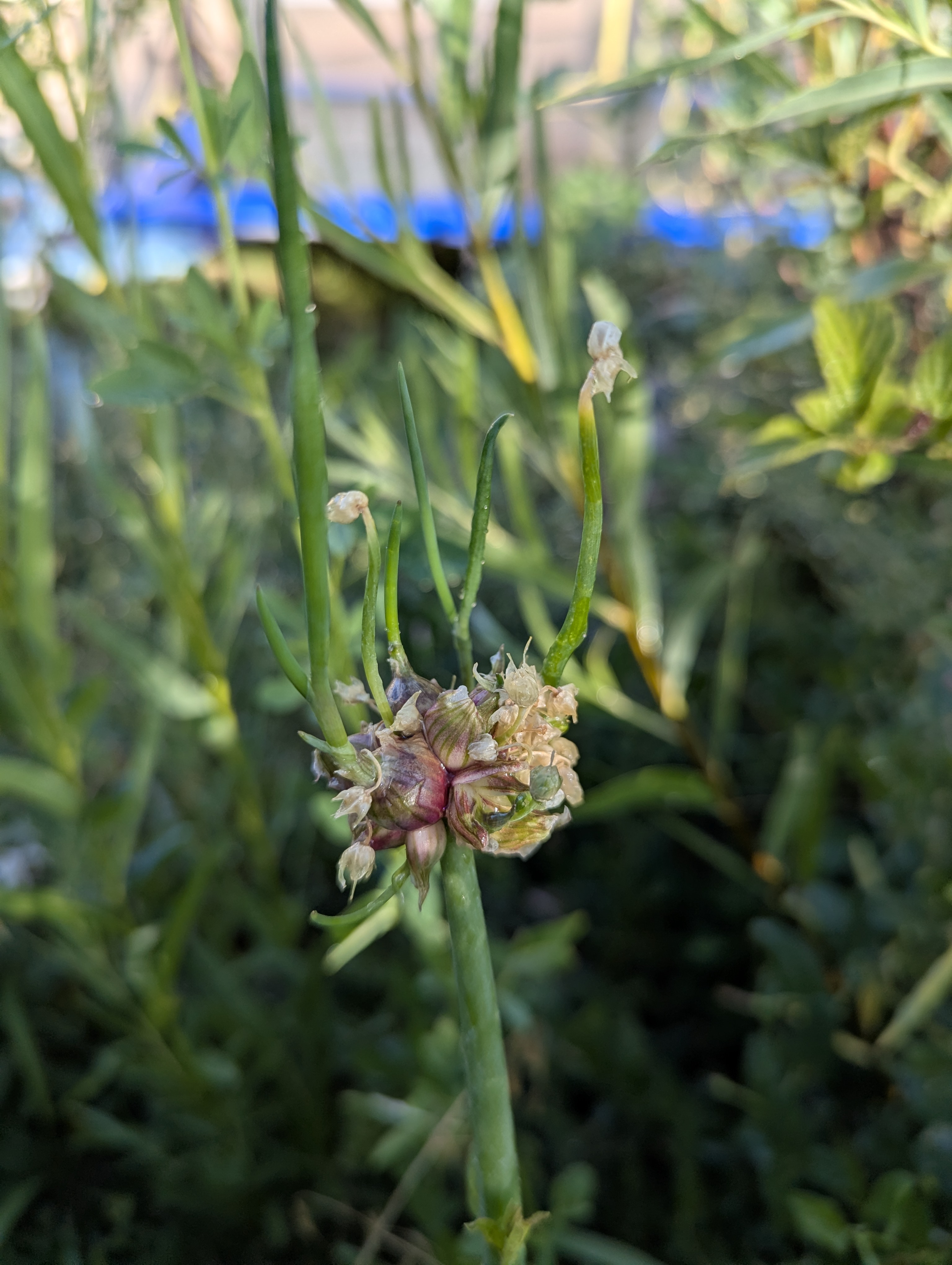
The onions are made for walkin'
 
Chance Lunceford
Posts: 159
Location: Payson, Utah, US of A - Zone6B/High Desert/4500' /14" Rainfall
88
  • Likes 5
  • Mark post as helpful
  • send pies
    Number of slices to send:
    Optional 'thank-you' note:
  • Quote
  • Report post to moderator
Greening the desert?

Sure thing.
PXL_20260802_135446997.jpg
2 worlds.
2 worlds.
PXL_20260802_134954033.jpg
Pretty green, man
Pretty green, man
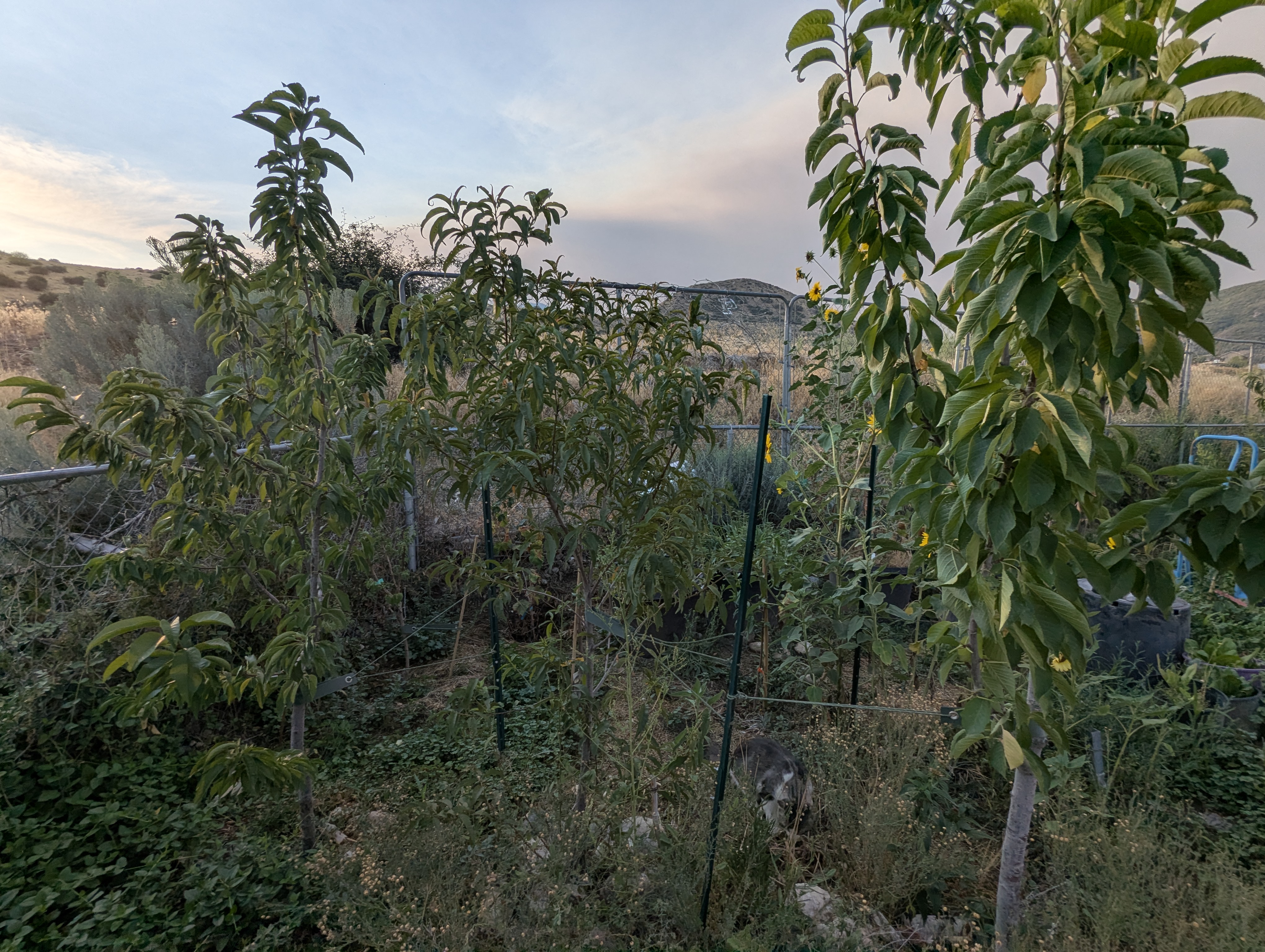
PXL_20260802_135218608.jpg
Cherries and nectarines in the foreground have been resilient through some harsh years
PXL_20260802_135547755.jpg
Marvelous beauty in the world
PXL_20260802_135354317.jpg
Happy plants, happy Chance
 
Chance Lunceford
Posts: 159
Location: Payson, Utah, US of A - Zone6B/High Desert/4500' /14" Rainfall
88
  • Likes 4
  • Mark post as helpful
  • send pies
    Number of slices to send:
    Optional 'thank-you' note:
  • Quote
  • Report post to moderator
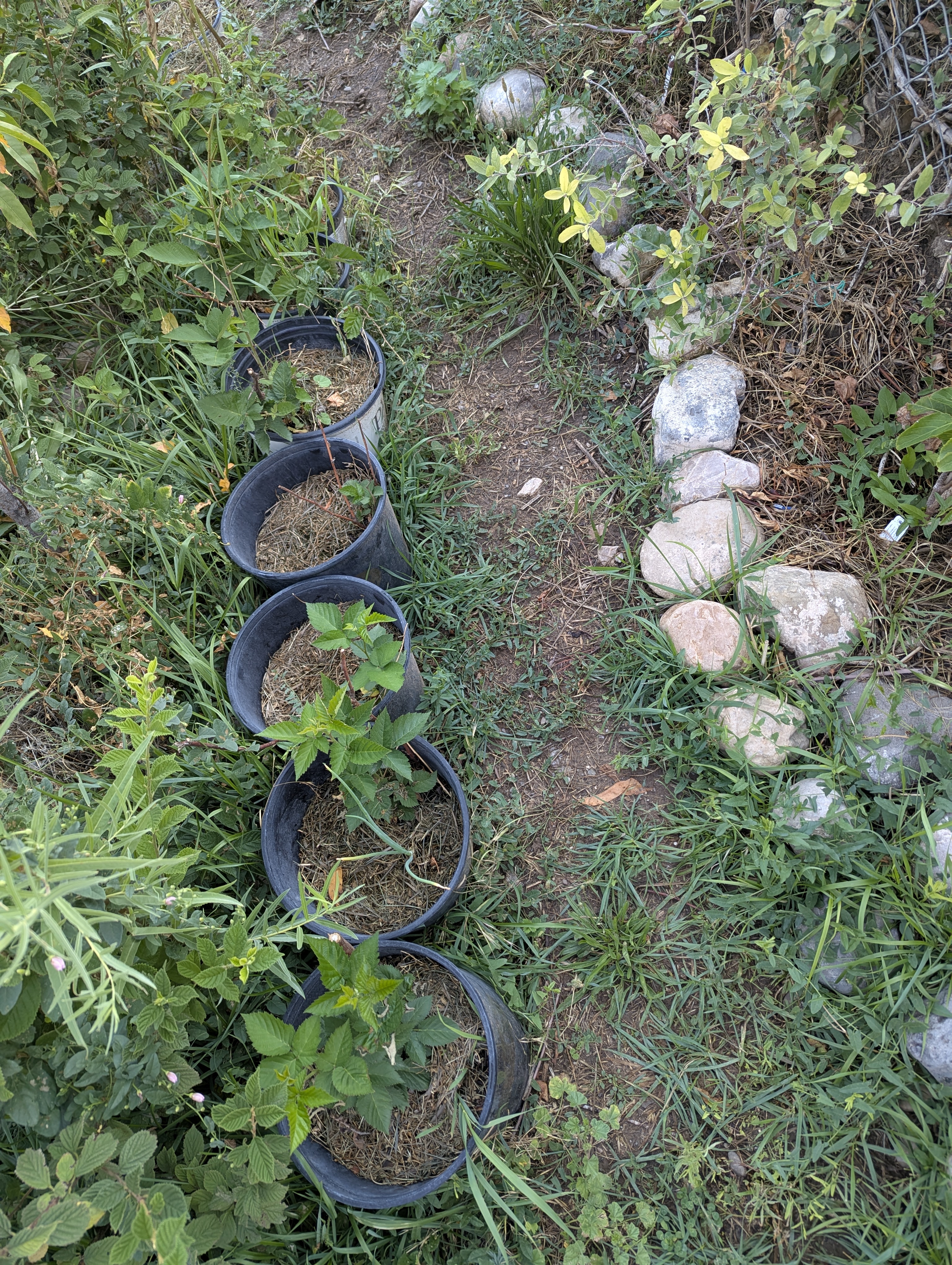
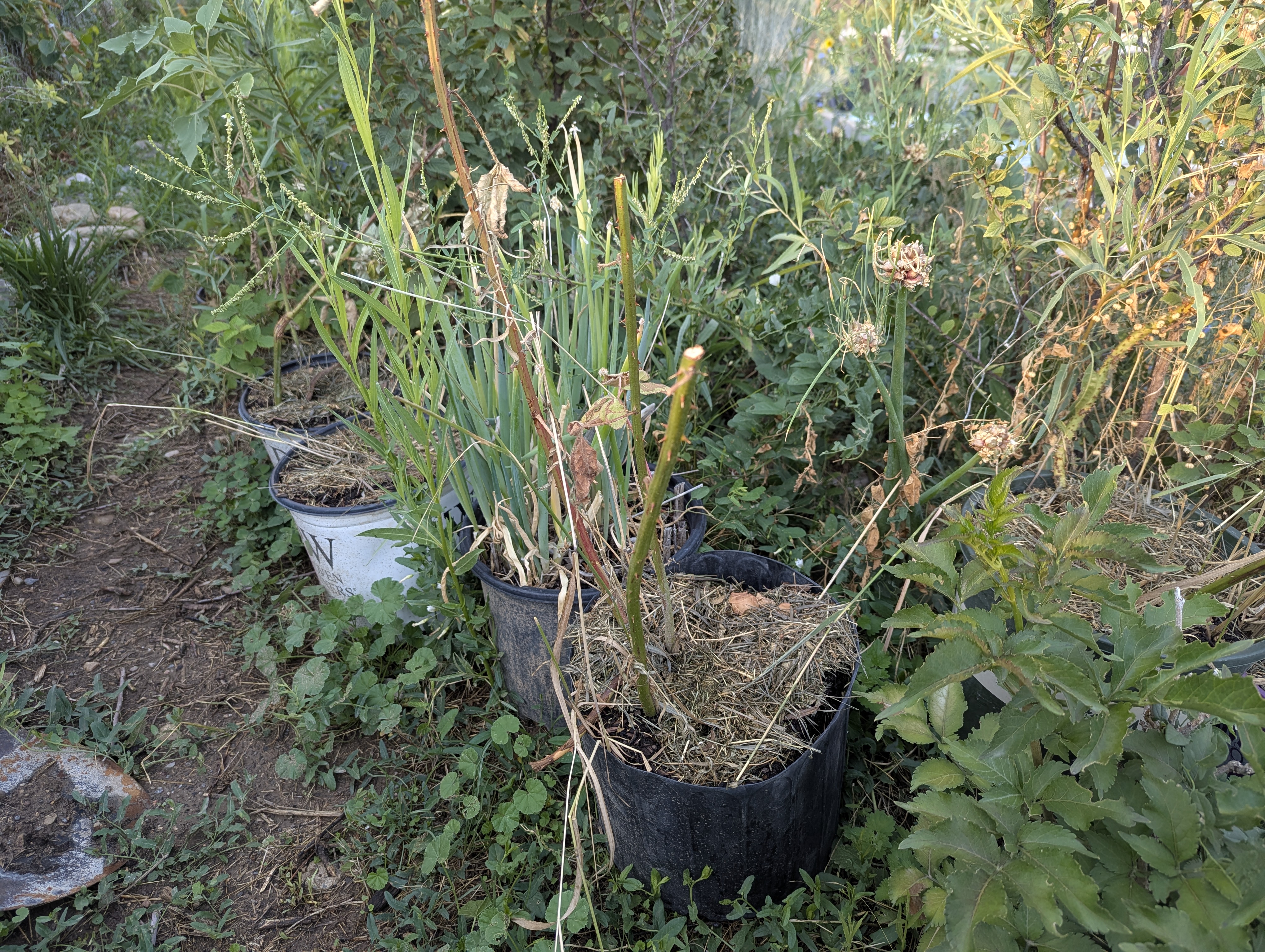
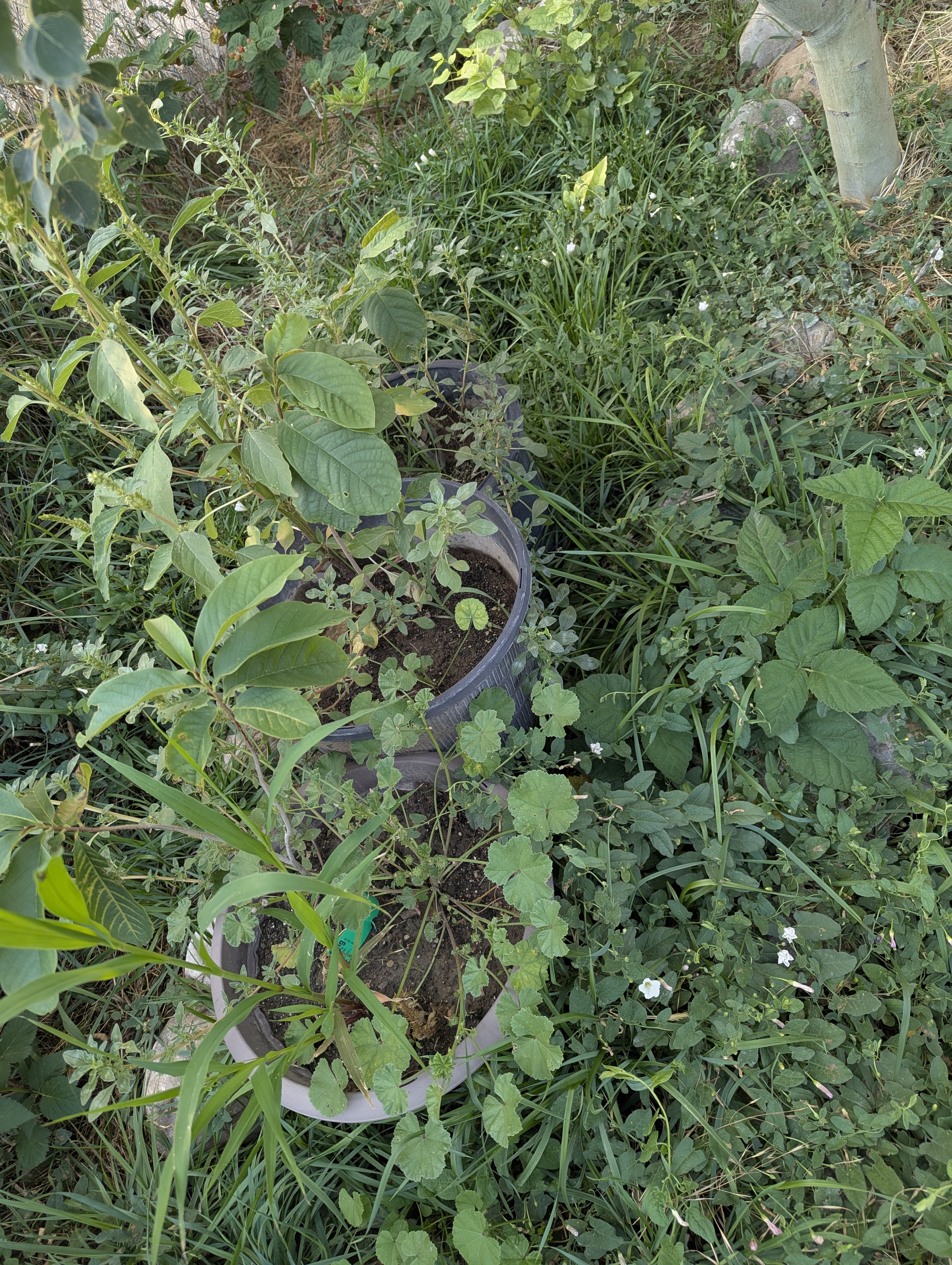
In the pots are; 6 different varieties of thornless blackberries, three each primocane and floricane only; one black raspberry; two pots of the same raspberry; two different varieties of thorny blackberry, one which I forgot, but I'd probably an olallie and six buckets worth of the Anderson Park Blackberry that I recently posted about elsewhere on the forum, which is an historic bramble population I have endeavored to preserve from a single (formerly massive) patch that has lived for at least 55 years (probably longer) in a park I used to live by; three pawpaw seedlings; and an incidental tip-rooted blackberry


All of these, except one of the Anderson Park Blackberries, are going into my guerrilla community food forest project as soon as the summer cools from murderous to challenging.
PXL_20260802_135018286.jpg
Blackberries, black raspberries, raspberries
PXL_20260802_135050181.jpg
More berries, and some onions store bought onions I planted in a pot last year which I grew next to the walking onions, and some more berries
PXL_20260802_140611955.jpg
Three seedling pawpaws from premium seed stock (allegedly), and an incidental tip-rooted blackberry which I'm gonna dig up and take over as well
Three seedling pawpaws from premium seed stock (allegedly), and an incidental tip-rooted blackberry which I
 
Chance Lunceford
Posts: 159
Location: Payson, Utah, US of A - Zone6B/High Desert/4500' /14" Rainfall
88
  • Likes 4
  • Mark post as helpful
  • send pies
    Number of slices to send:
    Optional 'thank-you' note:
  • Quote
  • Report post to moderator
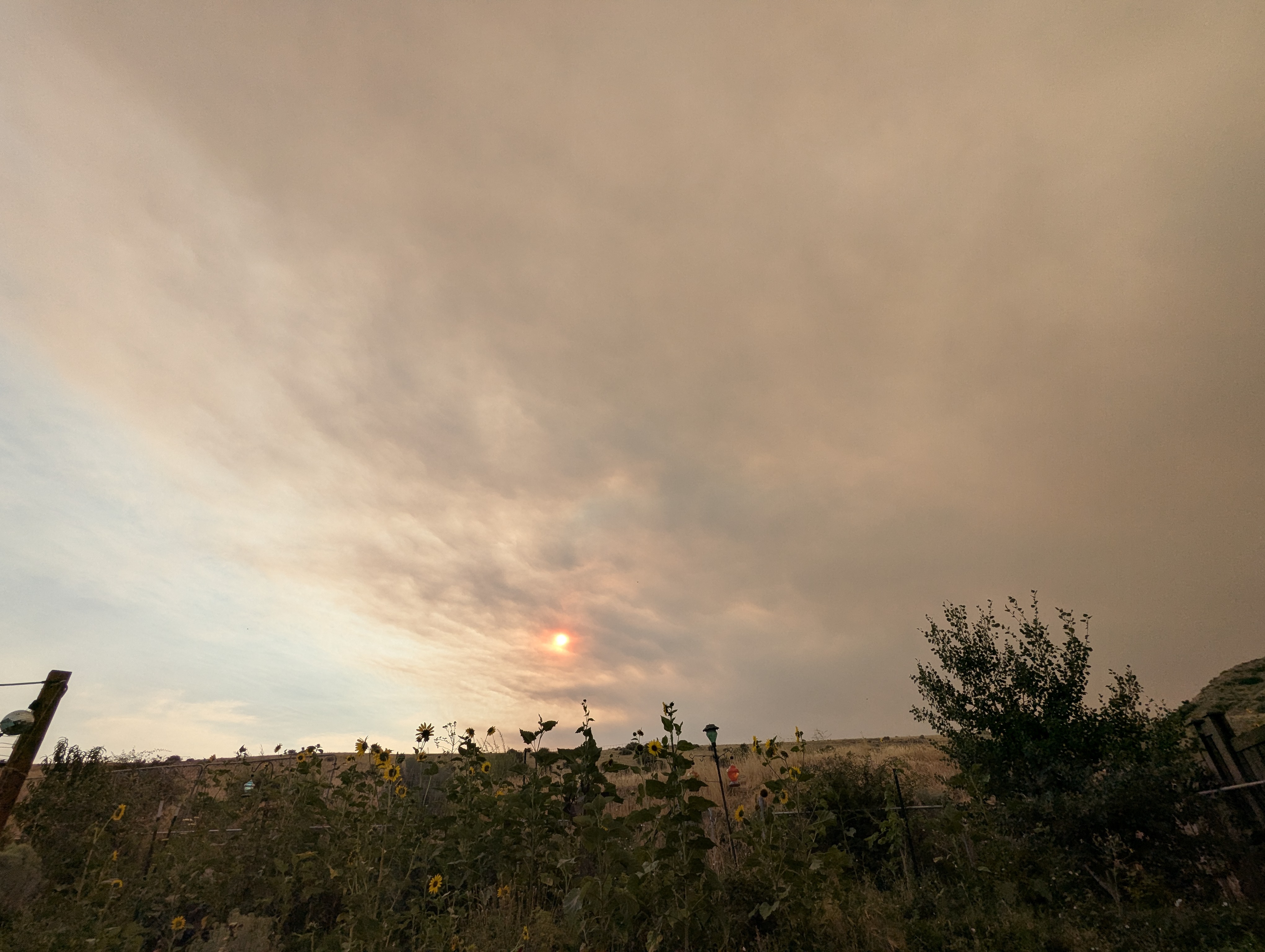
Another fire has started, it would seem. Rough fire year in the West.
PXL_20260802_141723483.jpg
Mordor?
Mordor?
 
Chance Lunceford
Posts: 159
Location: Payson, Utah, US of A - Zone6B/High Desert/4500' /14" Rainfall
88
  • Likes 9
  • Mark post as helpful
  • send pies
    Number of slices to send:
    Optional 'thank-you' note:
  • Quote
  • Report post to moderator
Just found out this is a plant that exists.

It's Crotalaria Cunninghamii, aka Green Bird Flower.

I LOVE hummingbirds, and the resemblance alone is justification enough for me to grow the plant, but it's also a rapidly growing nitrogen fixer which can grow up to 10' tall in a single season and can readily self-sow from its plentiful seeds arising from the beautiful flowers.

Supposed to be drought hardy. Thinking I'll order some seed and throw it down where my larkspur likes to grow to see if I can get it rolling.

Supposed to be a shortlived perennial in frost free areas, 2-4 years and apparently won't bloom without a long summer or overwintering/starting early indoors for cooler climates.

The pictures were pulled from the Internet, FYI.
e19a5cf7a947f4373713cb52123bb026.jpg
[Thumbnail for e19a5cf7a947f4373713cb52123bb026.jpg]
11216436444_a248e18a0b_3k.jpg
[Thumbnail for 11216436444_a248e18a0b_3k.jpg]
s-l1200.jpg
[Thumbnail for s-l1200.jpg]
 
Nancy Reading
steward and tree herder
Posts: 14097
Location: Isle of Skye, Scotland. Nearly 70 inches rain a year
7764
6
transportation dog forest garden foraging trees books food preservation woodworking wood heat rocket stoves ungarbage
  • Likes 7
  • Mark post as helpful
  • send pies
    Number of slices to send:
    Optional 'thank-you' note:
  • Quote
  • Report post to moderator
That flower is amazing! According to wikipedia Crotalaria cunninghamii, as well as being nitrogen fixing, is a useful fibre plant (and possiibly oil seed and medcinal).
 
Chance Lunceford
Posts: 159
Location: Payson, Utah, US of A - Zone6B/High Desert/4500' /14" Rainfall
88
  • Likes 7
  • Mark post as helpful
  • send pies
    Number of slices to send:
    Optional 'thank-you' note:
  • Quote
  • Report post to moderator
Quick Useful Knowledge About Dandelions:

1) The best dandelion greens are grown in the shade. They're longer, larger, more tender, and less bitter, and they'll either never flower or flower far less regularly.

2) You can blanch the greens by covering them with a bucket for a few days up to a week and they'll become yellow-green and more tender than lettuce.

3) The only thing on a dandelion that you shouldn't eat are the flower stems. They have a waxy compound that can cause an upset stomach. However, most folks won't enjoy consuming the root in any form, because it's both deeply earthy and notably bitter. Roast the root and then steep it for 15 minutes then add some honey if you find yourself disenjoying the dawn-born consequences of spelunking too deep into your cups. What you CAN do, though, is serve blanched shade grown dandelions to an unsuspecting crowd (like your family, for example) in a salad and it would likely be the most palatable and popular green in the salad.
 
Chance Lunceford
Posts: 159
Location: Payson, Utah, US of A - Zone6B/High Desert/4500' /14" Rainfall
88
  • Likes 5
  • Mark post as helpful
  • send pies
    Number of slices to send:
    Optional 'thank-you' note:
  • Quote
  • Report post to moderator
I didn't know that mulberries fruit after trimming.

That's great to know.

Here's an interesting system for growing mulberries in an orchard row context.

 
Chance Lunceford
Posts: 159
Location: Payson, Utah, US of A - Zone6B/High Desert/4500' /14" Rainfall
88
  • Likes 6
  • Mark post as helpful
  • send pies
    Number of slices to send:
    Optional 'thank-you' note:
  • Quote
  • Report post to moderator
I always like to try the fruit offerings at grocery stores.

It's interesting to see what makes it all the way to mass production consumer varieties from the breeding work.

The selection variables are much different than most of us on this forum value, but the keeping quality, consistency and ripening characteristics are not unwelcome additions to a diverse gene pool.

They're usually not as good, flavor wise, as backyard varieties, but sometimes there's that amazing crossroads where deliciousness and marketability and shippability all align. And, sometimes, you get a seasonal influx of regional fruit (yes, often even in the globocorp grocers) which is actually some of the best genetic stock you can ask for if you want to bring in regionally suited genetics.

This brings me to the main (maybe, I still like eating the fruit, even if it's often disappointing) point of buying the fruit:

I like to propagate from the seeds and plant them out in the area.

As mentioned above, there are a lot of plums in the area, and specifically in the area I'm working on my clandestine food forest project within.

So, I especially like trying to add new plum genetics to the mix. There are a couple seedling trees in the area, but they're in the liminal phase in this region where the summers cook them to within an inch of death, and then we see whether they can recover enough to withstand the winter and grow back sturdier the next year.

What often happens is that the cycle stunts the plants unable to cope, and they eventually quit and wither after a year or two or three.

Not surprising, especially since it's commercial varieties grown on their own roots. Most probably aren't disease resistant without the popular rootstocks beneath them.

Doesn't matter.

If there's only ever one store-bought seedling plum that develops into a worthy specimen in system, then I'm a big winner and so is the system.

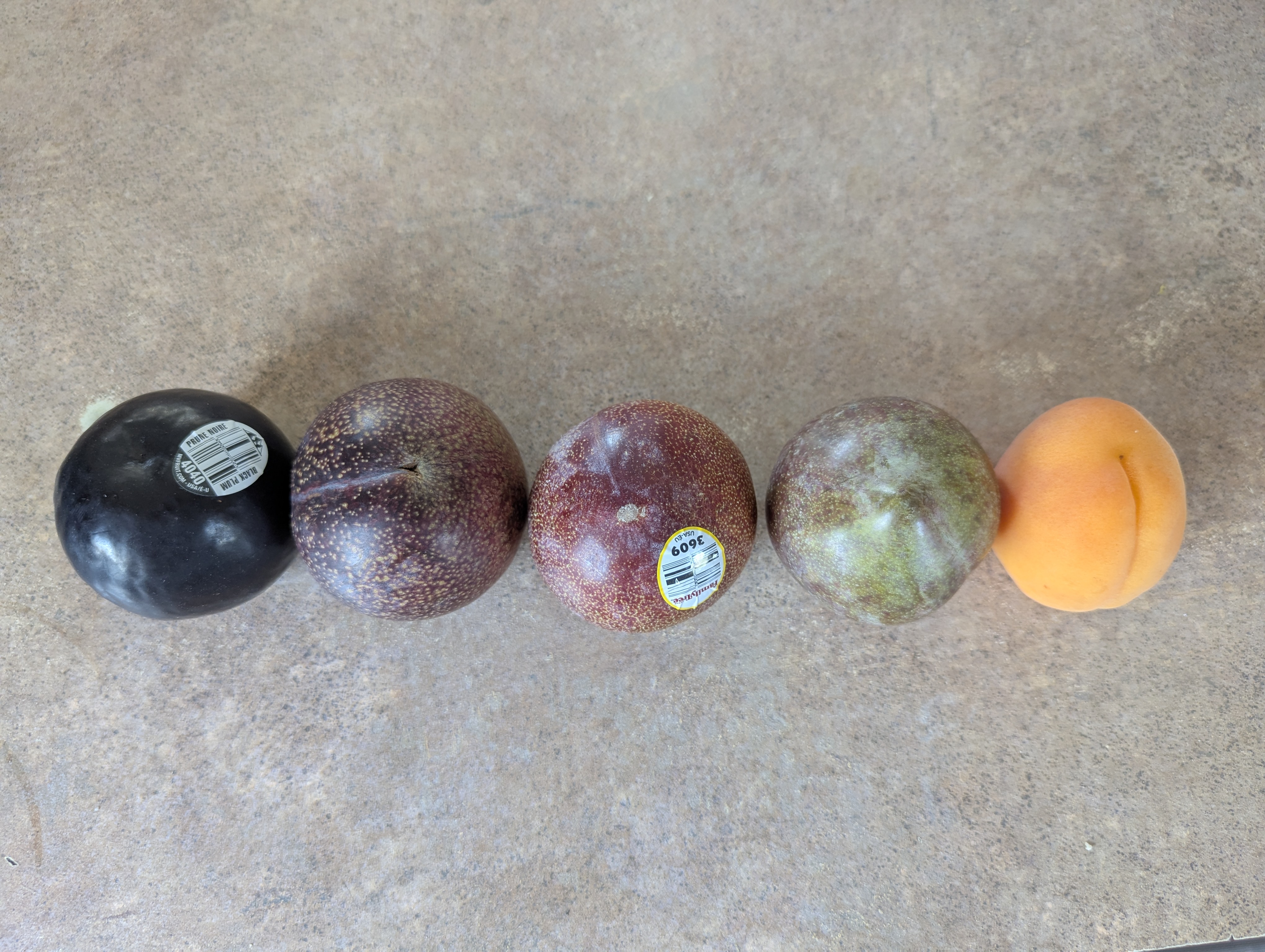
On that note, I have three plums, a plumcot, and an apricot from the grocery store, and I've got 2-4 of each, except the apricots which I have around 10 of, and I'll be stratifying the seeds after I eat the fruit.

BONUS:

Here is a fun thing I've been doing with my family - We do tastings of various things.

We've done fine water tasting (, I'm a big fan of trying new mineral waters from around the world. Try Borjomi if you think water is just water), we've done treat tasting, and we like to do fruit tastings.

Most recently we did apples. Gala was the universal loser. Cosmic Crisp, Honey Crisp and Fuji were the favorites, with various preferences for texture or flavor creating variation.

We've done melons as well, and that's an awesome experience. Highly recommended.

We'll do a tasting on the plums tonight.

Also, planting fruit seeds in pots and waiting until next year is a great way to get little kids excited about gardening without making them do a lot of work. Just have them water the pots a couple times per week.
PXL_20260804_201359779.jpg
Genetic Exploration
Genetic Exploration
 
Chance Lunceford
Posts: 159
Location: Payson, Utah, US of A - Zone6B/High Desert/4500' /14" Rainfall
88
  • Likes 5
  • Mark post as helpful
  • send pies
    Number of slices to send:
    Optional 'thank-you' note:
  • Quote
  • Report post to moderator
I also bought some Driscolls' strawberries to try and grow from seed. I considered buying some blackberries, because they're were 2.5" long, but they've been generally watery and insipid at that size in my experience, and I already have 15+ blackberry varieties installed and a couple more ordered for next year. Don't need any more. Heh.

Driscolls does an insane amount of breeding work, and their strawberry genetics are pretty awesome, even for home growers.

The raspberries and blackberries aren't what the average backyard grower is looking for, though. They're bred to be huge, firm, long-holding, and suited for growth (increasingly, but not exclusively, last I checked) in Mexico.
 
Chance Lunceford
Posts: 159
Location: Payson, Utah, US of A - Zone6B/High Desert/4500' /14" Rainfall
88
  • Likes 6
  • Mark post as helpful
  • send pies
    Number of slices to send:
    Optional 'thank-you' note:
  • Quote
  • Report post to moderator
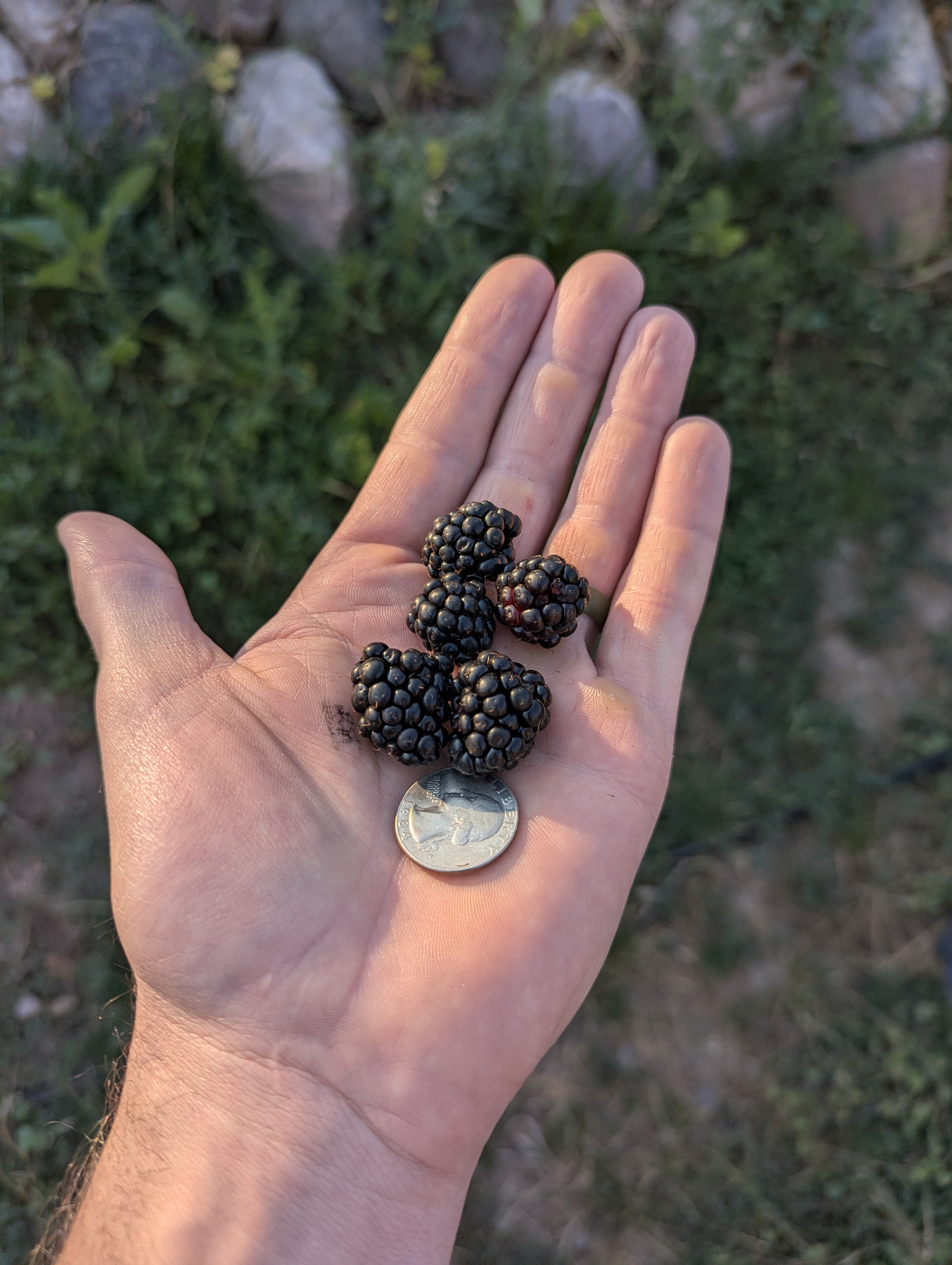
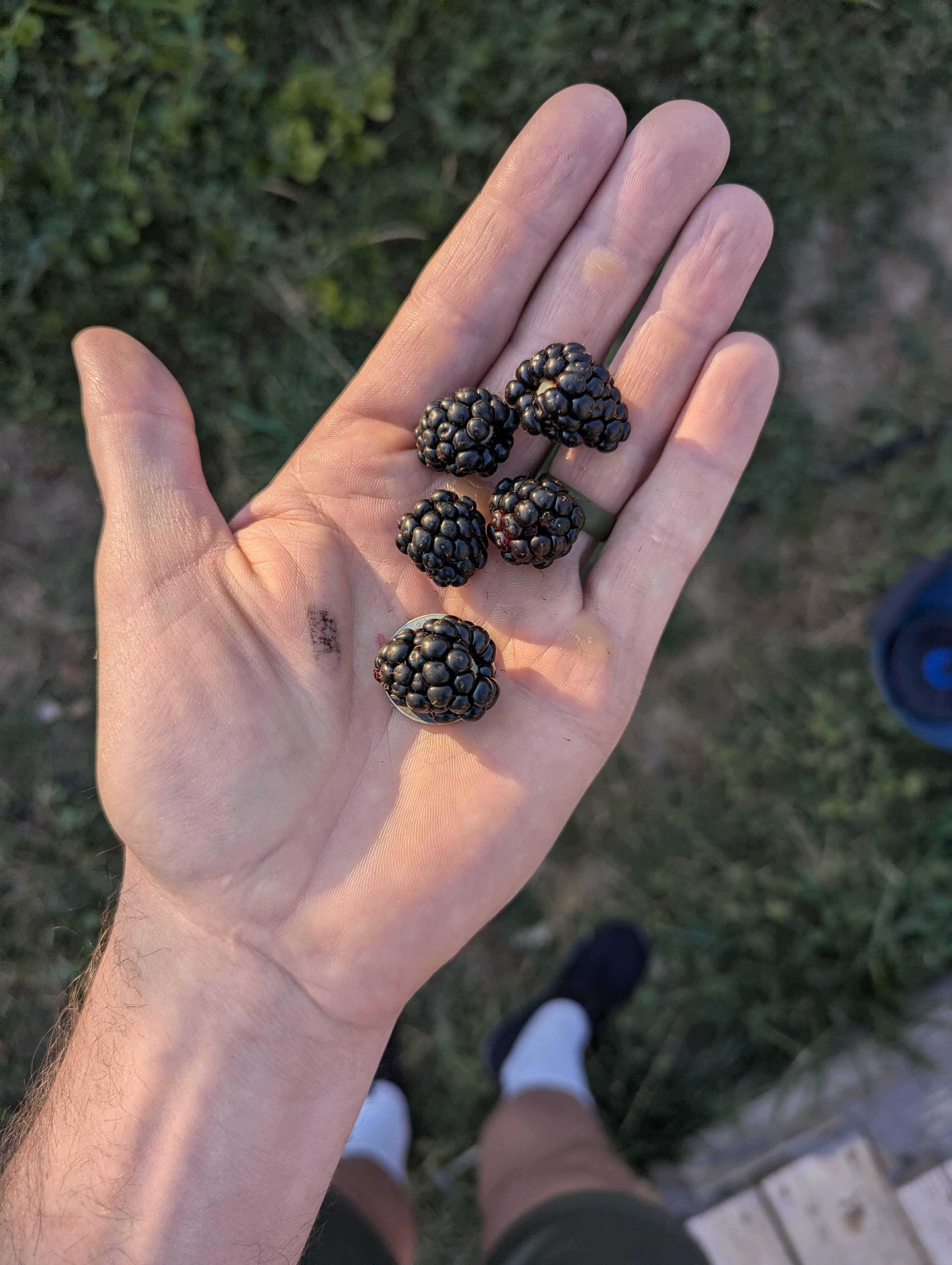
I saw this blackberry flowering awhile back, but spaced it, and didn't expect much anyway.

Then, this morning, I discovered it had fruited. It's about 4 weeks later than my earliest blackberry so far, and there's another blackberry next to it which is just beginning to flower, do it's a nice ripening window. I expect to extend my blackberry season from June to Late Fall with the various varieties I've planted.

The berries are quite large, about the same size as a Driscolls blackberry from 3-4 years ago before they introduced the mega sized ones. The quarter in the picture should help. Not too conical like a lot of large berries, but more round.

Not very thorny, either.

Flavor is mild and super sweet. Massively juicy berries, with great firmness. They'd ship and store well. But, they're kinda wimpy compared to the ones I've been enjoying for the last 6 weeks. My kids loved 'em, though, because of the juicy explosion.

Will monitor fruit quality the rest of the season and next year too, because this was the first year this blackberry produced, and see if it's a keeper or not.

If not, I'll dig it up and move it to the project area.
PXL_20260804_134552458.jpg
Surprise!
Surprise!
PXL_20260804_134902757.jpg
Size comparison one
Size comparison one
PXL_20260804_134950161.jpg
Size comparison two
Size comparison two
 
Chance Lunceford
Posts: 159
Location: Payson, Utah, US of A - Zone6B/High Desert/4500' /14" Rainfall
88
  • Likes 8
  • Mark post as helpful
  • send pies
    Number of slices to send:
    Optional 'thank-you' note:
  • Quote
  • Report post to moderator
Here's a variation on the hugel pit which I have developed specifically for use in dry land, but which will benefit almost any type of ecology:

The Battery Pit

Supplies:
- Logs
- Sticks, wood chips, it other small woody material
- manure
- organic matter of almost any kind
- biological soil amendments
- mineral soil amendments including clinoptilolite, Azomite, bentonite, gypsum, etc...
- NOTE: Everything is optional except for the large woody material (logs, branches, stumps)
- Kindling and a flame source

Method:
- Dig your pit, keep the soil handy, you're gonna need it in a bit
- Fill bottom of pit with logs and kindling
- Light the kindling and get the logs burning until there's a good crust of coals on the outside of the logs
- Throw in around 25-50% of your amendments, manure, and organic matter into the burning pit
- Immediately after adding those materials, smother the pit with your soil, the quicker the better, so equipment or helping hands can be beneficial here
- Once the soil is all back in place, you should have a slightly elevated mound, and you can layer your remaining organic matter and amendments on top of this mound however you prefer
- Walk away for about a day, and then return to water the new mound deeply (NOTE: Water as deeply and as frequently as you can manage in the initial months)

The Results:
- Inside the pit you've created a super sponge, because you've created a layer of char on the outside of the wood (which was enhanced via pyrolysis in the hypoxic environment created through the smothering) and rapidly broken down a portion of the wood via heat-induced lignin degredation, creating a negatively ionically charged sponge capable of drawing in nutrients and water and storing them immediately, rather than over the course of several years
- The amendments added just before smothering provide the necessary fertility and biological activity to charge the char and woody sponge, mitigating some of the temporary soil shock that can come with incorporating uncharged char into soil
- The remaining amendments provide the necessary fertility at the surface for the first season's planting and to prevent moisture loss as the soil structure settles and the system develops
- This is a structure that persists well in the soil versus traditional buried wood pits, due to the char shell providing a mineral scaffolding for the soil to build on

NOTES:
- It's best to place one of these battery pits in the path of water during your rain or irrigation events, i.e. at the bottom of a drainage, or in your storm water/grey water basin, kr anywhere that water flows across and could benefit from percolation instead
- Put it on contour to enhance water harvesting
- Sort of calibrate the size of your pit to the capacity of your equipment, i.e. you can't smother 100' of hugel swale with a shovel in a timely manner, or fill a 20' x 20' x 6' pit, so lay attention to how much work you're biting off and make sure you have the equipment (or labor) to get the work done

I've used this method several times. The first year I used such a structure, I grew 14' sunflowers from the same seed I grew 8' sunflowers literally 3' away.

This is one of the methods you use to bring long-term fertility and moisture storage to your system. They'll keep things green in summer desert conditions.
 
Nancy Reading
steward and tree herder
Posts: 14097
Location: Isle of Skye, Scotland. Nearly 70 inches rain a year
7764
6
transportation dog forest garden foraging trees books food preservation woodworking wood heat rocket stoves ungarbage
  • Likes 6
  • Mark post as helpful
  • send pies
    Number of slices to send:
    Optional 'thank-you' note:
  • Quote
  • Report post to moderator
That's a really interesting twist on a hugel bed Chance! It seems that it kickstarts the benefits almost from day one. Any downsides? I suppose the construction with the quick smothering could be tricky to get right. I like the idea of incorporating a biochar type material for longevity into the bed.

Re. blackberries; I've always been disappointed by cultivated varieties and would always sooner have a wild bramble I think despite the prickles and the smaller size. The taste just doesn't compare.
 
Chance Lunceford
Posts: 159
Location: Payson, Utah, US of A - Zone6B/High Desert/4500' /14" Rainfall
88
  • Likes 8
  • Mark post as helpful
  • send pies
    Number of slices to send:
    Optional 'thank-you' note:
  • Quote
  • Report post to moderator
Hey Nancy,

As far as downsides to the battery pit, there aren't really any, it's just a great tool.

As you pointed out, and as I suggested in the original post, getting your smothering done quickly can be a challenge. That's why scaling your project to your capacity is so important. One workaround for those without access to larger equipment or helping hands is to break a larger project into pieces.

Want that 150' of battery pit swale? Do 10' at a time for the next 15 weekends and then have a beer on the 16th weekend while you kick back and appreciate the massive amount of work you've finished.

---

Blackberries. Oh, blackberries. How I love 'em

So, there are some cultivated varieties that have wild blackberry taste in a berry that's slightly-to-moderately larger than wild blackberries (and usually have way smaller seeds). They're all thorny, and most of them are older selections that have been kept around by devotees in the nursery business because they know how important it is.

Most of the stuff coming out of Arkansas and Oregon these days is focused on commercial viability. The ARK, PrimeARK, and Sweet ARK lines have opened up the world of blackberries to millions of people who would otherwise not bother. Thornless primocane blackberries the size of a quail egg?! Yup, they've got about a half dozen varieties on the market right now that fit that description. But, yeah, they're mild and watery and lacking that fruity oomph that makes a blackberry so delicious.

Another thing to consider is that the "gold standard" for blackberry flavor, according to the industry and bramble berry lore, is the boysenberry. It's a delicious berry, with a uniquely deep, jammy flavor, but it's not anything like a wild blackberry. However, this is the flavor profile many breeders are aiming to match or replace when selecting.

All that said, there are great resources for finding lost varieties. Growingfruit.org is an awesome forum for finding people willing to sell/trade/give clumps of just about any bramble that has ever existed (and any other fruit, pretty much).
 
Chance Lunceford
Posts: 159
Location: Payson, Utah, US of A - Zone6B/High Desert/4500' /14" Rainfall
88
  • Likes 9
  • Mark post as helpful
  • send pies
    Number of slices to send:
    Optional 'thank-you' note:
  • Quote
  • Report post to moderator

Chance Lunceford wrote:On that same walk, I took some pictures of a peach tree I'm calling the Slaughterhouse Peach (because it's growing on the hillside beneath a slaughterhouse) which I discovered yesterday.

I'm going to harvest the fruit when it's ripe. WHAT? THE FRUIT?! Yes, the only stonefruit I've seen on any tree this year, wild or domestic, on a volunteer peach.

It's growing on the bank of the Strawberry Highline Canal, which I've mentioned multiple times before (and I'll teach you about the canal project and what a miracle it was for the region in a future post), in a damned harsh environment but likely with a root or two tapping into a crack in the canal's concrete so water isn't an issue for the Slaughterhouse Peach.

Two fruit are getting ripe, and then there are a few more lower down that are not significantly further back in the ripening process. Hopefully I'll be able to harvest all of them for propagation, because it's disease free and must be late-flowering (of great use here normally, because we have late frosts in general), and is clearly well adapted to the local soil, so (if it is delicious) would make incredible starting stock for my project area and my yarden alike.

Here's a few pictures:


Update:

Grabbed the two ripest ones. They're a little underripe, but they've got most of their color and they're fragrant, so they'll ripen on my kitchen table just fine.

I'll go back in a couple weeks and harvest the others, hopefully all the way tree ripe, since that'll increase the viability of the seeds

It was quite a bushwhack to get there, but I did find a better route on my egress, so I'll have a lot less bloody scratches the second time through. Heh.
PXL_20260806_011323967.jpg
The approach
The approach
PXL_20260806_011408005.MP.jpg
I've arrived
I've arrived
PXL_20260806_011602819.MP.jpg
Got 'em
Got 'em
PXL_20260806_011639724.MP.jpg
I'll be back for you, little buddies
 
Chance Lunceford
Posts: 159
Location: Payson, Utah, US of A - Zone6B/High Desert/4500' /14" Rainfall
88
  • Likes 6
  • Mark post as helpful
  • send pies
    Number of slices to send:
    Optional 'thank-you' note:
  • Quote
  • Report post to moderator
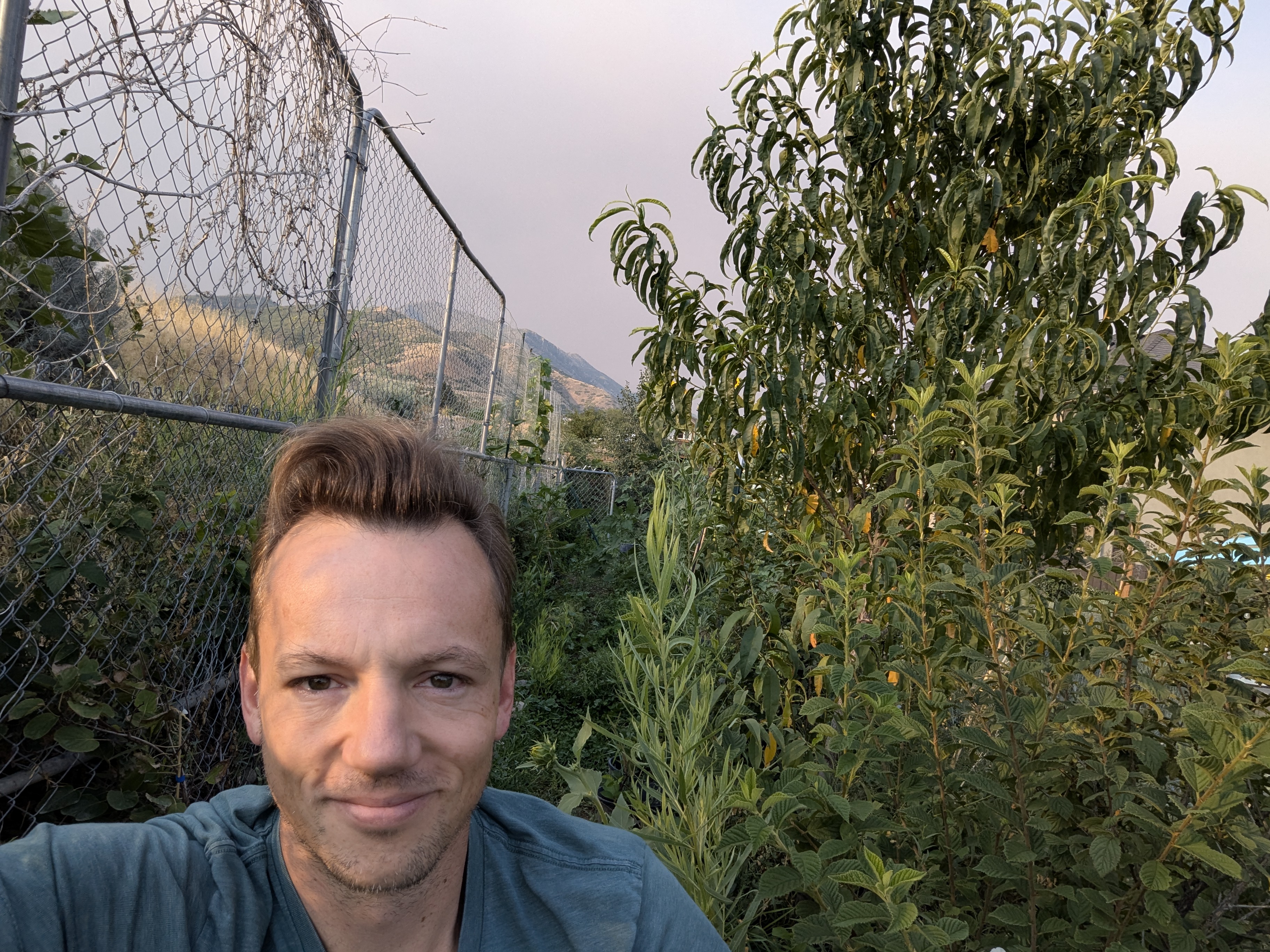
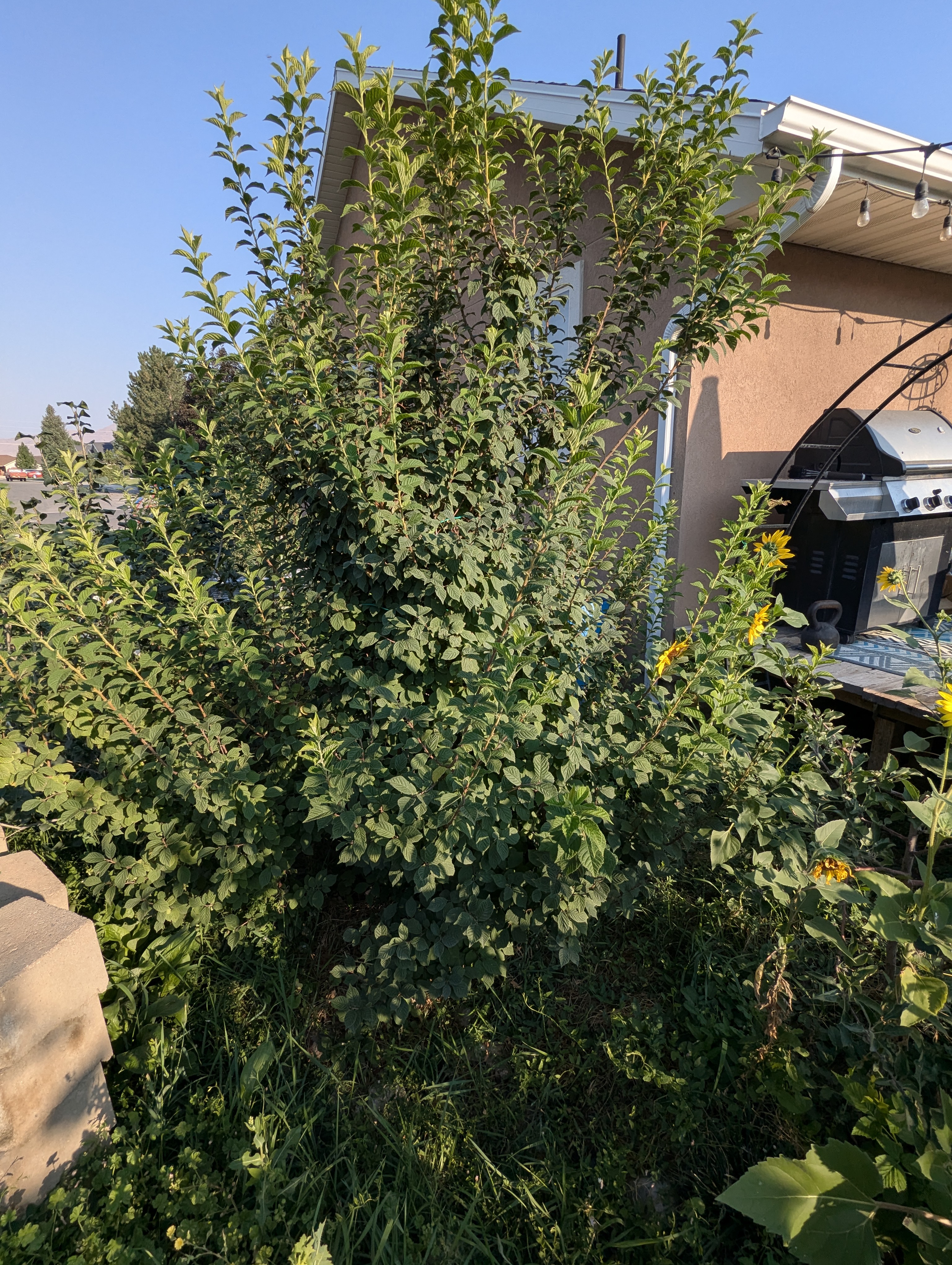
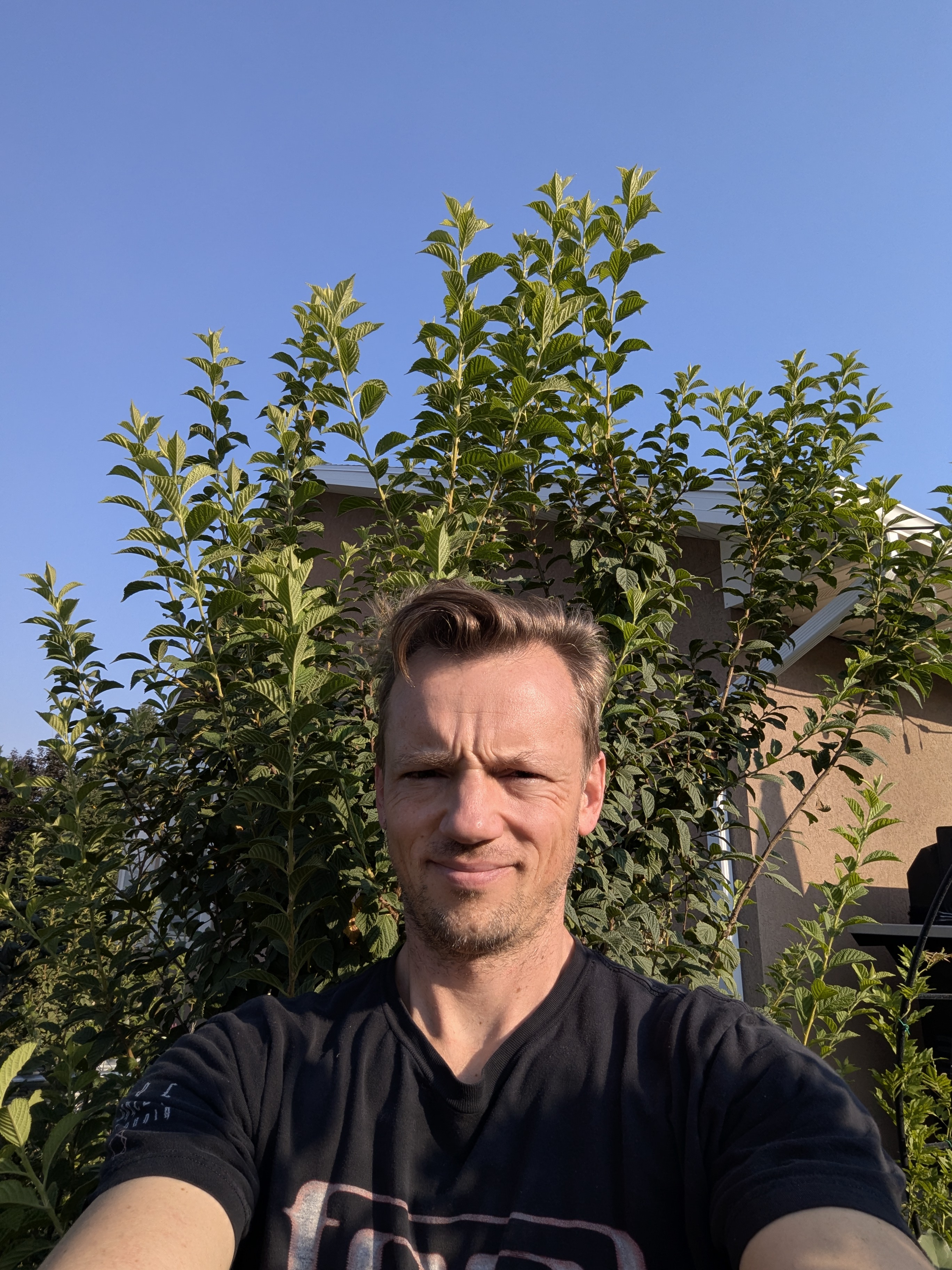
Here are two photos of my largest nanking cherry specimen. It's in a special place in the yarden, and gets basically infinite fertility and water.

It's about 9' tall.

I had to tie it up and support it this year, it grew about two feet and then we had a crazy late snow/frost and it had the then 7' plant drooping to the ground.

If I didn't have it tied up, it'd be as wide as it is tall. I'm going to be pruning this one, and most of my other nankings, this winter to clear out the bottom and to give them some shape. I'm also going to experiment with tree form versus shrub form, and monitor for production and aesthetics.

They're a great landscape plant, with spectacular spring blooms, attractive foliage, manageable size, and tasty fruits.
PXL_20260806_143759789.MP.jpg
My largest nanking cherry
PXL_20260806_143814099.jpg
I'm 6' for scale
I'm 6' for scale
 
Chance Lunceford
Posts: 159
Location: Payson, Utah, US of A - Zone6B/High Desert/4500' /14" Rainfall
88
  • Likes 4
  • Mark post as helpful
  • send pies
    Number of slices to send:
    Optional 'thank-you' note:
  • Quote
  • Report post to moderator
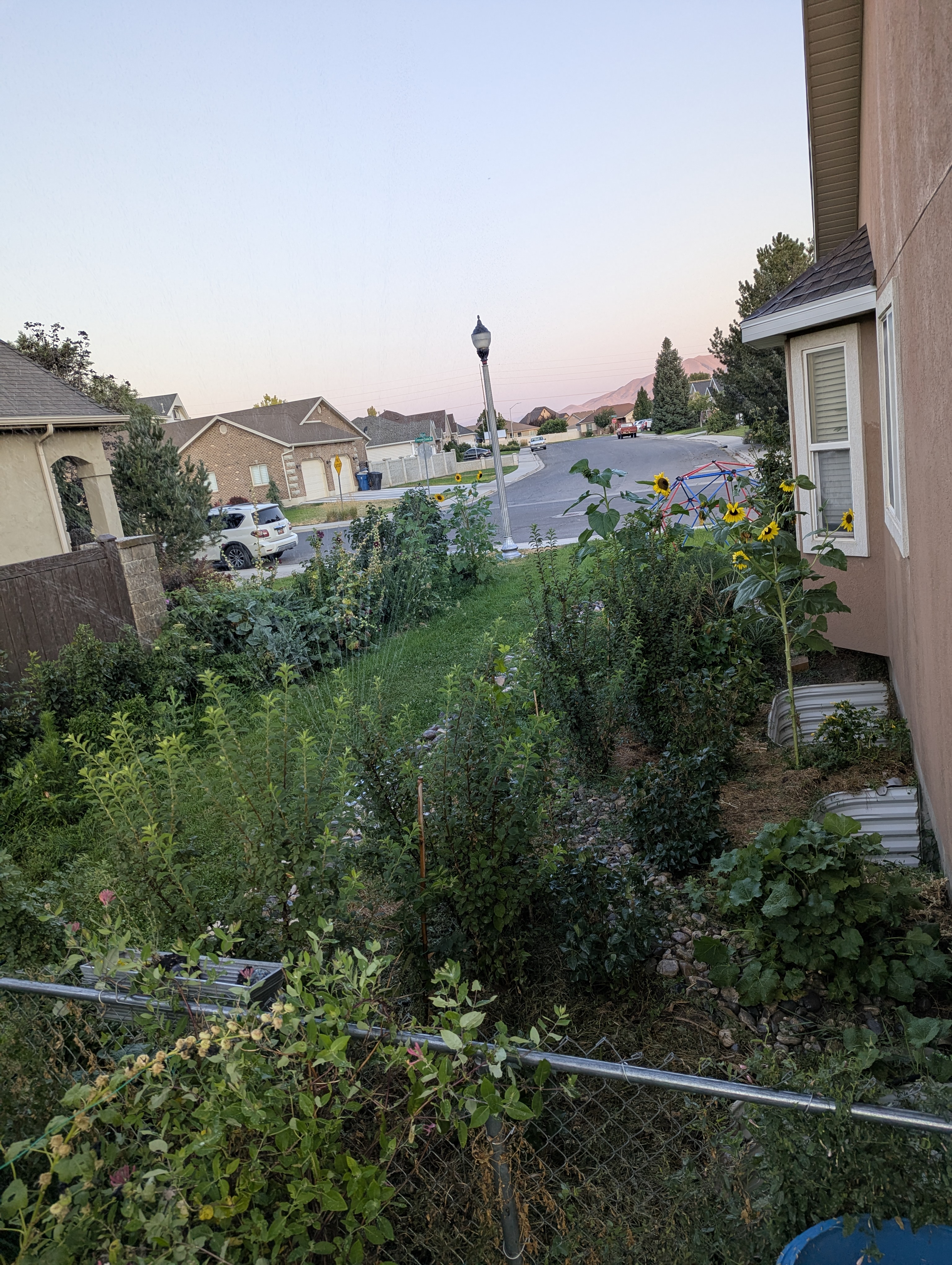
I've put a ton of work into the side yarden this year. We've got nanking cherries, honeyberries, jujubes, a grape, some blackberries, black raspberries, long-lived perennial kale, bush cherries, mulberries, red raspberries, strawberries (including a wild strawberry harvested from 9000' elevation about two hours south of where I live), lilacs, hollyhocks, mint, catmint, clematis, bush honeysuckle, sunflowers, hostas, rose of sharon, rose, Austrian black pine, ninebark hydrangea, cosmos, borage, wild carrot, helleborus, and a bunch of other stuff too.

I'm a bit wilder than my neighbors, but we're a tight community and I have no haters. Life is good.
PXL_20260807_125941363.jpg
From the back
From the back
PXL_20260804_143401324.MP.jpg
From the front
From the front
PXL_20260807_130226998.jpg
The view from my deck
 
Chance Lunceford
Posts: 159
Location: Payson, Utah, US of A - Zone6B/High Desert/4500' /14" Rainfall
88
  • Likes 5
  • Mark post as helpful
  • send pies
    Number of slices to send:
    Optional 'thank-you' note:
  • Quote
  • Report post to moderator
I've put a lot of work into that area every year. It's been rough because it's the south facing side and was getting cooked every summer, with my plantings barely hanging on.

But, this year we've entered a new paradigm. That's true for the whole of the yarden this year, but it's especially apparent in the side yarden, because it's thriving and vibrant and growing at a time when it's usually wilting, and paring branches as a drought response life support, and dying. So, the difference is most drastic. Last year things did okay instead of terrible during the summer, but this year this area has actually responded with vigor to the summer sun and heat.

There are a number of reasons why that is, but one of them is the mineral soil amendment regime I designed and implemented for my site this year. I'll discuss that in an upcoming post.
 
Chance Lunceford
Posts: 159
Location: Payson, Utah, US of A - Zone6B/High Desert/4500' /14" Rainfall
88
  • Likes 5
  • Mark post as helpful
  • send pies
    Number of slices to send:
    Optional 'thank-you' note:
  • Quote
  • Report post to moderator

Chance Lunceford wrote:

Chance Lunceford wrote:

Update:

Grabbed the two ripest ones. They're a little underripe, but they've got most of their color and they're fragrant, so they'll ripen on my kitchen table just fine.

I'll go back in a couple weeks and harvest the others, hopefully all the way tree ripe, since that'll increase the viability of the seeds

It was quite a bushwhack to get there, but I did find a better route on my egress, so I'll have a lot less bloody scratches the second time through. Heh.


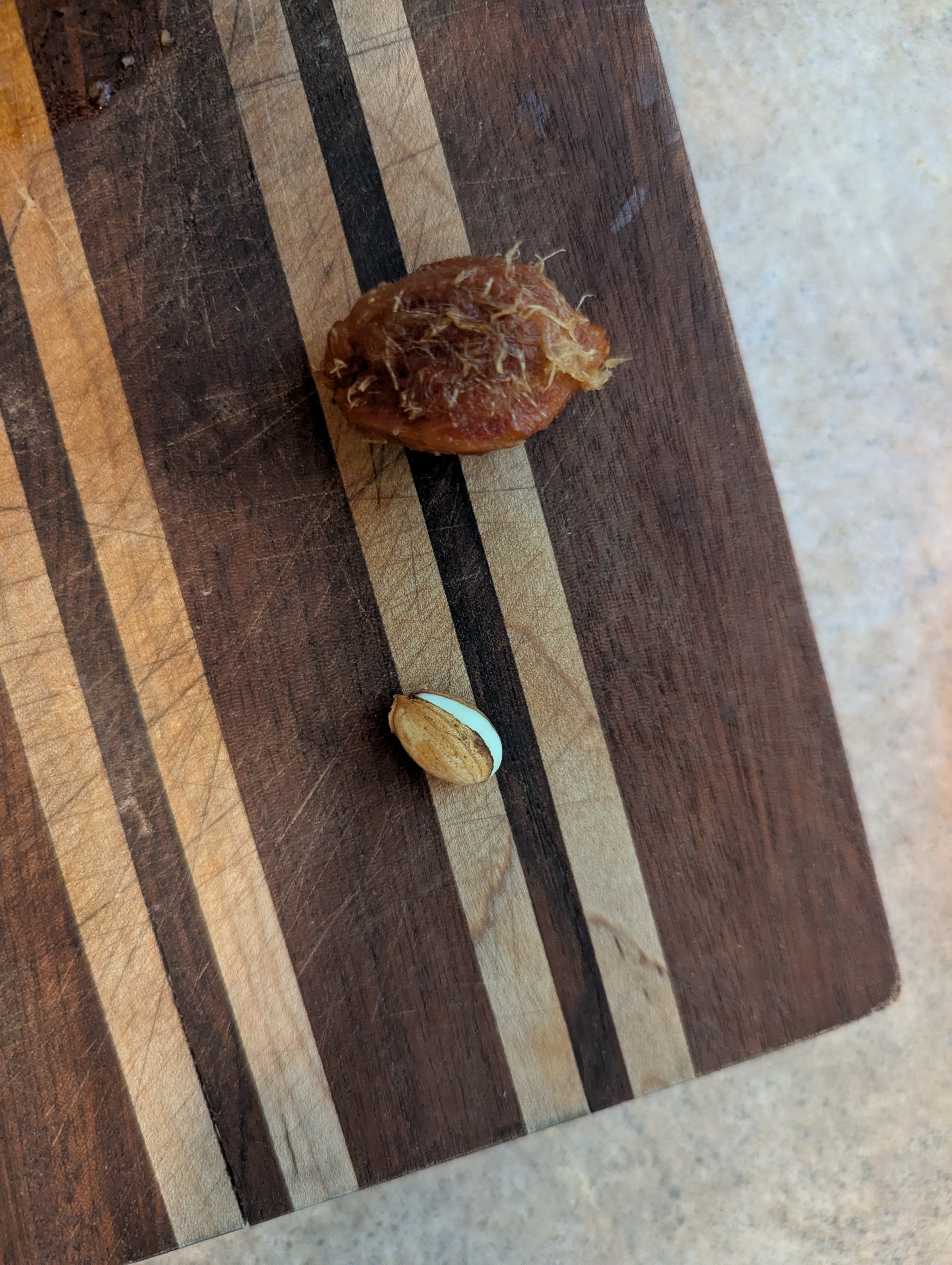
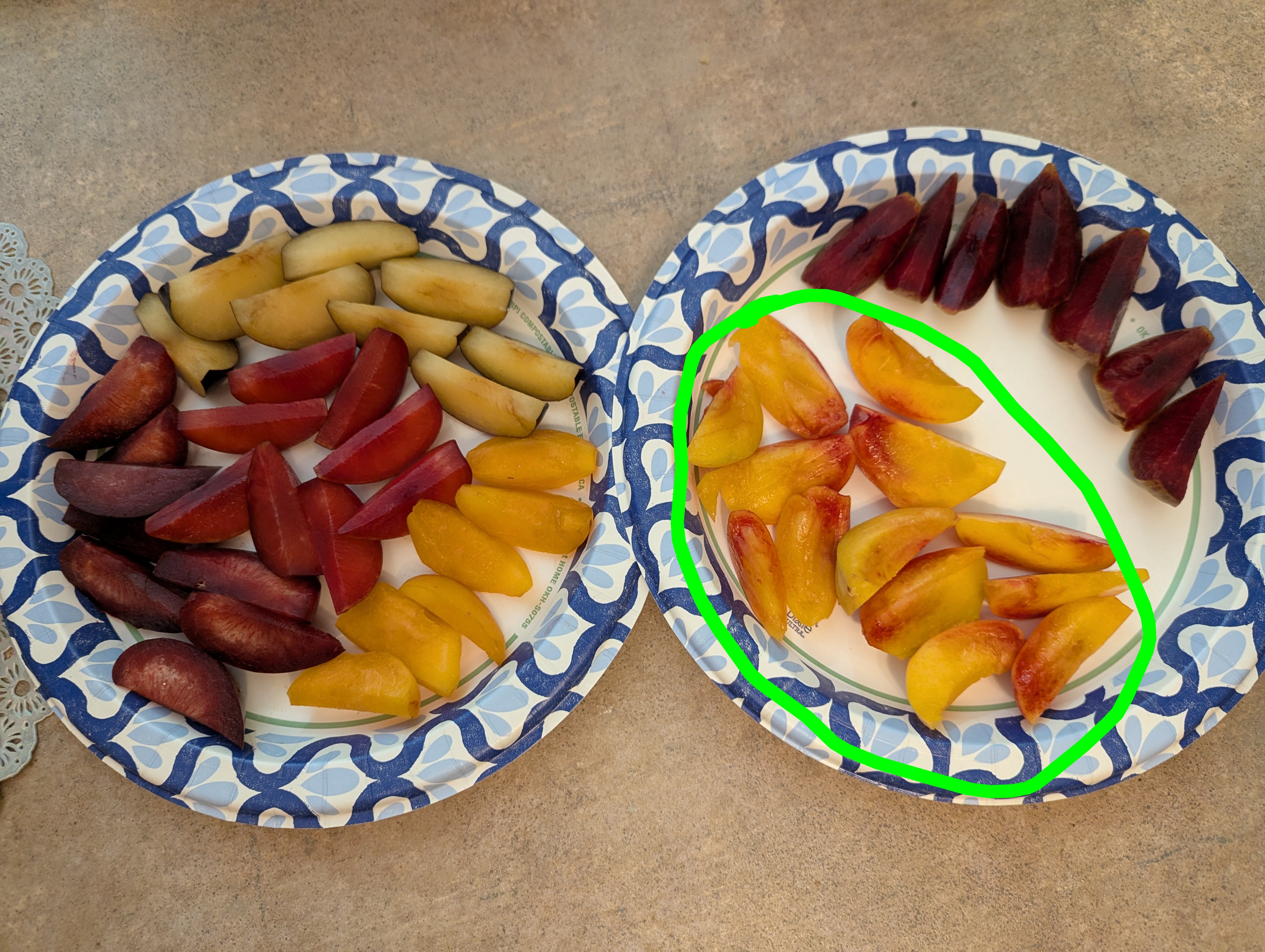
In the picture below, you'll notice the sliced peaches which I've circled in green.

They have a beautiful blood-splashed trait in the flesh. Flesh is otherwise a rich yellow, and these are fully clingstone.

Speaking of stones, I pulled one and the other split, but left the kernel intact, so I'm going to plant the kernel immediately, and I'll stratify the intact stone before planting later.

By the way, the peach was favored by 3/5 over all the plums, plumcot, and apricot sliced up beside them. Everybody liked the peach. It was a bit tart, with delectable aroma, great firm texture, and outrageous juiciness.

It's official:

The Slaughterhouse Peach is a keeper.

NOTE: One of my kids calls them the Pig's Bum peaches. We'll see which one sticks.
PXL_20260809_030628983-2.jpg
Mmmm.... peaches
Mmmm.... peaches
PXL_20260809_033409888.jpg
Kernel and Stone
Kernel and Stone
 
Chance Lunceford
Posts: 159
Location: Payson, Utah, US of A - Zone6B/High Desert/4500' /14" Rainfall
88
  • Likes 4
  • Mark post as helpful
  • send pies
    Number of slices to send:
    Optional 'thank-you' note:
  • Quote
  • Report post to moderator
Also, I found my first ever wild blackberry patch growing locally. They're not native, so it's likely from a picnic berry (it is growing on the edge of a bare-dirt canal/storm water ditch adjacent to a park with picnic areas), and they were -UNFORTUNATELY- the worst blackberries I've tried all year, even worse than the store bought ones.

However, it's still a thrill to see a blackberry patch growing in an area similar to the one I'll be planting in come autumn, in my guerrilla community food forest project, because it demonstrates the viability of what I'm about to do.

It's also cool because it's been naturalized in an area that blackberries don't normally thrive in (not the riparian area, that's normal, but the high-desert with hot, drought-stricken summers), and so I'll be digging up a clump to transport into the project.

The flavor genetics are awful, but the survival genetics are prime. So, we'll include this specimen in my project to help ensure long-term viability. I'll also be working on blackberry breeding, using the ≈dozen varieties I'm installing in the project this year as the basis. Stratifying and popping seeds over the next several years to further increase the genetic stock of the area, and then I'll mostly sit back and let nature run its course (propagating any outstanding offspring for further use, as I get my skills up for future nurseryman work).

I'll drop a picture of the wild patch soon.
 
Chance Lunceford
Posts: 159
Location: Payson, Utah, US of A - Zone6B/High Desert/4500' /14" Rainfall
88
  • Likes 4
  • Mark post as helpful
  • send pies
    Number of slices to send:
    Optional 'thank-you' note:
  • Quote
  • Report post to moderator
Also, a note on rubus breeding:

Ploidy matters.

What's ploidy? The qty of chromosomal copies in a cell, i.e. haploid=1 copy, diploid=2, triploid=3, tetraploid=4, etc...

Plants with odd ploidies are sterile and can't interbreed (though brambles are special and can produce genetically identical seeds with no fertilization in a process called apomixis, as well as creating sports far more often than other plants due to their wild cellular activity), and wild blackberries can be anything from diploid to dodecaploid (12-ploid), with 5, 7, and 3 ploidy specimens not uncommon.

Even ploidy plants, i.e. 2, 4, 6, etc... can typically interbreed, and what's interesting is that the larger polyploidy results in more potential genetic variation.

Most commercially available varieties are tetraploids (4-ploid), FYI. That's because larger ploidy usually means larger berries and healthier canes, and also because thornless genes (apparently, from what the research says) are stable and consistent in the tetraploid form

So, what this means is there's a decent chance that my wild blackberries won't cross with my commercial varieties. No worries, there's also a decent chance they will, and even if they don't, it's still worth preserving hardy genetics just in case -A crappy blackberry is still better than no blackberry, at least in my book.
 
Chance Lunceford
Posts: 159
Location: Payson, Utah, US of A - Zone6B/High Desert/4500' /14" Rainfall
88
  • Likes 5
  • Mark post as helpful
  • send pies
    Number of slices to send:
    Optional 'thank-you' note:
  • Quote
  • Report post to moderator
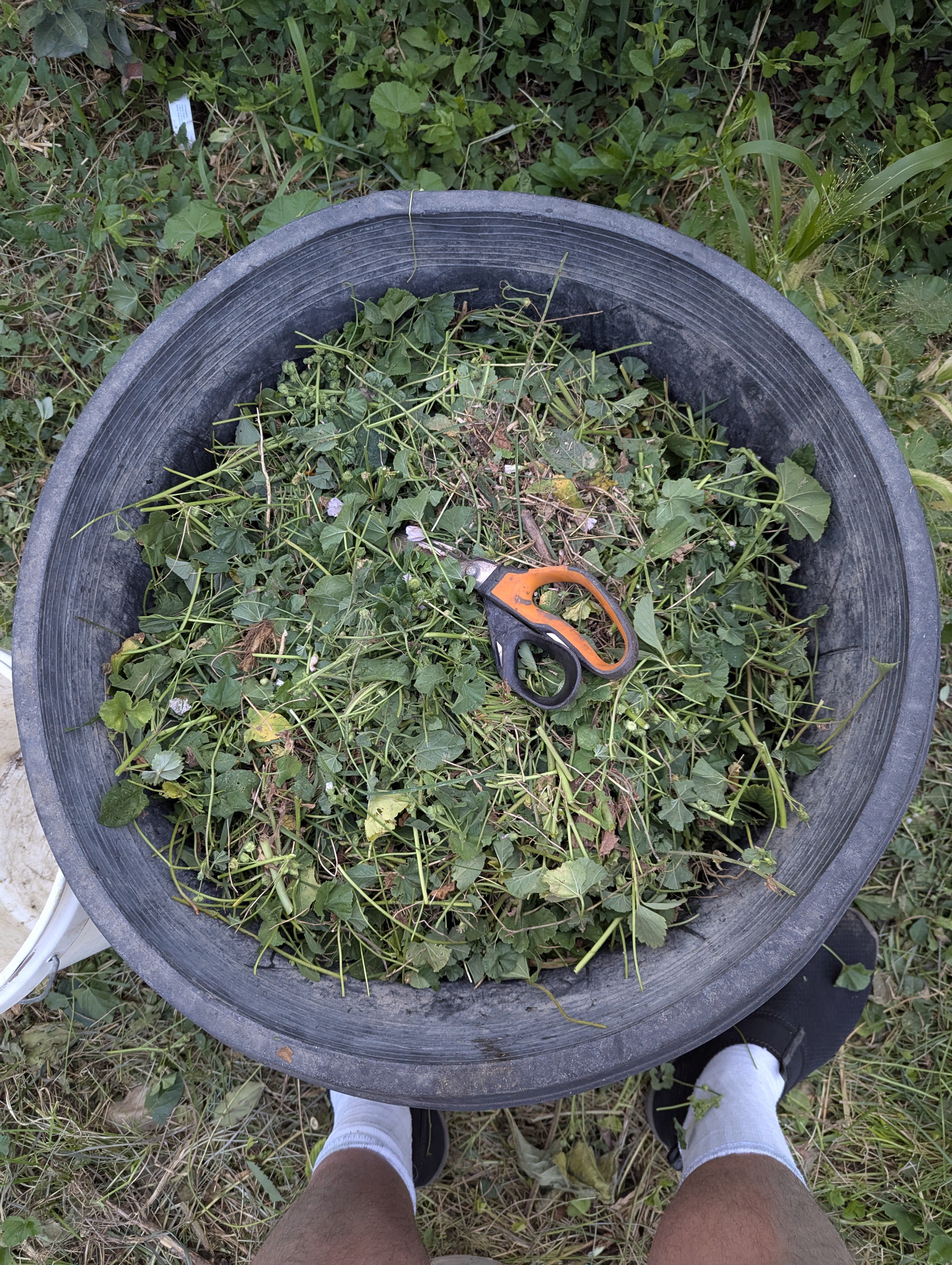
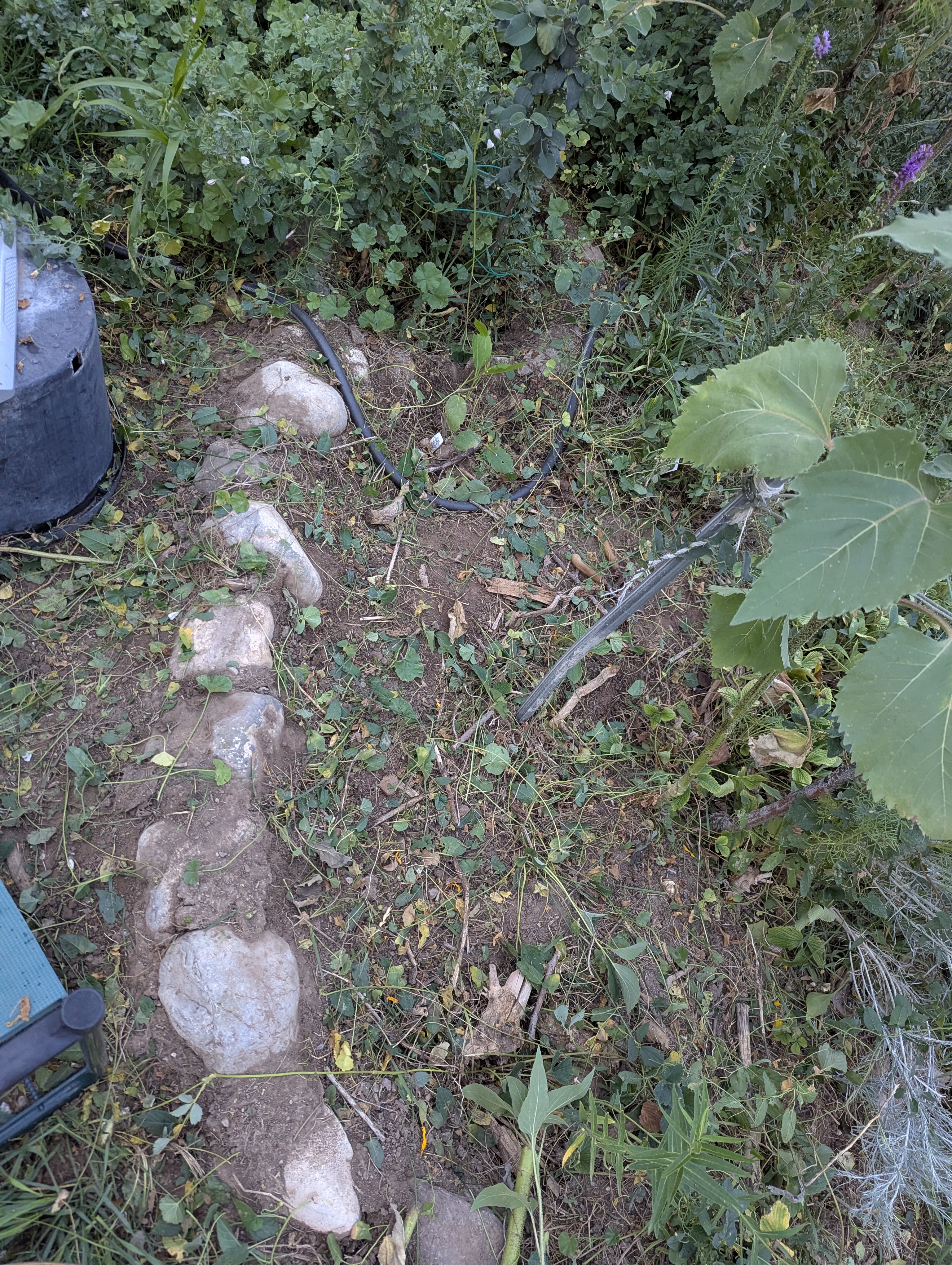
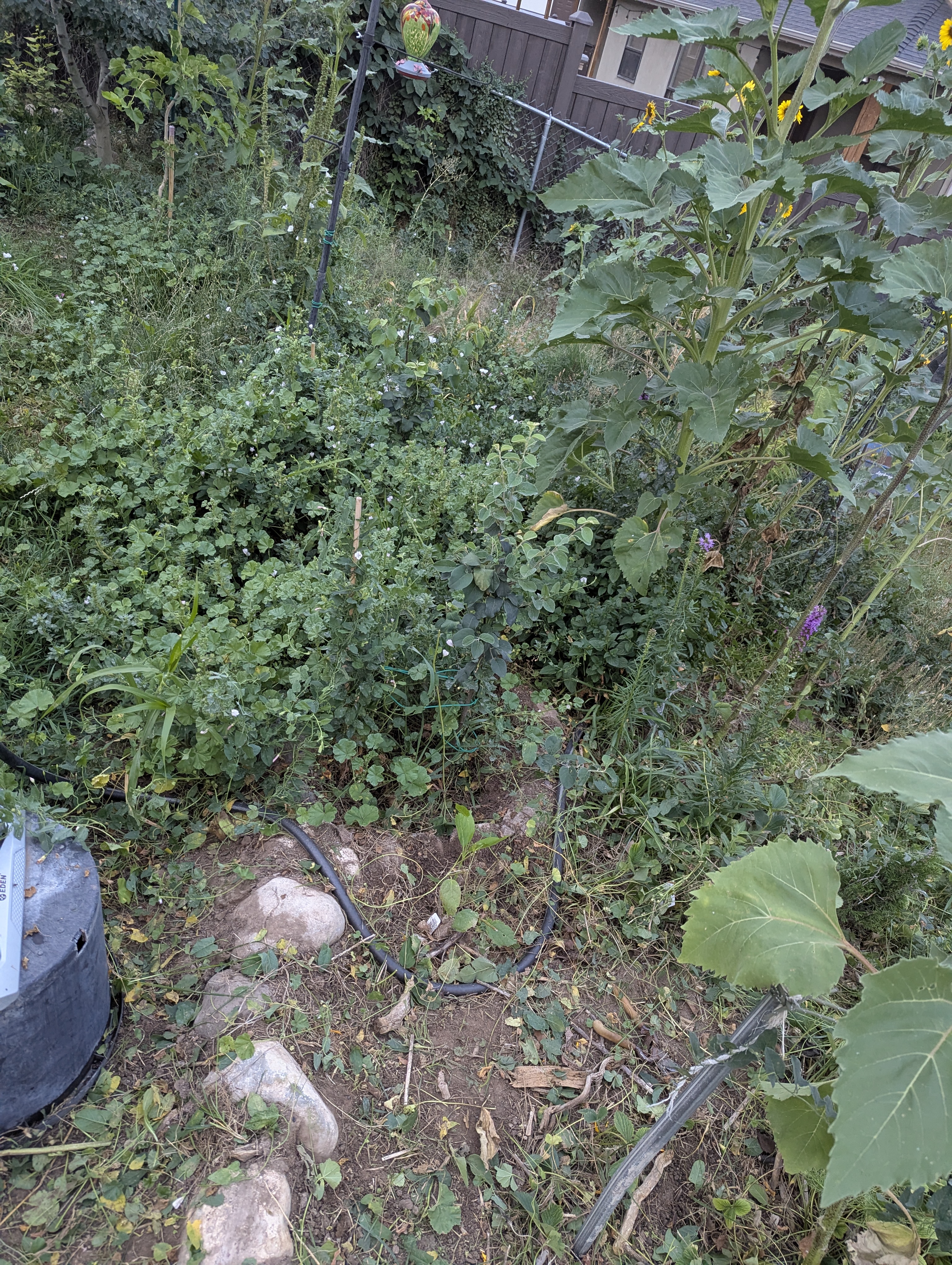
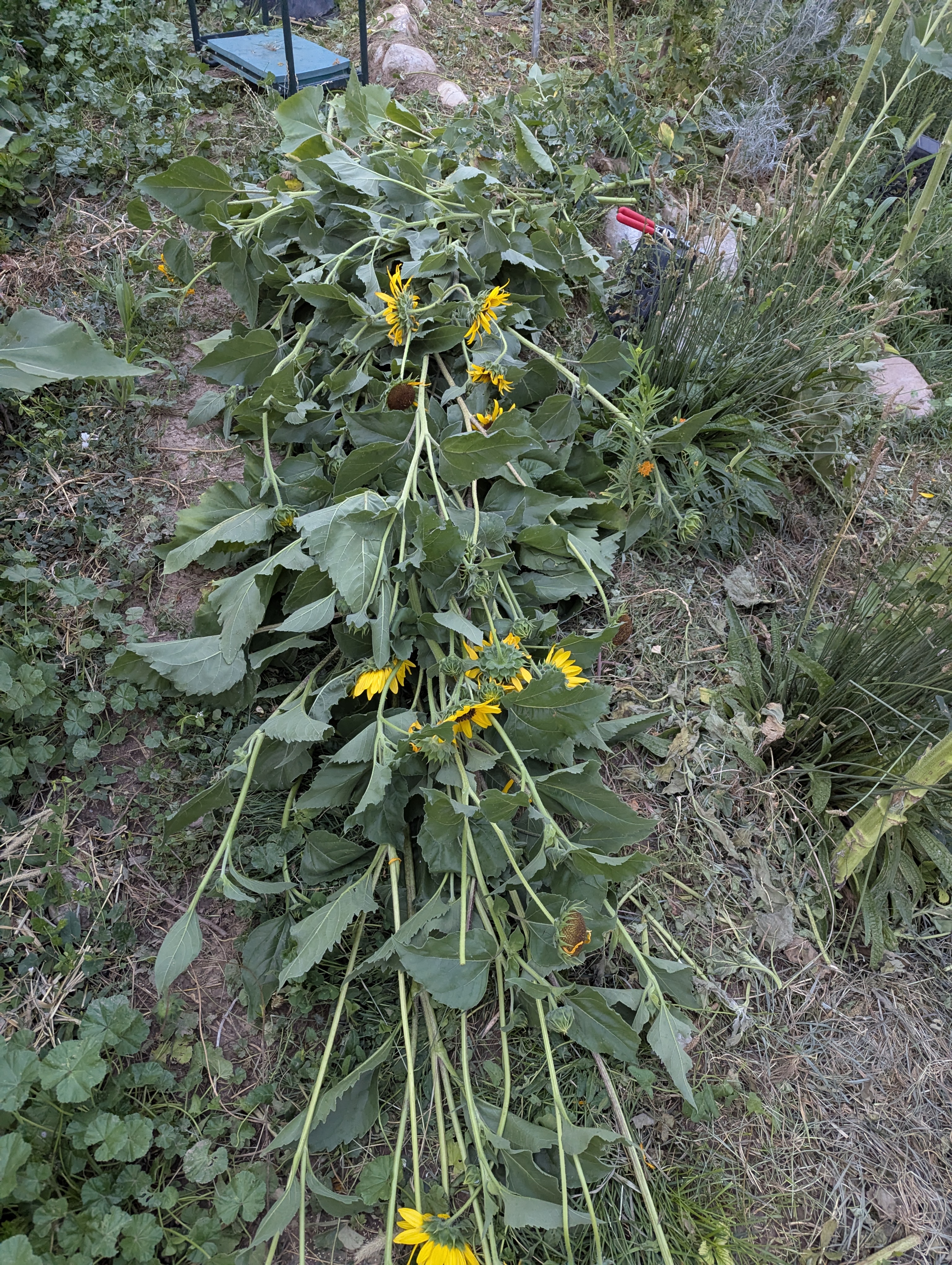
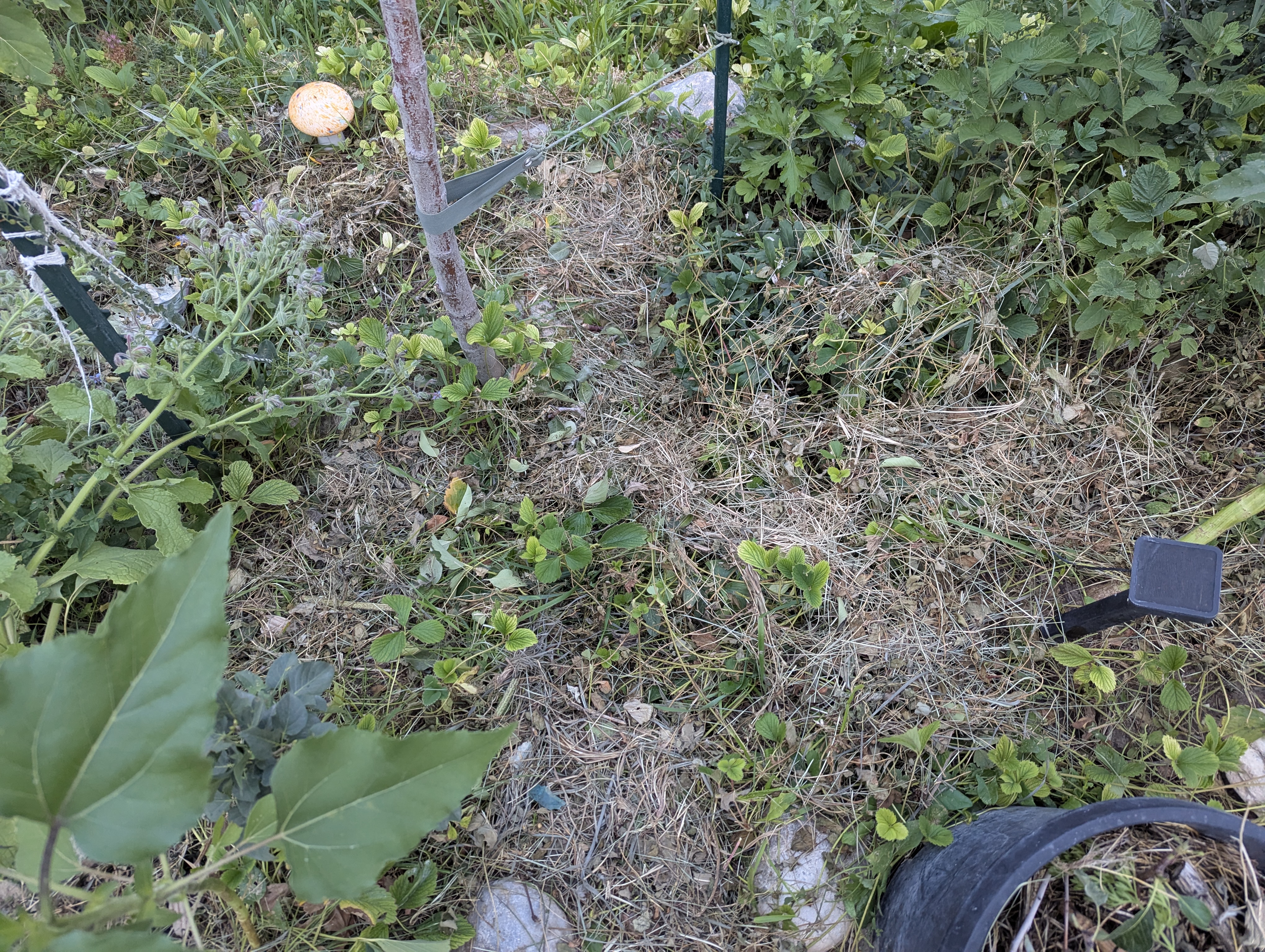
Chop N Drop in progress.

It's one of my favorite activities. So soothing.
PXL_20260809_130809283.jpg
Soon to be spread
Soon to be spread
PXL_20260809_130817546.jpg
Area cleared, and ready to receive the chopped mulch
PXL_20260809_130820292.jpg
The next area
The next area
PXL_20260809_130812053.MP.jpg
Thinning the sunflowers to decrease the canopy
PXL_20260809_130831177.jpg
Yesterday's handiwork
 
Chance Lunceford
Posts: 159
Location: Payson, Utah, US of A - Zone6B/High Desert/4500' /14" Rainfall
88
  • Likes 5
  • Mark post as helpful
  • send pies
    Number of slices to send:
    Optional 'thank-you' note:
  • Quote
  • Report post to moderator
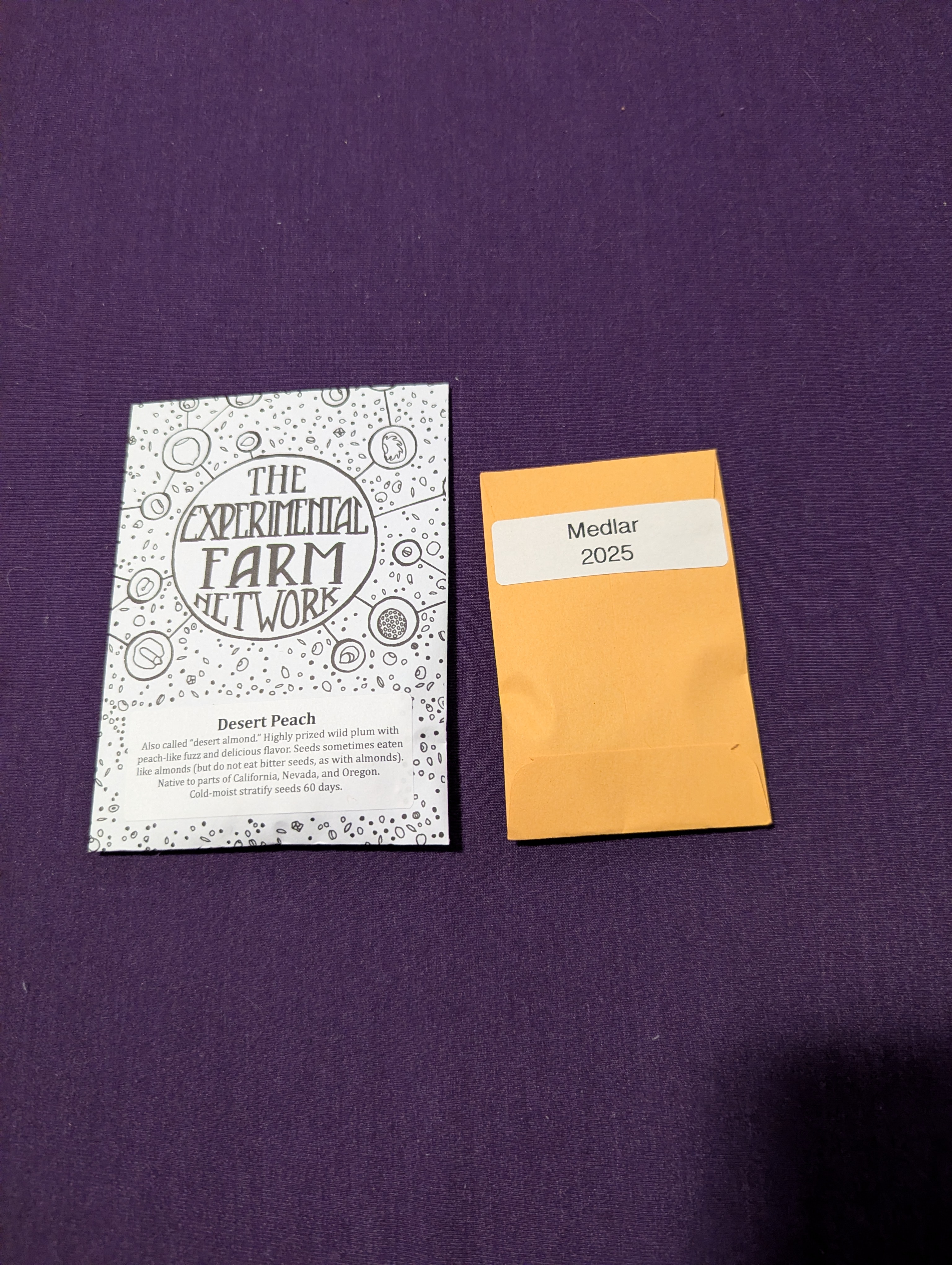
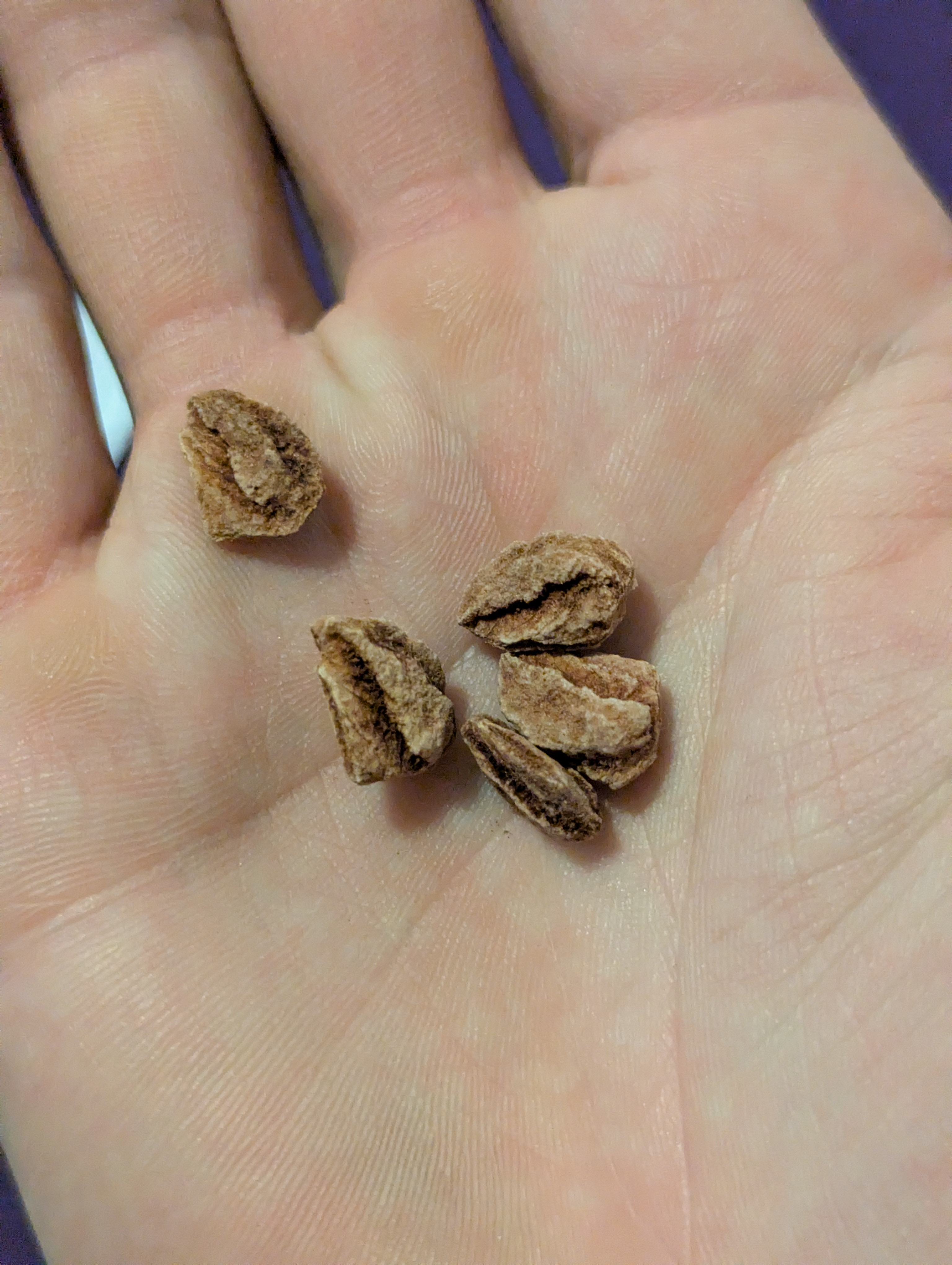
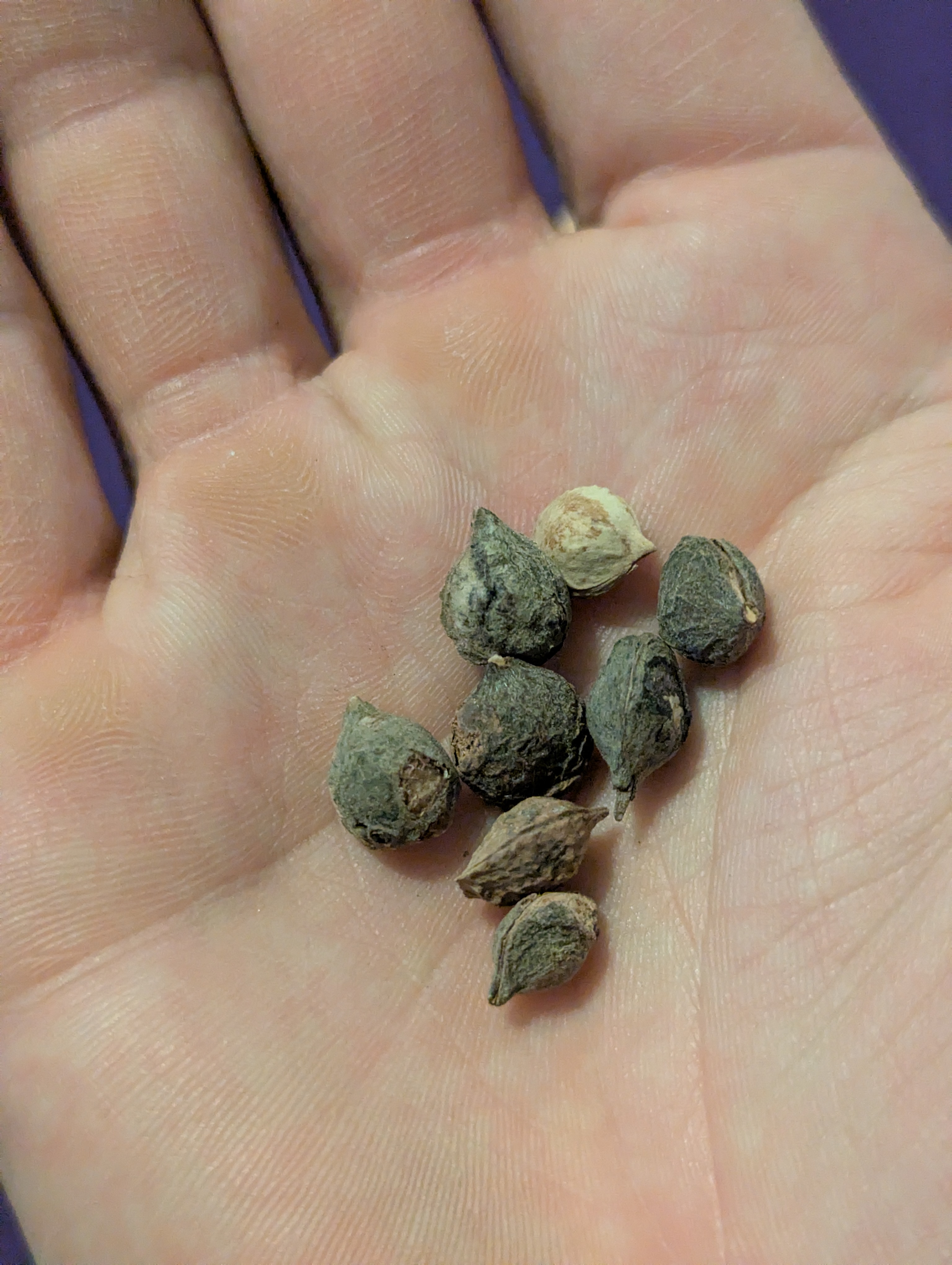
I've heard medlar seeds are about as difficult as it gets to sprout, or at least require a lot of patience.

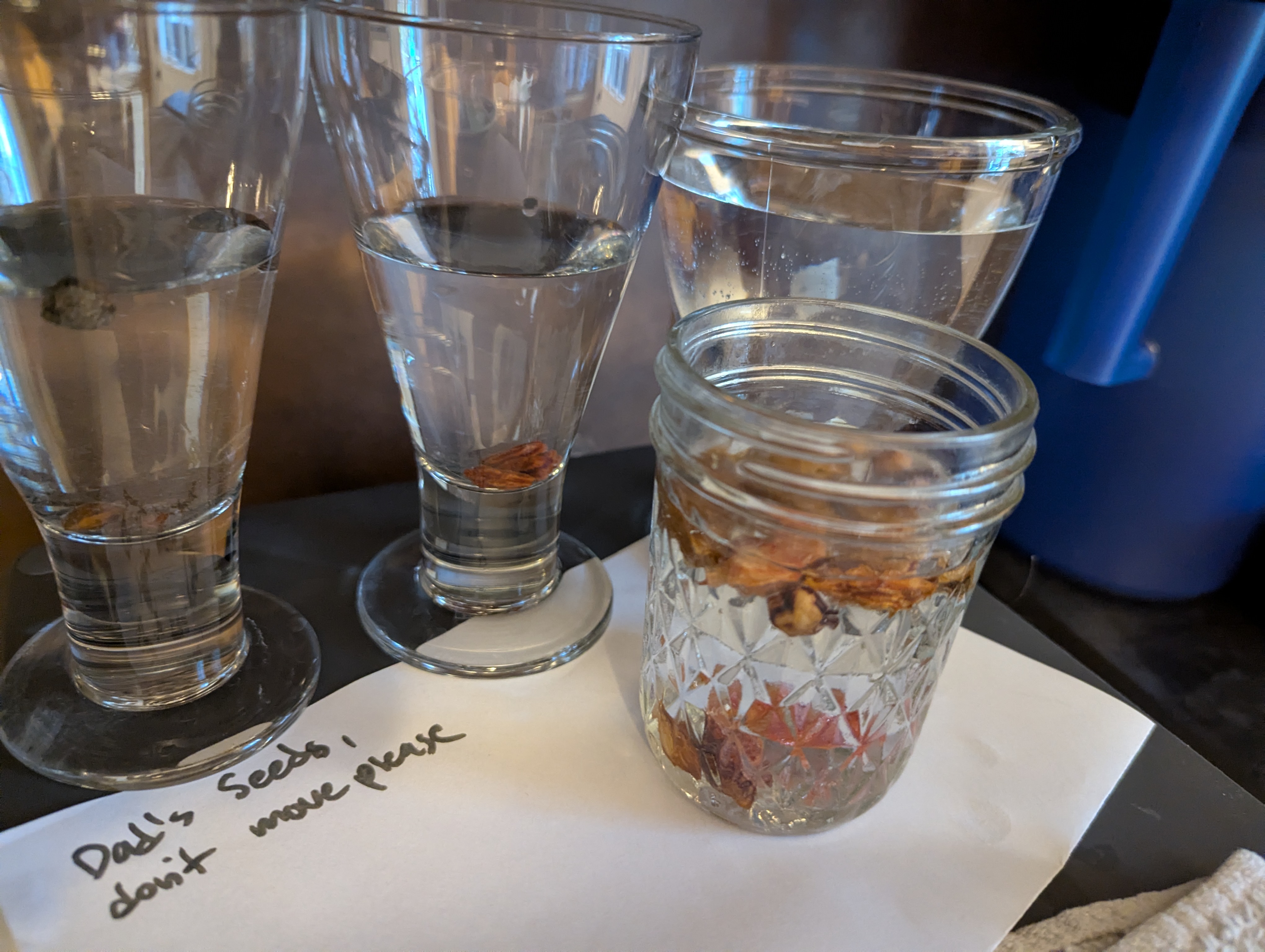
I'm going to give it a try. I'll tell you how it goes in about 18 months. Heh. I'm running a small experiment in which two of my five seeds are soaking in a mild acid solution for the 24 hour soak before stratification.

The desert peaches promise to be more immediately interesting, only requiring a 60 day stratification (or so I'm told), so that'll be interesting to see.

I'm going to stratify some in vermiculite in my fridge, and I'm going to sow some in pots in the late fall. I've got 8, so I'll split 'em down the middle.

I'm also preparing some plums, pluots, and cherries for the same (those pictured several posts above).
PXL_20260814_010120694.jpg
Desert Peach and Medlar
PXL_20260814_010406455.jpg
Medlar (ever seen 'em before?)
PXL_20260814_010447085.MP.jpg
Desert Peach aka Desert Almond (kinda wonky looking)
PXL_20260814_012211941.jpg
Soaking 'em
Soaking 'em
 
Chance Lunceford
Posts: 159
Location: Payson, Utah, US of A - Zone6B/High Desert/4500' /14" Rainfall
88
  • Likes 4
  • Mark post as helpful
  • send pies
    Number of slices to send:
    Optional 'thank-you' note:
  • Quote
  • Report post to moderator
This is 6+ weeks of harvesting so far. It's my most delicious blackberry currently. Next year I'll have about 15 more to compare it with.
PXL_20260814_014452679.jpg
A wonderful blackberry
 
I agree. Here's the link: http://stoves2.com
reply
    Bookmark Topic Watch Topic
  • New Topic