Frying likely began in much the same way as roasting. I imagine primitive man cracking an egg onto a stone, hot from the fire. He must have been amazed as the egg whitened and became solid, giving off a tantalizing smell. It must have been quite a frustration though, to try to scrape off the egg that was cooked on and stuck to the stone. Having discovered this new technique that could ensure even browning, which makes food taste better, I am sure he soon fried some meat. The meat had its own fat, so it didn’t stick. After a few times of cooking meat, surely he learned to use the rendered fat to fry eggs and vegetables.
Thus, the technique of sauteing was born. When we sauté, we fry (usually) vegetables in a hot pan with a small amount of fat. The pan is usually shaken rather than its contents stirred. The name refers to the way the vegetables jump in a hot pan.
Judson Carroll, Master Herbalist is a reader-supported publication. To receive new posts and support my work, consider becoming a free or paid subscriber.
Sweating is similar, but at a lower temperature. A little more fat is used. We often sweat onions, just cooking them until they are translucent and soft. If we continue this process, eventually the onions caramelize. This happens as the natural sugars brown. The onions become sweet and savory. All foods need salt, but salt really helps in caramelization as it pulls the water out.
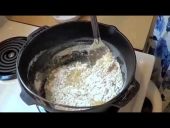
Once pans were invented, new cooking techniques became available. Shallow frying is often used in home cooking in the South. This is how we fry chicken, fish and “chicken fried” steak in cast iron pans. Only, perhaps, an inch of oil or rendered fat is added to the pan so that as the meat fries, it stays in contact with the surface of the pan. This causes dark brown spots on the meat or breading, and wonderful flavor. Most true southerners prefer pan fried chicken cooked in this way to the more commercially popular deep fried.
In deep frying, we use enough oil for the meat to be submerged and float when it is done. Contrary to popular belief, if fresh fat is used and the correct temperature is maintained, deep frying actually causes the meat, potatoes, etc. to absorb less fat than pan frying. The reason is that, since the food being cooked is submerged in hot oil, the water inside is quickly converting to steam and bubbling out into the fat. Oil and water do not mix. So, when properly done, deep frying produces a more crispy, less greasy dish. The problem is that deep frying is so rarely properly done. Any form of fat has a different smoke point temperature - the heat at which it will begin to burn. Each time the fat is heated and used, the smoke point lowers. Too many commercial establishments reuse the oil to save cost and soon end up cooking at too low a temperature, so that the food emerges soaked with grease.
Of course, there are many in between ways of cooking with more or less fat and higher or lower temps, but these are the basics. There are also hybrid techniques. One of the most traditional is braising. Braising is a much used technique in traditional Southern cooking. The cook would use tougher cuts of beef, an older chicken or tough game and fry it usually breaded, and usually with onions, then remove the meat and onions or push them to the sides of a large pan. Most of the fat would be poured off, then an equal amount of flour would be added and allowed to brown in the fat. Next a liquid (usually water) is poured in and stirred with the fat as it simmer into a rich gravy. If gravy was not used, the meat may slowly cook in vegetables and broth or wine. The meat and veg would be added back in and the deep pan or shallow pot in which they were cooked would be covered with a lid and left to slowly simmer. This slow cooking provided tender meat and delicious gravy or pan sauces. Many of us prefer this style of home cooking more than most any fine cut of meat.
This article is an excerpt from
Available on in paperback on Amazon:
The Omnivore’s Guide to Home Cooking for Preppers, Homesteaders, Permaculture People and Everyone Else: Carroll, Judson: 9798354856374: Amazon.com: Books
Also, I am back on Youtube. Please subscribe to my channel: @judsoncarroll5902 Judson Carroll - YouTube
Read about my new book:
https://sophiainstitute.com/product/herbs-that-heal/




 2
2