For my fellow permie-geeks, I am posting this to share some interesting data about water on the planet. Last night I watched Geoff Lawton's Permaculture Voices 2014 keynote where he summarizes Mollison's Permaculture Design Manual.... noting the chapter names and thought progression. Like one chapter very simply titled WATER, and it's implications. Wonderful - insightful! Worth listening to if you haven't... I think the Permaculture Voices series is frequently in the tiny ads, and maybe also in the digital market, or wherever other peeps look for things like that??)
Bill Mollison had incredible insights about water....
Today I saw this from NASA:
https://science.nasa.gov/earth/earth-observatory/the-human-fingerprint-on-earths-water-cycle/
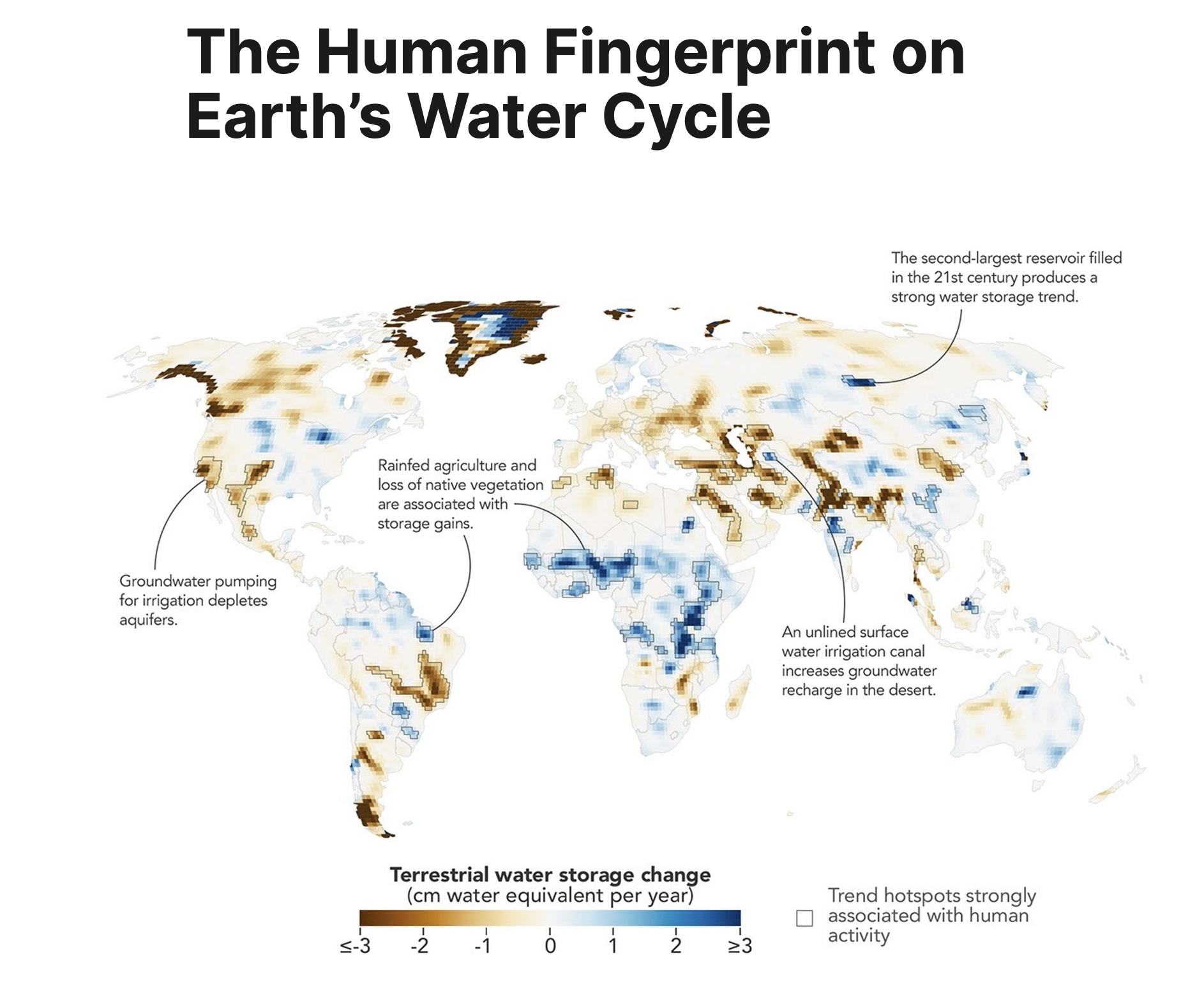
Here are some highlights from the article, which acknowledges the contribution of particular types of agriculture in sinking water:
"Using more than two decades of satellite measurements of subtle changes in Earth’s gravity, the researchers sharpened the picture of how—and why—terrestrial water storage has changed."
"Beyond the influence of climate variability, the scientists identified 40 regions where the changes also aligned with human activities such as irrigation, reservoir impoundment, and land-use change. These activities were significantly related to terrestrial water storage trends on every nonpolar continent except Australia."
“In four continental regions, an anthropogenic variable showed a stronger relationship with the storage trends than any climate variable did,” said Mary Michael O’Neill, a hydrologist at NASA’s Goddard Space Flight Center and lead author of the study.
"Across several continents, groundwater-irrigated farmland was strongly associated with declines in terrestrial water storage. In North America, these declines appeared in California’s Central Valley, the southern High Plains of the U.S., and Chihuahua, Mexico, where long-term droughts have increased farmers’ reliance on groundwater. Groundwater pumping also drove declines in northern India, where the refined analysis showed a steeper downward trend than previously realized. Consistent with previous findings, retreating Himalayan glaciers accounted for only 15 percent of the decline there."
'Other types of agriculture had a different relationship with water storage trends. In parts of sub-Saharan Africa, for example, some increases occurred where rainfed cropland has expanded. There, swaths of native savanna were replaced by millet cultivation throughout the study period, and water tables rose despite below-average precipitation. A similar pattern emerged in northern Brazil’s Maranhão state, where soybean fields have replaced forests and shrublands. The resulting water storage trend might be explained in part by the efficient water use of cereal and legume plants and by Indigenous practices that help direct water into shallow aquifers, the researchers said.'
Sometimes little steps forward, like the authors noticing the agriculture methods here that impact water shed in opposite ways, feel like a happy high five to all of us who are all in on permaculture and regen-ag. Just sayin'...











 11