

• Post Reply Bookmark Topic Watch Topic
  • New Topic
permaculture forums growies critters building homesteading energy monies kitchen purity ungarbage community wilderness fiber arts art permaculture artisans regional education skip experiences global resources cider press projects digital market permies.com pie forums private forums all forums
this forum made possible by our volunteer staff, including ...
master stewards:
  • Carla Burke
  • Anne Miller
  • Nancy Reading
  • John F Dean
  • r ransom
  • paul wheaton
  • Timothy Norton
stewards:
  • Jay Angler
  • Pearl Sutton
  • AndrĂ©s Bernal
master gardeners:
  • Christopher Weeks
gardeners:
  • M Ljin
  • Thekla McDaniels
  • May Lotito

Natural Timber Log Erosion Barriers

 
Steward of piddlers
Posts: 8579
Location: Upstate New York, Zone 5b, 43 inch Avg. Rainfall
5241
monies home care dog fungi trees chicken food preservation cooking building composting homestead
  • Likes 10
  • Mark post as helpful
  • send pies
    Number of slices to send:
    Optional 'thank-you' note:
  • Quote
  • Report post to moderator
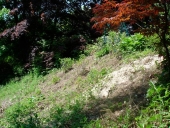
I've spent the last few years tending an eroding slope and have made good progress in 'restoring' the dirt into soil. The most significant technique I have employed is utilizing logs as tools to slow erosion. By laying timbers across a slope, on contour, the logs slow water and capture eroded fines while allowing plants a chance to stabilize the slope.

Log Erosion Barrier

I was first introduced to the idea through learning more about Log Erosion Barriers (LEBs) which are utilized on land damaged by wildfire. Shallow trenches are dug and fallen logs are placed in the trenches to become a barrier to runoff.  These are arranged in a particular way to not hold back large amounts of water/soil but rather intercept the flow to reduce erosion.

Where I differ is that I'm combining a mixture of trunk-section logs and smaller branches to create a semi-permeable 'net' to catch materials as they are going down the slope. The logs are not meant to function as a retaining wall but rather a biodegradable framework where organic material can collect behind it and eventually all be returned to soil material with, hopefully, a more gentle slope behind it. To expedite the process, anything organic can be thrown behind the logs to further hold things together. Twigs, leaves, old animal bedding, chipped wood, cold compost, brush and more can be placed.

My intention is for this process to be a temporary step towards a permanent solution. By building up the soil organic material on the hillside, it is my plan to start planting perennials/shrubs to root those areas in place. When the logs have rotted away and are no longer collecting soil organic matter, hopefully there will be beautiful productive shrubs holding the line.

Have you done something similar? How much slope is too much slope?
 
Timothy Norton
Steward of piddlers
Posts: 8579
Location: Upstate New York, Zone 5b, 43 inch Avg. Rainfall
5241
monies home care dog fungi trees chicken food preservation cooking building composting homestead
  • Likes 7
  • Mark post as helpful
  • send pies
    Number of slices to send:
    Optional 'thank-you' note:
  • Quote
  • Report post to moderator


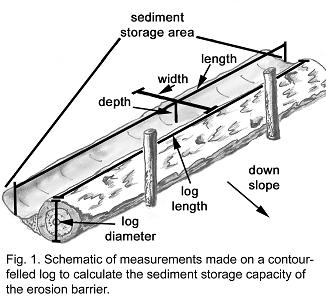
An example image of a log erosion barrier from the USDA Forest Service. This figure shows a log, pinned with stakes, with a shallow swale behind it with packed dirt against the log itself. This would be placed on contour and allowed to capture/intercept organic matter. The swale is intended to primarily capture sediment. Studies have shown that while these log barriers retention abilities may be overcome by large storms, they do well with 'regular' rain events over seasons.
 
Timothy Norton
Steward of piddlers
Posts: 8579
Location: Upstate New York, Zone 5b, 43 inch Avg. Rainfall
5241
monies home care dog fungi trees chicken food preservation cooking building composting homestead
  • Likes 8
  • Mark post as helpful
  • send pies
    Number of slices to send:
    Optional 'thank-you' note:
  • Quote
  • Report post to moderator
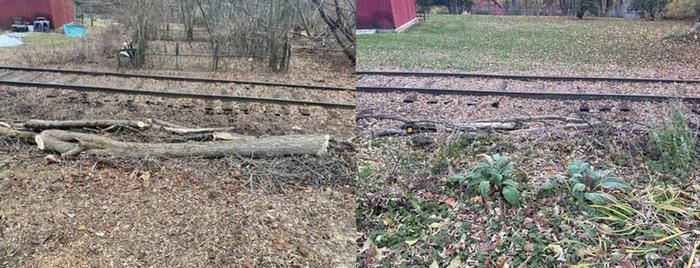
Before/After 4 Year Period of Log Erosion Barrier


This is a before and after over a period of around four years. The log is still pretty stout and hasn't slid down the hillside at all even with all of the organic material I have uphill of it. You can see the Russian comfrey I planted to assist in soil stabalization.
 
author & steward
Posts: 7615
Location: Cache Valley, zone 4b, Irrigated, 9" rain in badlands.
3918
  • Likes 18
  • Mark post as helpful
  • send pies
    Number of slices to send:
    Optional 'thank-you' note:
  • Quote
  • Report post to moderator
I do something similar, but with less labor. When in the forest, if I see a fallen tree facing downslope, I turn it to lie on contour. No stakes. No stabilization. I do that on both sidehills and in ravines. Those single layer checkdams work wonders out here in the desert.
 
pollinator
Posts: 596
Location: UK
197
kids urban seed
  • Likes 10
  • Mark post as helpful
  • send pies
    Number of slices to send:
    Optional 'thank-you' note:
  • Quote
  • Report post to moderator
Nice to see an actual four year before and after, that comfrey looks like it's doing a lot of the heavy lifting now. Does the log rot out eventually and get replaced by the plant roots, or do you keep topping up with fresh timber every few years?
 
Timothy Norton
Steward of piddlers
Posts: 8579
Location: Upstate New York, Zone 5b, 43 inch Avg. Rainfall
5241
monies home care dog fungi trees chicken food preservation cooking building composting homestead
  • Likes 5
  • Mark post as helpful
  • send pies
    Number of slices to send:
    Optional 'thank-you' note:
  • Quote
  • Report post to moderator

Joao Winckler wrote:Nice to see an actual four year before and after, that comfrey looks like it's doing a lot of the heavy lifting now. Does the log rot out eventually and get replaced by the plant roots, or do you keep topping up with fresh timber every few years?


My intentions are to primarily
A. Stabilize the bank from excess erosion
B. Reduce the degree of slope.

Once the logs rot out, I may need to place another log further down the slope as a second phase of restoration but hopefully I can just leave the built up soil as-is. Maybe put a layer of mulch on top of it while more plants take root?

I'm still in the observe and act stage even with this being a multi-year project.
 
pollinator
Posts: 6374
Location: Bendigo , Australia
614
plumbing earthworks bee building homestead greening the desert
  • Likes 6
  • Mark post as helpful
  • send pies
    Number of slices to send:
    Optional 'thank-you' note:
  • Quote
  • Report post to moderator
The Africans use rocks across the contour for the same purpose.
What are the characteristics of Russian comfrey, it looks sparse to me?
 
Timothy Norton
Steward of piddlers
Posts: 8579
Location: Upstate New York, Zone 5b, 43 inch Avg. Rainfall
5241
monies home care dog fungi trees chicken food preservation cooking building composting homestead
  • Likes 6
  • Mark post as helpful
  • send pies
    Number of slices to send:
    Optional 'thank-you' note:
  • Quote
  • Report post to moderator
The comfrey is being abused where I have planted it but seems to be holding its own.

Russian comfrey is known for its deep, fleshy roots. If you break off part of the root, it tends to regrow a new plant. I'm fine with this property of the plant due to the location of where they are planted. I just want stability at this time.

Unfortunate for these particular plants, the nearby Box Elder trees are known for their spreading shallow roots which cramp the comfrey a bit. This, paired with the rocky poor soil on the hillside make it a challenge for plants to establish. If that wasn't tough enough, it also is located in a shaded spot for the afternoon/evenings!

It is a challenging spot, but progress is being made.
 
Water! People swim in water! Even tiny ads swim in water:
Permaculture Voices 1, 2 and 3 - all 117 hours of video!
https://permies.com/t/voices123
reply
    Bookmark Topic Watch Topic
  • New Topic