I am not sure where this fits, so if someone want to cross post this - please do.
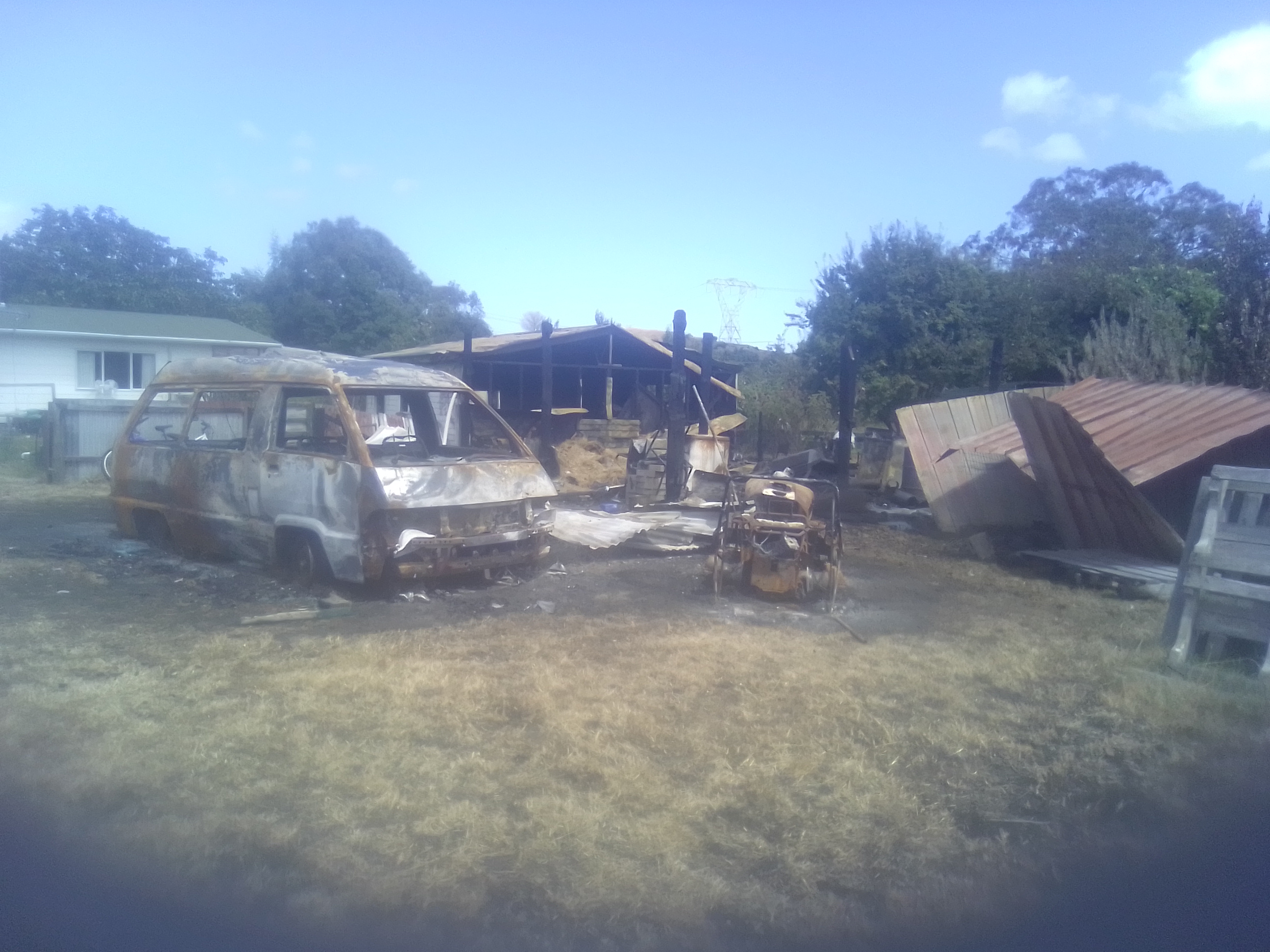
In the dry summer of the southern hemisphere I drove my rideon out of the shed to access a trailer, went to get something, and came back to this fire in the process. It started in the rideon engine (moral of the story - when you use a ride-on, lift the engine lid to help it cool, and brush out any grass).
There has been burnt to the ground two vehicles and a few extra tyres, two each 1000L IBC and 220L drums and a lot of household appliances and personal effects with plastic.
Our sand trap bore for land and animals is 1-2 metres down and about 4 metres from the garage. (we use rainwater in the house, and have disconnected this from the house roof till after demolition, and cleaned the tank and trucked in a load of water) Our house is about 10m away.
I know that burning plastics give off dangerous gas, but what about soil residue?
The first thing I think I should do after demolition is to cover the area with woodchip, or gravel or an above ground concrete natural pool (when they demolish the garage I have a 6x6m cement slab already that could be the base) to stop the soil toxins being air born.
But would it be safe it eat plants that have grown though woodchip into this?
If I did test the sand trap water, what should I be testing for?
IMG_20210212_124704.jpg
Why you always lift the engine lid on your ride-on after use!
Terribly sorry to hear of your fire and the loss of some of your personal items.
My offhand opinion is that for generally burning plastic and rubber if it did affect the soil, it would most likely be only the very top layer, unless the fire unintentionally released something else, such as an oil container. I would look for any signs of something soaking in and try to dig out and remove that soil. Around me with clay it would not have soaked in far, If you have sand it may be more of a challenge.
If it worries you, consider scraping off the top inch or so of soil. From there, you could look for discolorations which might indicate something soaking in deeper.
Many on here suggest encouraging fungal growth as a form of bio remediation.
My guess is similar to those already listed: I would think that a single burn would minimally affect the soil. I imagine that most of the icky stuff burned and went up as smoke. I further guess that any remainder is likely hydrophobic and lighter than water so it likely has already moved from that spot (though this is a guess and I could be wrong).
If you are still concerned then I would consider getting your soil tested.
Eric
Some places need to be wild
That's a very big dog. I think I want to go home now and hug this tiny ad:
A rocket mass heater heats your home with one tenth the wood of a conventional wood stove



 1
1