• Post Reply Bookmark Topic Watch Topic
  • New Topic
permaculture forums growies critters building homesteading energy monies kitchen purity ungarbage community wilderness fiber arts art permaculture artisans regional education skip experiences global resources cider press projects digital market permies.com pie forums private forums all forums
this forum made possible by our volunteer staff, including ...
master stewards:
  • Carla Burke
  • John F Dean
  • r ransom
  • Nancy Reading
  • Timothy Norton
  • Jay Angler
stewards:
  • paul wheaton
  • Pearl Sutton
  • Eric Hanson
master gardeners:
  • Christopher Weeks
  • M Ljin
gardeners:
  • thomas rubino
  • Megan Palmer
  • Benjamin Dinkel

Need some tips and help designing growing spaces

 
Posts: 21
1
  • Likes 7
  • Mark post as helpful
  • send pies
    Number of slices to send:
    Optional 'thank-you' note:
  • Quote
  • Report post to moderator
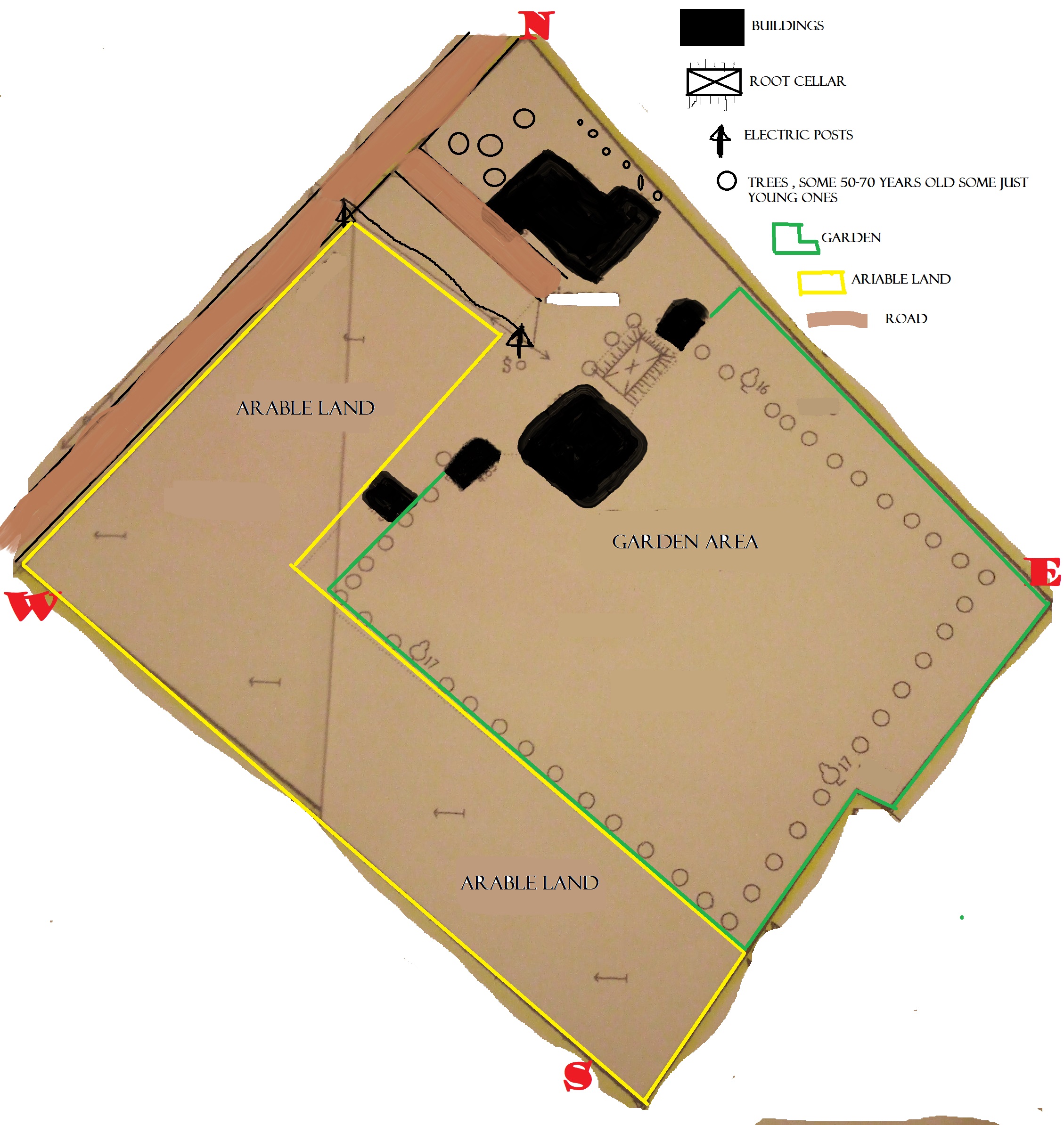
Hello been reading and watching quite a bit about permaculture and smart gardening . But cant crack it quite yet , especially how can i design and apply it in my run down property , that's were i need some helping hands and minds .

Info about the land :
Temperate climate zone (got all 4 seasons)
Flat lands
All around my land is arable land of mono-culture crops of other farmers
Attaching the drawing of the land and the topographical (hope its readable )
The whole piece of land is around 2.4 acres

Asking for help on some kind of general idea/blueprint where should i put zones and what to grow in them (this year thinking of planting some fruit trees(apple,pear,etc.) and berry bushes(blackcurrant, groundcherry,etc.) and perennials , should i use raised beds , hugelkultur , swales or so in my place and were to put them exactly , I'm still kinda cant understand what exactly swales are used for , how to create that symbiosis between plants .
For next year I'm hoping to start planting vegetables.

At the moment saving carton boxes and straws for preparing places for next years planting.
IMG_20221023_031348274k.jpg
permaculture-design
mapas222.jpg
topograghic-map-permaculture-design
 
gardener
Posts: 533
Location: WV
177
kids cat foraging food preservation medical herbs seed
  • Likes 7
  • Mark post as helpful
  • send pies
    Number of slices to send:
    Optional 'thank-you' note:
  • Quote
  • Report post to moderator
I'm still learning about permaculture, so I'm definitely not an expert (and please correct me if I'm wrong on any of the following).  I do believe that zones are based on the areas of your yard/farm which you visit the most often.  Zone 1 consists of the area/areas you visit daily and zone 5 is the untouched areas of your property.  While the zone 1 area usually consists of the area around your house and gardens that you may tend to daily, a chicken house will likely be a bit farther from the dwelling,  yet still be considered as a zone 1 area because you visit it every day and it could possibly border a zone 4 or 5 area.  

I think the first step would be to look at the plan you currently have and take time to walk your property and determine which areas you foresee visiting the most and possibly adjust your plan to reflect that.  Take note of the shady areas and try to map the angle of the sun in your garden area to determine the best planting areas.   I know you stated that some of the trees are pretty old but not sure if they're confined to one area or scattered around the perimeter of the garden area.  

Also I'm assuming that the area gently slopes away from the dwelling or is it the other way around?  I couldn't read the topo markings that were visible and again I'm a novice there too.  

I'm sure that someone will be able to further help you on your permaculture journey once provided with your growing zone and a list of goals for your property.

I've been trying to incorporate permaculture principles into my property for ten years or so and it's quite a commitment to do it a bit at a time on a non-existent budget.  If you have the resources to transform your property within a year, that's great!  If not, just do as much as you can with the budget you have and just keep working at it.  As my priorities have changed,  my zones have also changed.

 
steward
Posts: 18289
Location: USDA Zone 8a
4638
dog hunting food preservation cooking bee greening the desert
  • Likes 6
  • Mark post as helpful
  • send pies
    Number of slices to send:
    Optional 'thank-you' note:
  • Quote
  • Report post to moderator

Lorads said, "Asking for help on some kind of general idea/blueprint where should i put zones and what to grow in them (this year thinking of planting some fruit trees(apple,pear,etc.) and berry bushes(blackcurrant, groundcherry,etc.) and perennials , should i use raised beds , hugelkultur , swales or so in my place and were to put them exactly


The information that Michelle has given you about Zones is correct.

To me, Zone 1 is the area right outside your home where you spend most of your time outside.  You might have a kitchen garden there.

Zone 2 is the area in your yard that you visit on a daily basis.  This is where most of your gardens might be

Zone 3 is the area that you or your family visit only a few days a week. This is the area for your orchands.

Zone 4 as that is where you might have pastures.

Zone 5 Truly wild areas


Permaculture Zones


Lordas said, " I'm still kinda cant understand what exactly swales are used for , how to create that symbiosis between plants .


To me, swales are used to collect water.

We make mini-swales around fruit trees to help provide more water to the trees.  these mini-swales are just rings of dirt around the trees.
 
pollinator
Posts: 1589
Location: NW California, 1500-1800ft,
489
2
hugelkultur dog forest garden solar wood heat homestead
  • Likes 7
  • Mark post as helpful
  • send pies
    Number of slices to send:
    Optional 'thank-you' note:
  • Quote
  • Report post to moderator
The first permaculture design book I recommend to folks on 5acres or less is Gaia’s Garden by Toby Hemenway.

https://www.chelseagreen.com/product/gaias-garden/

Everything I would say is better articulated and illustrated in that brilliant and beautiful book.

I would also add to Anne’s point that swales catch sediment and thus fertility as well as water, because it drops out of suspension and is filtered into the soil when the water is at rest and seeping into the swale. In this way swales can also help clean/filter waterways downstream to help fish etc.

To me, the greatest challenge and rewards from permaculture come from connecting the landscape as an ecosystem, and facilitating connections so anywhere “excess/waste” is produced by one element/organism, it goes to support, shelter, or feed another.
 
Anne Miller
steward
Posts: 18289
Location: USDA Zone 8a
4638
dog hunting food preservation cooking bee greening the desert
  • Likes 4
  • Mark post as helpful
  • send pies
    Number of slices to send:
    Optional 'thank-you' note:
  • Quote
  • Report post to moderator
Another suggestion to add to the other comments if you can get wood chips, they are wonderful for helping the soil.

Grass in the summer makes the green part of a compost pile and leaves in the winter make the brown part of the compost pile.

A compost pile needs a mix of both green and brown if possible.
 
Lordas Zame
Posts: 21
1
  • Likes 4
  • Mark post as helpful
  • send pies
    Number of slices to send:
    Optional 'thank-you' note:
  • Quote
  • Report post to moderator

Anne Miller wrote:

Lorads said, "Asking for help on some kind of general idea/blueprint where should i put zones and what to grow in them (this year thinking of planting some fruit trees(apple,pear,etc.) and berry bushes(blackcurrant, groundcherry,etc.) and perennials , should i use raised beds , hugelkultur , swales or so in my place and were to put them exactly


The information that Michelle has given you about Zones is correct.

To me, Zone 1 is the area right outside your home where you spend most of your time outside.  You might have a kitchen garden there.

Zone 2 is the area in your yard that you visit on a daily basis.  This is where most of your gardens might be

Zone 3 is the area that you or your family visit only a few days a week. This is the area for your orchands.

Zone 4 as that is where you might have pastures.

Zone 5 Truly wild areas


Permaculture Zones


Lordas said, " I'm still kinda cant understand what exactly swales are used for , how to create that symbiosis between plants .


To me, swales are used to collect water.

We make mini-swales around fruit trees to help provide more water to the trees.  these mini-swales are just rings of dirt around the trees.


So as i understand zones are not something were to plant what/what plants have best symbiosis , but just based on the ease and frequency of movement  by the "farmer"
And if there is no problem with getting water onto a property , so there is not much need for swales ?

Been reading around and thinking maybe i should plan my place on the idea of sun trap , seems like its a good option for my climate
Permaculture-2-en-un-seul-volume-Bill-Mollison-62_1.jpg
sun-trap-Permaculture-Bill-Mollison]
 
Posts: 25
Location: Cévennes, South of France, an hour and a half north of Montpellier, zone 9a
4
forest garden trees books
  • Likes 6
  • Mark post as helpful
  • send pies
    Number of slices to send:
    Optional 'thank-you' note:
  • Quote
  • Report post to moderator
As far as I understand swales are used in areas where there is a slope. Then the water is invited to go in the earth rather than run over the surface and cause erosion. I have swales and I am on a slope. Erosion is a real issue here as the earth is very sandy.

In permaculture they say that it is good to observe your land at least during a year and then make plans for it. So you can adjust your plans to the qualities pf the land. IF not you are fighting against nature all the time. Rather you would like to work with nature. As you already have trees, that can give you an idea what trees would do well on your land. If you have flat land, I guess the direction from where the sun comes is less of an issues. All though, if you plant trees you have to think about that they are not going to create shade in an area where you might want to plant other plants or bushes that need sun.
They also say it is good to talk to your neighbours to see what grows well in your area. Have you been long on this land?
You have to look what kind of soil you have, clay or sandy or loam, or a mix. You can do a test by putting some soil in a jar with water and then shake it up. After letting the jar sit for a day or 2, you see the layers of different soil part. The organic matter floats on top.
It is very interesting! You can find more about this on internet, I presume, if you google 'soil test'.
Buying a book is a great idea, but you can also find a lot of free resources on the internet. There even exist free permaculture courses online. There used to be one in the Netherlands.
If your soil is good, you do not need to do raised beds. If the soil is poor, you can do raised beds so you do not have to improve all of the soil. Also are there any animals or pests in your area? We have wild boar. Before even thinking of a garden , we have ot make a fence against the wild boar. And even then..., they get in when they really want to.
Good luck and a lot of fun serving your land!
 
pollinator
Posts: 3829
Location: Massachusetts, Zone:6/7 AHS:4 GDD:3000 Rainfall:48in even Soil:SandyLoam pH6 Flat
559
2
forest garden solar
  • Likes 5
  • Mark post as helpful
  • send pies
    Number of slices to send:
    Optional 'thank-you' note:
  • Quote
  • Report post to moderator
Can you make a list of what you would like to grow/produce on your 2.4 acres? For me it might look something like this.

Kitchen Garden (Herbs, leafy greens, mushrooms)
Chicken coop, Milk Goat Area, 1/2 acre fish pond (15 Bass, 50 Bluegill, 15 Catfish)
Garden Area (Root Crop, beans, etc)
Orchard Area: Figs/Mulberry, Seaberry/Goumi, Elderberry, Jujube, Blueberry, hardy Kiwi, Grapes, Cherry/Peach/etc, Apple/Quince/Pear/etc, Raspberry/blackberry/etc, Hazelnut, Pistachio, Almond

Mushroom Area, BeeHive, Firewood, etc  
 
Weeds: because mother nature refuses to be your personal bitch. But this tiny ad is willing:
🤲🤲🌼🌿🌴 Hi,I’d love to invite you to share your post or comments ,links to your work. In our small, community SomeGardens.com
https://permies.com/t/13926/answer-hour-rule
reply
    Bookmark Topic Watch Topic
  • New Topic