posted 10 months ago
This year was a good foraging season for acorns here in Michigan. I will traditionally fill three baskets to get the quantity that I will need for two years. I collect double what I need for a year, because not all years are what they refer to as mast years. Mast is the term that refers to the different species of trees that produce nuts in the forest.
If you look at the first two photos you will see one of the tricks I employ. I have learned to hunt forest trails or beach edges. You can go into the forest and dig around in the leaves and forest floor vegetation, but it is so much easier to locate them on a trail where they are very fast to pickup. I will walk until I find a tree that has large nuts. This is important because every time you handle a large nut you are saving time. You are handling them as you gather, and crack them open. If you find large nuts the work is much more efficient in the long run.
As you read foraging books you will find authors that will tell you to avoid red oak acorns and look for the white oak instead. Their reasoning is based upon the amount of tannins that are found in the nuts. This tannin has to be removed or the nut meats will be bitter. Removing the tannin is very easy and not labor intensive. The most labor Intensive part of nut harvesting is cracking them open. This is why I favor the red oak acorns.
After I gather my nuts I will bring them into my seedling greenhouse and spread them in an area on the floor to dry. The meat inside the shell will begin to shrink. With the red oak species this shrinking is significant enough that when you go to crack them open to remove the meats, you will find them very easy to remove. With white oak acorns they don’t shrink as much, and the shells will often remain attached to the meats and create a very difficult job to remove them. Once you see how easy it is to remove the tannins you will see why this is so important.
I have to chuckle a little bit at many people today that are so far removed from their food production and processing that the thought of going through this process is some huge undertaking. Their ancestors would be speechless if they saw their reaction. Acorns have been a staple calorie source for many civilizations here in America and in Europe. They are very nutritious and good for you. A vast quantity of free food for the taking. In fact one of the things I like the most is that I can do most of the work in the winter months when I have more time on my hands.
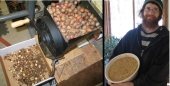
Once the nuts have dried in the shells some. I will bring them in my home and sit and crack them. This is an easy job and can be done while you talk with someone or as you watch a favorite movie. I have a board that I place on my lap. Then I place the acorn with the point down on the board and hit it gently with a small hammer. The shell cracks very easily. The point of the nut will make an indentation in the board that you can continue to place your nuts in as you crack them. After the meats have been separated from the shells, I will place them on an old window screen to dry in the warm dry heat that radiates from the wood stove. After they are dry and hard, you can take them and put them in a coffee grinder. At this point though it would be best if the pieces are not too fine like flour. Small chunks are better as you remove the tannins so the flour doesn’t pour off with the water. If you own some kind of food processor that could cut the acorns into small pieces while they are still a little moist after cracking, you could skip this extra drying process. I don't mind taking the time to dry them because it gives me flexibility in regards to dealing with them later.
Now I take the small bits and place them in a large stainless steal pot. Then I take cool water from my well and just fill the pot until there is an inch or so of water covering above them. I will stir this good a few time while it sits for a full day. The next day I will pour off this liquid and pour in more fresh water to repeat the same process. You continue to do changes of water until the liquid you pour off is relatively clear and the nut pieces are no longer bitter. This part of the process is not labor Intensive, it is more a waiting game. In the past my son and I have tanned hides using these changes of water. They make a beautiful brown leather.
I do not boil the nutmeats. I feel that it changes the quality of the oils present. Most of the people I have met that have been negative about their flavor have all processed them by boiling. If they are soaked in changes of cool water, the flavor is very mild and agreeable. For those that are skeptical try doing both.
Now I take the pieces and spread them out on an old sheet placed on my drying screen, and dry them thoroughly. After they are dry I will put them in a blender and turn them into a fine flour. I don’t think it would be wise to run them through a grain grinder. They have important oil in them that will probably gum up the plates or stone. You could definitely use the nutmeat pieces right away without drying them again. I dry them because of my favorite way to use them.
I use this flour in a favorite drink. I will use a tablespoon each of acorn, cocoa, and maple syrup in a quart of milk. YUM! Some of my online students have had this when they have visited our homestead. I have children that have been here and whenever I see them they immediately comment on how good the hot cocoa was. That makes me feel really good knowing there are people that have a very positive attitude about such a vastly neglected food source.
I hope some of you will try this and see how fun and rewarding foraging free food can be.
9928CC5F-64D1-41D7-8714-BE8867B26DC0.jpeg
![[Thumbnail for 9928CC5F-64D1-41D7-8714-BE8867B26DC0.jpeg]](/t/362965/a/278040/thumb-9928CC5F-64D1-41D7-8714-BE8867B26DC0.jpeg "Filename: 9928CC5F-64D1-41D7-8714-BE8867B26DC0.jpeg
Description:")
23039AB2-67D3-48DD-B3BC-71D1F7C76005.jpeg
![[Thumbnail for 23039AB2-67D3-48DD-B3BC-71D1F7C76005.jpeg]](/t/362965/a/278041/thumb-23039AB2-67D3-48DD-B3BC-71D1F7C76005.jpeg "Filename: 23039AB2-67D3-48DD-B3BC-71D1F7C76005.jpeg
Description:")
BFF4213B-E129-4A11-9113-0FDB2B2D3972.jpeg
![[Thumbnail for BFF4213B-E129-4A11-9113-0FDB2B2D3972.jpeg]](/t/362965/a/278042/thumb-BFF4213B-E129-4A11-9113-0FDB2B2D3972.jpeg "Filename: BFF4213B-E129-4A11-9113-0FDB2B2D3972.jpeg
Description:")

-B.png)






 14
14


![[Thumbnail for 9928CC5F-64D1-41D7-8714-BE8867B26DC0.jpeg]](/t/362965/a/278040/9928CC5F-64D1-41D7-8714-BE8867B26DC0.jpeg "Filename: 9928CC5F-64D1-41D7-8714-BE8867B26DC0.jpeg
Description:")
![[Thumbnail for 23039AB2-67D3-48DD-B3BC-71D1F7C76005.jpeg]](/t/362965/a/278041/23039AB2-67D3-48DD-B3BC-71D1F7C76005.jpeg "Filename: 23039AB2-67D3-48DD-B3BC-71D1F7C76005.jpeg
Description:")
![[Thumbnail for BFF4213B-E129-4A11-9113-0FDB2B2D3972.jpeg]](/t/362965/a/278042/BFF4213B-E129-4A11-9113-0FDB2B2D3972.jpeg "Filename: BFF4213B-E129-4A11-9113-0FDB2B2D3972.jpeg
Description:")


![[Thumbnail for 072E0953-639D-4DF9-90CA-1446DA0A5934.jpeg]](/t/362965/a/278052/072E0953-639D-4DF9-90CA-1446DA0A5934.jpeg "Filename: 072E0953-639D-4DF9-90CA-1446DA0A5934.jpeg
Description:")