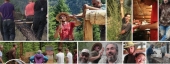
I want to share my experience of moving to the amazon jungle to live a simple, healthy life in the ecovillage called Terra Frutis, located in the beautiful rainforest of South Ecuador.
Why did I come here?
There where many reasons that motivated me to leave Germany to start a new life here. Here are some of the most important ones:
I wanted to live a simple and healthy life in beautiful nature
I was visiting this place a year ago and fell in love with the jungle
I wanted to escape wage slavery in Germany
I wanted to live in a sustainable way
Ways of living
There are different possibilities of how you can live here. I am curently voluntering. Which means, that I work for 20 hours per week and therefore I get a cozy cabin to sleep in, unlimited bananas and a portion of all the other fruits that we harvest here.
If you don't want to participate in the voluntering work, you can also rent a room a cabin or a big house. Renting a room costs 200$ a month.
There is also the possibility to buy a piece of land here and live like a neighbour. The land is much cheaper then in most countries. I believe 5000$ for 1 hectar is realistic. You can also hire local workers to buid you a decent cabin for 2000 – 5000$. (If you want electricity in your cabin, then it will be more expensive).
One other exiting and much cheaper option is to just go find a nice spot in the wild jungle (outside of the TF property) and just start building a shelter there. That is what I have been doing lately. No one cares if you don't actually „own“ the land if you are in the wild jungle. That way you can have your own shelter and be independet to some degree and at the same time be part of the community.
Cost of living
200$ per month is realistic. The only expenses that I have here are for buying food at the local market on Saturdays and the 25$ monthly utility fee. Most people here have some kind of part time online job like teaching english, swedish, python or mathematics in order to finance their life here.
Work
Monday through Friday we meet at 7am at the Community Center and usually go to a field where we have planted a lot of fruit trees. The area here is very big and there are hundreds of fruittrees. The most common task it to take a machete and clear the area around a fruittree so that it can grow better. It is not necessary to go to the gym when you are doing this kind of work. It is a good workout and a great way to start the day. Other tasks include harvesting, mapping the area and the trees and working in the plant nursery (watering and planting seeds). Besides that there are is other kinds of work that you can do if you are not working on the land: cleaning the kitchen area, taking care of compost buckets, preparing cugarcane juice (very delicious), drying bananas, preparing sacha inchi nuts, construction work, creating social media content and others. We work for 4 hours, until 11am and then the rest of the day is free. You have a lot of free time when living here. I usually like to work more because of that, doing things like creating and uploading videos for Instagram, where I document the daily life here.
People
There are around 9 long term residents here, several people that live nearby as neighbours and a few volunteers who come and go every now and then. The people are really chill here, they come from different countries like England, Sweden and USA and are mostly in their 30s.
My impressions
I can not possibly describe with words how beautiful the nature, the sounds and insects and how delicious some of the tropical fruits here are. Sometimes we harvest a fruit that I have never seen and tasted before and it just blows me away. It is like a new world of tastes that I can explore here. I love the sounds of the jungle as well. When I lived in Germany, I had a problem with tinitus, but here I do not have it at all, because the jungle sounds are always present. I feel healthier, stronger and happier since moving here.
Some important information about the Ecoviallge (from their website):
( Mission
Our mission is to be a vegan intentional community, taking inspiration from agroforestry, permaculture and syntropic agriculture to produce abundant and diverse food for a healthy, high raw vegan diet, in an environment where animals and humans thrive together. We hope to be an inspiration and to share our knowledge and methods.
We practise sustainability, non-violent communication and consensus based decision-making, and seek self reliance.
Our land
The Terra Frutis project is located in south-eastern Ecuador, 18 km from Gualaquiza, on 136 hectares (330+ acres) of land which slopes upward towards a mountainous western border, with the eastern border being the Zamora river and then two smaller streams along the north and south as general locations for the other respective borders. The elevation is 720 meters at the river. The majority of the land is between 730-900 meters, and the top of the mountain is about 1200 meters.
Most of the food forest project is located on land used until some years ago as a cow pasture (in other words: grass). Right now there are about 40 hectares of open pasture land that we are systematically clearing and re-planting with food forest pioneers. This land can/will be re-forested with trees, shrubs, vines, and herbs that provide food in a sustainable way, using agroforestry practices that work with and encourage local wildlife species. There are also bamboo forest sections, which can provide supplemental material for numerous residences and utility buildings.
Access
The land is reachable by pick-up truck via a gravel road. To get to/from the town of Gualaquiza involves a 40 minute taxi ride, or a 40 minute walk to a nearby village and then a 20 minute bus ride.
Accommodation and Facilities
We usually have plentiful rooms and/or private structures available for you to sleep in. You are also welcome to set up a tent, hammock, or other temporary accommodation. We charge 25$ per month for utilities (electricity, internet, kitchen...). We have: hot showers, hot water, a washing machine, a clothes dryer, blenders, dehydrators, a juicer, a cooking stove, a freezer, a fridge, internet, a hot tub. We also have a community center building for recreational activities or just hanging out.
Food from the land
We usually have more than enough bananas (several cultivars) all year round.
Often we have papaya, plantains, jackfruit, canistel, rough lemons, naranjilla, hot peppers, and noni. Seasonally you may enjoy biriba/rollinia, peach-palm, abiu, guava, iñaco, peanut butter fruit, mandarins, starfruit, marang, ice cream bean, apai, and cacao. Sometimes soursop, pineapple, limes, miracle berry, cucumber, cherry tomato, squash, jaboticaba, breadfruit, and matoa.
We are constantly planting and have planted hundreds of fruit-bearing plants throughout the property including: durian, mangosteen, mamey sapote, canistel, breadfruit, white sapote, custard apple, blackberry jam fruit, matoa, tangelo, pomelo, avocado and more.
Beside fruits, we have a fairly good amount of katuk and turmeric, sugarcane, a little bit of taro and some cassava. Sometimes: tropical lettuce, sweet potato, ginger, corn, and nuts.
It is currently not possible to get a healthy diet 100% off the land. So you’ll need to buy food. We either order food together to be delivered, or take a trip into town on market day.
Climate
Temperature is fairly steady throughout the year. The warmest month of the year is November with an average temperature of 23.8°C (73.84°F). The coolest month is July, when the average temperature is 22.1°C (71.78°F). Overnight lows tend to range from 16°C to 20°C. We have rarely seen as low as 13°C. )
You can visit our website if you are interested to learn more
https://www.terrafrutis.com/, and check out some photos on our Instagram or videos on our YouTube channel.







 7
7


![[Thumbnail for TF-main-picture.jpeg]](/t/365569/a/279773/TF-main-picture.jpeg "Filename: TF-main-picture.jpeg
Description:")
![[Thumbnail for bungalow31.jpg]](/t/365569/a/279774/bungalow31.jpg "Filename: bungalow31.jpg
Description:")
![[Thumbnail for birdseyeview.png]](/t/365569/a/279775/birdseyeview.png "Filename: birdseyeview.png
Description:")
![[Thumbnail for kitchen.jpg]](/t/365569/a/279776/kitchen.jpg "Filename: kitchen.jpg
Description:")
![[Thumbnail for Yogaroom.jpg]](/t/365569/a/279777/Yogaroom.jpg "Filename: Yogaroom.jpg
Description:")