• Post Reply Bookmark Topic Watch Topic
  • New Topic
permaculture forums growies critters building homesteading energy monies kitchen purity ungarbage community wilderness fiber arts art permaculture artisans regional education skip experiences global resources cider press projects digital market permies.com pie forums private forums all forums
this forum made possible by our volunteer staff, including ...
master stewards:
  • Carla Burke
  • Nancy Reading
  • John F Dean
  • r ransom
  • Jay Angler
  • Timothy Norton
stewards:
  • paul wheaton
  • Pearl Sutton
  • Tereza Okava
master gardeners:
  • Christopher Weeks
  • M Ljin
gardeners:
  • thomas rubino
  • Jeremy VanGelder
  • Megan Palmer

Repairing an acoustic guitar that sinks in at the bridge (saddle)

 
steward & author
Posts: 45826
Location: Left Coast Canada
18338
10
art trees books chicken cooking fiber arts
  • Likes 6
  • Mark post as helpful
  • send pies
    Number of slices to send:
    Optional 'thank-you' note:
  • Quote
  • Report post to moderator
This is more a thought experiment than project I plan to take on. But in learning how to play guitar, I got interested in learning about other aspects like minor luthiery.  So I took note of a few of the more affordable instruments I saw at the second hand shop the other day, and their major problems.  From there, looking up to see if it's a simple repair.

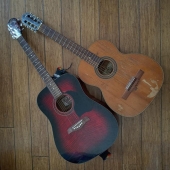
The guitar for this thought experiment is a circa 1980 Bently (note the lack of a second e), made in korea.  Spruce top, mahogany back and sides (the top was wood wood, and the grain matched inside and out on the back, from little i can find, plywood wasn't used for this one), it's a steel string, parlor size and shape, acoustic made for import to the usa.  The strings attach to a tail piece and the saddle is on a floating bridge - like how a violin works without glue to hols the bridge in place. The bridge even has screws for adjusting the height of the saddle.  Intonation is hugely customizable.

The guitar has had a lot of play time in it.  Parts of the fretboard have holes worn in, and the frets would need replacing if it was to be a daily player.  The pick guard is lifting at the corrner and there is a poor repair where the side of the body got bashed in.

And yet, with a low action in the early frets (near the head), there is no buzz. The set up is fine and it's easy to play for a steel string.  A lot of love and time have beem given to this guitar.  The sound is more pleasant than many of the new, expencive guitars.  It's comfortable to hold, but that could be because I'm learning on a parlor right now.

The problem:

When there is no strings on the guitar, the top is flat, as it should be.  When the strings are on it and tuned, ths place where the saddle (floating bridge) sinks into the top and the guitar starts to..,I don't know the vocabulary here, if I had to describe it, the guitar tacos.  Like it is folding just slightly head to tail.

The action near the sound hole becomes higher (still within normal for an acoustic and way less than a classical, but significantly more than before it's tuned.  

A quick mirror looking inside shows no loose support brace things.  It's ladder braced.

Take the tension off, everything flattened out as it should.

That's about all I remember from this guitar, but ask questions and maybe we can find more information in my notes.  

Oh, I should note, although there aren't many like this on the market, the current resale value is less than it would cost for a luthier to glance at it.  Professional care wouldn't be worth it.  They were a student grade instrument and weren't supposed to play as nice as this one did.  The value in this instrument is in the pretty sound and comfortable size.


The solution:

The first thing to ask is if this is a problem?   Is it?  It's  not behaving as designed or desired.  But is it adding to the pretty sound?  The action isn't too difficult. The steel strings on the other hand cut my fingers.  

Or is it only going to get worse?

String tension is often cited as the cause of this kind of issue.  Nylon strings have less than half he ppi (pounds per inch) pull of steel strings.  Could thst fix or, at least, stop it getting worse?

Nylon strings have less volume and softer sounds when put on an acoustic guitar.   I imagine this guitar would be for practice not performance.  So would it matter?

I like nylon strings.


The other solution I can think of is to take it apart and improve the bracing somehow.  This could happen if someone wanted to repair the cave-in on the side.  I probably wouldn't have a problem taking it apart...putting it back together is less my skillset?  So this isn't my favourite solution.


I bet there are a lot of other possibilities to repair a sunken top on an acoustic guitar that I missed.  Anyone want to join in the thought experiment?
 
master pollinator
Posts: 2116
Location: Ashhurst New Zealand (Cfb - oceanic temperate)
719
duck forest garden fungi trees chicken cooking solar sheep wood heat woodworking rocket stoves
  • Likes 4
  • Mark post as helpful
  • send pies
    Number of slices to send:
    Optional 'thank-you' note:
  • Quote
  • Report post to moderator
This is almost always a symptom of broken (or insufficient) bracing. If you can get a mirror in there, or a little USB endoscope with a light on it, you can look at the underside of the top in the area of the bridge. Sometimes it's just a matter of regluing a popped brace. If it's broken, then replacement is on the menu. If the top is dished in front of the bridge (or bowed up behind it) and you're certain that the bracing is firmly attached, then they're just not up to the task and replacement is the only long-term fix. You can always try lighter strings that exert less tension, but the tradeoff will be higher action since the bridge sits up more than it should.


This video shows how a luthier does it, using a clear top so you can see what's going on. He's got some cool ninja tricks like the special saw blocks he uses to clean out the old glue, and the steel pieces held on with magnets to keep glue from going where you don't want it.
 
master pollinator
Posts: 5671
Location: Canadian Prairies - Zone 3b
1609
  • Likes 4
  • Mark post as helpful
  • send pies
    Number of slices to send:
    Optional 'thank-you' note:
  • Quote
  • Report post to moderator
Pictures! I want pictures!

(Actually, I want you to beam this instrument over here -- put it in my hands and I can tell you exactly what's going on in 5 minutes. Long distance charges may apply.)

I have cobbled a lot of beater guitars back into playing condition. Nothing fancy, but good enough to pass around the campfire.

And I have found and restored beaters that turned out to be gems in the rough, not beaters at all, waiting for someone to rescue them.

A guitar with a tail piece and a floating bridge is super cool to look at (hanging on a wall) but complicated to restore to playing condition.

First thing:  You say it is a steel string instrument. Is there evidence of a truss rod beneath the neck? Usually there is a cover with screws right above the nut. Though sometimes it is tucked inside the sound hole, on the neck side. Look for a hex nut. If the guitar seems to "cave" under tension, the first culprit is lack of tension on the truss rod -- which is intended to balance out the tension applied by the steel strings.

Oh for Pete's sake, just beam it over, collect. I'll accept the charges.


r ransom
steward & author
Posts: 45826
Location: Left Coast Canada
18338
10
art trees books chicken cooking fiber arts
  • Likes 4
  • Mark post as helpful
  • send pies
    Number of slices to send:
    Optional 'thank-you' note:
  • Quote
  • Report post to moderator

Pictures! I want pictures!


They are on my friends phone, but neither of us can use a phone well enough to get the pictures off.

(Actually, I want you to beam this instrument over here -- put it in my hands and I can tell you exactly what's going on in 5 minutes. Long distance charges may apply.)


That would be lovely.

I found out the other day, i can do that with a spinning wheel.  Saw one during the guitar fact finding mission, someone asked an idle question not expecting a useful answer from a stranger, about it, and 40 min later, I suspect they bought it to make me stop.

Guitars still look identical to me at this stage.  I want to get to the place where I could see a guitar at a glance and tell them apart.  If I could get to your skill level, that would be amazing.

 You say it is a steel string instrument. Is there evidence of a truss rod beneath the neck


It said steel reinforced neck.  No obvious truss rod adjustment hole.  But it's a small guitar.  Some suggests it's a 1/4, but from what I can tell, at the time, it was considered a parlor.

This is the closest I can finds, but the one i saw in person was in...what would you call it?  Dog favourite chew toy state.  
https://reverb.com/item/13218134-bently-4299-1980s

The tail piece is designed for ball end strings.

It had steel strings on it.

I don't know if it's enough to say it's designed for steel strings.  It was my guess.


This was one of three we took pictures and notes of for thought experiments of what would need to happen to fix it?  this mandolin is another one.  I'll keep trying to get the pictures off their phone.
 
Douglas Alpenstock
master pollinator
Posts: 5671
Location: Canadian Prairies - Zone 3b
1609
  • Likes 4
  • Mark post as helpful
  • send pies
    Number of slices to send:
    Optional 'thank-you' note:
  • Quote
  • Report post to moderator
Nylon strings would not chew up the frets.

If there is no adjustable truss rod, walk away quickly. It's junk.

Or you can buy it for $5 max and hang it above your fireplace. Tail piece instruments look so cool.
 
r ransom
steward & author
Posts: 45826
Location: Left Coast Canada
18338
10
art trees books chicken cooking fiber arts
  • Likes 3
  • Mark post as helpful
  • send pies
    Number of slices to send:
    Optional 'thank-you' note:
  • Quote
  • Report post to moderator
Thank you. Good to know about the truss rod.  Most nylon string instruments don't seem to have one so I wasn't sure what it did and how it would be different than a steel rod in the neck.  Something i didn't know I didn't know until today.

I'm enjoying this thought experiment and have learned a lot about instruments already.

This one captured my attention because it was played so much more than any of the other ones in the shop (except maybe the mandolin in the other thread).  Loads of little adjustments, offen macgyvered repairs out of random stuff like the string packet being used as part of the patch for the dent in the side.  And yet, as much was kept as original as possible.  

I guess I'm not expressing this well.  It's sort of like ghosts.  A person used this instrument for probably hundreds of hours of their life, invested care into keeping it going long beyond what was reasonable for the quality and financial value.  It's like there was something more than the physical there.  The emotions the person invested in it perhaps?

Or maybe it's related to "opening up"?  But surely a 50 year old, poor quality instrument couldn't be so much better than a new one today?

I had heard it before I saw it, and the sound was cleaner and more misical than any of the  other (under $1k) guitars I looked at that day.  And it felt good to play, like it fit my hand, even with the obvious problems.


Perfect subject for the thought experiment.

But not enough for investing money in as it isn't "the one".  But with a wider neck,  higher action, and nylon string, it would be pretty darn close.
 
r ransom
steward & author
Posts: 45826
Location: Left Coast Canada
18338
10
art trees books chicken cooking fiber arts
  • Likes 2
  • Mark post as helpful
  • send pies
    Number of slices to send:
    Optional 'thank-you' note:
  • Quote
  • Report post to moderator

Phil Stevens wrote:This is almost always a symptom of broken (or insufficient) bracing. If you can get a mirror in there, or a little USB endoscope with a light on it, you can look at the underside of the top in the area of the bridge. Sometimes it's just a matter of regluing a popped brace. If it's broken, then replacement is on the menu. If the top is dished in front of the bridge (or bowed up behind it) and you're certain that the bracing is firmly attached, then they're just not up to the task and replacement is the only long-term fix. You can always try lighter strings that exert less tension, but the tradeoff will be higher action since the bridge sits up more than it should.

https://www.youtube.com/watch?v=df-tDHxBTRQ

This video shows how a luthier does it, using a clear top so you can see what's going on. He's got some cool ninja tricks like the special saw blocks he uses to clean out the old glue, and the steel pieces held on with magnets to keep glue from going where you don't want it.


Thanks. Very cool!

I couldn't get a good look inside to see if a brace was broken.  Just a mirror and it looks like no brace is near the bridge at all.  One near the hole and one further down.

No rattle sound when tapped.

Since it's the second big body repair, I can see taking it apart would be a thing to fix it.   People on YouTube seem to think taking the back off is easy.

I'm sort of wondering if it needs fixing.  It played nicely to my fingers, except i am not used to steel strings.  I could get nice up and down vibrations going with the rest stroke.  

The more guitars I meet,  the more I feel nylon string classic playing is a good place for me to settle in at this time.  If steel string acoustic was right,  i think this might be worth bringing home and fixing up.
 
Phil Stevens
master pollinator
Posts: 2116
Location: Ashhurst New Zealand (Cfb - oceanic temperate)
719
duck forest garden fungi trees chicken cooking solar sheep wood heat woodworking rocket stoves
  • Likes 2
  • Mark post as helpful
  • send pies
    Number of slices to send:
    Optional 'thank-you' note:
  • Quote
  • Report post to moderator
It's certainly possible that this guitar does not have broken or popped braces and that the problem is with the set of the neck. If there's a truss rod, it might be able to be adjusted. If there's not, the only thing for it is to remove and reset the neck to get a better angle. Have a look at the heel joint. That's where the neck is fixed to the body. You might be able to see if it's coming apart there.
 
Douglas Alpenstock
master pollinator
Posts: 5671
Location: Canadian Prairies - Zone 3b
1609
  • Likes 2
  • Mark post as helpful
  • send pies
    Number of slices to send:
    Optional 'thank-you' note:
  • Quote
  • Report post to moderator
I had a look at the item on reverb.com

Only somebody with a big sentimental attachment would pay anything for this "item."

And somebody has a hellava nerve to ask that kind of money. My 2c.
 
I'm a lumberjack and I'm okay, I sleep all night and work all day. Tiny lumberjack ad:

World Domination Gardening 3-DVD set. Gardening with an excavator.
richsoil.com/wdg


reply
    Bookmark Topic Watch Topic
  • New Topic