• Post Reply Bookmark Topic Watch Topic
  • New Topic
permaculture forums growies critters building homesteading energy monies kitchen purity ungarbage community wilderness fiber arts art permaculture artisans regional education skip experiences global resources cider press projects digital market permies.com pie forums private forums all forums
this forum made possible by our volunteer staff, including ...
master stewards:
  • Nancy Reading
  • Carla Burke
  • John F Dean
  • Timothy Norton
  • r ransom
  • Jay Angler
  • Pearl Sutton
stewards:
  • Devaka Cooray
  • Leigh Tate
  • paul wheaton
master gardeners:
  • Christopher Weeks
gardeners:
  • M Ljin
  • thomas rubino
  • Megan Palmer

Someone lent me a guitar - how do I learn classical guitar

 
steward & author
Posts: 44956
Location: Left Coast Canada
17535
10
art trees books chicken cooking fiber arts
  • Likes 5
  • Mark post as helpful
  • send pies
    Number of slices to send:
    Optional 'thank-you' note:
  • Quote
  • Report post to moderator
A knock on the door and a gorgeous guitar arrived.  It gets to live at my house for a little while so I can find out if I am a good match for the guitar.

I've had an absolute blast learning ukulele .  I had no idea my brain was compatible with making music.  As much as I love it, I am already feeling the limits of my starter instrument.   I want to learn more about string instruments to see what my limits are.  Can I think in six strings?  Can my hand improve enough to handle a guitar?  

If the answer is, a ukulele is the best for me.  That's okay.

But I kind of hope it isn't and I can learn guitar.

So what do I know about guitars?  What is my starting point

- the library has more "beginner ukulele " books then "beginner guitar" books.  But they have a lot of other guitar books.  

- guitars seem to be divided into electric, slightly electric and acoustic.  

- the acoustic style interests me at this time.

- acoustic guitars seem divided into ones that play mostly with a pick and ones that play mostly with fingers.  String type are related to this.

- acoustic guitars are also divided by size.

- size and play style don't seem very connected.

- I really like the play with finger style, especially the spanish and baroque music.  And other music that I know it when I hear it, but don't know the words for it.

- the words Classical Guitar keep coming up, but I don't know if that word means playing music, specific size/shape combination, or if it's any guitar with nylon strings.

- strumming and singing don't interest me much.  I like to listen to it, but playing isn't capturing my imagination at this time.


The book
I borrowed Solo Guitar Playing 1 by Noad from the interlibrary loan as so many forums suggested it as a starting place.  The book so far is a good match for my learning style and goals.

There is no tab, and we don't get to play a song for a month or more.  I am glad to learn to read music.

But I also know myself and need a song to work on in fun time that is a bit beyond my current skills.  


The guitar is absolutely beautiful.

It has a pretty sound and every string on every fret rings clear.  The disadvantage is, any failure will be user error and I cannot blame the instrument.

The strings are nylon, but three are wrapped in metal.

It's parlor size.  This influences the sound to make it more pleasant for playing at home in smaller rooms.  It also means less frustration trying to teach my hand to reach the frets.

Day one, I feel that my hand is no better than a hobbits foot and will never be able to do it.  I felt exactly the same on day one of ukulele.   This will pass.


Anyways, I feel like there are massive gaps in my understanding at this point.  I am missing vocabulary and so much.  I don't even know what I don't know.

Any thoughts are welcomed as I start on this adventure.
 
r ransom
steward & author
Posts: 44956
Location: Left Coast Canada
17535
10
art trees books chicken cooking fiber arts
  • Likes 4
  • Mark post as helpful
  • send pies
    Number of slices to send:
    Optional 'thank-you' note:
  • Quote
  • Report post to moderator
The first thing I need to do for my learning style is to create a daily ritual.

For the ukulele, this is what worked.  Although it had the advantage of having free daily YouTube lessons about 5 to 9 min long per day.  

Attach ritual to 2nd coffee.  That usually has 20 min of dedicated time.

1. Tune ukulele
2. Warm up
3. Review previous lessons
4. Watch and do todays lesson
5. Take notes and re-watch tricky bits
6. Review lesson
7. Fun ukulele play time (work on song that is way too hard for me or whatever)

Add to this, I usually get some shadow playing in the evening where I practice silently.   Usually four or five bars of a song I had trouble with during study time.


Guitar will have to be different as I am learning from a book.  I cannot find any YouTube tutorial series I can get along with.  

I suspect it will have to take over some if not all of my ukulele time.  That's okay.

 
r ransom
steward & author
Posts: 44956
Location: Left Coast Canada
17535
10
art trees books chicken cooking fiber arts
  • Likes 3
  • Mark post as helpful
  • send pies
    Number of slices to send:
    Optional 'thank-you' note:
  • Quote
  • Report post to moderator
Looking at my ukulele study ritual, on rush days or days that I don't feel like it, the minimum is step 1 (tune) and step 4 (lesson).  If I do that much, I consider it a victory.  And I often keep going even though I didn't feel like it when I started.

So I need to make a minimum effort um...boundry?... for bad days.


author & steward
Posts: 7451
Location: Cache Valley, zone 4b, Irrigated, 9" rain in badlands.
3692
  • Likes 5
  • Mark post as helpful
  • send pies
    Number of slices to send:
    Optional 'thank-you' note:
  • Quote
  • Report post to moderator
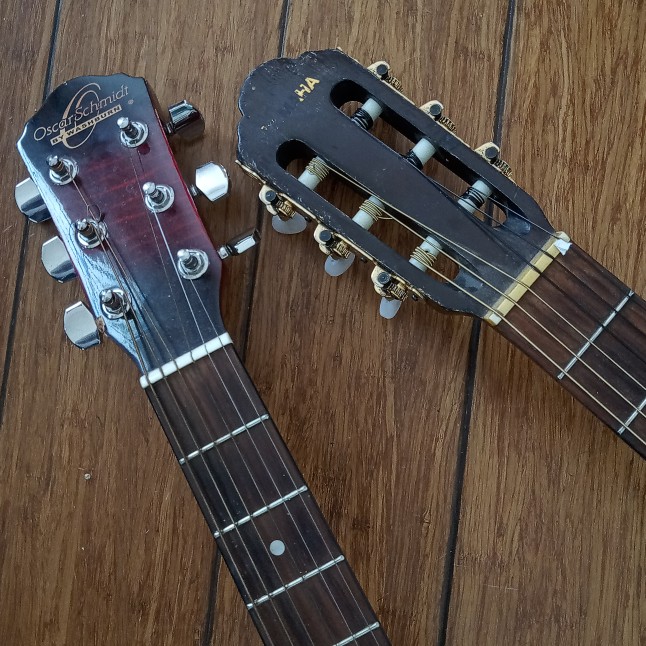
Typically, 'classic' guitar refers to instruments with nylon strings, and 'acoustic' refers to guitars with steel strings.

My guitar teacher friend will only teach new students on nylon stringed guitars, cause steel strings take a lot more effort and time on instrument to build sufficient callous. I started on steel strings. When I got an instrument with nylon strings, I stopped playing the steel stringed guitar. Though now, my callouses suffice to play either.

Also the classic guitar spaces the strings slightly wider apart, making them easier to play for people with larger hands like mine. The wider spacing makes for easier finger-picking.

The sound produced by classic guitars tends towards mellowness, and steel string tends towards brightness.

I love my classic guitar—wood finish—cause the tone matches my voice closely.
classic-vs-acoustic-guitar.jpg
classic vs acoustic guitar
classic-vs-acoustic-head.jpeg
compare the head of a classic vs acoustic guitar
 
r ransom
steward & author
Posts: 44956
Location: Left Coast Canada
17535
10
art trees books chicken cooking fiber arts
  • Mark post as helpful
  • send pies
    Number of slices to send:
    Optional 'thank-you' note:
  • Quote
  • Report post to moderator

Typically, 'classic' guitar refers to instruments with nylon strings, and 'acoustic' refers to guitars with steel strings.


That changes the classification in my mind.

So, how does this look?

Electric
Semi-electric
Acoustic
Classical

Am I missing anything?

For some reason, I got "all non-electric are Acoustic" from the library books.  The don't seem to mention classical guitar as it's own thing.

But these all give the same lesson pattern
1. How to hold pick and guitar
2. How to riff
3. How to cord
4. Put together in a song and make woawawa sounds

It doesn't seem like what I'm seeking in music.  Maybe they don't know about classical guitar style?
 
Joseph Lofthouse
author & steward
Posts: 7451
Location: Cache Valley, zone 4b, Irrigated, 9" rain in badlands.
3692
  • Mark post as helpful
  • send pies
    Number of slices to send:
    Optional 'thank-you' note:
  • Quote
  • Report post to moderator
I don't pay attention to electric or semi-electric guitars. I focus on old-fashioned techniques and instruments.  Electric guitars require an amplifier. Any guitar can have a sound-pickup attached to it to plug into an amplifier. (Do they call them semi-electric if they can play with or without amplifier?)

My guitar playing journey coincided with my journey to become a yoga teacher. I thought at first I would focus on campfire style music, but I actually went in the direction of devotional music, specifically chanting. So I stopped playing other people's music, and only play what I invent myself. My own chords, my own progressions. My own way of relating to the instrument and the world. Sure, I learned to play all the chords from official music theory, but I chose a different path for myself.

 
r ransom
steward & author
Posts: 44956
Location: Left Coast Canada
17535
10
art trees books chicken cooking fiber arts
  • Mark post as helpful
  • send pies
    Number of slices to send:
    Optional 'thank-you' note:
  • Quote
  • Report post to moderator
There is a style called electro-acoustic (i think that's the name) that have an acoustic body but also hookup and an internal speaker so we can play without hooking up, but still have fancy effects.

There seems to be a lot of variations of this technology.   I'm calling it semi-electric as they can be played without hooking up, but, in theory, aren't awesome at pure acoustic sound.

That is all I stored in my brain about these as I want to get to a place where music is away from electrical stuff.
 
Posts: 52
Location: Zone 7b, 600', Sandy-Loam, Cascadian Maritime Temperate
31
  • Likes 2
  • Mark post as helpful
  • send pies
    Number of slices to send:
    Optional 'thank-you' note:
  • Quote
  • Report post to moderator
I have steel-string acoustic guitars, and nylon string classical guitars.
I consider them both to be 'acoustic' as they are both generating the sound without electrical amplification.
Resonator types I think of as acoustic too even though they have more metal structure to amplify sound.

I had a steel-string acoustic and an electric guitar for a long time and never learned to play them, partly because of the pain it caused my uncalloused fingertips.

When I got a Classical nylon-string guitar I was finally able to get it.
Depending on the specific guitar, a Classical guitar usually is quieter than a Steel-string acoustic type.
I tend to use guitar as a vehicle for singing which is what I really like.
Mostly I play rhythm chords and sloppily pick out notes now and then.
My playing skills are not great, but it brings me great joy regardless.

I wish you success in your musical adventures!
 
gardener
Posts: 1776
Location: Zone 5
939
ancestral skills forest garden foraging composting toilet fiber arts bike medical herbs seed writing ungarbage
  • Likes 2
  • Mark post as helpful
  • send pies
    Number of slices to send:
    Optional 'thank-you' note:
  • Quote
  • Report post to moderator
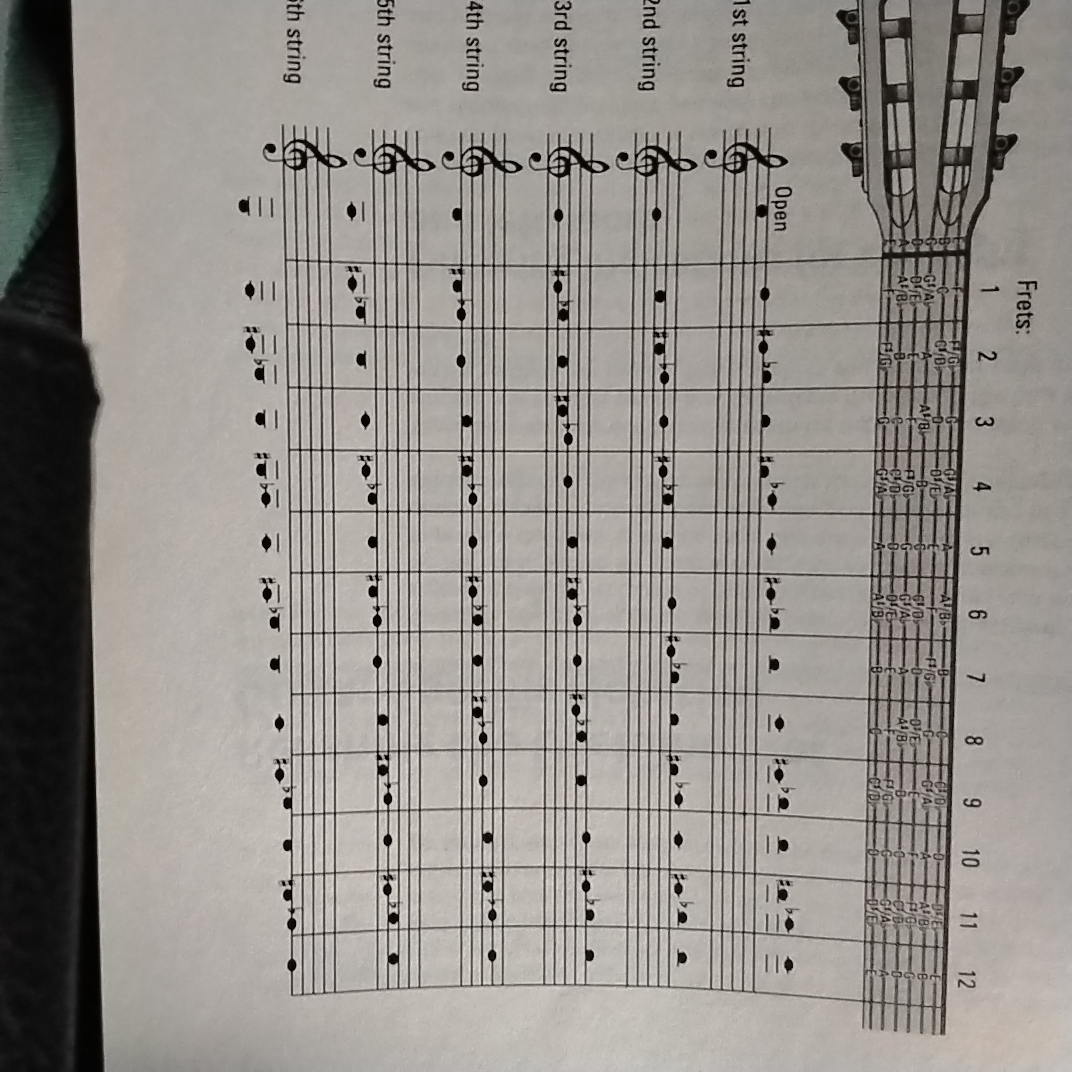
Much of classical guitar playing and fingerstyle ukulele are transferable. Relative to each other, the four highest strings on guitar are tuned a fourth lower (I think) than ukulele in low G, and then the low strings are all a fourth apart from each other. So standard tuning, low to high, is:

E A D G B E

So with muscle memory, playing fingerstyle guitar is almost like playing fingerstyle a large ukulele with two extra strings at the bottom. I think you will be able to figure it out!

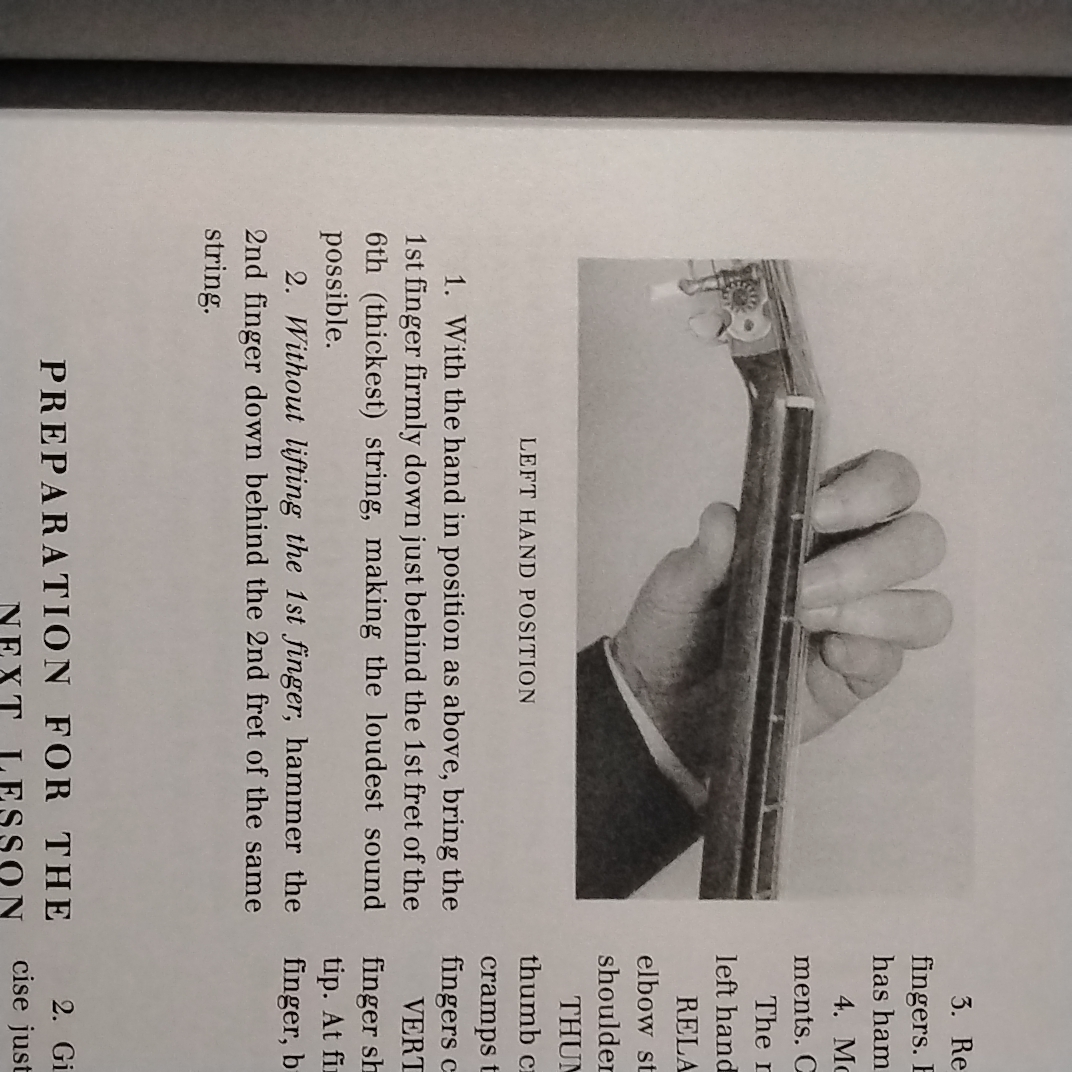
Usually, the lowest three strings are all played with the thumb, while:
G string - index finger
B string - middle finger
High E string - ring finger

This is all flexible too. If you need to move your hand then there is nothing wrong with that...

So for instance if you make the shape for what would be a C major chord on ukulele, and play only those higher strings, then that makes a G major chord for guitar. If you add in a low G (sixth string, third fret) and a low B (fifth string, second fret) then all strings played together make a very big G major chord.

I hope this helps. I am very happy that you have this opportunity now and ask as many questions as you wish!
 
r ransom
steward & author
Posts: 44956
Location: Left Coast Canada
17535
10
art trees books chicken cooking fiber arts
  • Mark post as helpful
  • send pies
    Number of slices to send:
    Optional 'thank-you' note:
  • Quote
  • Report post to moderator
Parlor guitar and strings.

I have a fear of breaking strings, so I would like to get some backup ones.  Also, I think it's nice to give it back with spare strings as a way of saying thank you for lending me this beautiful thing.

Like how we return a car with a full tank when someone lends it to us for free.  It's the nice thing to do.


I looked up the guitar, it is designed to be used with medium nylon strings.  But can take stronger tension ones if necessary.

Somewhere, I stored in my head, my play style and body wants medium or light tension strings.

Somehow this information should get me to what kind of string do I buy.  Somehow?  Nylon, medium, parlor guitar.

Is there anything specific about Parlor guitar strings?  Or do all strings fit all sizes?

Ukulele does best with the right size string for the right size Ukulele. It makes a big difference (i know because my current strings are the wrong size and it sounds muted)
 
This tiny ad dresses like this just to get attention:
Learn Permaculture through a little hard work
https://wheaton-labs.com/bootcamp
reply
    Bookmark Topic Watch Topic
  • New Topic