• Post Reply Bookmark Topic Watch Topic
  • New Topic
permaculture forums growies critters building homesteading energy monies kitchen purity ungarbage community wilderness fiber arts art permaculture artisans regional education skip experiences global resources cider press projects digital market permies.com pie forums private forums all forums
this forum made possible by our volunteer staff, including ...
master stewards:
  • Carla Burke
  • Nancy Reading
  • John F Dean
  • r ransom
  • Jay Angler
  • Timothy Norton
stewards:
  • paul wheaton
  • Tereza Okava
  • Nicole Alderman
master gardeners:
  • M Ljin
  • Christopher Weeks
gardeners:
  • Jeremy VanGelder
  • thomas rubino
  • Megan Palmer

Growing native flowers in a salad box

 
gardener
Posts: 4574
759
7
forest garden fungi trees food preservation bike medical herbs
  • Likes 12
  • Mark post as helpful
  • send pies
    Number of slices to send:
    Optional 'thank-you' note:
  • Quote
  • Report post to moderator
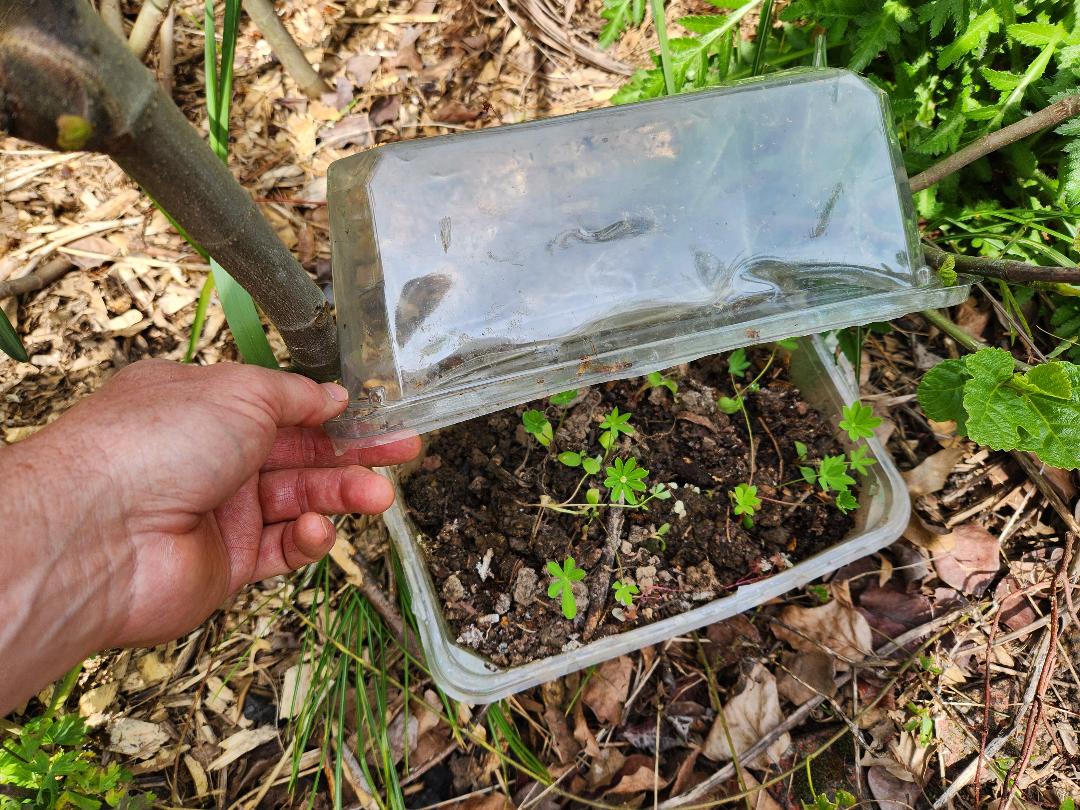
I love lupines and I wanted to grow some for my yard, but also for some school gardens that I volunteer at.  I had read that growing them in a take out food container was a good way to let them grow up enough to more likely survive and stop animals from eating them while tiny.  I started in a regular take out food container, but it was small and they outgrew it quickly.  Then I moved them to these large plastic salad boxes that we get from eating so many green salads.  I drilled 3 holes in one side of each box, so I could use the second container as a flip up top. I wove a string through and tied it. The plants are protected but they can grow up to be pretty big before I plant them out.  Of course I stabbed a slit in the bottom for drainage and in the top so a bit of rain can come in.  They maintain moderate moisture this way.   I have been planting some out and so far about half have survived.  I'll keep gradually planting more out to see if they'll make it.  It seems so much cheaper than buying a full plant.

John S
PDX OR
Salad-box-native-seeds-lupine.jpg
Starting seeds in a salad box
 
pollinator
Posts: 518
Location: Oz; Centre South
165
trees books cooking fiber arts writing
  • Likes 4
  • Mark post as helpful
  • send pies
    Number of slices to send:
    Optional 'thank-you' note:
  • Quote
  • Report post to moderator
What a good idea - planter and mini greenhouse all in one - and it can be recycled afterwards.
 
John Suavecito
gardener
Posts: 4574
759
7
forest garden fungi trees food preservation bike medical herbs
  • Likes 5
  • Mark post as helpful
  • send pies
    Number of slices to send:
    Optional 'thank-you' note:
  • Quote
  • Report post to moderator
I transferred the lupines to the deeper salad box fairly quickly, because in the article I read, it warned about their deep roots.

Sadly, I neglected the checkermallows.  I have to say I love this plant because it is a PNW native plant, pretty flower, and edible vegetable, all wrapped up into one.  While focusing on the lupines, I failed to notice that I had put insufficient amounts of soil in the take out container for the checkermallows.  Some got burned up. Some failed to grow because I hadn't put enough soil in there, nor transferred it quickly enough to the double salad box.  Maybe they'll survive. Maybe I'll try again next year.  Live and learn.
John S
PDX OR
 
Jill Dyer
pollinator
Posts: 518
Location: Oz; Centre South
165
trees books cooking fiber arts writing
  • Likes 5
  • Mark post as helpful
  • send pies
    Number of slices to send:
    Optional 'thank-you' note:
  • Quote
  • Report post to moderator
So, vigilance is the key.  I've been using 2kg yogurt buckets set up as a water well - stones at the bottom about 3 cm, small drainage hole at the side level with the top of the stones, a piece of shadecloth then the soil.  Works most of the time, if I forget occasionally to water - which I do,  enough water to drip out of the drainage hole.
Garlic chives at the moment, and had great success at getting roots to form on rhubarb transplants.  Once again, the buckets can be recycled.
 
Happily living in the valley of the dried frogs with a few tiny ads.
Learn Permaculture through a little hard work
https://wheaton-labs.com/bootcamp
reply
    Bookmark Topic Watch Topic
  • New Topic