
• Post Reply Bookmark Topic Watch Topic
  • New Topic
permaculture forums growies critters building homesteading energy monies kitchen purity ungarbage community wilderness fiber arts art permaculture artisans regional education skip experiences global resources cider press projects digital market permies.com pie forums private forums all forums
this forum made possible by our volunteer staff, including ...
master stewards:
  • Carla Burke
  • Anne Miller
  • Nancy Reading
  • John F Dean
  • r ransom
  • paul wheaton
  • Timothy Norton
stewards:
  • Jay Angler
  • Pearl Sutton
  • AndrĂ©s Bernal
master gardeners:
  • Christopher Weeks
gardeners:
  • M Ljin
  • Thekla McDaniels
  • May Lotito

Natural Timber Log Erosion Barriers

 
Steward of piddlers
Posts: 8498
Location: Upstate New York, Zone 5b, 43 inch Avg. Rainfall
5157
monies home care dog fungi trees chicken food preservation cooking building composting homestead
  • Likes 1
  • Mark post as helpful
  • send pies
    Number of slices to send:
    Optional 'thank-you' note:
  • Quote
  • Report post to moderator
I've spent the last few years tending an eroding slope and have made good progress in 'restoring' the dirt into soil. The most significant technique I have employed is utilizing logs as tools to slow erosion. By laying timbers across a slope, on contour, the logs slow water and capture eroded fines while allowing plants a chance to stabilize the slope.

Log Erosion Barrier

I was first introduced to the idea through learning more about Log Erosion Barriers (LEBs) which are utilized on land damaged by wildfire. Shallow trenches are dug and fallen logs are placed in the trenches to become a barrier to runoff.  These are arranged in a particular way to not hold back large amounts of water/soil but rather intercept the flow to reduce erosion.

Where I differ is that I'm combining a mixture of trunk-section logs and smaller branches to create a semi-permeable 'net' to catch materials as they are going down the slope. The logs are not meant to function as a retaining wall but rather a biodegradable framework where organic material can collect behind it and eventually all be returned to soil material with, hopefully, a more gentle slope behind it. To expedite the process, anything organic can be thrown behind the logs to further hold things together. Twigs, leaves, old animal bedding, chipped wood, cold compost, brush and more can be placed.

My intention is for this process to be a temporary step towards a permanent solution. By building up the soil organic material on the hillside, it is my plan to start planting perennials/shrubs to root those areas in place. When the logs have rotted away and are no longer collecting soil organic matter, hopefully there will be beautiful productive shrubs holding the line.

Have you done something similar? How much slope is too much slope?
 
Timothy Norton
Steward of piddlers
Posts: 8498
Location: Upstate New York, Zone 5b, 43 inch Avg. Rainfall
5157
monies home care dog fungi trees chicken food preservation cooking building composting homestead
  • Mark post as helpful
  • send pies
    Number of slices to send:
    Optional 'thank-you' note:
  • Quote
  • Report post to moderator


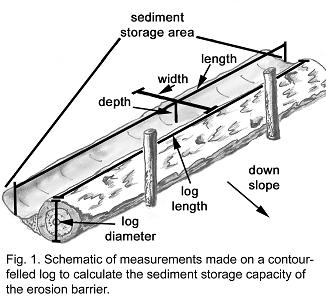
An example image of a log erosion barrier from the USDA Forest Service. This figure shows a log, pinned with stakes, with a shallow swale behind it with packed dirt against the log itself. This would be placed on contour and allowed to capture/intercept organic matter. The swale is intended to primarily capture sediment. Studies have shown that while these log barriers retention abilities may be overcome by large storms, they do well with 'regular' rain events over seasons.
 
I yam what I yam and that's all that I yam - the great philosopher Popeye. Tiny ad:
Switching from electric heat to a rocket mass heater reduces your carbon footprint as much as parking 7 cars
http://woodheat.net
reply
    Bookmark Topic Watch Topic
  • New Topic