Dear Permie-people, I need some help. Of course most of you can not come to the Netherlands to help me with their muscle power. But you can give good advice.
My son is busy (in his spare time) building a garden shed in my allotment garden. He's using pallet wood (he can get the pallets from his work). The largest part is finished and it's sturdy and strong ...
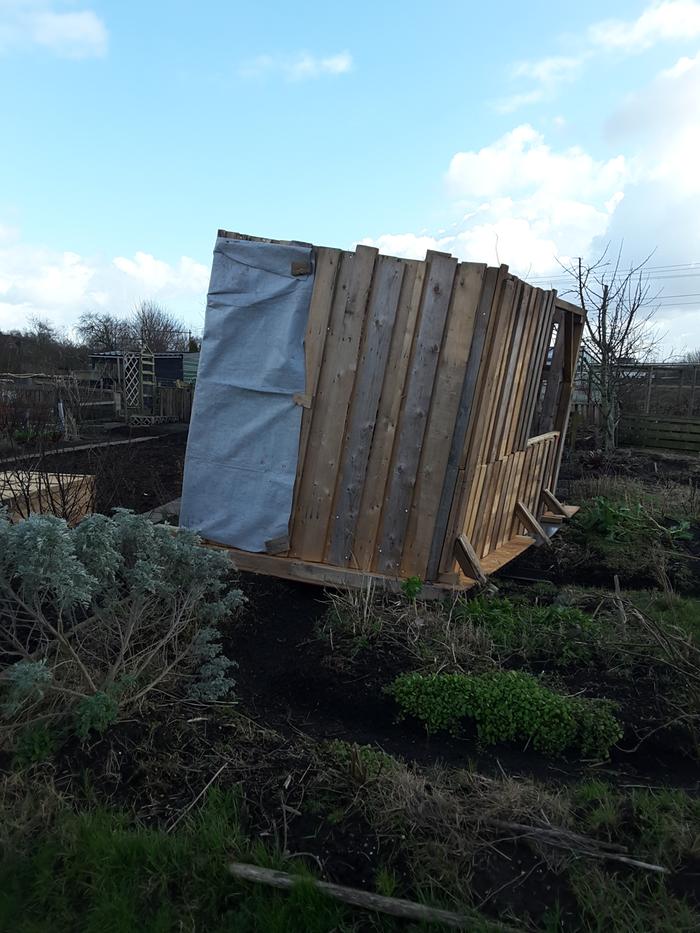
... but then the storm came (named Eunice) ... in the night of February 18 - 19 (2022) my garden shed is completely blown over! Upside-down on its roof! This wind must have been very strong (maybe it even was a little like a hurricane)! My sons estimates the weight of the shed about 500 kg (1100 lbs).
Now is the problem: how to get it back upright again???
And then we'll have to 'anchor' it to the ground. That underground exists of a sand-peat mixture (in the past this was a boggy place). So not just any method of fixing a building to the ground can be used there. F.e. wood in the ground will rot too fast. What do you advice?
They come in many different sizes, putting 6 or 8 of them down and then attaching the shed to that. If you want to make it really secure then concrete the holders in, but personally I wouldn't bother.
I am thinking that you use T-stakes and come alongs. First I would pound a couple of stakes into the ground (but be able to get them out later. Then I would attach a come-along on the stake close to the ground and again to the highest point of your shed. Then crank and slowly rotate the shed back onto its correct orientation.
After the shed is upright I would think about pounding stakes along each corner—that is two per corner for a total of eight stakes. And I would make them tall, sturdy stakes as in maybe 2 meters. I would pound those stakes in as far down as I could get them but at least 1 meter. Finally I would attach the stakes directly to the framing of the shed. Don’t just attach to the siding as that comes off, but I would go right to the structural members of the shed so that the whole structure is well and thoroughly anchored to the ground.
At least this is what I would do. I hope it helps.
Thank you for your tips.
A come-along looks like something useful for this job. So I hope to find someone who has it and can help. A strong car (like a jeep) would be helpful too ...
And then I think I need large pointed metal things that go into the ground. And concrete added in the hole. Those metal pins has to be attached to the frame of the shed, yes. No wooden stakes, they will rot.
Eric Hanson
,
Steward and Man of Many Mushrooms
staff
A steel T-Stake is meant for regular fencing and is quite sturdy and strong. It will not bend easily. It can be purchased in several lengths and thicknesses. Amazon has several varieties, but I would choose one that is fairly long (2 meters) and thick/heavy gauge. It is not meant for electric fencing.
Eric
Eric Hanson
,
Steward and Man of Many Mushrooms
staff
Could easily use 2, pull with one and hold while attaching second one. Pull with second one and hold while you reattach first one till you have it rolled over.
At least it flipped over without getting smashed to bits!
Do you have a neighbor with a tractor? That could pull it easier than a come-along or winch. Whatever you use, I'd tie onto it in the two corners of the building on the upper left of the picture. Don't tie on in the center or it could buckle the shed. Then pull it over 90 degrees. Then reattach to the next corner and keep pulling. If you can get a tractor or something with a front end loader on it, pulling from higher up will put less force on the shed. Alternately, if you're pulling with a tree as your anchor, tie onto the tree up higher (assuming it's beefy enough).
Anchoring to t-posts or similar large metal posts would be a good plan. I don't think Skandi's post base would be strong enough for uplifting wind forces. Maybe I'm wrong...
Thank you for more advice.
If only I knew someone with a tractor ... I will ask around ... (maybe someone I know knows someone?)
I don't know if here in the Netherlands I can buy the things you show. Here instead of 'home depot' there are 'gamma' and 'praxis' (and some more).
Re Mike's advice which sounds good to me, which direction did the shed flip from? Left or right in the picture? I would attach the cables/ropes to the corners on the far side from where you want to pull it over, so that as it starts to tip the lever arm gets longer and more effective. This would also be pulling the joints of the shed together rather than apart.
Inge, I just mentioned a similar thing to Mike Hassl... screw pilings, or ground screws.
Here's a company in NL : stopdigging.nl
It may be totally overkill or out of the budget, but worth a look? Not sure if the salvage wood shed is by necessity or design.
Maybe a solution for someone else in a similar situation...
The installation equipment is small and maneuverable, which might suit you well, and it is ready to build upon once driven in, no waiting for curing of concrete.
Kenneth Elwell wrote:Inge, I just mentioned a similar thing to Mike Hassl... screw pilings, or ground screws.
Here's a company in NL : stopdigging.nl
It may be totally overkill or out of the budget, but worth a look? Not sure if the salvage wood shed is by necessity or design.
Maybe a solution for someone else in a similar situation...
The installation equipment is small and maneuverable, which might suit you well, and it is ready to build upon once driven in, no waiting for curing of concrete.
Yes, we (my son, I mean) thought of these ground-screws ... but this is indeed much more than our budget. We need a DIY solution. Maybe there are smaller ground-screws one can turn in without a specialized machine?
After I wrote I don't know anyone with a tractor I realized I do know real farmers with tractors. But I can not bother them to drive the tractor to the allotment plot and do this for me, it will take too much of their valuable time. I want to pay them, but that's outside my budget too.
Glenn Herbert wrote:Re Mike's advice which sounds good to me, which direction did the shed flip from? Left or right in the picture? I would attach the cables/ropes to the corners on the far side from where you want to pull it over, so that as it starts to tip the lever arm gets longer and more effective. This would also be pulling the joints of the shed together rather than apart.
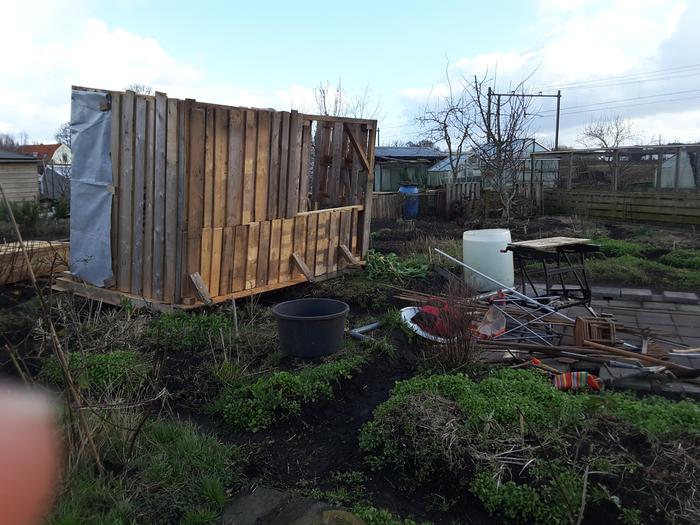
To make this clear I need to show the other photo. Here you can see where it was first and where it is now:
As you see: the white plastic barrel with rainwater (from the roof) is still standing. The shed was 'hopped' over it!
My allotment garden ends just behind where the roof is now. I am glad it did not land on the garden of my allotment-neighbour! I am glad too there wasn't much growing there where it landed. If the wind was from a different direction my apple tree could have been damaged badly. Now there's only one rosemary and one lavender bush at that spot where the roof is now. And for the rest the beds were still empty (prepared with mulch/compost for coming spring).
In your area, do they sell screw anchors to tie grazing animals to or to stake trees with? They're much smaller and affordable and might do the job for your situation.
Mike Haasl wrote:In your area, do they sell screw anchors to tie grazing animals to or to stake trees with? They're much smaller and affordable and might do the job for your situation.
Thanks all for your advice. Since yesterday the garden shed is standing right up again! Thanks to a few strong men and well-balanced women ;-)
We bought some hardwood square posts that will go into the ground (for 3/4 of the length) and large nuts-and-bolts to fix them to the corner posts of the shed. According to others who have sheds there (neighbouring allotment gardens) that is the way to do it.
If this weren't a cheap garden shed but a real Tiny House, I would have chosen for professional ground-screws (see this site: https://pnl.nl/ ).
![[Logo]](/templates/default/mobile/images/mobile-permies-2015.png)







.png)

