Funny you should mention that. There are many things that when we think of building them, our minds go to metal work. However, a large percentage of them can just as easily be built from wood and will handle the job just fine. I don't have a lot of metal working equipment and if I get near a welder even Navy Seals run screaming. Wood projects, on the other hand, I am more than equipped to take on. So I have to remind myself many things can be done using wood instead of metal, or the two can be forced to play together.
Nancy Reading wrote:Thank you for that firewood rack post Kelly! It's given me ideas - I want to make some wood trolleys - to shuffle wood from the wood shed into the house - that are small enough to store under the kitchen counter. I was thinking metal - but there is no reason they can't be made of wood (which might be much easier).
One of my little projects has been outside - I like to use comfrey as a cut-and-come-again mulch. It is also good in my climate for holding back the grass from my growing areas. I'm in the process of planting up a new set of beds at the moment, so I dug up part of an established clump that is starting to sprout:
digging comfrey
When I teased apart the growing points I had about 20 small plants to plant out
comfrey starts
That was enough to do one side of the patch with a double layer of comfrey starts. That will make a nice barrier in a year or two.
Flling in a hole in the wood shed wall. This had been covered with a tatty bit of woven plastic, but I got fed up with looking at that and decided to try my hand a some wattle instead. Technically the wood should be split hazel for longevity, but I don't have so much of that around, whereas I do have a bit of willow that I cut down a couple of years ago which has been lying in the mud. Time to tidy that up too! It is still remarkably flexible so seems it may be up to the job for a year or two at least.
I added a couple of uprights from some coppiced hazel. These will do to weave the willow around. I cheated and used screws to fix them.
Then for the willow: I left all the side branches on, they will help catch the rain and wind a bit.
There is still a bit of a gap at the top. I couldn't work out how to easily infill above the roof support and am hoping we can replace the end roof panel which is leaking at the middle due to not being adequately fixed down and flexing in the winds. By wrapping the panel down, that will make a nice bit of flashing....If not well I have four dimensional plans for this space anyhow!
It isn't water tight, but should catch the majority of the rain (which doesn't tend to come from this direction much) and a bit of ventilation is a good thing in a wood shed!
Jay Angler wrote:I think that sometimes the most important projects are the ones that repair broken things so they can go back into full service.
good as new
Hopefully the handle will last a few more years now. I'll try and do better about putting it away properly out of the weather now I have my new yurt-shed.
I can relate to a well repared tool. I have no idea why I delay fixing tools in regular use. Well, I do. I'm too busy with the task at hand to stop, go to the workshop, repair and then go back to doing what I wanted in the first place. It's always, I'll do it when I'm done here and then I'm either too tired or forget. And the cycle repeats. And you'd think I'd learn - so many times when I eventually get too fed up with a loose rake head or wobbly spade and fix it, the job satisfaction goes way up and my frustration is a thing of the past!
Changing one thing, no matter how tiny, is still change
Nancy Reading
steward and tree herder
Posts: 14953
Location: Isle of Skye, Scotland. Nearly 70 inches rain a year
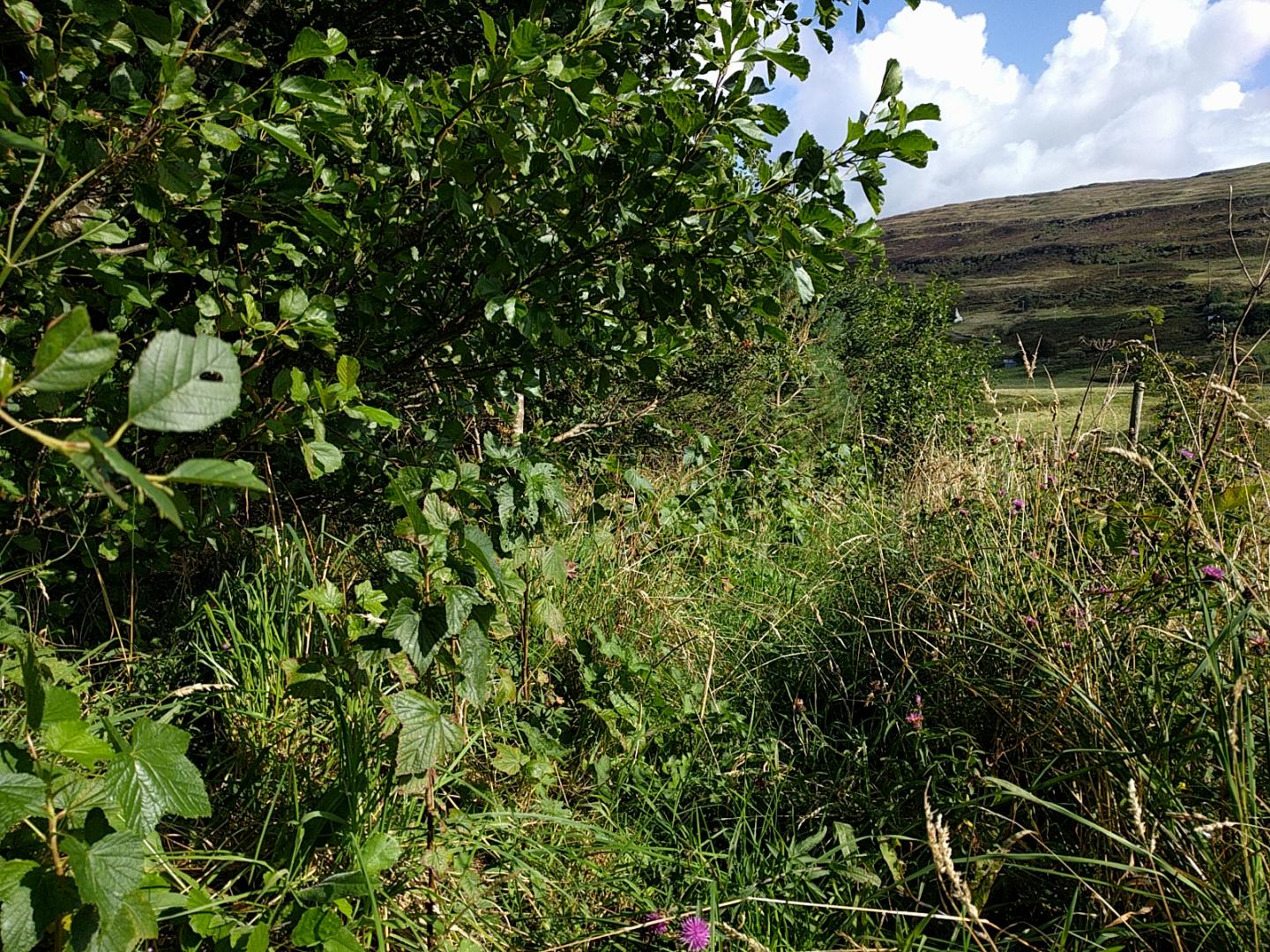
I checked on the cuttings today and they're looking good! Might be some currants next year I pulled the grass from around them and mulched them slightly, but my experience is that they fruit fairly well without much attention.
That's fantastic. Soft fruit is starting to struggle in our hotter, drier summers: I lost a green gooseberry plant this summer, and everything else looks unhappy & fruited poorly.
--
"Whitewashed Hope: A Message from 10+ Indigenous Leaders and Organizations"
https://www.culturalsurvival.org/news/whitewashed-hope-message-10-indigenous-leaders-and-organizations
Quick projects....does anyone else do this? You think it's going to be so easy that you'll just squeeze it in tomorrow, and tomorrow and tomorrow and suddenly a year has gone by?!
Today's "quick" project is to cut a length of hardware cloth, fold it in half and attach the upper half to the length of porch where a skunk enters, and the other half semi-buried into the ground and using ground staples, secure it there along the length. I have some perennials that I want to dig out first. I've dreaded this job because I always get sliced to ribbons when handling hardware cloth. This has been on my to do list for a year now. Today will be the day...I hope!
Update: Done! Well, one side is done. I'll be proactive and do the other side tomorrow, even though there is no evidence of activity there. I did do it a little differently than I planned. I didn't have to cut the hardware cloth at all; the piece I had was actually two feet shy of what I needed, so I overlapped an extra 2' piece that I had to make up the difference. I went to the hardware store to get some fence staples to hammer into the fascia board, which I got, but I also got 1/2 high solid cement blocks. They were $3 each, so I got ten and laid them across the edge of the metal hardware cloth that's on the ground. I am so tired of dealing with this skunk. There was a new hole in the corner of the house and I want to prevent it from getting in anywhere. Tomorrow, I can start right in now that I know how to attack it and I'll do the other side of the steps. It may be still under the porch, and at this point, I don't care.
The guy I'd hired to do all of this lifted one board and told me that it was beyond him. The skunk had dug two 2' round holes and large parts of the foundation were just hanging there. He had planned on filling the unknown hole with cement, but this spooked him. He gave me a name of another person who works on foundations; when I called him and asked for a ballpark figure, he told me anywhere between $40,000 and $150,000. He had visions of lifting the house, I think...needless to say, after a few heart palpatations, I calmed down and did my own searching. (At this point, the first guy had packed up and left after charging me $170.)
I found someone who came the next day, insulated and cemented up the holes and embedded hardware cloth into the cement. For three guys working a good part of the day, I was only charged $500, but as you can see, this skunk has become my nemisis! I have spent well over $700 trying to prevent it from entering my house, and I've had NPR blasting in the basement for months--which comes up through all of the registers in the house. Apparently, talk radio helps to keep skunks away. The first guy, who was supposed to repair the lattice around the porch (where the critter bashed through) and install the hardware cloth, told me that his next first opening was in mid to late December and by then the ground would be frozen. Am I wrong to be mad? He never finished the job he was contracted to do, and then I go to the end of his list??? Grrr.
I have a leaky faucet on my irrigation system manifold that has needed attention for well over a year, necessitating many extra trips to shut it off after the attached timer shuts off the water to the garden. I have the replacement on hand and just need to do the five minute swap! This will save much time, trouble and water, not to mention the pain from my bad knees.
Bob Waur The Elder
Eat what you can, and what you can't you can
<Farm wisdom> Sell the best and eat the rest
My small easy project would be something I look forward to doing each year, usually in the beginning of December when I am stuck indoors because of the weather.
That is clearing off the dining room table and bringing in my seed tote. Then resorting and making my inventory list and next my need list then wish list.
Then when the catalogs start arriving I am ready !!
The tool repair ideas are giving me the urge to finally try my hand at repairing the assorted broken tools I have refused to let my husband throw out. All my tools need cleaning and sharpening.
I'm feeling overwhelmed. So, I'd like to have some help with getting a list of what tools for the repairs/sharpening/cleaning I'd need in order to have them all in one place. This would help me stop avoiding the disorganized painful part of learning a new set of skills. I could also work at it a bit put it down and jump back in when I have a little time.
The Southwest US region has made national news with our recent floods following a brutally hot and rainless summer. I am eager to share how this small easy project saved my property from record flooding.
During the extreme heat period of June through August, I had to find a way to channel my despair about desertification and water guzzling data centers. As a regular practice (small project) I worked through the anger by dimpling my yard with ~3' circular depressions. One dimple takes about a half hour to fill up two wheelbarrows with silty-sand then rake the bowl smooth. Over the course of the dry pitiless summer, I cut out these bowls nearly every day to retain water if it ever came again. Over time, some of the bowls linked together to form chains of bowls. In a matter of about 10 weeks, the whole acre became dimpled. The cut-dirt went around trees to form raised basin edges.
When the 215 thousand gallons of water arrived over the past 8 weeks (that's 2/3 of an acre-foot), the bowls, chains of bowls and linked tree wells took all that water.
The small easy project of "manifesting depressions" and releasing anger in a positive way when all seemed out of my control helped me get through a really difficult period.
Was runoff/erosion a problem at all or were the depressions deep enough and the soil porous enough to take the deluge?
The short answer is, there were no problems at all: all water stayed and infiltrated. Here is some more detail:
The ground here is porous. The road where I live was originally a natural channel to the Rio Grande and is prone to flooding during monsoon season. Home builders are required to create low spots for extreme weather events. Unfortunately, these depressions fill up over the years with blowing sand, silt, clay, seeds and clutter. When the rains do come, most of the water in this neighborhood runs down the roads and never infiltrates the land. The majority of water and debris runs into the Rio Grande. The biggest polluter of the river is top soil!
Here on this property, I've kept the original water-catchment basin functional. When the rains come, most of the water originally went to that one spot leaving the rest of the yard dry under the surface. The purpose of the little basins explained above is to infiltrate water throughout the landscape as opposed to a single low spot. The extensive shallow basins enable a much wider distribution of rainwater AND (for the basins by the road) the catchment of other peoples topsoil on its way to the river.
For me, setting up temporary shelters with tarps (hoardings) lets me work through the cold winters. And that's huge-- I can't just sit around for 6 months. Make a dry area, cut the wind, let in good light, fire up a beater wood stove -- and I can operate. It ain't pretty, but it's pretty damn practical.
I have begun to write a book. I already have all the page numbers done! And one tiny ad:
Permaculture Voices 1, 2 and 3 - all 117 hours of video!










 7


 I pulled the grass from around them and mulched them slightly, but my experience is that they fruit fairly well without much attention.