
• Post Reply Bookmark Topic Watch Topic
  • New Topic
permaculture forums growies critters building homesteading energy monies kitchen purity ungarbage community wilderness fiber arts art permaculture artisans regional education skip experiences global resources cider press projects digital market permies.com pie forums private forums all forums
this forum made possible by our volunteer staff, including ...
master stewards:
  • Carla Burke
  • Nancy Reading
  • John F Dean
  • r ransom
  • Jay Angler
  • Timothy Norton
stewards:
  • paul wheaton
  • Pearl Sutton
  • Tereza Okava
master gardeners:
  • Christopher Weeks
  • M Ljin
gardeners:
  • thomas rubino
  • Jeremy VanGelder
  • Megan Palmer

Feedback after 6 years of living in a self-built container

 
Posts: 24
Location: Auvergne/France
54
gear rocket stoves homestead
  • Likes 22
  • Mark post as helpful
  • send pies
    Number of slices to send:
    Optional 'thank-you' note:
  • Quote
  • Report post to moderator
Hello, I’d like to share my experience with a self-built, converted shipping container.
One of its key features is that it uses natural insulation. In fact, I built it as if I were constructing a timber-frame house inside a container. I live in it year-round and I’m not connected to any utilities. The container is located in a mid-mountain area in France at an altitude of 1,000 meters, and it sits directly on the ground without foundations.


The container I chose is a 20-foot High Cube dry container, which gives me an interior height of 2.55 m once the ceiling is finished. The interior width is 2.08 m and the length is 5.70 m.


The inner wall thickness is 13 cm. The walls and ceiling are made of a timber frame using 45 × 95 mm sections and 13 mm OSB panels. The insulation is Biofib Trio, a natural insulating material made from cotton, hemp, and flax fibers.


fitting natural insulation slabs in a container house

The steel walls of the container were left exposed, and there is a 2.5 cm air gap between the steel and the timber frame. Roof vents allow air from this cavity to escape outside. A small mechanical ventilation system helps remove interior's moisture. Heating is provided by a wood stove.
Since humidity is a key issue in container homes, I immediately installed a thermometer/hygrometer.

Currently, winter is the easiest season, with indoor temperatures ranging between 13 and 25°C and humidity levels between 40% and 60%. Summer causes more problems because I can’t use the stove, and humidity rises to around 70%. The location in the middle of a forest is a critical factor that significantly increases humidity. I’m considering using a professional dehumidifier in summer, as my solar panels should provide enough power.
After inspection by removing some panels, the walls have never shown any signs of condensation. The critical area is the ceiling, where condensation can occur. I would recommend applying 1 to 2 cm of sprayed insulation, such as cork, on the inner surface. Proper ventilation in the kitchen and shower areas is essential to expel moisture outside before it migrates into the walls.


I built my own ventilation system using an electrical cabinet fan with a capacity of 90 m³/h.


This is a broad topic, and I will add more details in future posts. Thank you for your patience.
 
steward
Posts: 18661
Location: USDA Zone 8a
4731
dog hunting food preservation cooking bee greening the desert
  • Likes 10
  • Mark post as helpful
  • send pies
    Number of slices to send:
    Optional 'thank-you' note:
  • Quote
  • Report post to moderator
Thanks for sharing> and welcome to the forum!

I am looking forward to seeing more picture of your build.

Is there anything you would do different if you build another one?
 
pollinator
Posts: 6046
Location: Bendigo , Australia
559
plumbing earthworks bee building homestead greening the desert
  • Likes 8
  • Mark post as helpful
  • send pies
    Number of slices to send:
    Optional 'thank-you' note:
  • Quote
  • Report post to moderator
great outcome, well done.
Was there any outgassing from the wall sheets?
 
pollinator
Posts: 353
Location: 6a Alpine Southwest USA
179
cat hunting cooking building woodworking
  • Likes 7
  • Mark post as helpful
  • send pies
    Number of slices to send:
    Optional 'thank-you' note:
  • Quote
  • Report post to moderator
I'm very interested to see how you finished out the interior. This is what we call a "Tiny Home" here in the US.
I guess you have to clean the snow off the solar panels in the winter?
 
John C Daley
pollinator
Posts: 6046
Location: Bendigo , Australia
559
plumbing earthworks bee building homestead greening the desert
  • Likes 5
  • Mark post as helpful
  • send pies
    Number of slices to send:
    Optional 'thank-you' note:
  • Quote
  • Report post to moderator
Have you considered moving the solar panels closer to the edge so snow may just slide off  the panles and drop away to the ground?
 
Rémy LaCabaneFieutée
Posts: 24
Location: Auvergne/France
54
gear rocket stoves homestead
  • Likes 10
  • Mark post as helpful
  • send pies
    Number of slices to send:
    Optional 'thank-you' note:
  • Quote
  • Report post to moderator
Thank you very much for your messages.
I’ll answer your questions:

Hi Anne, yes, I have two regrets about my build. The first is not being able to go with a 40-foot container at the time due to budget constraints. The second is not having spray-applied insulation on the ceiling metal or installing 19 mm Armaflex. This detail now requires me to regularly monitor the humidity levels inside.

Hi John, if you’re referring to the phenomenon of water vapor migration within the walls, I ended up limiting it unintentionally. I chose to paint my walls with washable kitchen paint for practical reasons, without anticipating that it would actually restrict airflow in a way similar to a membrane.
As for the solar panels, when it snows here, the temperature stays very close to freezing. The first snowflakes melt on the panels and then refreeze, creating a sticky layer that holds the snow in place. My brother, who also lives in a container home on the same property, chose an interesting solution: half of his panels are mounted on the roof for summer sun, and the other half are installed vertically on a wall to avoid snow buildup in winter.

Hi Joshua, I keep a small ladder to access the roof so I can take care of the panels or carry out chimney sweeping. I really only have a critical period of about one month each year for snow. The rest of the time, a bit of sunshine is often enough to melt it.
I didn't take many pictures of my interior, here is my kitchen :


And bedroom is above my "living" due to extra heigh of the high cube size


Rémy LaCabaneFieutée
Posts: 24
Location: Auvergne/France
54
gear rocket stoves homestead
  • Likes 14
  • Mark post as helpful
  • send pies
    Number of slices to send:
    Optional 'thank-you' note:
  • Quote
  • Report post to moderator
Hi, I’d like to come back to the topic of humidity management. Through my work, I’ve had the opportunity to interact with many tiny house residents. After observing the same humidity issues in their homes, I eventually understood something important: the main limitation is not the lack of wall breathability, but the living volume.

A person, through breathing, washing, or cooking, produces the same amount of water vapor whether in a large or a small house. However, that vapor is much more diluted in a larger space and across a greater wall surface. In addition, insulation in tiny houses is often thinner and therefore reaches condensation more quickly. It is therefore very important to remove moisture before it enters the walls.

In the specific case of container homes with a ventilated air gap between the metal shell and the insulation, my brother and I developed a technique to purge moisture from the walls. This system is inspired by car heating systems. The wood stove inside was modified to allow for forced-air heating.
We draw in cold, dry outside air, and a fan pushes it through a heat exchanger around the stove. The warmed air is then injected into the house under slight positive pressure. This warm, dry air absorbs moisture from the indoor environment. It then passes through vents installed in the ceiling. The air gap between the insulation and the metal shell is also flushed before the moisture-laden air is expelled outside through roof vents.
We call this process “ballast flushing.”
The sketch is annoted in French but I think it will be easy to understood


A full drying cycle takes about 10 to 20 minutes with a drop of humidity from 10 to 20%.
For air injection, I recommend a minimum flow rate of 120 m³/h for a 20-foot container.
 
John C Daley
pollinator
Posts: 6046
Location: Bendigo , Australia
559
plumbing earthworks bee building homestead greening the desert
  • Likes 7
  • Mark post as helpful
  • send pies
    Number of slices to send:
    Optional 'thank-you' note:
  • Quote
  • Report post to moderator
Remy, I love your detailed explanations an the thinking both of you use.
Thank you
Do you think if you insulated directly against the wall metal you would have condesation issues on the wall interior?
 
Rémy LaCabaneFieutée
Posts: 24
Location: Auvergne/France
54
gear rocket stoves homestead
  • Likes 7
  • Mark post as helpful
  • send pies
    Number of slices to send:
    Optional 'thank-you' note:
  • Quote
  • Report post to moderator
Hi, I’d like to discuss a construction detail that required quite a bit of thought: installing watertight window frames. The main challenge was that I couldn’t weld on site, so I had to design removable steel frames made from angle sections.


The key point is that the angle section must match the full thickness of the corrugated sheet, including both the crests and the troughs. The profiles should be assembled in the direction of water runoff. Ideally, the frame should start on a crest and end on a crest.


During installation, the frame is held tightly against the sheet by screws that pass through the frame and the sheet, and are anchored into the internal wooden structure. The screws need to be tightened firmly, but not excessively, to avoid deforming the container sheet.
Once everything is in place, ensure watertightness with silicone sealant. You can then install the window.

 
John C Daley
pollinator
Posts: 6046
Location: Bendigo , Australia
559
plumbing earthworks bee building homestead greening the desert
  • Likes 6
  • Mark post as helpful
  • send pies
    Number of slices to send:
    Optional 'thank-you' note:
  • Quote
  • Report post to moderator
Clever, are you relying on silicone to seal the top corners on the side?
That may be a leak spot.
 
pollinator
Posts: 545
78
  • Likes 8
  • Mark post as helpful
  • send pies
    Number of slices to send:
    Optional 'thank-you' note:
  • Quote
  • Report post to moderator
I can't thank you enough for these details,  it is instructive and quite inspirational. After a few years of observations,  do you  see any problems?  

Also, no regrets are needed.......perhaps add on to this pleasant home in future, a breezeway between? who can know?  Rest assured , your home origin is truly noble work
 
Rico Loma
pollinator
Posts: 545
78
  • Likes 8
  • Mark post as helpful
  • send pies
    Number of slices to send:
    Optional 'thank-you' note:
  • Quote
  • Report post to moderator
If you later observe moisture,  you might retrofit a solution above the window. One example here
Screenshot_20260329_153837_Photos.jpg
[Thumbnail for Screenshot_20260329_153837_Photos.jpg]
 
Rémy LaCabaneFieutée
Posts: 24
Location: Auvergne/France
54
gear rocket stoves homestead
  • Likes 11
  • Mark post as helpful
  • send pies
    Number of slices to send:
    Optional 'thank-you' note:
  • Quote
  • Report post to moderator
Thank you all for your messages!

Hi John, your question about whether the insulation should be in contact with the metal sheet or not is one of the major questions in this type of construction. At the moment, I don’t know, and I’m not sure a definitive answer can be found.
Spray polyurethane foam remains a well-known solution, although it is somewhat debatable.
I chose to leave an air gap because I was using a fibrous insulation material that is potentially hydrophilic.
With insulation materials such as cork or hemp, I think direct contact with the metal sheet is possible.
It also seems possible that having the insulation in contact with the metal could reduce condensation.
Regarding the window sealing, the photo only shows the beginning of the process. Both the window and the frame have seals on all four sides.

Hi Rico, I remain very satisfied with my experience. The one aspect I would redo is the internal insulation of the roof sheet. This container was my first experiment in the field of autonomous housing. It serves as a laboratory for a future, slightly larger home that I plan to start building this year.
 
Rémy LaCabaneFieutée
Posts: 24
Location: Auvergne/France
54
gear rocket stoves homestead
  • Likes 9
  • Mark post as helpful
  • send pies
    Number of slices to send:
    Optional 'thank-you' note:
  • Quote
  • Report post to moderator
Hello, here is some feedback on my water setup.
I was fortunate to find a spring on my land, and I chose to filter its water rather than have running water. I also decided not to use a conventional system with a pump and taps. I live in a somewhat cold region and sometimes I’m away for 3 or 4 days. When I come back, it can occasionally freeze inside the container. Without a conventional setup, I don’t have anything to drain to prevent pipes from bursting.


So I mainly use a gravity water filter. I chose a Gravidyn model from the manufacturer Katadyn, with ceramic filters. I live in an area with very little pollution, so I didn’t need to opt for activated carbon.

The filtered water is used for everything related to food: cooking, washing dishes, and washing hands. Showers and laundry are done with unfiltered water.
Since I don’t have a pump, I use a modified garden sprayer to take my showers.
 
Rico Loma
pollinator
Posts: 545
78
  • Likes 7
  • Mark post as helpful
  • send pies
    Number of slices to send:
    Optional 'thank-you' note:
  • Quote
  • Report post to moderator
A man after my own heart!

Observers might chide, " that's a lot of work."
.....I would chime in, that's perfect meditation in Nature followed by healthy exercise
 
John C Daley
pollinator
Posts: 6046
Location: Bendigo , Australia
559
plumbing earthworks bee building homestead greening the desert
  • Likes 5
  • Mark post as helpful
  • send pies
    Number of slices to send:
    Optional 'thank-you' note:
  • Quote
  • Report post to moderator
Have you thought about having a hydraulic ram moving water from the spring, close to home and draining back to the stream.
That way you have running water without walking over to get it?
 
Rémy LaCabaneFieutée
Posts: 24
Location: Auvergne/France
54
gear rocket stoves homestead
  • Likes 4
  • Mark post as helpful
  • send pies
    Number of slices to send:
    Optional 'thank-you' note:
  • Quote
  • Report post to moderator
Thanks a lot for the compliment, Rico!

Hi John, a ram pump is a great idea. For now, I’m not really developing the container any further. I’m using what I’ve learned to design my new home, a sort of treehouse. I’ll come back to the pump idea when the time comes.

I am working on a platform to put a cabin on, the hexagone's diameter will be 6,40 meters, it could be good to put another container on.


Rémy LaCabaneFieutée
Posts: 24
Location: Auvergne/France
54
gear rocket stoves homestead
  • Likes 4
  • Mark post as helpful
  • send pies
    Number of slices to send:
    Optional 'thank-you' note:
  • Quote
  • Report post to moderator
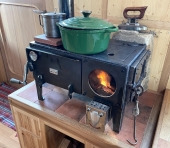
Hi, here is my feedback and experience with heating a container using wood.

I built several wood stoves before arriving at my current solution.
My stove is a high-radiation model based on the design of workshop sawdust stoves. It allows me to burn all types of wood: firewood, reclaimed wood, compressed wood, etc.


Although my living space is 12 m², the stove has a power output of 6 kW. The need for extra power is explained by my absence during the day while I work in my workshop.
So I run two heating sessions of 1 hour and 30 minutes each per day.
The stove has two sides covered with bricks, for a total of 20 bricks. They store heat during the heating phase and release it over approximately 6 to 7 hours.
I did not choose a traditional mass rocket stove because I sometimes leave for several days, and in winter the temperature inside the container drops to 0°C. With my stove, I can raise the temperature by 19°C in one hour. However, it would take several hours with a mass rocket stove.
In terms of wood consumption, I need about two steres of firewood per year, or 500 kg of compressed logs.
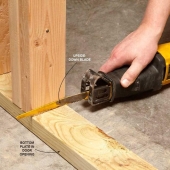
When I’m not using compressed logs, I prepare my own firewood by cutting down damaged trees using a Japanese hand saw and a reciprocating saw, which I recharge using my solar panels.


On my planet I'm considered quite beautiful. Thanks to the poetry in this tiny ad:
Learn Permaculture through a little hard work
https://wheaton-labs.com/bootcamp
reply
    Bookmark Topic Watch Topic
  • New Topic