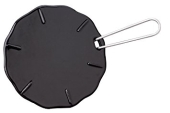
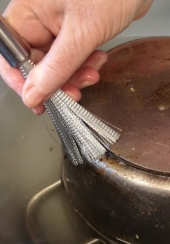
As I mentioned earlier, I like heavy, sturdy cookware. The reason is not only because it is quality made and lasts, but it distributes heat evenly and is not as prone to scorching and burning due to sudden fluctuations in heat. My advice is to get the heaviest cookware you can comfortably use - within reason, of course. I would not buy something just because it is heavy. I also look for solid, sturdy handles and inspect the overall condition of the piece. Something is better than nothing though, so if you have arthritis or are not in the physical shape to handle heavy cookware, buy whatever works best for you.
One Thing I absolutely avoid though, is Teflon coated, nonstick cookware. I know that the “experts” say it is safe when the coating is unscratched and for cooking under a certain temperature. I don’t believe them though. Such coatings are very toxic and many people experience flu-like symptoms even when using the pans as directed… and I have yet to see one that remained unscratched for long. Chemicals from a plant that made such coatings were recently found to have contaminated much of the groundwater in a county where much of my family lived. Cancer rates and strange autoimmune diseases have become epidemic there. I will not sacrifice health for convenience. Besides, there are options that are just as good.
In truth, I don’t buy much cookware. I inherited what seems like a literal ton of old cast iron passed down and collected by several generations. I have nearly every size and shape of Lodge, Wagner and many unbranded pans, pots, dutch ovens, etc, some dating to well over 200 years old. There are some modern-ish brands of cookware that I will not pass up if I find one used, for a reasonable price. Those include (but are not limited to) Le Creuset, which is enameled cast iron, and Mauville - both are expensive French cookware that is actually worth the price. There are good American brands, too. I have not had much experience with All Clad stainless steel cookware, but have been impressed when I did. Recently, a brand called Made In has gotten a lot of good reviews - I am looking forward to trying it. Many people buy copper ware for the looks, alone, and display it in their kitchens. They are hesitant to use it because copper tarnishes so quickly. However, it cleans up and polishes easily with salt and lemon juice. Quality made copper ware should be used and enjoyed. I like stainless steel for a roasting pan. A roasting pan isn’t so much of a pan used for cooking as it is just a vessel in which the roasts cooks while it is in the oven. Stainless, though, goes easily from the oven to the stove so that pan juices can be used for gravy and sauces. It cleans up easily, too. You can choose a model with a roasting rack to keep the meat off the bottom of the pan, or use the old fashioned method of roasting your meat on a bed of root vegetables and celery.
That said, I would not trade my cast iron for all the Mauville in France! If I had to, I could literally get by with just one piece. That one piece would be a dutch oven. That simple item of cookware enabled the settling of North America. A dutch oven can be used as a soup or stew pot, to deep fry, shallow fry or saute, as a roasting pan for a chicken or a small roast, a stock pot, a brazier, you can make a sauce in it… you can even bake bread in it! In contrast, a true favorite in my collection is a small, flat skillet, with a slightly raised edge that I inherited from my grandmother. This little pan is my personal egg pan. The surface is as perfectly non-stick as any Teflon coating as it has been seasoned through decades of use. I can make perfect omelets in this pan. I also use it when making a grilled cheese or quick quesadilla or two for lunch. Were I cooking for more than one, this pan would not be as practical. For a large gathering, a cast iron griddle would be more practical. In between, I have cast iron of nearly every size and depth. I even have a very old, 2 ft wide, 4 inch deep pan perfect for frying catfish!
In shopping for cast iron, older is generally better. But, Lodge (at least) still makes good products. I haven’t had experience with other modern brands. The caveat is to never buy cast iron that looks red and/or pitted. Folks used to think the way to restore an old pan was to burn it in a hot fire. Unfortunately, this ruined the pan. Many historical pieces continue to be destroyed by burning due to the persistence of this myth on the internet. Almost as bad is to try to mechanically grind off the rust. What you should do is to scrub off any gunk, coat the pan in oven cleaner and run it through an oven cleaning cycle a few times. This will strip it down and clean it. It will then have to be re-seasoned. People say you should never wash cast iron, but sometimes you have to. When you do, it will again have to be reheated. Rub down your clean pan with vegetable shortening, then bake in your pre-heated over at around 450 degrees Fahrenheit for an hour. I say “around”, because some people swear 400 degrees is the perfect temp while others state 500 degrees. I shoot for the middle. After an hour, turn the oven off and leave the pan in overnight. In the morning, wipe it down with a paper towel or cloth and it should be ready to use. With each use, the fat you use will add to this non-stick, polymerized surface.
There are two things you should absolutely NEVER do with cast iron. One is, don’t drop it on your foot. I know that seems obvious. But, most folks who cook with heavy pans will drop one at some time… especially if you have a small dog or cat that is underfoot hoping for scraps. The second is to never pour cold water into a hot pan or plunge a hot pan into cold water. A sudden change in temperature will cause the pan to warp or even crack. Such warped pans are called “spinners” as they will no longer sit flush on a flat surface. A spinner can still be used on the spider burners of a gas stove or for campfire and outdoor cooking. I have one small dutch oven that I use for camping, that was purchased as a spinner for just a few dollars. I don’t mind giving it rough use and although it is a bit heavy, it is an essential in my backpack.
When it comes to casseroles and baking dishes, there are many options from earthenware to modern materials. I inherited a lot of Corningware and Pyrex made in the 1950s and 60s, and I absolutely love them. If your only experience with casseroles has been frozen food or those made with canned soup, you are in for a real surprise and a flavor treat when we get to that chapter. Real, from scratch casseroles are a big part of my French heritage and I am an absolute casserole fanatic! Baking dishes though, are much like roasting pans in that they are a vessel for holding the food while it cooks. The main qualities we are looking for are that it be made from a nonreactive material and that it be heavy and dense. Baking dishes should heat evenly and provide insulation. Thin materials can cause food to scorch and burn.
Other essential cookware for me would be a saucepan and a stock pot. I have a couple of stainless steel saucepans. They are just small pots used for simmering and reducing a sauce. Again, you want a heavy enough pot so you can maintain an even temperature. I have two stockpots, a 2 ½ gallon and a 5 gallon. Both are stainless. I use the big one mainly for beer brewing. A stock pot should hold a large capacity so that bones, meat and veg can be cooked at a simmer for hours without reducing to the point it may scorch. Traditional stock recipes require 12 - 17 hours of cooking. That usually means leaving them to simmer, unattended, overnight. Most folks these days use an instant pot. I still prefer a stock pot.
This article is an excerpt from
Available on in paperback on Amazon:
The Omnivore’s Guide to Home Cooking for Preppers, Homesteaders, Permaculture People and Everyone Else: Carroll, Judson: 9798354856374: Amazon.com: Books
Also, I am back on Youtube. Please subscribe to my channel: @judsoncarroll5902 Judson Carroll - YouTube
Read about my new book:
https://sophiainstitute.com/product/herbs-that-heal/





 4
4