Forums Login/signup

Beetle-ish nibbler in the soon to be orchard - friend or foe

2
+Pie Number of slices to send: Send
Can you guys help me ID this pretty looking bug that was all over the field where I was planting my soon to be fruit forest/ orchard at the beginning of this month?

These guys are fairly big, and appeared to be  in their mating in this season (looked like all they cared about was finding others of their kind).

Any clue what this is? And should I be worried or happy (or indifferent) with them being in the same spot where I just planted all my fruit trees?

74ED00D6-BB40-4147-9ADF-10582339F2A2.jpeg
Black with a blue iridescent shine, about the size of half my finger (small hands though)
[Thumbnail for 74ED00D6-BB40-4147-9ADF-10582339F2A2.jpeg]
+Pie Number of slices to send: Send
I honestly don't know, and I would need to see it from an overhead angle to even try to identify it but I think most of the larger beetles are either dung beetles or cadaver beetles.
+Pie Number of slices to send: Send
Also no expert, but does look a bit like a dung beetle. If so, I don’t think they are any harm to an orchard or other crops.
+Pie Number of slices to send: Send
I agree that it is a dung beetle.  They are my friend as they carry off the dog's poop from our patio area.  Save me from having so much to pickup.

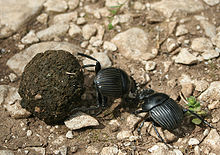
Dung beetles play a role in agriculture and tropical forests. By burying and consuming dung, they improve nutrient recycling and soil structure.[28][29] Dung beetles have been further shown to improve soil conditions and plant growth on rehabilitated coal mines in South Africa



https://en.wikipedia.org/wiki/Dung_beetle
2
+Pie Number of slices to send: Send
That looks like a blister beetle to me.  I tried to search for European blister beetles, and this type looks similar to your picture.  There are many types of blister beetles, and they eat all sorts of things.  But the ones that looked most like your picture above -to me - are the Meloe genus.  It's a total guess, but there is a similarity. It's hard not being able to see the abdomen in your picture. But you know what it looked like, so check this out:

Meloe genus blister beetles on Wiki

One type of blister beetle:

+Pie Number of slices to send: Send
 

Kim Goodwin wrote:That looks like a blister beetle to me.  I tried to search for European blister beetles, and this type looks similar to your picture.  There are many types of blister beetles, and they eat all sorts of things.  But the ones that looked most like your picture above -to me - are the Meloe genus.  It's a total guess, but there is a similarity. It's hard not being able to see the abdomen in your picture. But you know what it looked like, so check this out:

Meloe genus blister beetles on Wiki

One type of blister beetle:


Thanks everyone for your fast responses!

Looking from the pictures I’m fairly sure Kim has hit the nail on the head!! I should have taken a picture from the abdomen but forgot to do so. However I vividly remember them having a wasplike waist and then that disproportionately huge abdomen. So I’m fairly sure blister beetle is the correct one. Never heard of them though!
Should I consider these guys as my friendly neighbors, or are they more that kind of annoying loud neighbor that steals your tomatoes?

I already saw that they are sort of parasitic towards bees. That’s not very cool, as I had planned to set up a few hives in the orchard, so right into blister bug territory...
+Pie Number of slices to send: Send
Well according to the link they are parasites of bees, and some other stuff I read said they can occasionally become garden pests, adults feeding on foliage and flowers. However they can release an irritant when handled so don't play around with them with bare hands. From what I read I don't think they will be a serious problem in an orchard that has enough diversity to keep them in check.
+Pie Number of slices to send: Send
You beat me to it, Sarah.

Good thing I was wearing gloves when I took this picture then!
I hope the parasitic tendencies won’t be a problem, as I had planned to set up hives in the orchard.
Would chickens happen to eat these guys?
2
+Pie Number of slices to send: Send
I don't think my chickens were ever keen on eating the bugs with nasty defense mechanisms. I wonder if there's mesh small enough to keep the bugs out of hives, but big enough to let the bees through? They lay their eggs on the bee larvae I think, so keeping them out of the hives could be enough to limit their reproduction.
(1 apple) 2
+Pie Number of slices to send: Send
From my understanding, the larva of the oil beetle hang out on flowers and send out pheromones to attract a male bee, who they then hitch a ride on back to the nest. There, they feed on the bee larvae and pollen. Once they pupate, they emerge from the hive as adults. So alas, there'd be no excluding them with mesh. There's more detailed info about their life cycle here
From the article, it sounds as if they parasitize ground dwelling solitary bees. So maybe they don't bother honey bees?

+Pie Number of slices to send: Send
 

Heather Olivia wrote:From my understanding, the larva of the oil beetle hang out on flowers and send out pheromones to attract a male bee, who they then hitch a ride on back to the nest. There, they feed on the bee larvae and pollen. Once they pupate, they emerge from the hive as adults. So alas, there'd be no excluding them with mesh. There's more detailed info about their life cycle here
From the article, it sounds as if they parasitize ground dwelling solitary bees. So maybe they don't bother honey bees?


I took a look at the link... really fascinating!
3
+Pie Number of slices to send: Send
Meloe genus parasites only on nests of solitary bees, so don´t worry about your honey bees.. The adults occur only in early spring, they dissapear during April and May. I call them "messengers of the spring". When I see first of them, I know the spring is definitely here. They secrete some nasty tasting and poisoning lympha through their limb joints when disturbed and the chickens learn very soon that these ladies are not the tasty ones..
+Pie Number of slices to send: Send
I’m glad to read they don’t prey on honey bees. But I’m not terribly fond of them preying on the solitary bees either,  seem way more useful to me then these guys so far.
I’m not entirely keen on the idea of just squashing these guys, but I don’t suppose chucking them in the river to be washed away could be, might be an idea? Or would that have no effect, since bees can travel very far?
1
+Pie Number of slices to send: Send
The nature is full of parasites (parasitism is the most common strategy of living). Your opinion that Meloe is "bad" and the solitary bee is "good" is very subjective and the best thing you can do is not interfere..
Self destruct mode activated. Instructions for deactivation encoded in this tiny ad.
permaculture thorns, A Book About Trying to Build Permaculture Community - draft eBook
https://permies.com/wiki/123760/permaculture-thorns-Book-Build-Permaculture
Sepp Holzer Desert or Paradise Documentary apropedia earth Green Living Book


reply
reply
This thread has been viewed 674 times.
Similar Threads
Companion Strategies similar to Three Sisters?
Help deciding what trees and how many to plant for coppiced firewood?
Lye and aphids
Japanese beetle control
What is this critter a centipede like thing? (ID: wire worm)
permaculture thorns, A Book About Trying to Build Permaculture Community - draft eBook
Support the Permaculture Bootcamp - Back the BEL
More...

All times above are in ranch (not your local) time.
The current ranch time is
Mar 11, 2026 03:10:23.