• Post Reply Bookmark Topic Watch Topic
  • New Topic
permaculture forums growies critters building homesteading energy monies kitchen purity ungarbage community wilderness fiber arts art permaculture artisans regional education skip experiences global resources cider press projects digital market permies.com pie forums private forums all forums
this forum made possible by our volunteer staff, including ...
master stewards:
  • Carla Burke
  • Nancy Reading
  • John F Dean
  • r ransom
  • Jay Angler
  • Timothy Norton
stewards:
  • paul wheaton
  • Tereza Okava
  • Nicole Alderman
master gardeners:
  • M Ljin
  • Christopher Weeks
gardeners:
  • Jeremy VanGelder
  • thomas rubino
  • Megan Palmer

Water from fog collection

 
pollinator
Posts: 6108
Location: Bendigo , Australia
568
plumbing earthworks bee building homestead greening the desert
  • Likes 4
  • Mark post as helpful
  • send pies
    Number of slices to send:
    Optional 'thank-you' note:
  • Quote
  • Report post to moderator
This topic is actually as old as mankind, but today modern materials are being used.
Try this for a taste!
water from fog collection
 
pollinator
Posts: 394
Location: Central TX
166
5
homeschooling kids forest garden foraging books medical herbs building homestead greening the desert
  • Likes 2
  • Mark post as helpful
  • send pies
    Number of slices to send:
    Optional 'thank-you' note:
  • Quote
  • Report post to moderator

John C Daley wrote:This topic is actually as old as mankind, but today modern materials are being used.
Try this for a taste!
water from fog collection


I’m just imagining if everyone with 1/2+ acre in foggy areas were to have one of these systems... either to supplement their potable water needs or just to use for irrigation. What a change it would have on the world!

I love their mention of using it for reforestation. We just bought land in the hills so I’m starting to think of ways we could use this system. It may do us well to supplement our potable water.

John, have you implemented a system like this on your property or do you have something planned?
 
John C Daley
pollinator
Posts: 6108
Location: Bendigo , Australia
568
plumbing earthworks bee building homestead greening the desert
  • Likes 5
  • Mark post as helpful
  • send pies
    Number of slices to send:
    Optional 'thank-you' note:
  • Quote
  • Report post to moderator
No Rebecca, you need plenty of fog and we rarely get it in the climate I am in.
Coastal ares etc are fantastic for them.
The link I supplied details various projects that have been carried out.
Some collect 2-300L per day.
 
Posts: 25
Location: Mason County, WA USA:Ha; Harstine gravel ashy sandy loam
16
duck rabbit chicken medical herbs bee solar wood heat rocket stoves
  • Likes 3
  • Mark post as helpful
  • send pies
    Number of slices to send:
    Optional 'thank-you' note:
  • Quote
  • Report post to moderator
Hi  Permies -

In my off grid Pacific Northwest (Puget Sound) location, the estimate for a drilled well is about $35K; that will be a goal for 2-3 years from now. In the mean time, I am setting up rainwater catchment from hoophouse (20'W x 30'L x 12' arch) covered with UV poly fabric, into raingutters, into catchment tanks, through filtration, into peeps / livestock / plants. Here is my question about this: The fabric is stretched tight over the arch frame, overlapping the infill end walls. I do not want to put holes in it which can lead to tears and rips and shreds and bad-things-happen. In order to attach the vinyl rain gutter along the side of the hoophouse, could magnets be used? The archers and purlins are steel.  (see pic attached) If magnets were glued to the interior side of the rain gutter, and aligned with those arches and purlins, would that be likely to hold the rain gutter in place? This would also allow gutters to be easily removed before snow (kinda rare but it happens) so that snow being swept off the arch did not ruin the gutters. Has anyone tried this? All suggestions welcome.

I am also planning to build a fog collector for irrigation catchment on the natural birm that runs through the center of the property. The prevailing wind comes across the brim, and should allow for good airflow and dew capture. I am working with this resource: https://sfcfieldguide.wordpress.com/ where I purchased FogQuest's excellent 'Fog Collector Field Guide' downloadable .pdf.  See pics attached.  Here is my question about this: The instructions in the field guide, and in many places online, suggest using a double layer of HDPE shade cloth for the capture mesh. In an ongoing effort to limit microplastics into the collected water supply wherever possible, I am evaluating alternatives. The cheap-doable-right-away solution is to use burlap/jute instead, knowing that it would need to be replaced yearly (or maybe seasonally). A longer term enduring solution could be to use a double layer of 20 stainless steel mesh 316L which would outlive me (but requires more initial investment), and could later be put on the same framing as the jute.  Has anyone used burlap for this? Again, all suggestions welcome.

Always grateful for perspectives of experience! Thanks
FogQuest1.png
[Thumbnail for FogQuest1.png]
FogQuest3.png
[Thumbnail for FogQuest3.png]
FogQuest4.png
[Thumbnail for FogQuest4.png]
FogQuest5.png
[Thumbnail for FogQuest5.png]
Hoop_Inside.jpg
[Thumbnail for Hoop_Inside.jpg]
 
master pollinator
Posts: 2152
Location: Ashhurst New Zealand (Cfb - oceanic temperate)
747
duck forest garden fungi trees chicken cooking solar sheep wood heat woodworking rocket stoves
  • Mark post as helpful
  • send pies
    Number of slices to send:
    Optional 'thank-you' note:
  • Quote
  • Report post to moderator
I like the stainless steel mesh option. Natural fibres not only will need replacing frequently, but also will trap dust and pollen, which will provide a habitat for things to grow that you might not want in potable water.
 
Kara Ann
Posts: 25
Location: Mason County, WA USA:Ha; Harstine gravel ashy sandy loam
16
duck rabbit chicken medical herbs bee solar wood heat rocket stoves
  • Likes 3
  • Mark post as helpful
  • send pies
    Number of slices to send:
    Optional 'thank-you' note:
  • Quote
  • Report post to moderator
Thanks Phil - yes, it seems like Burlap would be more friendly to microbes. Not a value added quality.

Also in the meantime, I found some other posts,  ( Thankyou to  Mike Fedderson for posting)  same topic / different post chain with this really interesting link:  
http://news.mit.edu/2013/how-to-get-fresh-water-out-of-thin-air-0830

In this article, the peeps at MIT are adamant that a mesh like typical window screen has tiny openings that are much better at condensing water out of air than the burlap or the sun screen mesh.  Good to know!

I found a roll of about 4ft W x 100ft long 20 mesh stainless window screen on Amazon for about $100.... will prototype with that, and post some pics and some data once it is up and going.

Looks like you are near Palmerston North in NZ, Phil! I lived in Wellington for several years and traveled through that area many times - you have a lovely part of the world to enjoy! Thanks again for sharing your thoughts on this.
 
John C Daley
pollinator
Posts: 6108
Location: Bendigo , Australia
568
plumbing earthworks bee building homestead greening the desert
  • Likes 4
  • Mark post as helpful
  • send pies
    Number of slices to send:
    Optional 'thank-you' note:
  • Quote
  • Report post to moderator
Kara, that stainless steel mesh is known as fly screen mesh in Australia, it will be plastic coated, as will Aluminium mesh of a similar size but much less cost.
I have observed condensation on the underside of 'carport' roofs in foggy aras.
The level of fog you have may be a great place to benefit with water collection.
I promote rainfall collection and my signature may have insights for you.
 
Posts: 1055
Location: In the woods, West Coast USA
220
  • Likes 5
  • Mark post as helpful
  • send pies
    Number of slices to send:
    Optional 'thank-you' note:
  • Quote
  • Report post to moderator
Tried this during the drought years for garden water.  Not all fog is created equal, especially during a drought.   Apparently everything is drier then!   We are close enough to the coast to get a "marine layer," a lot during the summer and my rough estimate is that less than 50% of the fog left moisture on surfaces that could be collected, and even then it wasn't much.  

Maybe those pictures of large installations that claim they get enough water are very high in elevation and they are actually in the clouds as well.   Or their fog is just wetter than ours.

Didn't work for me.
 
John C Daley
pollinator
Posts: 6108
Location: Bendigo , Australia
568
plumbing earthworks bee building homestead greening the desert
  • Likes 2
  • Mark post as helpful
  • send pies
    Number of slices to send:
    Optional 'thank-you' note:
  • Quote
  • Report post to moderator
Christo, you might be onto something, in Australia we had an area in Queensland rainforest which was cut down to make dairy farms, the area dried out quickly and years later
it was ralised that the trees were pulling water out of clouds which hung around.
No trees, no cloud catching and hence no more water.
 
Kara Ann
Posts: 25
Location: Mason County, WA USA:Ha; Harstine gravel ashy sandy loam
16
duck rabbit chicken medical herbs bee solar wood heat rocket stoves
  • Likes 4
  • Mark post as helpful
  • send pies
    Number of slices to send:
    Optional 'thank-you' note:
  • Quote
  • Report post to moderator
Thanks John and Cristo for weighing in on this.

John, I have benefitted from reading so many of your postings, and am grateful for all the wise perspectives you have shared. Thank you! I will follow up on your other links and posts. I will be planning to use a double layer of 40 mesh size (screen mesh as you have indicated) based on the MIT research.

Cristo - yes, the proof is in the doing, not in the theory or the planning. I am sorry to hear that this was not a successful endeavor in your location.

Here is the justification for prototyping and data gathering on this dew collection strategy for my specific location (thanks Claude.ai for helping me research and document this):

Location and topographic advantage:
The property in Mason County, WA sits in the maritime Pacific Northwest, one of the most fog-prone regions in the continental United States. A natural berm rising 15–20 feet bisects the property on an east-west axis. The west-facing slope of this berm creates a localized orographic lift effect — the same mechanism that makes coastal mountain ranges effective fog collectors worldwide. Moist maritime air moving inland from Puget Sound is forced upward by the berm, cools, and deposits moisture on surfaces — exactly the conditions that FogQuest and the MIT research identify as optimal for fog and dew collection.
Wind patterns — confirmed by WRCC historical data (KSHN Shelton Airport, 1992–2002):
Prevailing winds are WSW to SW virtually year-round, averaging 5–7 mph with gusts to approximately 11 mph. This is significant because FogQuest field research identifies 4–9 mph as the optimal wind speed range for fog interception — fast enough to drive droplets into the mesh, slow enough that droplets coalesce rather than passing through. Shelton's average wind speed sits squarely in this optimal range across all twelve months.
Humidity — a critical baseline factor:
Historical climate data for the Shelton area shows relative humidity ranging from 72% in July (the driest month) to 90% in November through December. Even the driest summer months maintain humidity well above the threshold needed for meaningful dew formation on a cooled surface. Combined with the cool Pacific Northwest nights — when surface temperatures regularly drop below the dew point — the property has a long and productive dew collection season.
The berm as a force multiplier:
The west-facing berm slope provides morning shade — keeping collection surfaces cooler longer into the morning, extending the collection window beyond sunrise. It also positions collectors to intercept the first wave of moist air moving inland before it has lost moisture to the flat terrain. Both effects increase yield compared to flat-ground installations.
MIT research conclusion on mesh — directly applicable:
MIT's 2013 peer-reviewed research (published in Langmuir) found that existing fog collection systems using standard mesh may capture only 2% of available water in mild fog, while optimized mesh can capture 10% or more — a fivefold improvement. Their optimal specification calls for stainless steel filaments at approximately 210–280 microns diameter with spacing of 420–560 microns — corresponding to approximately 40-mesh stainless steel. This means the difference between a mediocre and an excellent collector is not location or structure — it is mesh specification, and that specification is now known and available.
The bottom line for prototyping:
This property combines the right geography (orographic berm), the right wind speed range (5–7 mph average, optimal for interception), the right humidity baseline (72–90% year-round), the right orientation (WSW prevailing wind directly up the west-facing slope), and now the right mesh specification from peer-reviewed research. The argument for prototyping is not optimism — it is that all the known success factors are present and measurable. The prototype's purpose is to quantify yield under these favorable conditions, not to test whether the conditions are favorable. They demonstrably are.

After the prototype is built and I have some actual datat to share I will update this post! I am looking forward to seeing how this goes!
 
John C Daley
pollinator
Posts: 6108
Location: Bendigo , Australia
568
plumbing earthworks bee building homestead greening the desert
  • Likes 2
  • Mark post as helpful
  • send pies
    Number of slices to send:
    Optional 'thank-you' note:
  • Quote
  • Report post to moderator
Kara, I am fascinated by your last post, I had not realised the specific requirements for fog collecting!
It sounds great and I will keenly watch your progress.
What volume of water will you aim to get early on?
Heaps I hope, so you can proof the concept and show it is more than  subsistence system.
 
John C Daley
pollinator
Posts: 6108
Location: Bendigo , Australia
568
plumbing earthworks bee building homestead greening the desert
  • Likes 2
  • Mark post as helpful
  • send pies
    Number of slices to send:
    Optional 'thank-you' note:
  • Quote
  • Report post to moderator
This is another video about the concept which may enlighten others.

 
Kara Ann
Posts: 25
Location: Mason County, WA USA:Ha; Harstine gravel ashy sandy loam
16
duck rabbit chicken medical herbs bee solar wood heat rocket stoves
  • Mark post as helpful
  • send pies
    Number of slices to send:
    Optional 'thank-you' note:
  • Quote
  • Report post to moderator
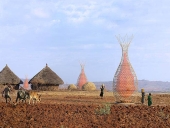
Thanks for posting that John - I had read about warka water towers before, but not had all the background, so it was interesting to watch. I would have to do some deep dive into the county building code information before I could create something 33 feet high on the farm - it would absolutely require a building permit.

Has anyone here on permies built a warka water tower and have some output data?

For now I am planning for three dew catchers to verify efficacy - honestly I have no way to predict how much water they will condense, as you have asked, so I will measure and see!
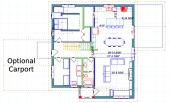
Each dew catcher will have a 4ft x 9.5ft double layer of 40mesh horizontally mounted, positioned over a trough with drain hose, on cedar posts, secured with guy wires, connected to water barrel. Two will have stainless steel mesh and one will have copper mesh for comparison. Copper has slightly different characteristics for water, and I want to see if it interacts differently in water condensation production here. Specific placement could also make a difference in water output... Mesh panel will face WSW for best wind engagement The plan is for 3 of them staggered at different height, with minimum 16 feet between panels to keep them out of eachother's wind shadows. First will be 4ft upslope on the berm from the surrounding lower area. Second will be 8ft upslope, staggered further northward. Third will be 12ft upslope, again staggered further northward. Attaching prototype plan on topo.

Expecting to build these in June. Will post pics when they are up, and data when the dewcatchers are in action!
Thanks for the encouragement.
Dewcatcher_Topo.png
[Thumbnail for Dewcatcher_Topo.png]
 
John C Daley
pollinator
Posts: 6108
Location: Bendigo , Australia
568
plumbing earthworks bee building homestead greening the desert
  • Likes 2
  • Mark post as helpful
  • send pies
    Number of slices to send:
    Optional 'thank-you' note:
  • Quote
  • Report post to moderator
With your land size I wonder if you could just build a tower without worrying about a permit?
 
John C Daley
pollinator
Posts: 6108
Location: Bendigo , Australia
568
plumbing earthworks bee building homestead greening the desert
  • Likes 2
  • Mark post as helpful
  • send pies
    Number of slices to send:
    Optional 'thank-you' note:
  • Quote
  • Report post to moderator
I just pulled a book from my collection
"Harvesting fog for water"
by Cecilia Pinto McCarthy pub lished by Abdobooks.com
 
Kara Ann
Posts: 25
Location: Mason County, WA USA:Ha; Harstine gravel ashy sandy loam
16
duck rabbit chicken medical herbs bee solar wood heat rocket stoves
  • Likes 2
  • Mark post as helpful
  • send pies
    Number of slices to send:
    Optional 'thank-you' note:
  • Quote
  • Report post to moderator
Thanks John - will look at that book - published in 2019, more recent data than some of the other references I have been looking at.
And building a tower 30+ feet high without a permit - oh my golly, this is not the right county for that approach. My farm is on a little island, about 18sq miles. It is very rural, no commerce on the island, not even a gas station or coffee shop.  Lots of trees. Some farms. Some park service land. A few bears. But plenty of visibility within the county, and the county planning office is exceedingly proactive. They require notification / approval for agricultural buildings like the hoop house and greenhouse, with strict guides about how tall / amount of roof square footage etc.

I can definitely put up the dew catchers and anything up to 10 feet or so without anybody raising eyebrows, so will start there...

Is the permitting quite open minded / lax where you are?
 
John C Daley
pollinator
Posts: 6108
Location: Bendigo , Australia
568
plumbing earthworks bee building homestead greening the desert
  • Mark post as helpful
  • send pies
    Number of slices to send:
    Optional 'thank-you' note:
  • Quote
  • Report post to moderator
Sounds as isolated as my place, but I am not on an island, just inside a big forest, the Wellsford Forest.
Building regs are applied with permits here, but I have been here a long time and council records are lost.
I am also isolated from anybody so I have built a few things to suit myself.

That island of yours sounds great.
Where does the fog come from, the water around the island?
 
I agree. Here's the link: http://stoves2.com
reply
    Bookmark Topic Watch Topic
  • New Topic