
• Post Reply Bookmark Topic Watch Topic
  • New Topic
permaculture forums growies critters building homesteading energy monies kitchen purity ungarbage community wilderness fiber arts art permaculture artisans regional education skip experiences global resources cider press projects digital market permies.com pie forums private forums all forums
this forum made possible by our volunteer staff, including ...
master stewards:
  • Carla Burke
  • Anne Miller
  • Nancy Reading
  • John F Dean
  • r ransom
  • paul wheaton
  • Timothy Norton
stewards:
  • Jay Angler
  • Pearl Sutton
  • Andrés Bernal
master gardeners:
  • Christopher Weeks
gardeners:
  • M Ljin
  • Thekla McDaniels
  • May Lotito

Nature journaling and "sit spots"

 
steward
Posts: 22955
Location: Pacific Northwest
13832
13
homeschooling hugelkultur kids art duck forest garden foraging fiber arts sheep wood heat homestead
  • Likes 15
  • Mark post as helpful
  • send pies
    Number of slices to send:
    Optional 'thank-you' note:
  • Quote
  • Report post to moderator
My kids are in a sort of environmental studies/forest school class. A large part of the class is keeping nature journals to observe the world around them and write down things they notice, wonder, and learn. I couldn't resist joining in on the fun!

Step 1: Get a book!
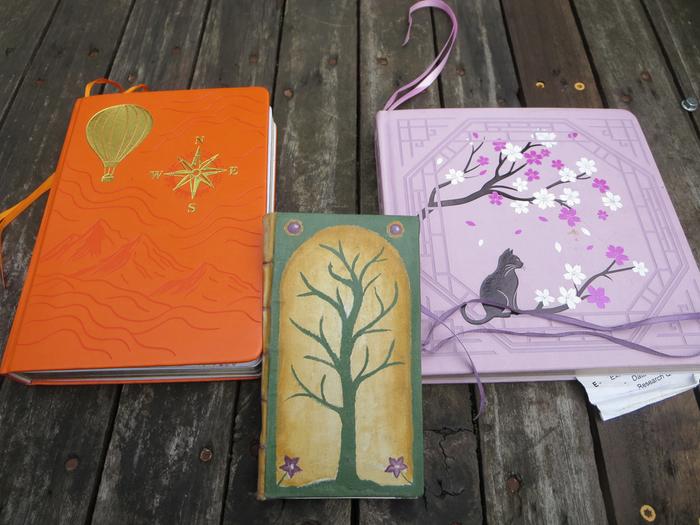
The teachers encouraged us to get hard-cover books that allowed for both art and descriptions. I let my kids pick their own books, and I decided to use the book that I'd made as an test-book/example for my medieval history class.

My kids and my nature journals!


Step 2: Learn about "sit spots" and how to nature journal.
A sit spot is a place you pick out to sit quietly for at least 15 minutes and write down what you notice, wonder, and realize. The things you document can help you identify stuff later on! My kids teachers have 4 rules for sit spots. They should be: silent, solo, sitting and safe (you might not sit if it's raining!).

These are some of the videos my kids have watched to learn about sit spots & nature journaling:


You can pick a sit spot at your own property to continually observe the same area all year round:


Step 3: Start journaling!
You can journal at your own place, to see how thing change all year round. You can visit other places to learn about more plants. I'm kind of surprised at how much I've learned in just three weeks of nature journaling. I've found and identified my first Hawthorne, realized trees I thought were Douglas Firs were actually Sitka Spruces, and the Beaufort scale for identifying wind speeds.

It's also a really fun way to engage your creative mind and have an excuse/reason to draw and paint. But, if you don't like art, you can just use words and numbers to record what you're noticing.
 
Nicole Alderman
steward
Posts: 22955
Location: Pacific Northwest
13832
13
homeschooling hugelkultur kids art duck forest garden foraging fiber arts sheep wood heat homestead
  • Likes 13
  • Mark post as helpful
  • send pies
    Number of slices to send:
    Optional 'thank-you' note:
  • Quote
  • Report post to moderator
I thought I'd share some of my kids' and my journal entries. This is a great way to get kids noticing their world, and also get reluctant artists and writers to see a reason for writing.

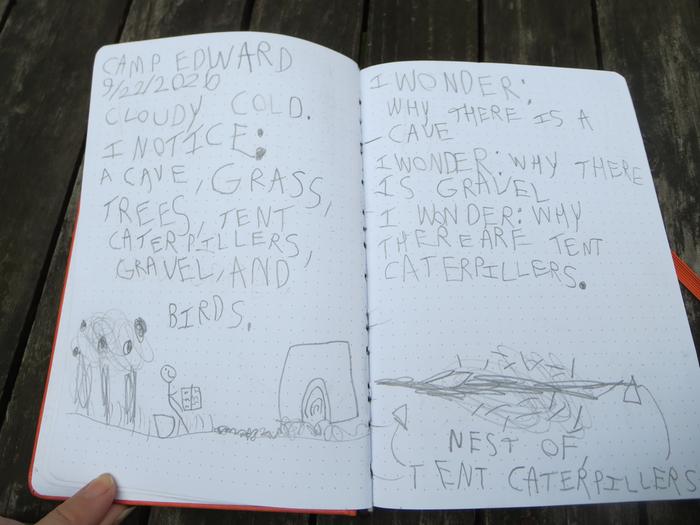
My reluctant writer wrote quite a bit!


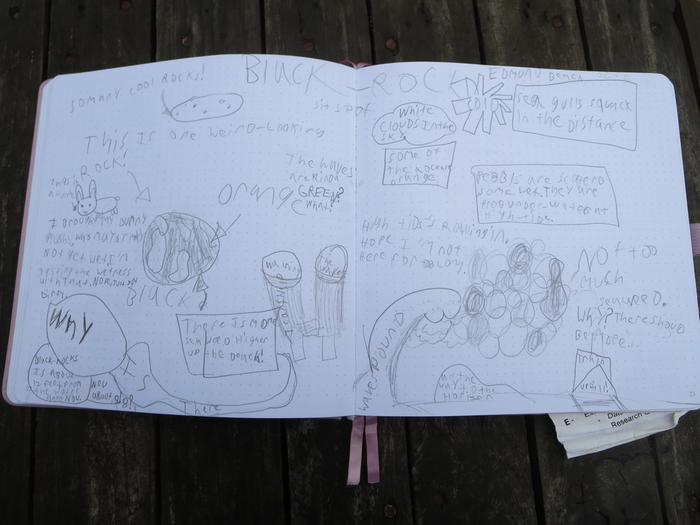
My creative artist/writer had a lot of fun making her journal page be fun and artistic.


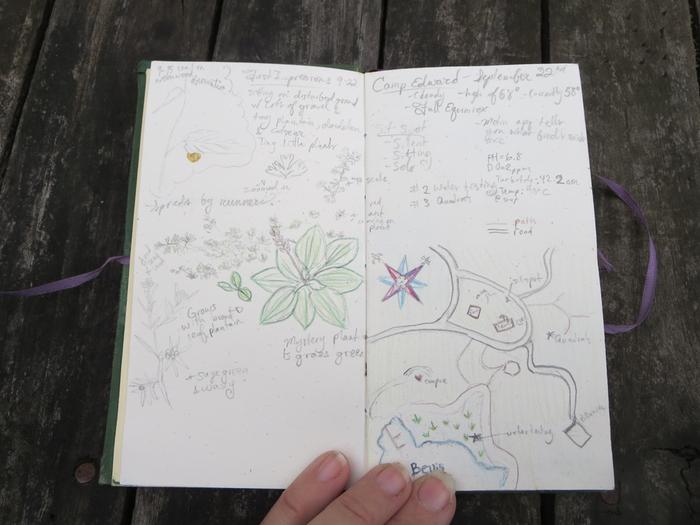
This was our first field trip, and so my first entry. We learned about using meta data--like maps and temperature--in our journal entries


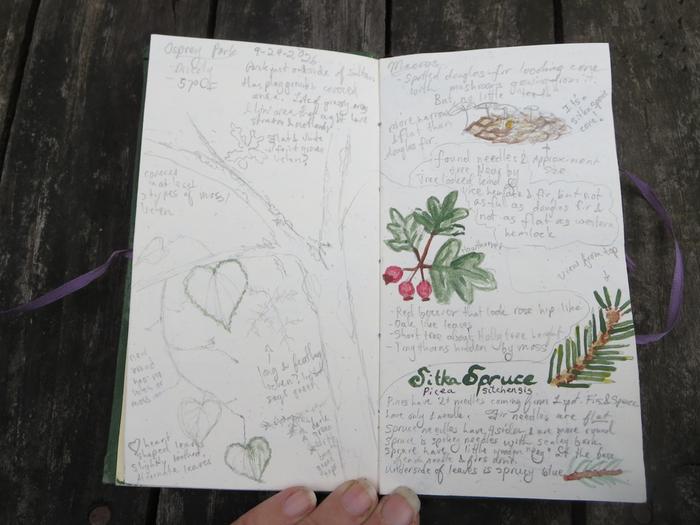
The next week was rather fun, because I finally spotted my first hawthorn! And, I learned how to distinguish Douglas firs from Sitka spruce! One of the students found a cone with mushrooms growing out of it. They thought it was a Douglas fir, but it didn't have the little "bracts" coming out of it. I took as many notes as possible about the tree and plant, and identified it when we got back to school! Then I found out that the trees I'd planted thinking they were doug firs were actually sitka spruce!

I wish I'd recorded more info about the tree on the left. It was covered in moss & lichen, with alternate slightly-serrated heart-shaped leaves. But, I ended up spending most of my time helping my son with his journal since it was raining.


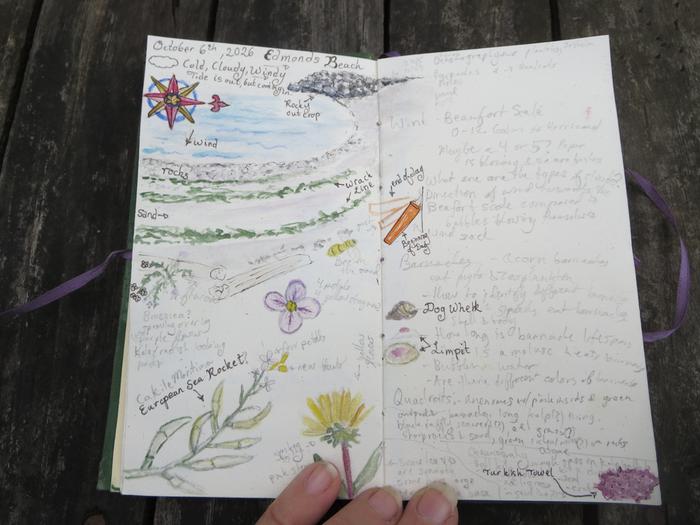
The next week, we went to the beach, and I learned about Turkish towel seaweed, identified European sea rocket (a brassica! I didn't try eating it, though. It probably had dog pee), and I learned about the Beaufort wind scale.

I had fun painting and inking parts of this page when I got home. I took a few pictures with my camera while I was at the beach so I could identify stuff better and paint them better.


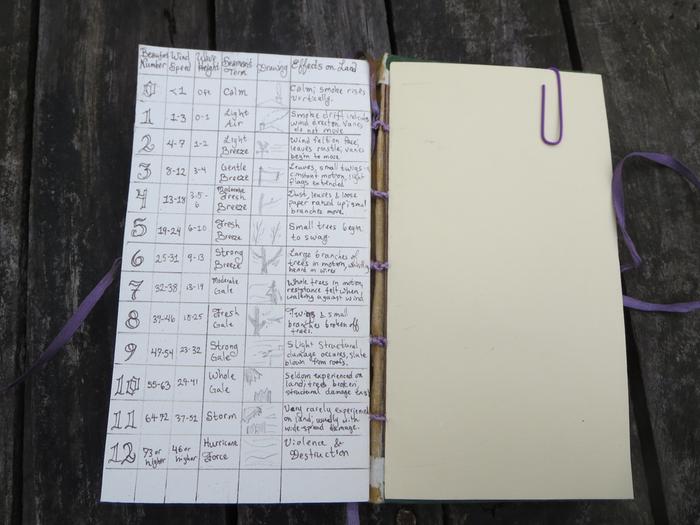
I thought the Beaufort wind scale was facinating and super handy, so I transcribed it into the back of my journal!

I've always kind of wondered what wind speeds were happing outside. Now I have a way, using just what I see and feel!


Here's the video we watched about the Beaufort wind scale:

 
master steward
Posts: 19914
Location: USDA Zone 8a
4992
dog hunting food preservation cooking bee greening the desert
  • Likes 10
  • Mark post as helpful
  • send pies
    Number of slices to send:
    Optional 'thank-you' note:
  • Quote
  • Report post to moderator
What beautiful journals you and your kids have made.

Those will be memories that can be carried down through generations.

I have my grandfather journal.  The first page that I opened talked about how my mother had taken me and gone back to her home state.

I also have a memory of my dad coming in a big red truck with all our belongings.
 
Nicole Alderman
steward
Posts: 22955
Location: Pacific Northwest
13832
13
homeschooling hugelkultur kids art duck forest garden foraging fiber arts sheep wood heat homestead
  • Likes 14
  • Mark post as helpful
  • send pies
    Number of slices to send:
    Optional 'thank-you' note:
  • Quote
  • Report post to moderator
Thank you, Anne ♥. One of the class teachers mentioned how, if a fire happened, the first things she'd be grabbing were her and her kids' nature journals. They have like 6 years of nature journals full of beautiful memories.

I have a copy of my great-great-great grandfather's diary from when he traveled up to Alaska during the Klondike Gold Rush. Reading it really brought the past to life and connected me to my family.
 
Anne Miller
master steward
Posts: 19914
Location: USDA Zone 8a
4992
dog hunting food preservation cooking bee greening the desert
  • Likes 6
  • Mark post as helpful
  • send pies
    Number of slices to send:
    Optional 'thank-you' note:
  • Quote
  • Report post to moderator
If I did a nature journal it would have to be done in spring when all the wild flowers are blooming.

Or in August when all the prickly pear tunas are purple.

Maybe it would be fun to do a journal month by month so the nature journal tells a story of what can be seen each month.

How interesting to be able to read about that trip to Alaska.
 
pollinator
Posts: 1613
Location: Wheaton Labs, Montana, USA
3176
11
home care trees books wofati food preservation bike bee building writing seed
  • Likes 11
  • Mark post as helpful
  • send pies
    Number of slices to send:
    Optional 'thank-you' note:
  • Quote
  • Report post to moderator
I'd kicked myself repeatedly this year, as I had aspirations of detailing the succession of plants and animals that passed through Wheaton Labs throughout the year. I want it to be a kind of reference for the Boots:
- First plants blooming in the spring.
- Types of insects and when they arrive on the scene.
- When to harvest annual vegetables.
- Aggressive yellow jackets.
- Periods of 0 precipitation, hottest temps in the summer, and plant "dormancy" due to high temps.
- Last flowers for pollinators to feed from.
- Procession of perennial forage greens on the property.

I think that kind of information will be useful, even just as a foundation, for long-term residents/residence and future planning. "There's always next year..."

As for sit spots, fellow boot Esteban is chipping away at a "Boot Sit Spot" location here at Basecamp. Alongside a footpath, there's a small raised garden bed there so far. He intends to install a three-log-bench there and do a series of plantings so that Boots and other guests will have a quiet place to sit and observe nature.

Thanks for the inspiration (and reminder), Nicole...!
 
steward & author
Posts: 48853
Location: Left Coast Canada
20622
10
art trees books chicken cooking fiber arts
  • Likes 8
  • Mark post as helpful
  • send pies
    Number of slices to send:
    Optional 'thank-you' note:
  • Quote
  • Report post to moderator
This is so cool.  

The kids journals are amazing

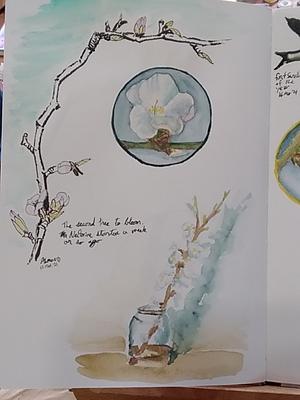
I did a bit like this a few years ago as I wanted to document what the different fruit tree flowers looked like.  I find I refer to this quite a lot in the spring and often wonder if a bigger version of a nature journal would come in handy.


Nicole Alderman
steward
Posts: 22955
Location: Pacific Northwest
13832
13
homeschooling hugelkultur kids art duck forest garden foraging fiber arts sheep wood heat homestead
  • Likes 6
  • Mark post as helpful
  • send pies
    Number of slices to send:
    Optional 'thank-you' note:
  • Quote
  • Report post to moderator

Stephen B. Thomas wrote:I'd kicked myself repeatedly this year, as I had aspirations of detailing the succession of plants and animals that passed through Wheaton Labs throughout the year. I want it to be a kind of reference for the Boots:
- First plants blooming in the spring.
- Types of insects and when they arrive on the scene.
- When to harvest annual vegetables.
- Aggressive yellow jackets.
- Periods of 0 precipitation, hottest temps in the summer, and plant "dormancy" due to high temps.
- Last flowers for pollinators to feed from.
- Procession of perennial forage greens on the property.

I think that kind of information will be useful, even just as a foundation, for long-term residents/residence and future planning. "There's always next year..."

As for sit spots, fellow boot Esteban is chipping away at a "Boot Sit Spot" location here at Basecamp. Alongside a footpath, there's a small raised garden bed there so far. He intends to install a three-log-bench there and do a series of plantings so that Boots and other guests will have a quiet place to sit and observe nature.

Thanks for the inspiration (and reminder), Nicole...!


I love this, Stephen! I'm frequently amazed at how often I put things off thinking "There's always next year"...and then the things never get done.

The great thing about something like a nature journal, is that it doesn't just help future us, or other people--it helps us in the present as well. A lot of stuff we'd never notice or realize gets figured out when we just take the time to intentionally observe.

For example, we've lived and walked along our private road for over 14 years now. I've spotted western hemlocks, western red cedars, Douglas firs, and one or two blue spruces. But, no other conifers. I figured, since we had *so many* hemlocks, that it was likely logged and seeded with just hemlocks and cedars. I figured those were the only conifers out here--they were the only native ones I ever "saw" growing up.

It wasn't until I was writing in my journal about a weird cone that I found at a nearby park that I found out that there are Sitka spruce this far inland! And then I realized that the little baby "Douglas firs" I'd dug up from the gravel on the side of the road, were actually baby Sitka spruce! I took a walk with my kids yesterday and really looked at the trees and their cones, and finally found a full-sized Sitka spruce, with it's scaly bark and soft cones. It's been there all along, but I'd  just assumed it was a fir. I'd never really looked at it. We learn a surprisingly large amount when we just take the time to look, record, and wonder!
 
Nicole Alderman
steward
Posts: 22955
Location: Pacific Northwest
13832
13
homeschooling hugelkultur kids art duck forest garden foraging fiber arts sheep wood heat homestead
  • Likes 10
  • Mark post as helpful
  • send pies
    Number of slices to send:
    Optional 'thank-you' note:
  • Quote
  • Report post to moderator

r ransom wrote:This is so cool.  

The kids journals are amazing

I did a bit like this a few years ago as I wanted to document what the different fruit tree flowers looked like.  I find I refer to this quite a lot in the spring and often wonder if a bigger version of a nature journal would come in handy.


You're journal page is so pretty, and such a great resource! Isn't it amazing how much more we learn about something when we make ourselves draw it? We have to ask ourselves lots of questions when we draw stuff--how many petals are there? How many stamen? How far apart are the leaves? What are the leaves actually shaped like? What color is that leave and that bark? We notice and learn so much that we would not otherwise!
 
Nicole Alderman
steward
Posts: 22955
Location: Pacific Northwest
13832
13
homeschooling hugelkultur kids art duck forest garden foraging fiber arts sheep wood heat homestead
  • Likes 7
  • Mark post as helpful
  • send pies
    Number of slices to send:
    Optional 'thank-you' note:
  • Quote
  • Report post to moderator
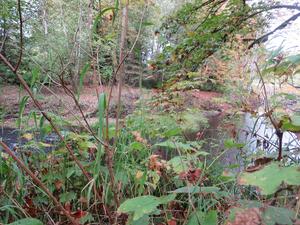
Yesterday, we did our sit spots near a river, and I realized just how hard it is to draw a river bank, let alone paint it! I didn't have my paints with me, so I took pictures to try to get the colors right.

The river bank--hard to see through the plants in front of me!


The river bank is in the top left--it didn't really turn out. It was fun using the random mix of colors from my dried up cup of water for the grey of the water, though!


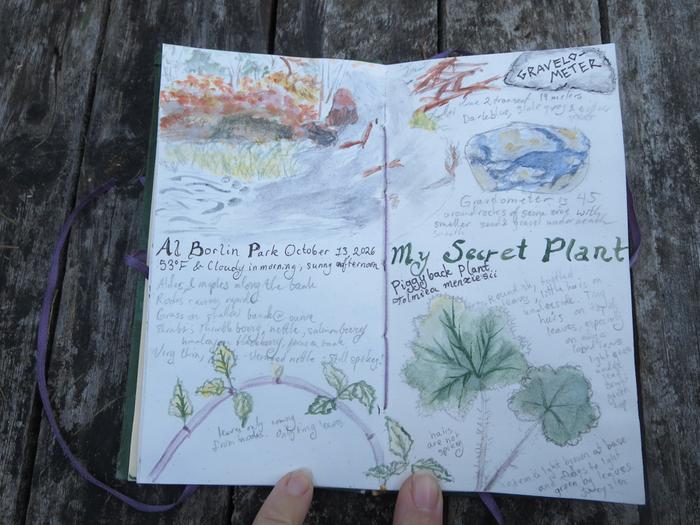
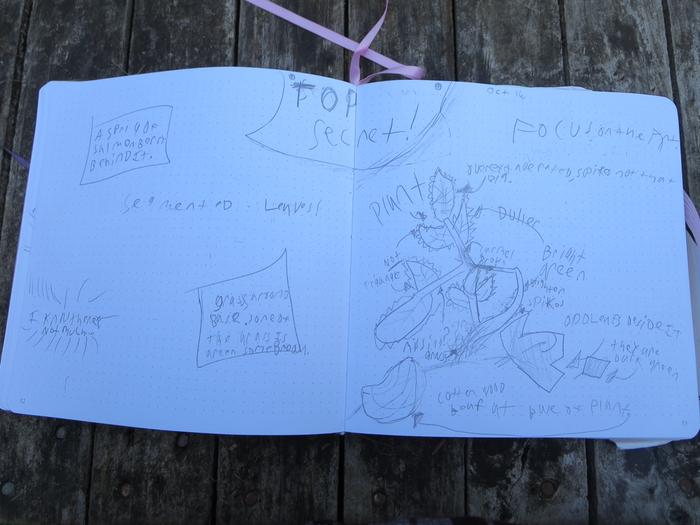
The kids also played a game called, "My Secret Plant." In the game, each kid picked a plant to try to describe in as much detail as possible--using words and drawings. They then handed their journal to a friend, and the friend had to find the plant. This was a lot of fun!

My daughter's secret plant. You can see mine above


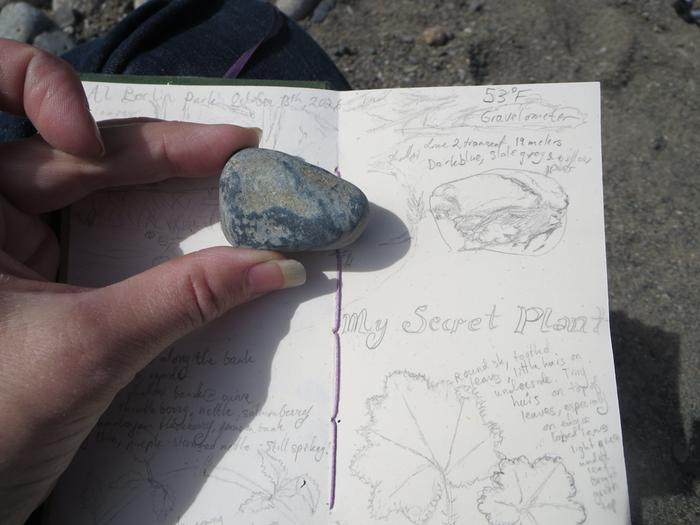
After our Secret Plant game, we learned some gravelology and used a gravelometer to measure rocks along a transverse line of a river bank. Each kid was assigned a meter spot along the transverse tape measure and inspected a rock in their spot. They drew it, described it, and measured it with a gavelometer. It was tricky trying to draw our rocks!

Trying to draw my rock. I took a picture of it so I could paint it when I got home.


I have a lot of fun painting these when I get home. I might try bringing paints in the upcoming nature journal days, though I usually don't have as much time as I'd like to sketch things out on the spot. Painting it when I get home gives me time to reflect.

I've also been trying to challenge myself to learning and identifying a new plant each week. The first week it was Sitka spruce. Then it was sea rocket, and this week I identified our native Piggyback Plant.

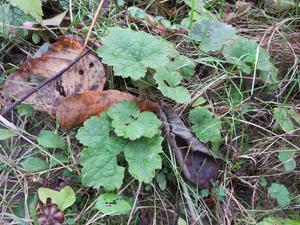
Piggyback plant--it's hairy on the stem, as well as the bottom of the leaves. There's even hairs on the tops of the leaves!
 
r ransom
steward & author
Posts: 48853
Location: Left Coast Canada
20622
10
art trees books chicken cooking fiber arts
  • Likes 4
  • Mark post as helpful
  • send pies
    Number of slices to send:
    Optional 'thank-you' note:
  • Quote
  • Report post to moderator
One of the challenges I have is supplies.  I want to bring all the paints, but then, it's so much hassle to wait for it to dry before packing up.  If I close the paper too soon, it's all messy later.


One thing I'm experimenting with is just ink and pencil and this seems pretty good...except monochrome.

So, I have a tiny set of inktense which are basically watercolour pencils (for practical purposes).  I can colour the items in lightly on the spot, then activate with water when I get home.

 
Nicole Alderman
steward
Posts: 22955
Location: Pacific Northwest
13832
13
homeschooling hugelkultur kids art duck forest garden foraging fiber arts sheep wood heat homestead
  • Likes 12
  • Mark post as helpful
  • send pies
    Number of slices to send:
    Optional 'thank-you' note:
  • Quote
  • Report post to moderator
Ooooh, I have a set of Prismacolor watercolor pencils that I never end up using. Maybe those would be fun to bring along! I could always augment with normal watercolors when I get back.

One thing I'm wondering about is how to carry all the things in an easy, hands-free way.

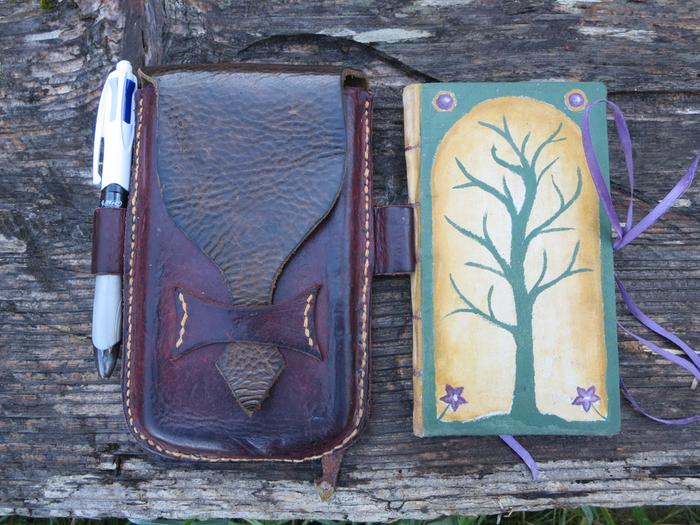
A few years back, I'd a cellphone pouch to carry my parents' old cellphone to use as a camera. That cellphone has since died, and I've moved onto using a digital camera for pictures. I'd spent a lot of time making that pouch, though, and wished I could put it to use. I've also often wished I had a book holster to carry my little notebook around in.

The pouch I'd made when it was new


So, I thought to myself, "Why don't I just make a book to fit this pouch!?" Which is what I did

Book fits nicely in the pouch! The pouch isn't as pretty as it once was, but it's still useful!


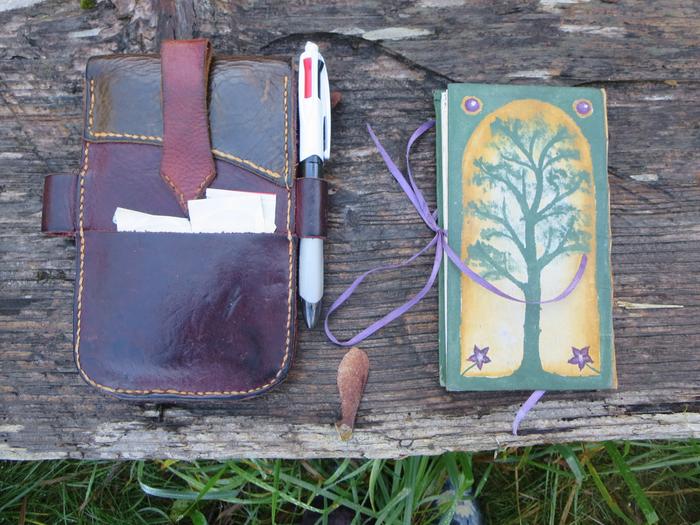
I really like that I can carry two writing utensils (my daughter forgot her pencil and so stole my extra one on the last trip), and that there's space for bandaids if someone gets bumped and scratched. I also like that I can whip it out whenever I need or want to. I'm usually carrying a heavy backpack with our lunch and extra clothes, so there really isn't room for me to store my journal in there, and it takes time to take off and ruffle through a backpack--it takes two seconds to whip out my journal from it's journal pouch!

backside of my journal and journal pouch. The book ties shut, which helps flatten paper that wrinkled when painting. The pouch also helps with that!


I wonder if I could make an art-supplies pouch that I could strap on my belt, too. It could have extra pencils for the kids, watercolor pencils for me, and maybe even a tiny paint set, like the little one I put my hand-made watercolors in. I wonder what an art-supply pouch would look like. Maybe like a tool pouch roll (like you can make in SKIP) or a sewing hussif or those little rolls you store knitting needles in.

Or maybe a pouch that opens up to display everything?

Or maybe like a quiver full of pencils and paintbrushes with a separate pouch for the watercolor set?

So many ideas!
 
r ransom
steward & author
Posts: 48853
Location: Left Coast Canada
20622
10
art trees books chicken cooking fiber arts
  • Likes 10
  • Mark post as helpful
  • send pies
    Number of slices to send:
    Optional 'thank-you' note:
  • Quote
  • Report post to moderator
This was the video that introduced me to nature journaling all those years ago.  This guy is great.


gardener
Posts: 518
Location: Victor, Montana; Zone 5b
255
hugelkultur forest garden composting toilet building rocket stoves
  • Likes 6
  • Mark post as helpful
  • send pies
    Number of slices to send:
    Optional 'thank-you' note:
  • Quote
  • Report post to moderator
A great practice. I have a local who does this as a course at our local library. I provide notebooks and coloring supplies, she provides the instruction and they go to the park.
 
r ransom
steward & author
Posts: 48853
Location: Left Coast Canada
20622
10
art trees books chicken cooking fiber arts
  • Likes 15
  • Mark post as helpful
  • send pies
    Number of slices to send:
    Optional 'thank-you' note:
  • Quote
  • Report post to moderator
This is some of my nature journaling from spring, or book of the farm, to keep track of timings.  

What I didn't expect was the way the different fruits flower.   I could always tell them apart at a glance,  but I never had a reason to look this close.


steward and tree herder
Posts: 14930
Location: Isle of Skye, Scotland. Nearly 70 inches rain a year
8549
6
transportation dog forest garden foraging trees books food preservation woodworking wood heat rocket stoves ungarbage
  • Likes 12
  • Mark post as helpful
  • send pies
    Number of slices to send:
    Optional 'thank-you' note:
  • Quote
  • Report post to moderator
This is a lovely thing to do R.
It reminds me of a book I was given as a child :

The Country diary of an Edwardian Lady
The pictures were lovely, with a little story of where and how she saw the plants and wildlife. Edith Holden used to live near where I was in the West Midlands, but when it was a lot less conurbated.
I think it was done as a school project - she was a teacher I believe, but obviously (like yourself) a pretty talented artist.
 
r ransom
steward & author
Posts: 48853
Location: Left Coast Canada
20622
10
art trees books chicken cooking fiber arts
  • Likes 8
  • Mark post as helpful
  • send pies
    Number of slices to send:
    Optional 'thank-you' note:
  • Quote
  • Report post to moderator
Ohhh... this looks like a fun take on nature journals.   I may just have to try it.

  • Likes 6
  • Mark post as helpful
  • send pies
    Number of slices to send:
    Optional 'thank-you' note:
  • Quote
  • Report post to moderator
These are lovely. I might just give it a try and add it to my list of hobbies.
 
r ransom
steward & author
Posts: 48853
Location: Left Coast Canada
20622
10
art trees books chicken cooking fiber arts
  • Likes 5
  • Mark post as helpful
  • send pies
    Number of slices to send:
    Optional 'thank-you' note:
  • Quote
  • Report post to moderator
I wonder if this would combine well with Plein April
Content minimized. Click to view
 
pollinator
Posts: 406
Location: New Mexico USA zone 6
112
3
  • Likes 13
  • Mark post as helpful
  • send pies
    Number of slices to send:
    Optional 'thank-you' note:
  • Quote
  • Report post to moderator
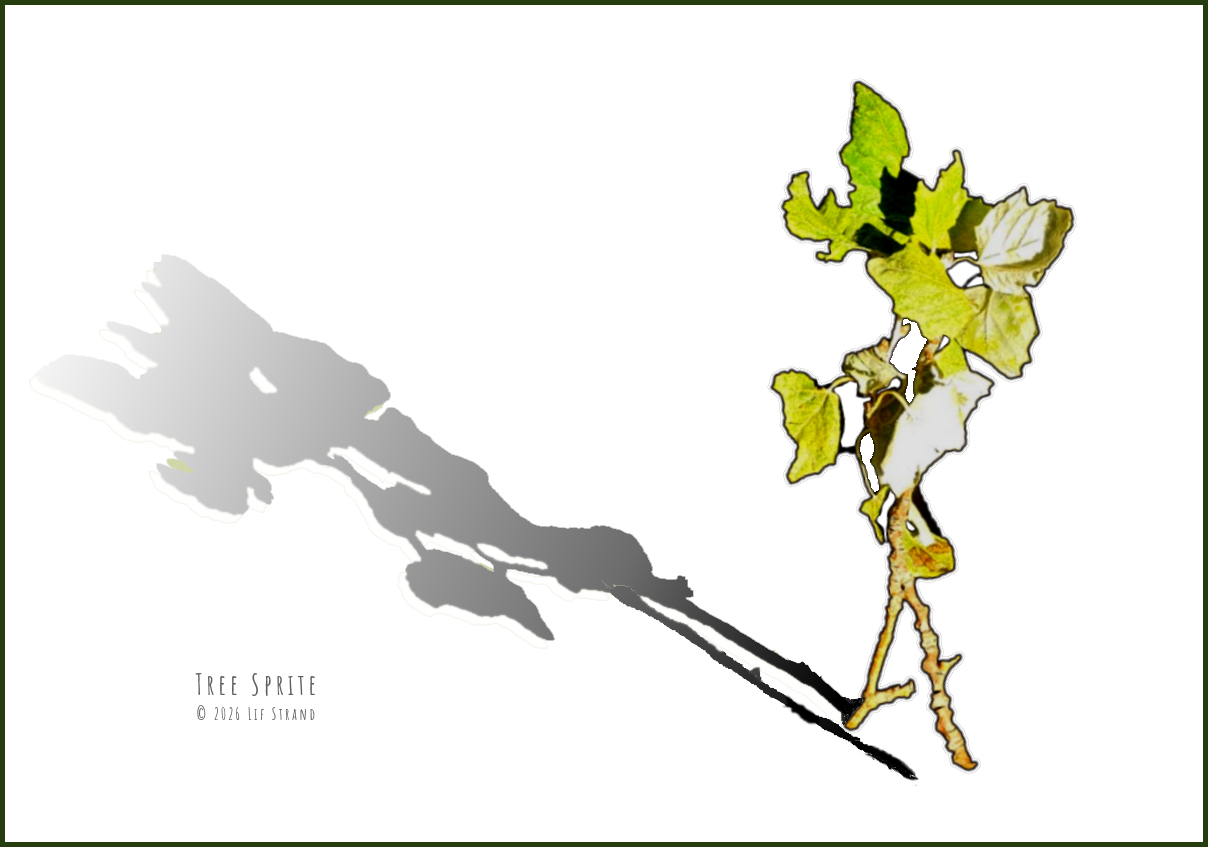
For those who like the idea of using art for nature journaling but aren't into realistism, try fantasy, or go abstract.  Journaling has many possibilities!

This is an image I made from some bits and pieces of aspen tree trimmings that were laying on the pavement after a road crew went through. The branch tips dried up and then got in the way in my art studio till I decided to take photos before putting them on the kindling pile. One of the photos happened to capture a cute little tree sprite who danced her way into my art. Her image will eventually become part of a larger piece I'm working on.
Tree-sprite-Aspen-elemental-_-05_s.jpg
Tree sprite (c) 2026 Lif Strand
 
pollinator
Posts: 3617
Location: Meppel (Drenthe, the Netherlands)
1282
dog forest garden urban cooking bike fiber arts
  • Likes 13
  • Mark post as helpful
  • send pies
    Number of slices to send:
    Optional 'thank-you' note:
  • Quote
  • Report post to moderator
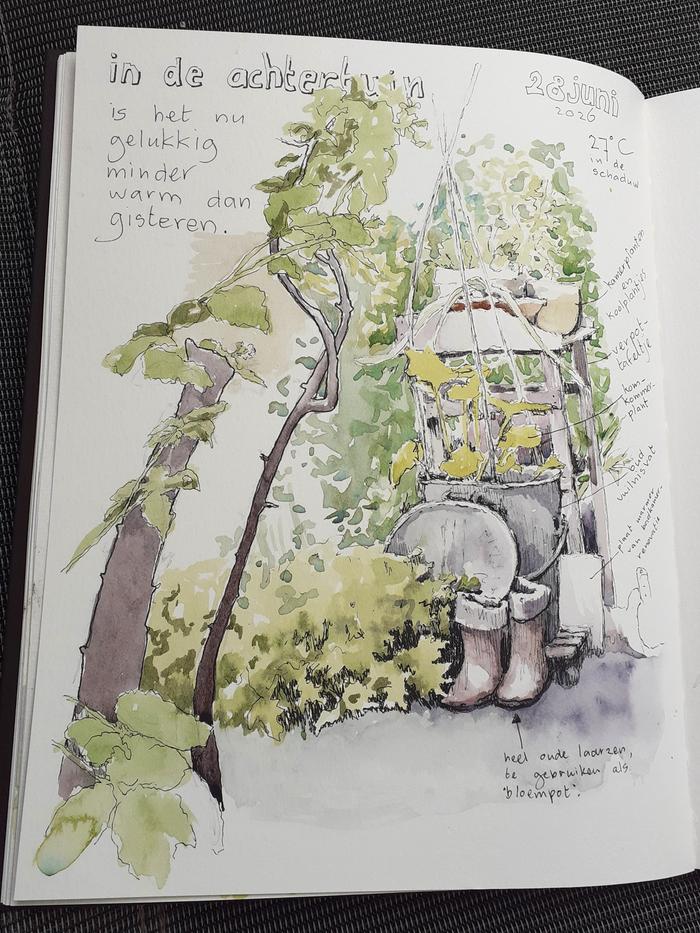
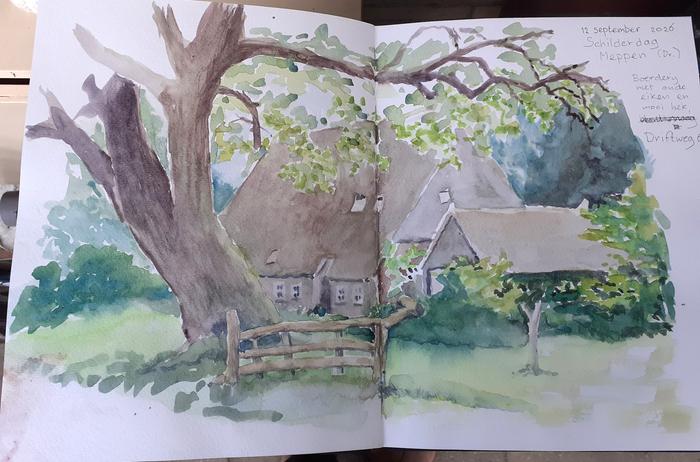
Before this year started I bought myself a luxurious watercolour sketchbook. The idea was this would become my Nature Journal. I thought I would draw/paint a page in it at least every week ...
Okay, maybe once a month ... Anyway: I did paint a few pages in it. And there's still plenty left for next year!


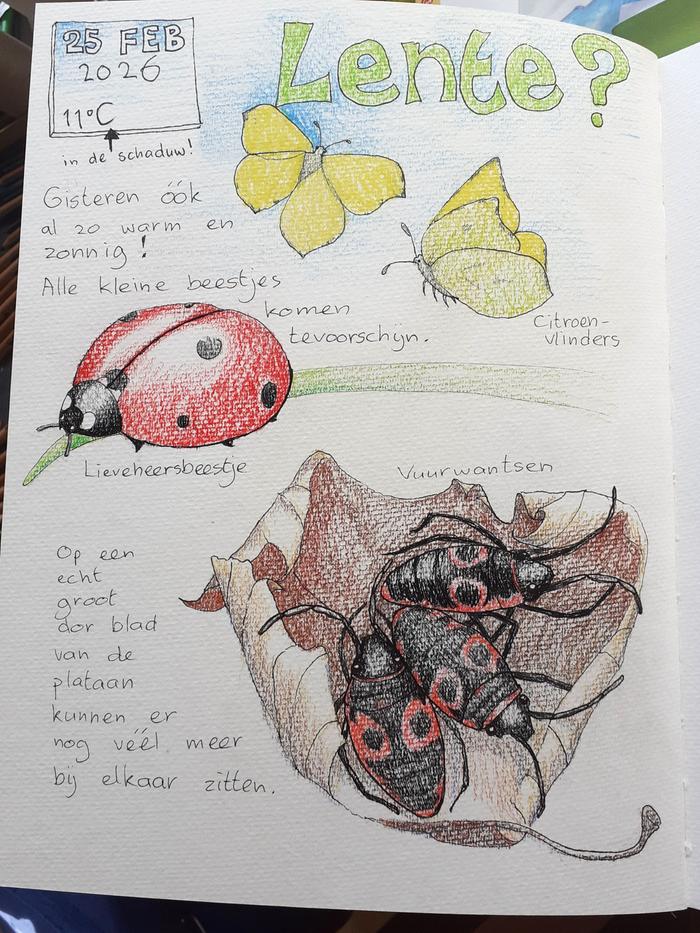
Spring. The tiny creatures enjoy the warm-ish sunny weather.


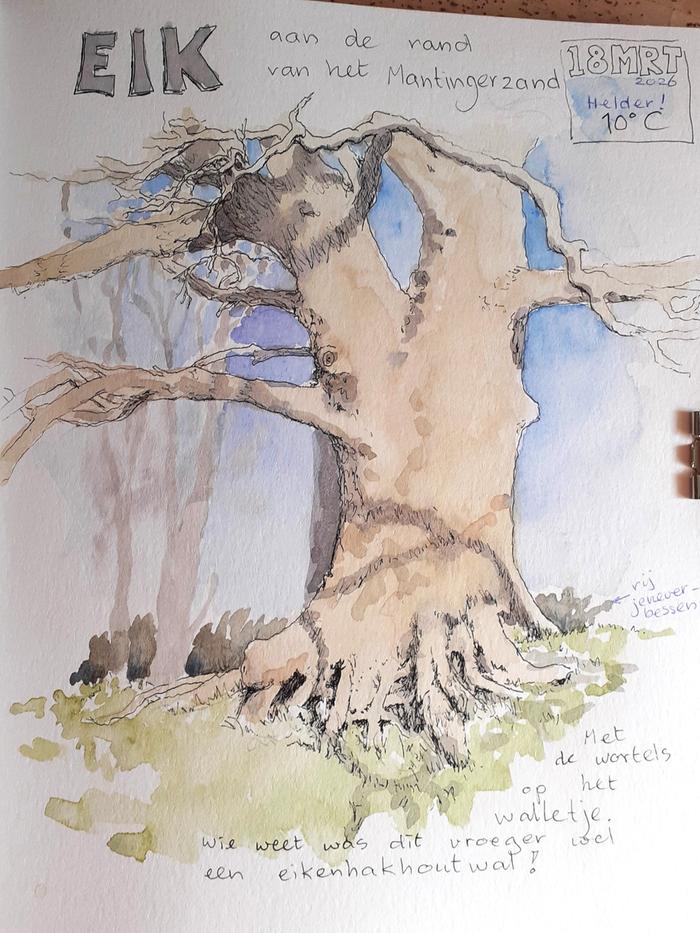
An old oak at the edge of the nature reserve near Mantinge (Drenthe, NL).


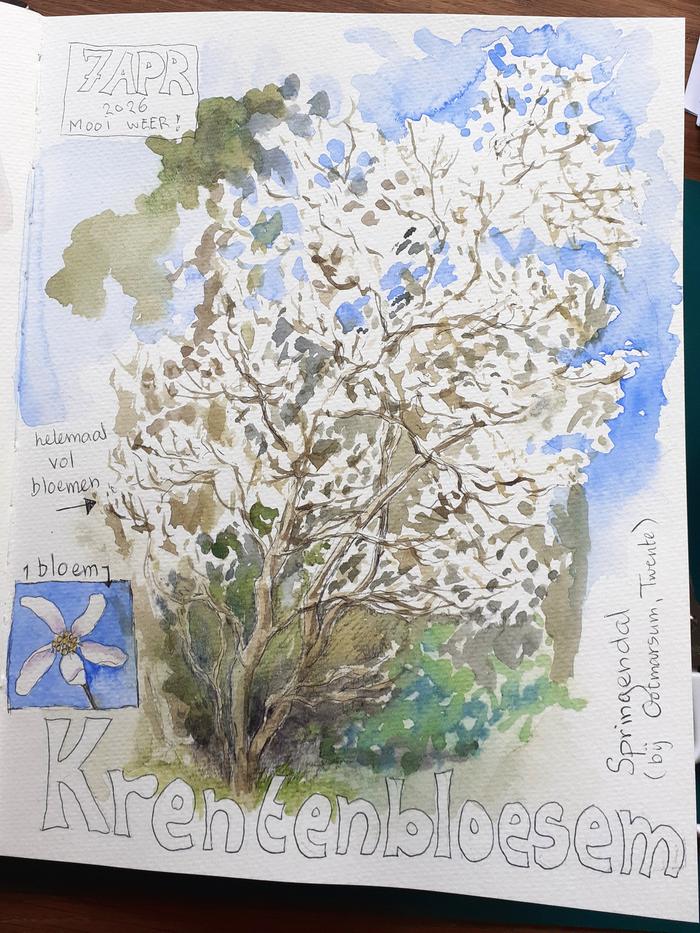
Serviceberry tree in full bloom. Springendal in the region Twente (close to the German border in NL).


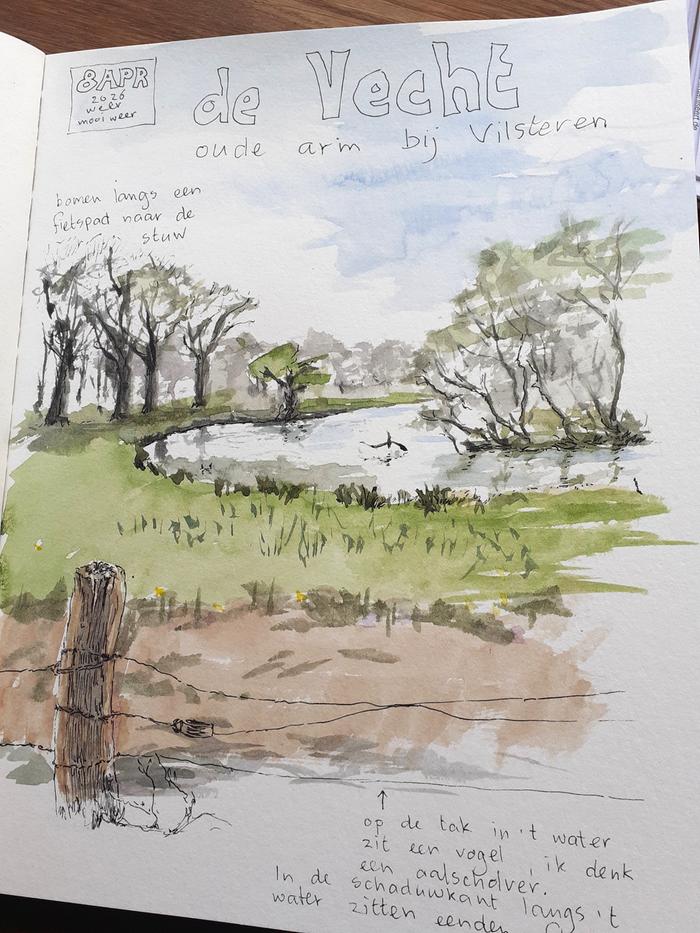
'Old arm' (cut-off meander) of the river Vecht near Vilsteren (Overijssel, NL).


In my back yard.


Old farmhouse (Saxon style), oak tree and fence in the village of Meppen, Drenthe.


Nicole Alderman
steward
Posts: 22955
Location: Pacific Northwest
13832
13
homeschooling hugelkultur kids art duck forest garden foraging fiber arts sheep wood heat homestead
  • Likes 8
  • Mark post as helpful
  • send pies
    Number of slices to send:
    Optional 'thank-you' note:
  • Quote
  • Report post to moderator
Inge, your journal entries are so beautiful! They are such an inspiration, and such a delight to look at!
 
Nicole Alderman
steward
Posts: 22955
Location: Pacific Northwest
13832
13
homeschooling hugelkultur kids art duck forest garden foraging fiber arts sheep wood heat homestead
  • Likes 6
  • Mark post as helpful
  • send pies
    Number of slices to send:
    Optional 'thank-you' note:
  • Quote
  • Report post to moderator

Nicole Alderman wrote:
I wonder if I could make an art-supplies pouch that I could strap on my belt, too. It could have extra pencils for the kids, watercolor pencils for me, and maybe even a tiny paint set, like the little one I put my hand-made watercolors in. I wonder what an art-supply pouch would look like. Maybe like a tool pouch roll (like you can make in SKIP) or a sewing hussif or those little rolls you store knitting needles in.

Or maybe a pouch that opens up to display everything?

Or maybe like a quiver full of pencils and paintbrushes with a separate pouch for the watercolor set?

So many ideas!


I was thinking about this, and my love of multi-colored pens. They allow for 4 colors in one pen! But, I don't like drawing with pens--I like to be able to erase.

Then I wondered, "Are there multi-colored mechanical pencils?" I did a little searching, and found that there are some! Pentel makes a https://www.amazon.com/Pentel-XPH804ST-Multi-Color-Refill/dp/B0DQ3WXM9M

It comes with extra colors, so you can customize what you need. I think I'll need both greens!


I think I'll be putting this on my Christmas list!
 
r ransom
steward & author
Posts: 48853
Location: Left Coast Canada
20622
10
art trees books chicken cooking fiber arts
  • Likes 4
  • Mark post as helpful
  • send pies
    Number of slices to send:
    Optional 'thank-you' note:
  • Quote
  • Report post to moderator
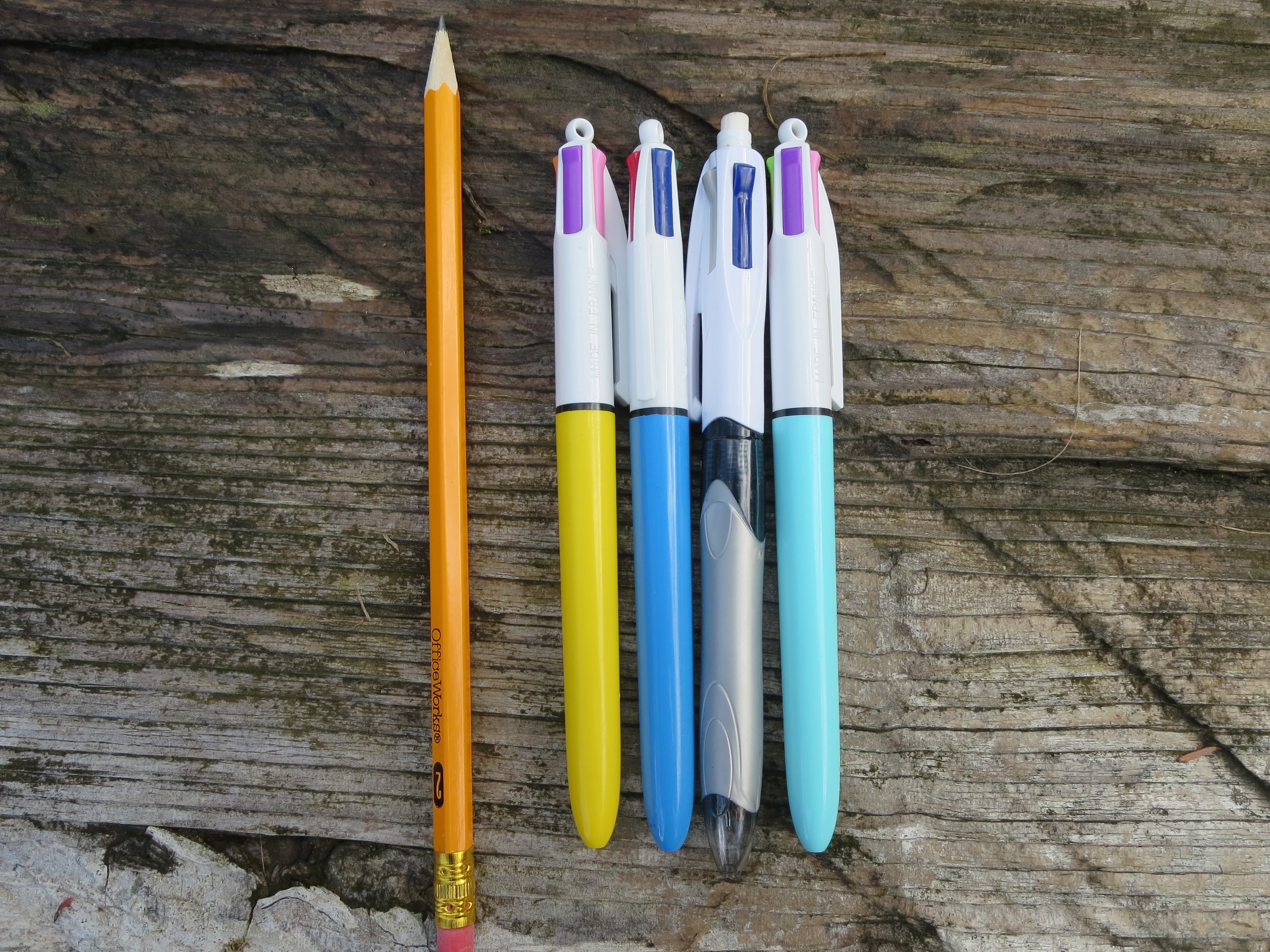
Multi pen!  That brings back memories!

I wanted one so bad as a kid, but it was a bit fat for my hands and I lost interest after a week.  I wonder if taking the kids to a stationary store to try the big pen in their hands would work?  Although, this one looks smaller and easier to use than the one I had.
 
r ransom
steward & author
Posts: 48853
Location: Left Coast Canada
20622
10
art trees books chicken cooking fiber arts
  • Likes 5
  • Mark post as helpful
  • send pies
    Number of slices to send:
    Optional 'thank-you' note:
  • Quote
  • Report post to moderator
This might not work for most people, but some might find it useful.

I have dot cards of watercolour paint I got for samples from various shops.  They are watercolour put on paper and easily rewet to paint with.  Very portable

Here is how to make your own if you have tube watercolours.

 
Inge Leonora-den Ouden
pollinator
Posts: 3617
Location: Meppel (Drenthe, the Netherlands)
1282
dog forest garden urban cooking bike fiber arts
  • Likes 7
  • Mark post as helpful
  • send pies
    Number of slices to send:
    Optional 'thank-you' note:
  • Quote
  • Report post to moderator

Nicole Alderman wrote:Inge, your journal entries are so beautiful! They are such an inspiration, and such a delight to look at!


Thank you Nicole.

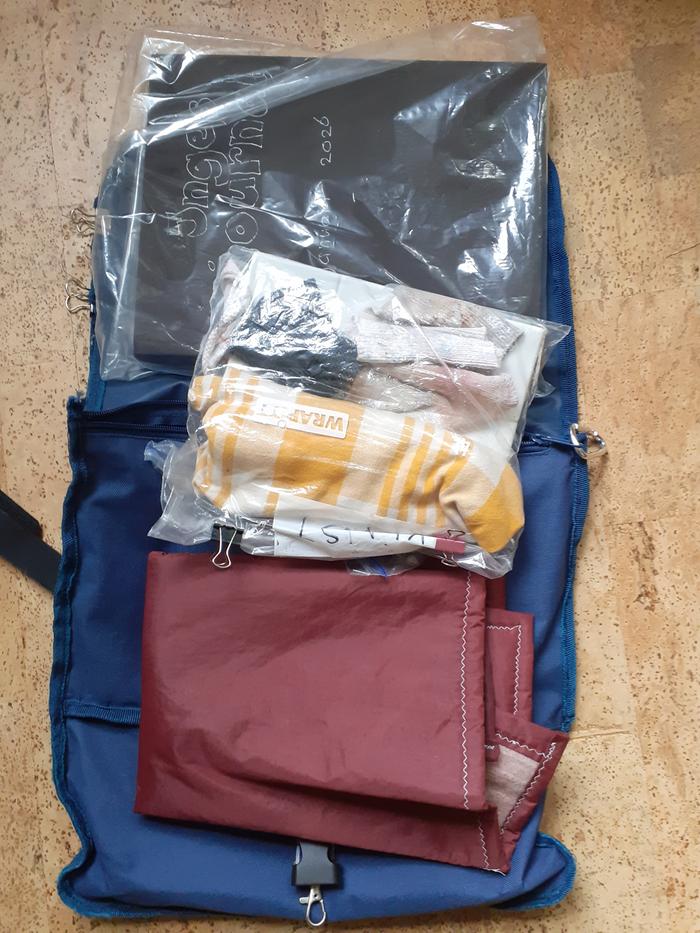
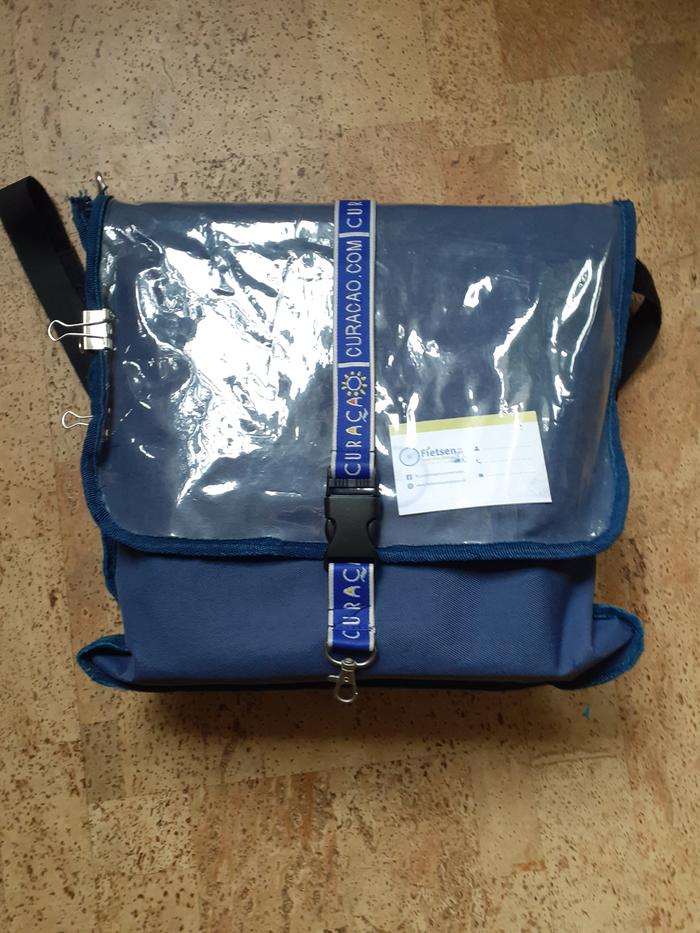
I need to make a photo of my journaling materials, and the bag/pouch they're in.
I can tell you: the watercolour sketchbook is the biggest thing in the bag.
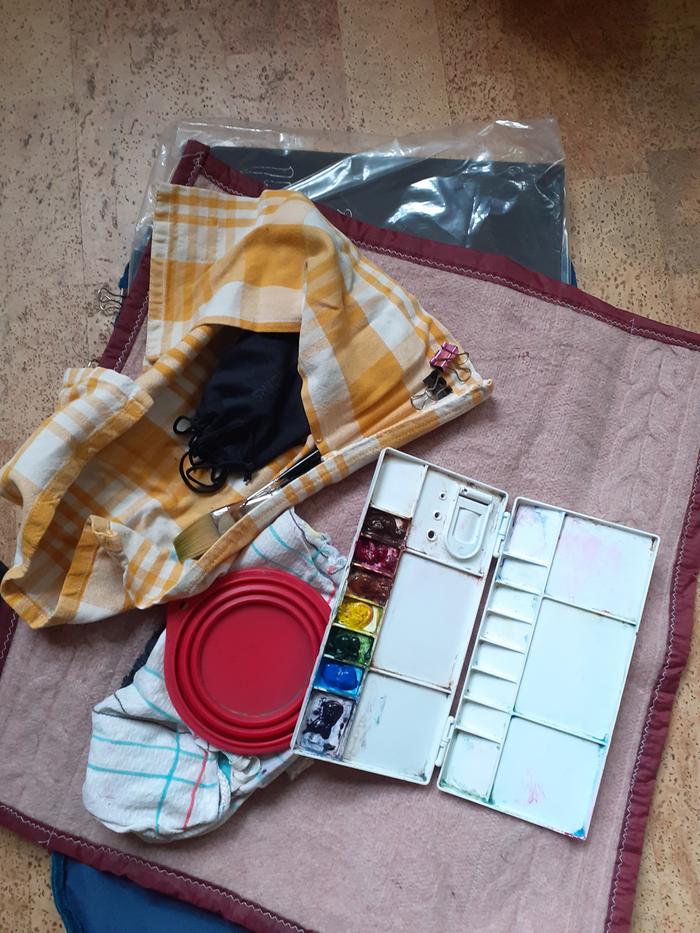
I have a small plastic watercolour palette with 7 colours in it (I filled from tubes, Daniel Smith, the best watercolours I know).
Three watercolour brushes: 1 flat large (1 cm width), 1 pointed medium and 1 pointed small.
1 pencil I use for the first sketchlines and 1 permanent ink fineliner for drawing lines and writing (I do have more pens with me, but they're not really needed).

The first page I showed, with the insects in Spring, I made at home using coloured pencils.

I also have a 'sit mat' in the bag. But if possible I take a (Helinox) camping chair with me.

 
Nicole Alderman
steward
Posts: 22955
Location: Pacific Northwest
13832
13
homeschooling hugelkultur kids art duck forest garden foraging fiber arts sheep wood heat homestead
  • Likes 4
  • Mark post as helpful
  • send pies
    Number of slices to send:
    Optional 'thank-you' note:
  • Quote
  • Report post to moderator

r ransom wrote:Multi pen!  That brings back memories!

I wanted one so bad as a kid, but it was a bit fat for my hands and I lost interest after a week.  I wonder if taking the kids to a stationary store to try the big pen in their hands would work?  Although, this one looks smaller and easier to use than the one I had.
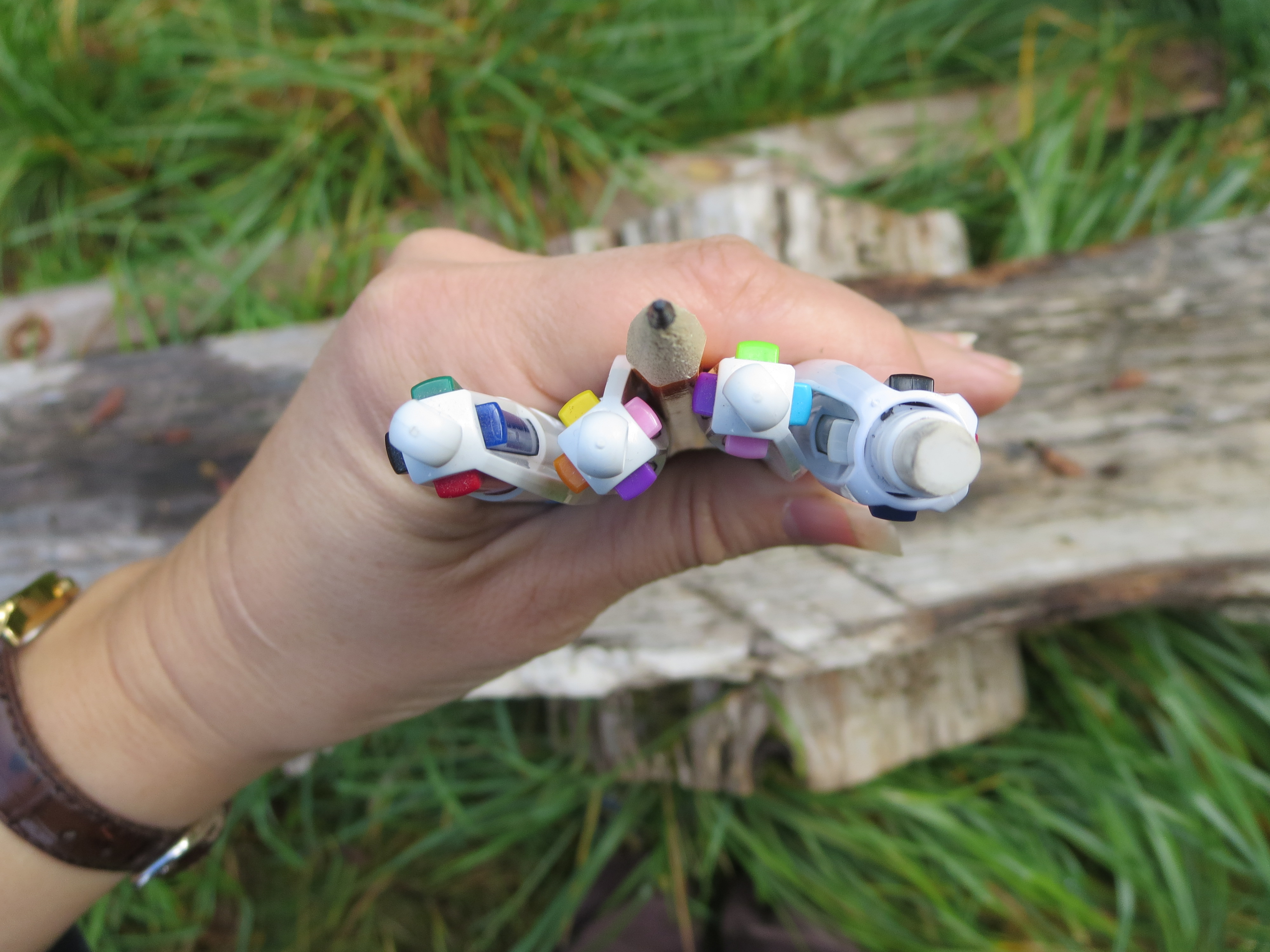


Maybe that was one of the super big multi-pens that have like 10 colors in them. Those things are chonky!

I like these BIC ones--they're not too big for my hands, and you get 4 colors for one pen. The pen I usually carry actually has: black ink, mechanical pencil, blue ink, and red ink. I use the pencil part the most, but I like that I have the colored ink if I need them.

They also now make Bic multi-pens with more fun colors, like pink, yellow, cyan, purple, lime green, and orange. These are super fun to have around, especially at the end of the year when my students ask me to sign their yearbooks.
IMG_2934.JPG
Not too much fatter than a pencil, unlike the really big multi-pens
IMG_2937.JPG
So many colors!
So many colors!
 
Nicole Alderman
steward
Posts: 22955
Location: Pacific Northwest
13832
13
homeschooling hugelkultur kids art duck forest garden foraging fiber arts sheep wood heat homestead
  • Likes 6
  • Mark post as helpful
  • send pies
    Number of slices to send:
    Optional 'thank-you' note:
  • Quote
  • Report post to moderator

Inge Leonora-den Ouden wrote:
I need to make a photo of my journaling materials, and the bag/pouch they're in.


I'd love to see pictures! I think the organizing of this stuff is half the battle to nature journaling.
 
r ransom
steward & author
Posts: 48853
Location: Left Coast Canada
20622
10
art trees books chicken cooking fiber arts
  • Likes 6
  • Mark post as helpful
  • send pies
    Number of slices to send:
    Optional 'thank-you' note:
  • Quote
  • Report post to moderator
Those 4 colour pens look far more sensible.
 
Inge Leonora-den Ouden
pollinator
Posts: 3617
Location: Meppel (Drenthe, the Netherlands)
1282
dog forest garden urban cooking bike fiber arts
  • Likes 10
  • Mark post as helpful
  • send pies
    Number of slices to send:
    Optional 'thank-you' note:
  • Quote
  • Report post to moderator

Nicole Alderman wrote:

Inge Leonora-den Ouden wrote:
I need to make a photo of my journaling materials, and the bag/pouch they're in.


I'd love to see pictures! I think the organizing of this stuff is half the battle to nature journaling.

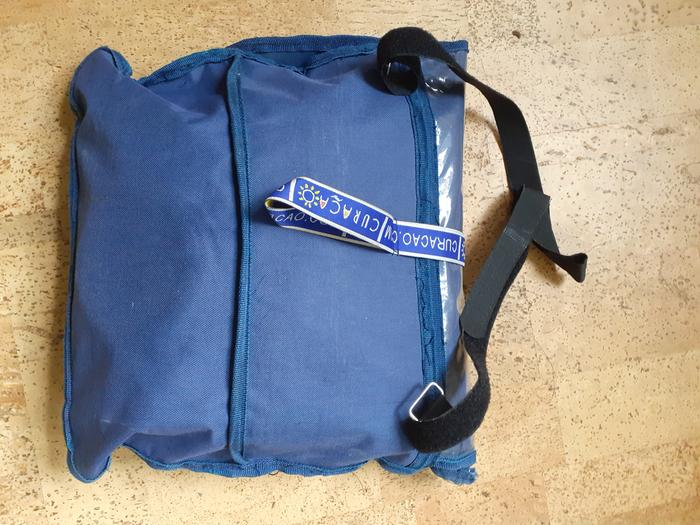
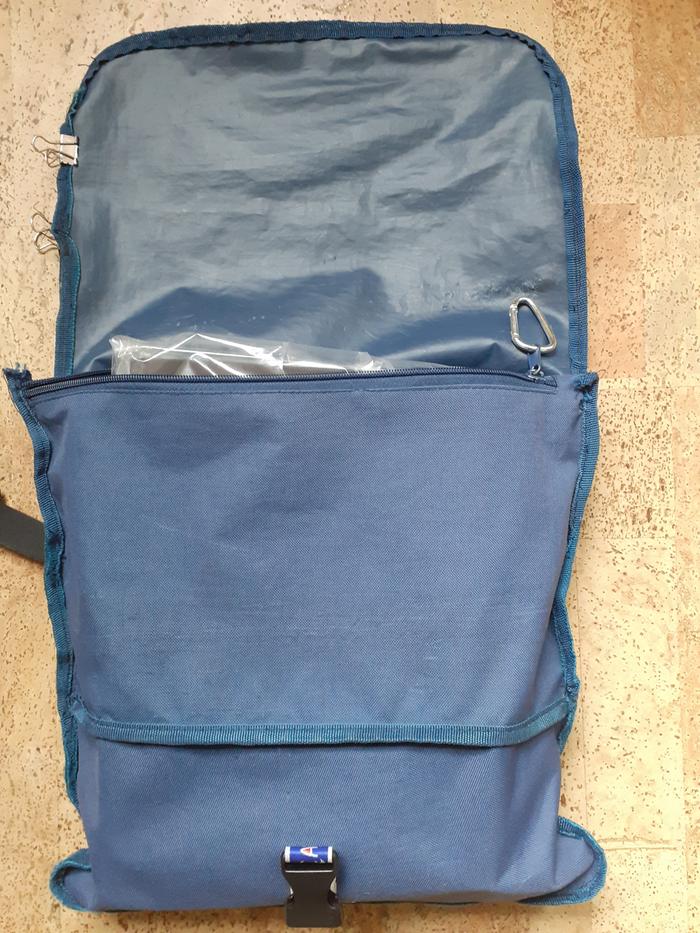
Here are the photos. If my description isn't clear ... Please ask your question.


Bag made from recycled materials. Frontside. (Sometimes I put a map in the transparant plastic front flap).


Backside. The black straps with velcro can be used to fix the bag to the handle-bar of my bicycle. Or 'velcroed' together as a shoulder strap.


Bag with flap and zipper open.


Everything that was in the bag. Still in plastic bags (to protect from the rain).
From back to front: Journal, art materials, sit mat (I made of parts of an old rain poncho and a felted wool sweater)


The art materials: roll pouch with brushes, small clips (can be used to prevent the paper from moving in the wind, or other uses), pens/pencil in black pouch (repurposed from sunglasses), foldable water container (bought at pet shop), 'rags', palette with watercolour paint.


Nicole Alderman
steward
Posts: 22955
Location: Pacific Northwest
13832
13
homeschooling hugelkultur kids art duck forest garden foraging fiber arts sheep wood heat homestead
  • Likes 6
  • Mark post as helpful
  • send pies
    Number of slices to send:
    Optional 'thank-you' note:
  • Quote
  • Report post to moderator
Thank you so much, Inge! I really like the idea of having a sit mat. It's often cold and damp here, and I'm really not enjoying the soggy ground on my bum! I'm thinking about using the left over PUL "fabric" from when I made a wet bags and changing mats when my son was a baby. I just have to figure out where I stashed it....
 
Nicole Alderman
steward
Posts: 22955
Location: Pacific Northwest
13832
13
homeschooling hugelkultur kids art duck forest garden foraging fiber arts sheep wood heat homestead
  • Likes 9
  • Mark post as helpful
  • send pies
    Number of slices to send:
    Optional 'thank-you' note:
  • Quote
  • Report post to moderator
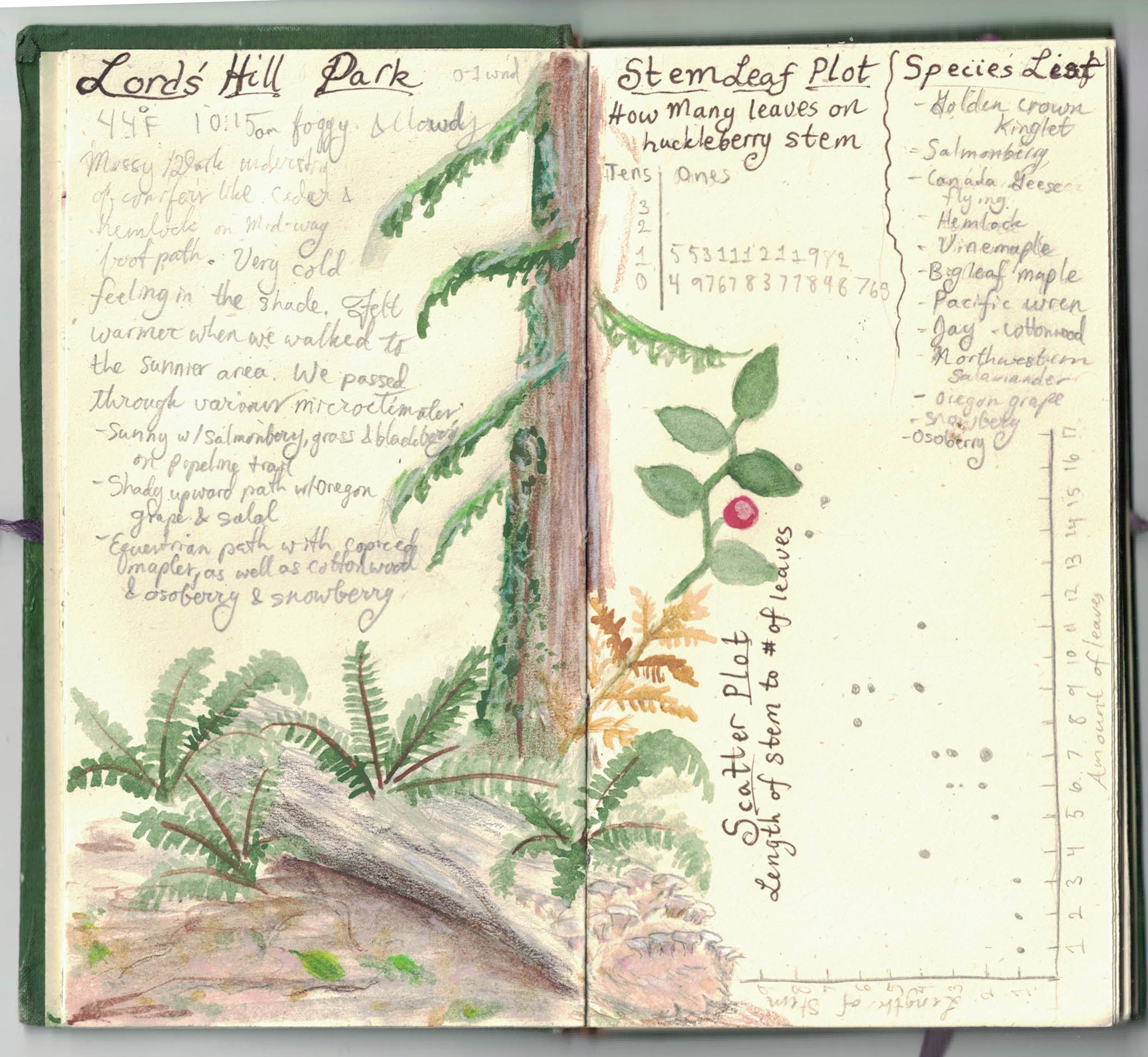
Today, my kids and I went to another local park for their environmental science class. We focused on fun ways to collect and graph data in our nature journals.

This is the video we watched to learn about graphing:


My kids and I focused on seeing how many leaves were on a red huckleberry stem. It was kind perfect for the "stem & leaf graph" we made. Then we made a scatterplot of how many leaves there are per length of stem. Just the process of measuring and counting taught us a lot. We hadn't realized that there really isn't that big of a variation in amount of leaves per stem, or even the length of stem. My son thought that a larger plant would have longer stems with more numerous leaves, but that wasn't the case (at least with the few huckleberry bushes we looked at).

There's a lot you don't notice until you're actually counting and recording it!


I didn't get as much time to draw or look at plants, but I did manage a rough sketch of a scene, which I painted when I got home. I also didn't get a nice out-door picture of my journal....because it was dark by the time I'd finished painting it! So, scanner it is.

I'm finding the painting of scenes really tricky! I don't usually have the right color (especially with browns) and I'm not really keen on mixing paints on the tray to get the right hue for such tiny paintings. And, the paint likes to soak instantly into this paper, making it hard to blend and blot out colors. But, I did find that if I did a rough color with the watercolors, I could touch up with colored pencils, and that would work a bit better. But, I'm learning I have a lot to learn about painting nature scenes!

But, the fun thing about it, is that the only way I'll get better is if I keep painting and trying. I'm loving that I get a chance and reason to do this!
Nature-journal-10-20-2026.png
Today's journal spread. My scene isn't great, but I'm learning!
Today's journal spread. My scene isn't great, but I'm learning! The scatterplot is sideways because that was the best way to fit in the info!
 
r ransom
steward & author
Posts: 48853
Location: Left Coast Canada
20622
10
art trees books chicken cooking fiber arts
  • Likes 7
  • Mark post as helpful
  • send pies
    Number of slices to send:
    Optional 'thank-you' note:
  • Quote
  • Report post to moderator
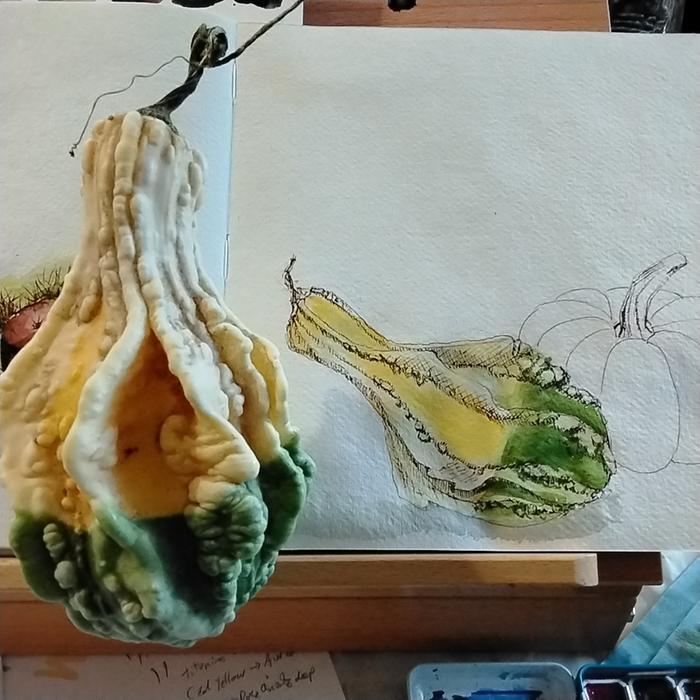
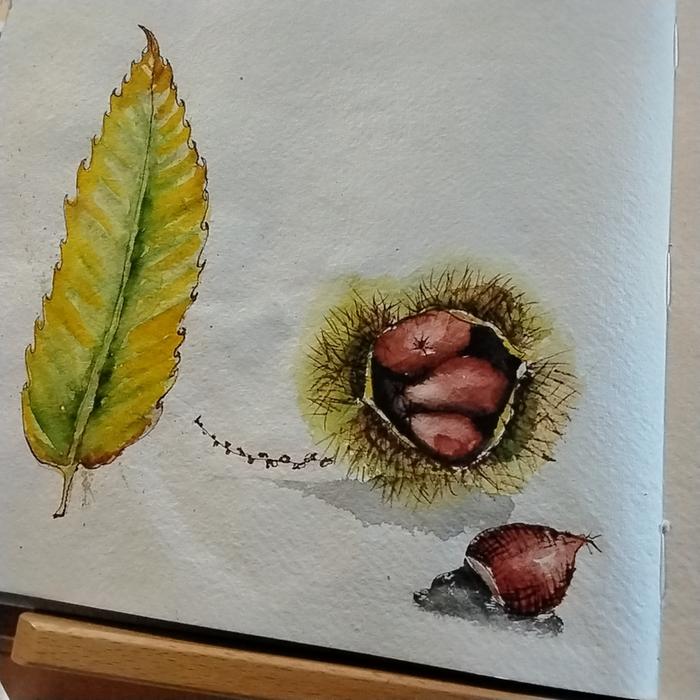
I haven't been able to take my art supplies outside, but instead, am trying to document the harvest as it comes in.


Warty gourds that volunteered to grow in the potato patch.  Warm weather lasted long enough to harvest three, although more are growing on the vine now.

It would be fun if they could dry hard but gourds always seem to rot instead.


And chestnuts from trees we grew from seed.  

I left room for writing which comes after the photos because I don't want to care about spellcheckers.  That's the nice thing about a journal, we don't have to share the parts we want to keep secret, but we can share the bits that work out well.
 
r ransom
steward & author
Posts: 48853
Location: Left Coast Canada
20622
10
art trees books chicken cooking fiber arts
  • Likes 5
  • Mark post as helpful
  • send pies
    Number of slices to send:
    Optional 'thank-you' note:
  • Quote
  • Report post to moderator

I'm finding the painting of scenes really tricky! I don't usually have the right color (especially with browns) and I'm not really keen on mixing paints on the tray to get the right hue for such tiny paintings. And, the paint likes to soak instantly into this paper, making it hard to blend and blot out colors. But, I did find that if I did a rough color with the watercolors, I could touch up with colored pencils, and that would work a bit better. But, I'm learning I have a lot to learn about painting nature scenes!


You are doing better than me.  It's lovely!

I'm still nervous of painting scenes, so stick to objects.  Composition isn't something that fits well with my brain yet as I don't know how to edit what i see to make sense as a painting.

I think a lot about browns.  If every paint has hue, saturation, and value, where does brown live?  I often think of it as purple-orange, but I'm pretty sure that isn't right.  If the area is dark enough, I seem to be able to fudge browns and just add orange to darkness.  

I wonder if the idea of brown is too wide?  It can be any colour, or all of them.  Now, I experiment with plopping lots of colours in that part of the painting until it's dark enough and hope.  Sort of mixing on paper.  But I don't know yet.
 
Inge Leonora-den Ouden
pollinator
Posts: 3617
Location: Meppel (Drenthe, the Netherlands)
1282
dog forest garden urban cooking bike fiber arts
  • Likes 8
  • Mark post as helpful
  • send pies
    Number of slices to send:
    Optional 'thank-you' note:
  • Quote
  • Report post to moderator

r ransom wrote:...
I think a lot about browns.  If every paint has hue, saturation, and value, where does brown live?  I often think of it as purple-orange, but I'm pretty sure that isn't right.  If the area is dark enough, I seem to be able to fudge browns and just add orange to darkness.  

I wonder if the idea of brown is too wide?  It can be any colour, or all of them.  Now, I experiment with plopping lots of colours in that part of the painting until it's dark enough and hope.  Sort of mixing on paper.  But I don't know yet.


I don't think there is one colour 'brown'. There are many browns and brownish colours.
You probably know the 'colour wheel'. If you mix two opposite colours from that wheel, but not in exactly equal amounts, you'll get a brown.

I like mixing watercolours. For many years now (even decades) I only have the 'primary' and 'secundary' colours. Everything else I make by mixing two (or sometimes three) of these. Often I don't get the colour I want, so I go on adding some more of this or that ...

When I bought a new set of paints I first did pages full of try-outs of the different mixes.

 
Nicole Alderman
steward
Posts: 22955
Location: Pacific Northwest
13832
13
homeschooling hugelkultur kids art duck forest garden foraging fiber arts sheep wood heat homestead
  • Likes 6
  • Mark post as helpful
  • send pies
    Number of slices to send:
    Optional 'thank-you' note:
  • Quote
  • Report post to moderator
The kids and I were sick yesterday, so we didn't make it to their environmental science class. So, we did our nature journals at home.

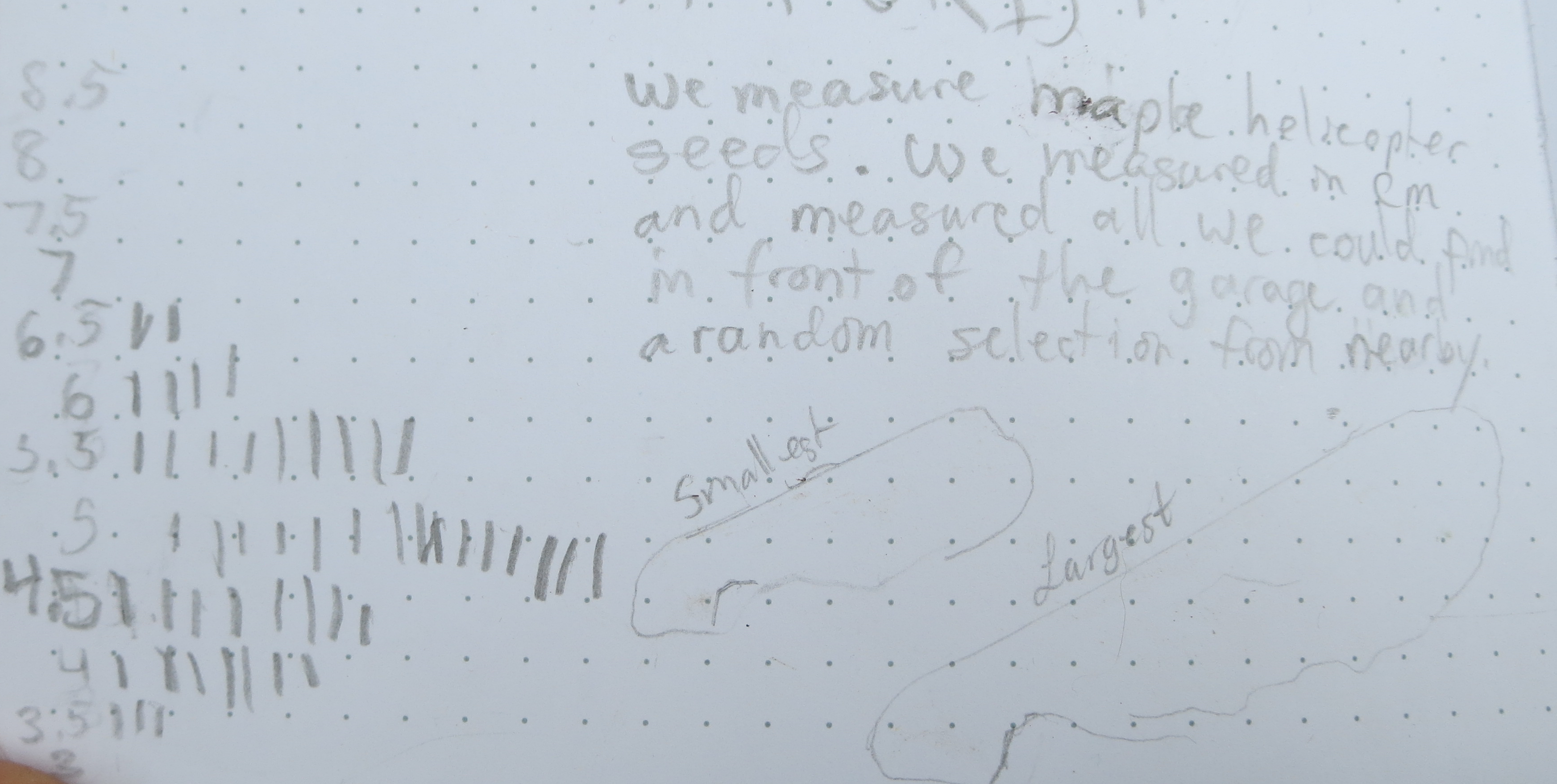
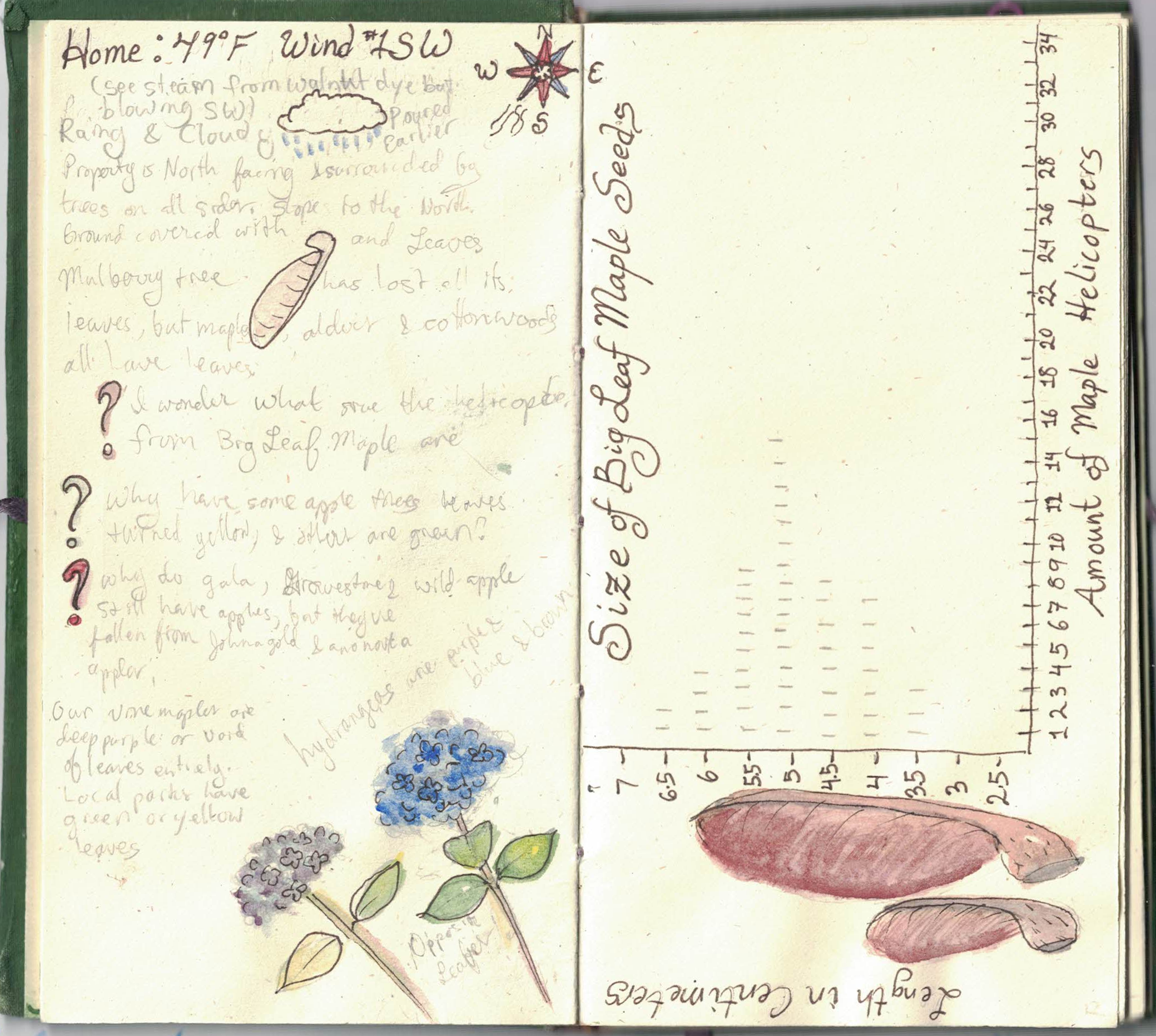
I chose a time when it wasn't raining...but the rain kicked in before our sit spot time was over. To survive the rain, I brought my daughter an umbrella to draw under, and my son and I retreated to the open garage. This made for interesting observations, because we could still see nature from the garage, but  it was all pretty far away, except for weeds and....helicopter seeds! That got me wondering about how big those big leaf maple seeds are, and how wide their size varies.

The video my kids watched this week was about measuring and counting, so measuring and counting maple seeds seemed perfect!

Below is this week's video (note: my kids really did not like this video. They were really disturbed by someone counting and measuring a dead bird's feathers.)


It was fun measuring the maple seeds. We found all the maple seeds by the garage door, as well as a selection of large and small ones from nearby. It wasn't a perfect sample selection, but my son was the one finding a lot of the seeds, so I went with it. I measured the seeds, and my daughter put dashes down for each size.

I had a lot of fun copying it into my own journal and tracing and painting the largest and smallest helicopters that we found. I'm pretty happy with how the colors came out on my paintings today--I didn't need to touch up anything with colored pencils. I also experimented with outlining/accenting the paintings with pen, and I like the result!

One funny thing happened when we were trying to find out how strong the wind was on the Beaufort Scale. I had just strained a dye pot full of black walnuts, and the walnuts were sitting outside. They were still hot and steaming, and that allowed us to see that there was a slight amount of wind (even if we couldn't feel it), and that it was blowing south-southwest. It was fun having such a relatively accurate way to measure wind strength and direction!

image_2026-10-27_203101590.png
The original recording of the data in my son's journal, done by my daughter.
Nicole-Journal.png
It was raining and dark by the time I painted it, so you get an ugly scan again today.
 
Nicole Alderman
steward
Posts: 22955
Location: Pacific Northwest
13832
13
homeschooling hugelkultur kids art duck forest garden foraging fiber arts sheep wood heat homestead
  • Likes 6
  • Mark post as helpful
  • send pies
    Number of slices to send:
    Optional 'thank-you' note:
  • Quote
  • Report post to moderator

r ransom wrote:I think a lot about browns.  If every paint has hue, saturation, and value, where does brown live?  I often think of it as purple-orange, but I'm pretty sure that isn't right.  If the area is dark enough, I seem to be able to fudge browns and just add orange to darkness.

I wonder if the idea of brown is too wide?  It can be any colour, or all of them.


I like to say humans are all shades of brown. Some are pinkish browns, purplish browns, dark browns, light browns, yellowish browns, reddish browns. But, we're all brown. It shows the diversity of the colors of browns that there are in the world!

Now, I experiment with plopping lots of colours in that part of the painting until it's dark enough and hope.  Sort of mixing on paper.  But I don't know yet.


I think a lot of my frustration with watercolor is the paper I used to make this nature journal. It's nice and thin, while sill not letting the paint bleed through or really show much on the other side of the page. Because the paper is thin, I was able to put a lot more pages in my thin journal than if I'd used actual water color paper.

But! Despite it not bleeding or tearing, it's not actually watercolor paper. The paints interact weirdly with it. They don't blot off easily, and they soak in quickly, so I can't blend on the page like I'd like. Thankfully, the maple helicopters I was measuring could be painted with brown ocher, red ocher and yellow ochre, so blending wasn't too necessary, But, it sure would have been handy!

 
For my next feat, I will require a volunteer from the audience! Perhaps this tiny ad?
A book about better recipes for green living
https://greenlivingbook.com/
reply
    Bookmark Topic Watch Topic
  • New Topic