• Post Reply Bookmark Topic Watch Topic
  • New Topic
permaculture forums growies critters building homesteading energy monies kitchen purity ungarbage community wilderness fiber arts art permaculture artisans regional education skip experiences global resources cider press projects digital market permies.com pie forums private forums all forums
this forum made possible by our volunteer staff, including ...
master stewards:
  • Devaka Cooray
  • Carla Burke
  • John F Dean
  • Nancy Reading
  • Timothy Norton
  • r ranson
stewards:
  • Jay Angler
  • Pearl Sutton
  • paul wheaton
master gardeners:
  • Christopher Weeks
  • M Ljin
gardeners:
  • thomas rubino
  • Eino Kenttä
  • Jeremy VanGelder

barm for making bread

 
author & steward
Posts: 5721
Location: Southeastern U.S. - Zone 7b
3432
6
goat cat forest garden foraging food preservation fiber arts medical herbs writing solar wood heat homestead
  • Likes 7
  • Mark post as helpful
  • send pies
    Number of slices to send:
    Optional 'thank-you' note:
  • Quote
  • Report post to moderator
Has anybody tried using barm for making bread instead of baking yeast? Barm is the yeasty foam that forms when brewing ale or beer. I've been researching historical baking and found it in recipes from the 1700s all the way back to the Saxon era of England, where Old English has specific words for leavened bread and barm.

I don't brew so I don't have access to barm, but I'm really curious if anyone as tried this, how it worked for them, and what they thought.
 
gardener
Posts: 621
Location: Grow zone 10b. Southern California,close to the Mexican border
458
4
home care duck books urban chicken food preservation cooking medical herbs solar homestead greening the desert
  • Likes 4
  • Mark post as helpful
  • send pies
    Number of slices to send:
    Optional 'thank-you' note:
  • Quote
  • Report post to moderator
I haven’t tried this, but you can make a similar yeast using raisins and water. I haven’t tried it yet, but it’s on my todo list. I have seen this method used by families in rural China and Japan, and by others who are living off grid. One person only uses this type of yeast in her bakery. Her baked goods are also all baked in fire heated ovens.
As far as I know you just mix filtered water and raisins and let it ferment on your countertop like you would with sour dough.
 
Leigh Tate
author & steward
Posts: 5721
Location: Southeastern U.S. - Zone 7b
3432
6
goat cat forest garden foraging food preservation fiber arts medical herbs writing solar wood heat homestead
  • Likes 4
  • Mark post as helpful
  • send pies
    Number of slices to send:
    Optional 'thank-you' note:
  • Quote
  • Report post to moderator
Ulla, that's very interesting. I'll have to see if I can find more information about it. I know there are several other threads on permies about making different kinds of yeast, but I haven't really tried any of them except sourdough.
 
Ulla Bisgaard
gardener
Posts: 621
Location: Grow zone 10b. Southern California,close to the Mexican border
458
4
home care duck books urban chicken food preservation cooking medical herbs solar homestead greening the desert
  • Likes 3
  • Mark post as helpful
  • send pies
    Number of slices to send:
    Optional 'thank-you' note:
  • Quote
  • Report post to moderator
I will look too. Maybe I can find the video I talked about. I also vaguely remember my grandmother talking about things like this.
 
steward
Posts: 18107
Location: USDA Zone 8a
4615
dog hunting food preservation cooking bee greening the desert
  • Likes 5
  • Mark post as helpful
  • send pies
    Number of slices to send:
    Optional 'thank-you' note:
  • Quote
  • Report post to moderator
I like using wild yeast such as Ulla suggests.  I have not tried the raisin method of capturing wild yeast.

We have not made beer so we do not have barm though we might try that with the scum off of making wine.
 
master gardener
Posts: 5424
Location: Carlton County, Minnesota, USA: 3b; Dfb; sandy loam; in the woods
3007
7
forest garden trees books chicken food preservation cooking fiber arts seed woodworking homestead ungarbage
  • Likes 5
  • Mark post as helpful
  • send pies
    Number of slices to send:
    Optional 'thank-you' note:
  • Quote
  • Report post to moderator
I've had times when any of: sourdough starter, country wine, or a ginger bug wasn't taking off the way I wanted and adding raisins gave it a kick in the pants. But I also haven't used barm.
 
Leigh Tate
author & steward
Posts: 5721
Location: Southeastern U.S. - Zone 7b
3432
6
goat cat forest garden foraging food preservation fiber arts medical herbs writing solar wood heat homestead
  • Likes 6
  • Mark post as helpful
  • send pies
    Number of slices to send:
    Optional 'thank-you' note:
  • Quote
  • Report post to moderator
One source I found described a combination of a type of sourdough starter and barm. It dates back to Anglo-Saxon Britain (400 - 1000 CE). I found it as a PDF article from Acta Linguistica scholarly review magazine entitled  The Domain Of Bread In Anglo-Saxon Culture by Irina Yanushkevich. The author was reporting on a study she did of the Old English language surrounding everything they wrote about bread.

Here's her description of how they made leavened bread:

"The dough was kneaded in a wooden trough which was cut out of a split log. The leaven was made by souring a handful of flour stirred in water or milk and left in the open for fermentation because wild yeasts were present in the air. After that small birch sticks were dipped into the leaven and dried; they could be soaked whenever needed. Such leaven was not always working, so the bread was probably coarse and hard, especially if the flour and the other ingredients had not been ground thoroughly. As brewing and baking went hand in hand, the foam from fermenting the beer with hop was also added to the dough; such kind of leaven (barm < Anglo-Sax. beorma) produced lighter, softer, and more flavored bread."
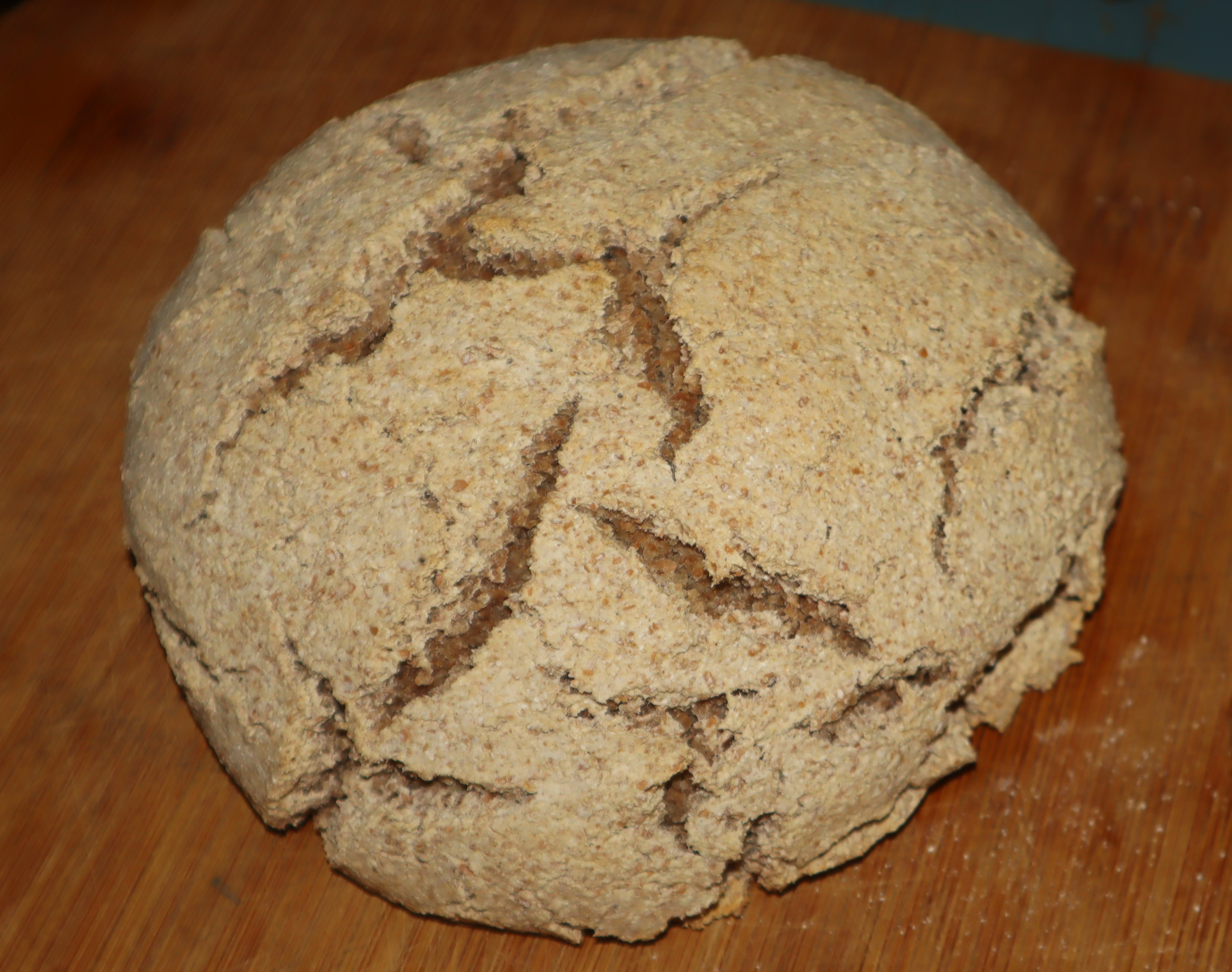
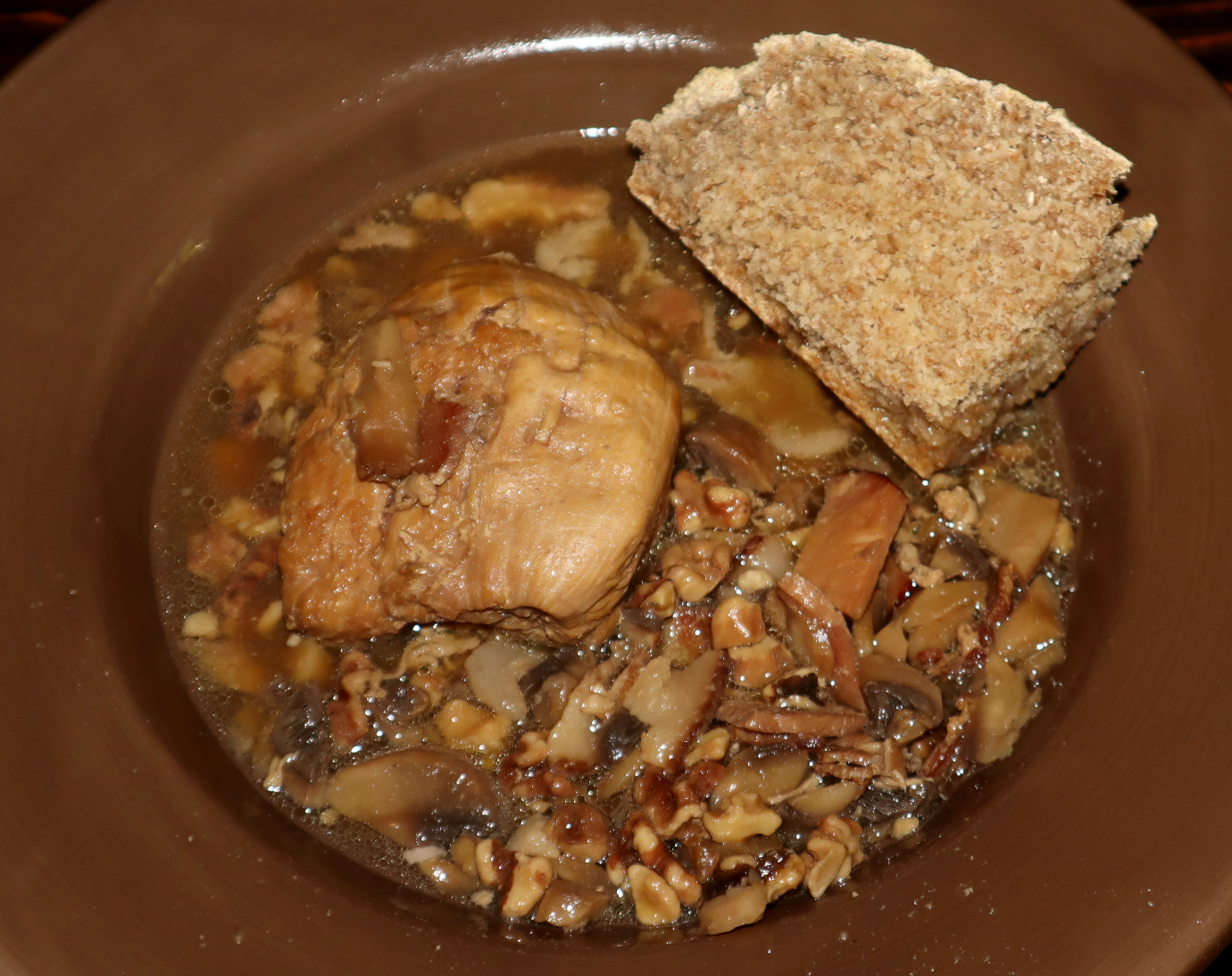

I adapted a recipe to try this, except I substituted ale yeast for the barm. Ale yeast isn't formulated for baking so the rise wasn't as good as baking yeast, and it did give an distinct and interesting flavor to the bread.

Make the sourdough batter:

1 cup warm whey
2 cups flour (I used half whole wheat and half barley flour)
Cover bowl with a cotton dishtowel and allow to sit in a warm place, until it begins to bubble from wild yeasts (at least several hours, overnight in a warm place is best).

Make the pseudo barm:

1/4 cup warm water
1½ tsp ale yeast
Let proof until bubbly

Make and bake the bread:

Mix the sourdough starter and yeast water together
Add 1 tsp sea salt and enough flour to knead the dough until no longer sticky.
Shape into loaves and let rise several hours.
Bake on a pizza stone for about an hour at 350°F (180°C).

I have to say that it went really, really well with the Saxon stew.
saxon-bread.JPG
Gebyrmed (Anglo-Saxon Leavened Bread)
saxon-stew.JPG
Saxon Game Bird and Bacon Stew
 
Leigh Tate
author & steward
Posts: 5721
Location: Southeastern U.S. - Zone 7b
3432
6
goat cat forest garden foraging food preservation fiber arts medical herbs writing solar wood heat homestead
  • Likes 6
  • Mark post as helpful
  • send pies
    Number of slices to send:
    Optional 'thank-you' note:
  • Quote
  • Report post to moderator
A little more history. The bread recipes in Martha Washington's Book of Cookery use ale yeast or barm. This one is said to have been originally copied from A Booke of Cookyre, pubished in 1591.

TO MAKE A BUTTERED LOAFE

Take 4 quarts of milke, put runnet to it, whey it, and hang the curd up in a cloth to dreyne for an houre or 2. Then take 10 eggs and leave out 3 off the whites, then take a little ginger, a pinte of ale yeast (barm), as much fine flowre as will make it up to a loafe. When it is well baked, cut it up and butter it with sweet butter and sugar. Your butter must be melted and beat up with the sugar before you put it into the loafe.

 
Leigh Tate
author & steward
Posts: 5721
Location: Southeastern U.S. - Zone 7b
3432
6
goat cat forest garden foraging food preservation fiber arts medical herbs writing solar wood heat homestead
  • Likes 2
  • Mark post as helpful
  • send pies
    Number of slices to send:
    Optional 'thank-you' note:
  • Quote
  • Report post to moderator

Anne Miller wrote:We have not made beer so we do not have barm though we might try that with the scum off of making wine.


Anne, you jogged my memory. When I was researching barm, I ran across something to that effect, but I let it go because I was focused on something else. Your comment prompted me to do a search on Brave browser, and this is what Brave AI came up with regarding wine lees.

Wine lees, the sediment of dead yeast cells and other particles left after fermentation, can be used in bread making. They can be incorporated directly into bread dough or used to feed a sourdough starter, potentially adding a subtle flavor profile such as a slight apple aroma when derived from cider.
Research indicates that adding Cava lees (a type of wine lees) at a 5% concentration to bread dough can improve microbial growth during short fermentations, enhancing the production of volatile compounds that contribute to aroma and flavor.
The lees are rich in nutrients and can support the growth of both lactic acid bacteria and yeast in the dough.
While lees from wine or other fermented beverages may contain residual alcohol, this typically evaporates during baking.
Additionally, lees can be used to make soft cheese or mozzarella by curdling milk with their natural acids.
Some home brewers and winemakers have successfully used wine lees or leftover yeast from fermentation to make bread, reporting good results and unique flavors.

AI-generated answer. Please verify critical facts.


I'm not sure I'm up to learning to brew ale or beer, but I do make a few homemade natural wines. So I could try this. I'd be willing to try it as a cheese culture as well.
 
Christopher Weeks
master gardener
Posts: 5424
Location: Carlton County, Minnesota, USA: 3b; Dfb; sandy loam; in the woods
3007
7
forest garden trees books chicken food preservation cooking fiber arts seed woodworking homestead ungarbage
  • Likes 3
  • Mark post as helpful
  • send pies
    Number of slices to send:
    Optional 'thank-you' note:
  • Quote
  • Report post to moderator
Another tangent: sake lees make a nice vegetable fermentation medium. I never thought to try it as a levain.
 
Cats say "meow" because they think that is what people sound like. This tiny ad told me so:
The new purple deck of permaculture playing cards
https://www.kickstarter.com/projects/paulwheaton/garden-cards
reply
    Bookmark Topic Watch Topic
  • New Topic