• Post Reply Bookmark Topic Watch Topic
  • New Topic
permaculture forums growies critters building homesteading energy monies kitchen purity ungarbage community wilderness fiber arts art permaculture artisans regional education skip experiences global resources cider press projects digital market permies.com pie forums private forums all forums
this forum made possible by our volunteer staff, including ...
master stewards:
  • Carla Burke
  • John F Dean
  • r ransom
  • Nancy Reading
  • Timothy Norton
  • Jay Angler
stewards:
  • paul wheaton
  • Pearl Sutton
  • Eric Hanson
master gardeners:
  • Christopher Weeks
  • M Ljin
gardeners:
  • thomas rubino
  • Megan Palmer
  • Benjamin Dinkel

Quick and easyish Strawbale building

 
Posts: 6
Location: The Mayenne, France
1
  • Likes 3
  • Mark post as helpful
  • send pies
    Number of slices to send:
    Optional 'thank-you' note:
  • Quote
  • Report post to moderator
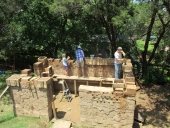
This is how I personally build Strawbale structures, I was tutored by Barbara Jones.
Step 1. Level the area on which the structure is going to be sited. Then cover with some type of aggregate that can then be compacted to form a solid base, no need for concrete in most cases.
Step 2. Collect old Tyres of the same size, as this makes leveling much easier. I like to put 3 high as this allows access under the floor to run services. Place them in the shape of the plan of the floor for the building, in larger structures load, may require cross runs, rather than just a perimeter. Then fill with gravel to form a solid footing that water will drain through, but will not wick up.
Step 3. Place a ring beam on top of the footing ( gravel filled Tyres) you can then join joist hangers to the ring beam for the floor. The ring beam should be a similar width to the bales laid flat, ( strings up ). Wire mesh between the Tyres and the ring beam is also a good idea, if rodents are likely to be a problem, stainless steel is best, if lime is to be used in the render.
Step 4. Install the floor on the joist hanger’s, size to carry load, insulation etc after the floor is done you can then move onto the next step.
Step 5. You will need to get very well compressed, preferably organic wheat straw, if possible with long stems as these makes the best bale for construction. Put short wooden pegs in the ring beam to hold the bales, 2 in each bale.
As you build up, turn the bales so you get the same face on one coarse, and the other on the next coarse, each bale pinned with wooden spikes which travel though 2 layer of bale to fix them, no wooden structure is needed as the weight of the roof, built off of the second ring beam puts pressure on the walls and helps keep it secure.
Step 6. Install the second ring beam, this is for a single floor construction, I then installed the roof, whatever type of roof you would like, tiles shingles, tin, up to you.
Step 7. Allow the structure to settle, the bale will compress over a few weeks, can be speeded up with truck load securing straps, but if time allows just let the settlement happen naturally.
Step 8. After settlement I use plastic pallet banding to strap the whole structure together, this is all rendered over, so it is not visable when the structure is complete.
Step 9. Render inside and out to keep rodents etc out of the walls, including the ring beams.

All this is in Barbara Jones book, with a few things I have learned over the years working with bales, NEVER use steel or concrete near or within the bales, both sweat , and can be a problem later on in most moister locations.
Your thoughts and experiences all welcome as you never stop learning.
 
pollinator
Posts: 5869
Location: Bendigo , Australia
528
plumbing earthworks bee building homestead greening the desert
  • Likes 3
  • Mark post as helpful
  • send pies
    Number of slices to send:
    Optional 'thank-you' note:
  • Quote
  • Report post to moderator
Some questions;
What material is the ring beam made off?
What is the size of the ring beam?
What size aggregate is used in the tyres?
What is the name of the reference book?
 
pollinator
Posts: 393
Location: Klumbis Oh Hah, Zone 6
146
  • Likes 2
  • Mark post as helpful
  • send pies
    Number of slices to send:
    Optional 'thank-you' note:
  • Quote
  • Report post to moderator
A couple things I’m curious about just off the top of my head:

1) how do you handle lintels over exterior doorways and windows?

2) how do you do penetrations e.g. for electric, plumbing, etc.?
 
Paul Wells
Posts: 6
Location: The Mayenne, France
1
  • Likes 3
  • Mark post as helpful
  • send pies
    Number of slices to send:
    Optional 'thank-you' note:
  • Quote
  • Report post to moderator

John C Daley wrote:Some questions;
What material is the ring beam made off?
What is the size of the ring beam?
What size aggregate is used in the tyres?
What is the name of the reference book?


The ring beam, as an example can be made using 4”x 2” timber covered each side with osb, or ply.
The width of the ring beam, as stated, to match bale width.
The size of aggregate 3/4 inch/ 20mm shingle, crushed stone.
The book, which I cannot locate at this moment, is by Barbara Jones, I think it’s Strawbale building, should be able to find it from that, sorry the book and the title are not eluding me.
 
Paul Wells
Posts: 6
Location: The Mayenne, France
1
  • Likes 3
  • Mark post as helpful
  • send pies
    Number of slices to send:
    Optional 'thank-you' note:
  • Quote
  • Report post to moderator

Ned Harr wrote:A couple things I’m curious about just off the top of my head:

1) how do you handle lintels over exterior doorways and windows?

2) how do you do penetrations e.g. for electric, plumbing, etc.?


The doors and windows are installed in boxes constructed in a similar way to the ring beam, using 4”x 2” timber and osb or ply due to the fact the weight is spread for the roof ring beam little weight needs to be supported.

As for services this is why I like to lift the building on 3 high tyre foundations so all service can run under the floor and are accessible, with minimal internal runs.
 
John C Daley
pollinator
Posts: 5869
Location: Bendigo , Australia
528
plumbing earthworks bee building homestead greening the desert
  • Mark post as helpful
  • send pies
    Number of slices to send:
    Optional 'thank-you' note:
  • Quote
  • Report post to moderator
Is OSB weatherproof?
Building with Straw Bales
A practical manual for self-builders and architects. Barbara Jones
 
Paul Wells
Posts: 6
Location: The Mayenne, France
1
  • Likes 1
  • Mark post as helpful
  • send pies
    Number of slices to send:
    Optional 'thank-you' note:
  • Quote
  • Report post to moderator

John C Daley wrote:Is OSB weatherproof?
Building with Straw Bales
A practical manual for self-builders and architects. Barbara Jones


OSB is generally not waterproof, but the whole structure is built to be breathable, that is why you should never use cement on structures which are designed to breathable, the lime or clay render keeps the water out, this type of building is very badly damaged by water ingress, having good roof overhang like traditional cabins works well on this type of building.
 
pollinator
Posts: 450
49
  • Mark post as helpful
  • send pies
    Number of slices to send:
    Optional 'thank-you' note:
  • Quote
  • Report post to moderator
Yes, I use plywood when required, but OSB is a bit too toxic to work with.  Please correct me if I seem needlessly obstinate,  but I view it as half wood shreds and half unhealthy glue.  Even when painted it falls apart if wet or moistened

I am not certain if this material fits with the earth friendly vibe of straw bale construction. Any others have opinions on this inclusion?
 
Paul Wells
Posts: 6
Location: The Mayenne, France
1
  • Mark post as helpful
  • send pies
    Number of slices to send:
    Optional 'thank-you' note:
  • Quote
  • Report post to moderator

Rico Loma wrote:Yes, I use plywood when required, but OSB is a bit too toxic to work with.  Please correct me if I seem needlessly obstinate,  but I view it as half wood shreds and half unhealthy glue.  Even when painted it falls apart if wet or moistened

I am not certain if this material fits with the earth friendly vibe of straw bale construction. Any others have opinions on this inclusion?


I agree with you, it is possible to get OSB and ply with natural glues in some places, but often much more expensive, if you have timber available as planking use it, I like many have had to go to the dark side now and again when working on projects, life is not always ideal.
 
Pay attention! Tiny ad!
Regionally adapted Midwest Seeds for the rest of US
http://flyoverseeds.com
reply
    Bookmark Topic Watch Topic
  • New Topic