• Post Reply Bookmark Topic Watch Topic
  • New Topic
permaculture forums growies critters building homesteading energy monies kitchen purity ungarbage community wilderness fiber arts art permaculture artisans regional education skip experiences global resources cider press projects digital market permies.com pie forums private forums all forums
this forum made possible by our volunteer staff, including ...
master stewards:
  • Carla Burke
  • Nancy Reading
  • r ransom
  • John F Dean
  • paul wheaton
  • Jay Angler
stewards:
  • Timothy Norton
  • Pearl Sutton
  • Tereza Okava
master gardeners:
  • Christopher Weeks
  • M Ljin
gardeners:
  • Jeremy VanGelder
  • Matt McSpadden
  • thomas rubino

What happens if you mix hydrated lime with Plaster of Paris? (Making frescos with kids)

 
steward
Posts: 22426
Location: Pacific Northwest
13079
13
homeschooling hugelkultur kids art duck forest garden foraging fiber arts sheep wood heat homestead
  • Likes 13
  • Mark post as helpful
  • send pies
    Number of slices to send:
    Optional 'thank-you' note:
  • Quote
  • Report post to moderator
I'm teaching kids about the ancient Minoans, and thought it would be fun and educational to have them make their own frescos. I have bagged plaster of Paris and hydrated lime on hand. A lot of the instructions online say to just use plaster of Paris. This stuff sets super fast, which kind of defeats the purpose of fresco painting .

With traditional buon fresco, you're painting with pigments on wet lime plaster. As the lime sets, it also sets the pigments in stone, making them last a lot longer. You usually have a few hours paint, so you only apply enough plaster that you can paint in one sitting.

The plaster of Paris sets in like 5 minutes. I also found it was really hard to add paint to--it didn't really absorbed, and it also sometimes wicked the paint along the plaster. Not optimal. But, lime plaster is expensive and very alkaline--not too good for use with kids.

I did a quick google search, and AI told me, "Mixing hydrated lime with Plaster of Paris (gypsum) creates a durable, workable "gauged" lime plaster, often used for smooth interior finishes. A common, strong mix is 50/50 by weight of both ingredients, with water added to reach a cream-like consistency. It sets faster than lime alone" This was actually taken from this permies thread.

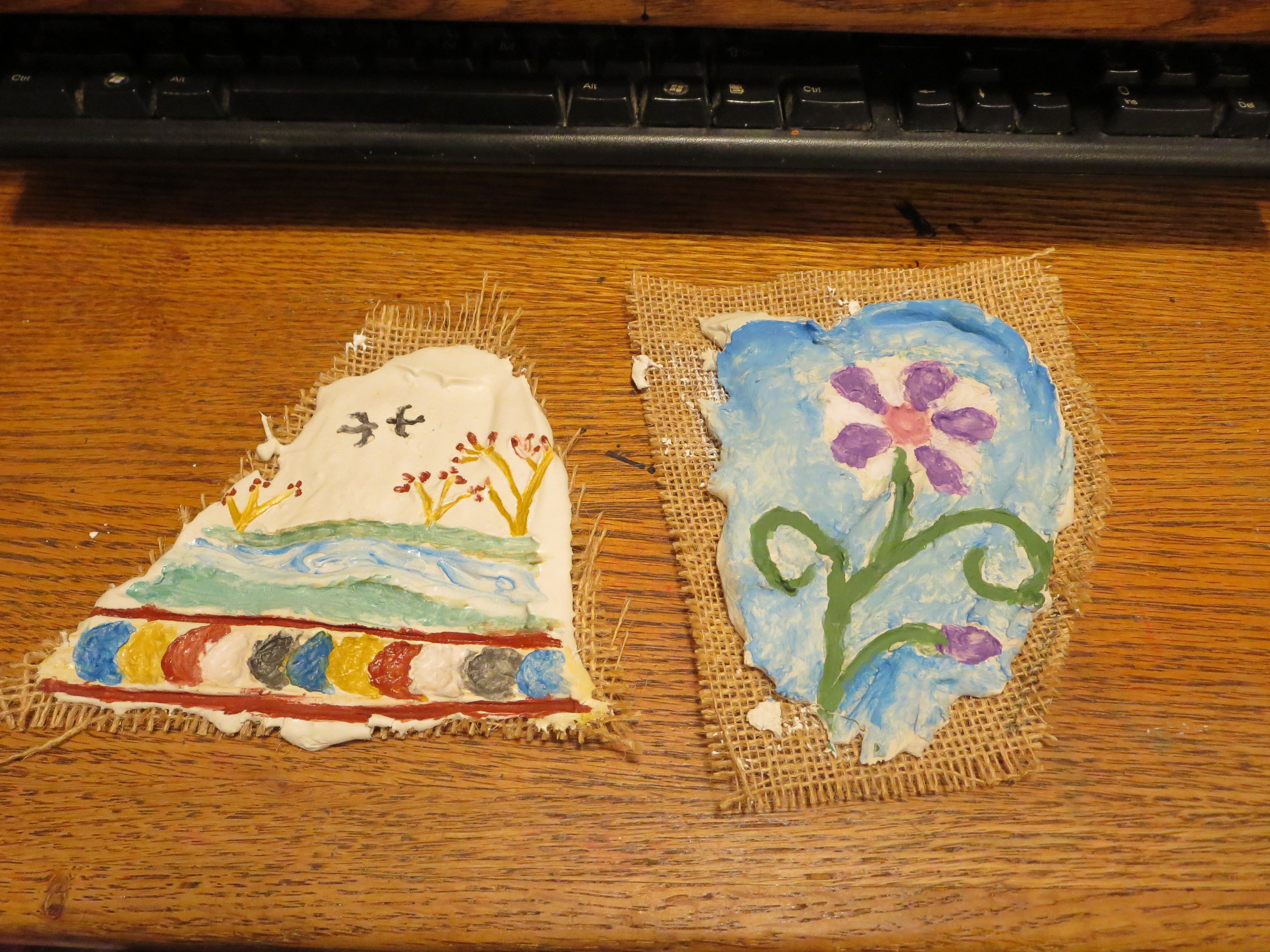
I figured I might as well give it a whirl and see how it worked out. I eyeballed a 50/50 mixture and added about half as much water by volume. The resulting mixture was:
(A) Easier to smooth
(B) Took quite a bit longer to set--more like 30 minutes. Perfect for a classroom activity.
(C) Absorbed the pigments a lot nicer--no wicking or running of the paint
(D) A bit more resilient: the 100% plaster of Paris really pushed down when I applied the brush. The lime/gypsum mix was more...elastic?
(E) The colors are shinier! The painting just looks a lot more vibrant. Both my kids thought it looked better than my 100% plaster-of-Paris version.

I'm not sure how durable each one is. They're just applied on burlap, and both are pretty easy to crack. I feel like the 50/50 mixture is currently easier to crack, but it's also thinner and it still feels a bit damp (it's going to take longer to set, I'm sure!)

I'm mostly posting this to document my little experiment. But, if anyone has any ideas or input or experience with these mixtures, I'd love to know more!
IMG_0992.JPG
Left is 50/50 lime & plaster of Paris. Right is 100% plaster of Paris
 
Nicole Alderman
steward
Posts: 22426
Location: Pacific Northwest
13079
13
homeschooling hugelkultur kids art duck forest garden foraging fiber arts sheep wood heat homestead
  • Likes 7
  • Mark post as helpful
  • send pies
    Number of slices to send:
    Optional 'thank-you' note:
  • Quote
  • Report post to moderator
Here you can see an example of someone else trying to make a fresco in Plaster of Paris. The pigment really doesn't want to apply, and it impressed deeply with each brush stroke:

 
Nicole Alderman
steward
Posts: 22426
Location: Pacific Northwest
13079
13
homeschooling hugelkultur kids art duck forest garden foraging fiber arts sheep wood heat homestead
  • Likes 7
  • Mark post as helpful
  • send pies
    Number of slices to send:
    Optional 'thank-you' note:
  • Quote
  • Report post to moderator
Hmmm, it's been a few hours. I picked up both frescos to show my husband. He agreed that the 50/50 mixture was far nicer. But, even just holding it gently to show him, the 50/50 mixture cracked. It is thinner than the 100% Plaster of Paris, so that might be why. Or, is it that the lime is still setting?

I wonder what a 25% lime/75% plaster would look and work like?
 
Nicole Alderman
steward
Posts: 22426
Location: Pacific Northwest
13079
13
homeschooling hugelkultur kids art duck forest garden foraging fiber arts sheep wood heat homestead
  • Likes 7
  • Mark post as helpful
  • send pies
    Number of slices to send:
    Optional 'thank-you' note:
  • Quote
  • Report post to moderator
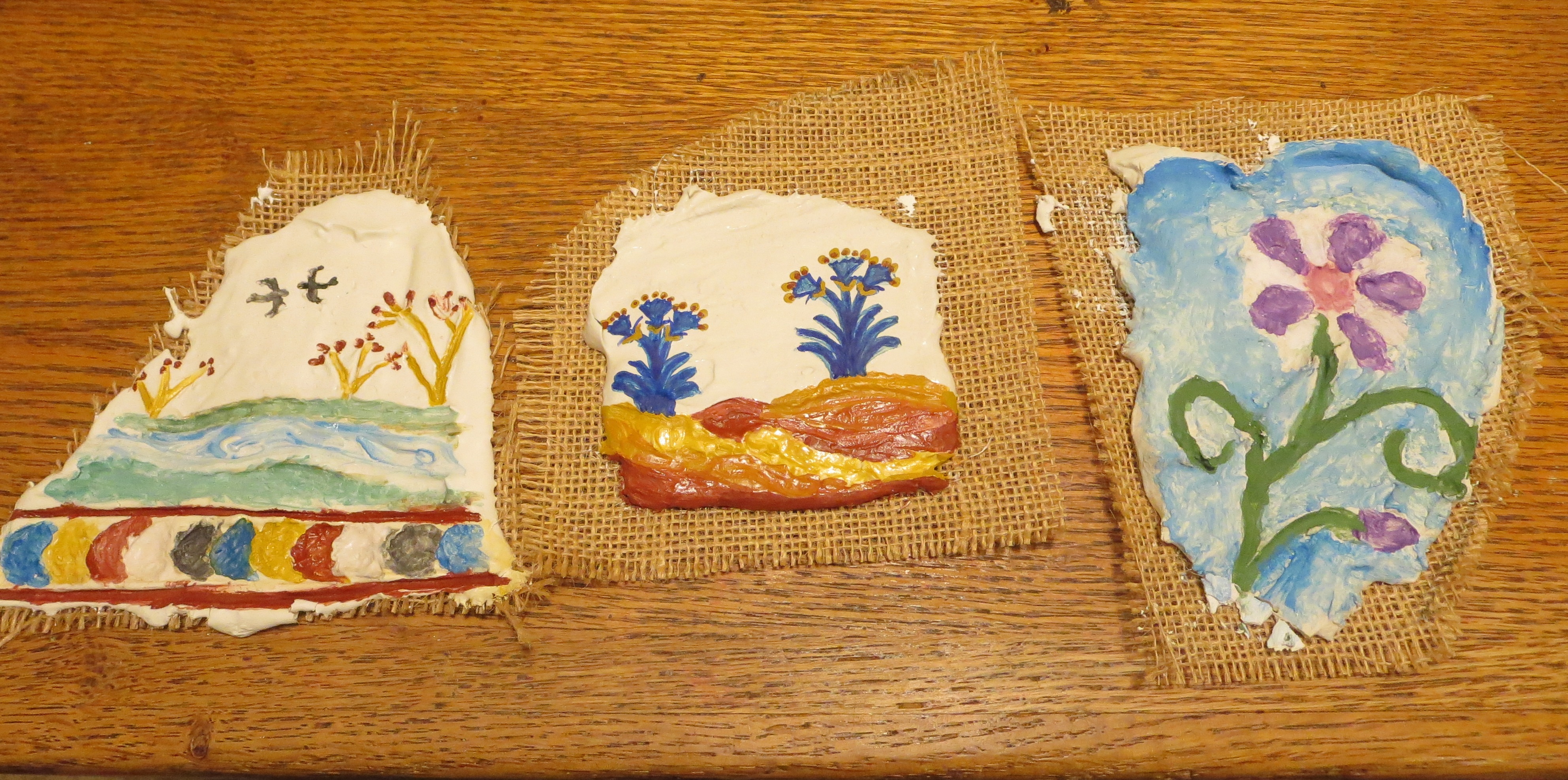
I thought, "Why not try another test!?" So, this time I did 1/3rd lime and 2/3rds plaster. (1 tbsp lime, 2 tbsp plaster, a little over 1 tbsp water). I also laid it on a little thicker.

It seems that this mixture retains the benefits of lime. The paint and plaster are still shiny, and there isn't frustrating wicking going on. It might have been slightly harder to work with than the 50/50 mixture. It didn't seem to dry too fast, but it might have dried faster than the 50/50 mixture. I was able to finish my painting before it had solidified.

It should be less alkaline (so better for kids), and hopefully will be more durable. I also have a lot more plaster of Paris than I do hydrated lime, so this should help stretch the amount.

We'll see how they all look in the morning. I'm going to try to be good and not mess with them until then.
Fresco.jpg
1st: 50/50 lime & plaster. 2nd: 1/3rd lime + 2/3rd plaster. 3rd: 100% plaster
 
Nicole Alderman
steward
Posts: 22426
Location: Pacific Northwest
13079
13
homeschooling hugelkultur kids art duck forest garden foraging fiber arts sheep wood heat homestead
  • Likes 8
  • Mark post as helpful
  • send pies
    Number of slices to send:
    Optional 'thank-you' note:
  • Quote
  • Report post to moderator
I've been watching more videos about traditional lime plaster. It looks like most of the time, the lime was mixed with other substances like sand, volcanic ash, or ground quartz. The final coating was 50% lime and 50% ground quartz.


This makes me feel good about using a smaller portion of lime in this plaster. It should still calcify the pigments.

This site states that the intonaco (the layer you paint on), "is made with clean and finely sieved river sand and/or crushed white stone mixed (marble dust for example) with well seasoned slaked lime, worked to a creamy consistency (grassello di calce). In this case the proportions of the plaster are 1 part filler to 1 part lime."

So, if the default is 50/50 lime and something else, then doing 1/3rd will probably still result in decent results...I'm hoping.
 
gardener
Posts: 5577
Location: Cincinnati, Ohio,Price Hill 45205
1205
forest garden trees urban
  • Likes 10
  • Mark post as helpful
  • send pies
    Number of slices to send:
    Optional 'thank-you' note:
  • Quote
  • Report post to moderator
Neat experiments!
I suspect you could cut either the lime or the plaster of Paris with something neutral and white, and get food results.

Plaster of paris is kind of expensive to me and I've always gotten good results with  the 30,60 and 90 minute dry wall mud  that comes dry and is mixed onsite.
Very predictable working times, and drys plenty hard.

Will your final project be over unstretched burlap or something else?
That will effect durability.
 
Nicole Alderman
steward
Posts: 22426
Location: Pacific Northwest
13079
13
homeschooling hugelkultur kids art duck forest garden foraging fiber arts sheep wood heat homestead
  • Likes 7
  • Mark post as helpful
  • send pies
    Number of slices to send:
    Optional 'thank-you' note:
  • Quote
  • Report post to moderator
The tutorials online generally show putting it on burlap...often because people purposefully crack it to make it look distressed. I'm doing the project with students tomorrow, so I'm not sure what other backing I could use that I can easily & affordably attain. I could glue the burlap to cardboard or cardstock--would that work?

30,60 and 90 minute dry wall mud  that comes dry and is mixed onsite.
Very predictable working times, and drys plenty hard.


I wonder how it does at accepting pigment when wet? How long does it take to dry?

 
gardener
Posts: 645
Location: Boudamasa, Chad
257
2
forest garden
  • Likes 11
  • Mark post as helpful
  • send pies
    Number of slices to send:
    Optional 'thank-you' note:
  • Quote
  • Report post to moderator
Nice work Nicole! I have done fresco with my kids, but we used just lime plaster. It is, indeed, about 50% lime and 50% super fine sand. Ideally powdered marble. But I've just sifted my sand to get something acceptably fine.

There's no problem using lime with kids so long as they aren't finger painting. It's a good opportunity to teach them proper handling of real materials.

It doesn't have to be expensive; just go to a DIY store and buy a bag of lime powder. Lime gets stronger the longer is "slakes"--that is, remains wet. Ideally, mix a thin lime putty and store it in a sealed bucket for a month. The Romans aged theirs in a pit in the ground for up to five years for public buildings.  Otherwise 3 days will work too.

The strength of your finished product depends on the support material. Burlap is not gonna do it. The easiest thing is to buy floor tiles and apply the plaster to the unglazed ceramic on the back of the tile. My kids usually use a brick they find laying around.

Lastly, working with plaster of Paris is an entirely different chemistry. Plaster of Paris hardens by a reaction with water--it would harden in a sealed container. Lime hardens in a reaction with carbon dioxide. As it cures it is turning into limestone again (i.e., calcium carbonate, from whence it was originally processed). As the calcium carbonate crystals form, through a reaction with the air, the mineral pigment particles actually get trapped within the crystals that are forming. You are literally painting into stone. This is why once the surface of the plaster is dry, the paint just sits on top.

But all this depends on actually using mineral pigments. If you're using something synthetic then you might as well wait till it sets up and paint.  

Have fun!!
 
Nicole Alderman
steward
Posts: 22426
Location: Pacific Northwest
13079
13
homeschooling hugelkultur kids art duck forest garden foraging fiber arts sheep wood heat homestead
  • Likes 8
  • Mark post as helpful
  • send pies
    Number of slices to send:
    Optional 'thank-you' note:
  • Quote
  • Report post to moderator

Nathanael Szobody wrote:It doesn't have to be expensive; just go to a DIY store and buy a bag of lime powder. Lime gets stronger the longer is "slakes"--that is, remains wet. Ideally, mix a thin lime putty and store it in a sealed bucket for a month. The Romans aged theirs in a pit in the ground for up to five years for public buildings.  Otherwise 3 days will work too.


My problem is that I keep doing intensive projects in all my classes/subjects each week....so I usually don't have more than a day or two to prepare materials. But, it's good to know that 3 days of slaking will still create a usable result!

The strength of your finished product depends on the support material. Burlap is not gonna do it. The easiest thing is to buy floor tiles and apply the plaster to the unglazed ceramic on the back of the tile. My kids usually use a brick they find laying around.


If it was just my own two kids, I'd totally go with the tile or bricks. Sadly, I'm teaching this to about 50 different kids over the next few days, so buying that much tile or even bricks would cost a pretty penny!

Lastly, working with plaster of Paris is an entirely different chemistry. Plaster of Paris hardens by a reaction with water--it would harden in a sealed container. Lime hardens in a reaction with carbon dioxide. As it cures it is turning into limestone again (i.e., calcium carbonate, from whence it was originally processed). As the calcium carbonate crystals form, through a reaction with the air, the mineral pigment particles actually get trapped within the crystals that are forming. You are literally painting into stone. This is why once the surface of the plaster is dry, the paint just sits on top.

But all this depends on actually using mineral pigments. If you're using something synthetic then you might as well wait till it sets up and paint.  


Yeah, this is why I didn't like a lot of the tutorials I was seeing for painting on plaster of Paris (or even corn starch). It doesn't have the chemistry "magic" of working with lime that locks the pigments into stone!
 
Nicole Alderman
steward
Posts: 22426
Location: Pacific Northwest
13079
13
homeschooling hugelkultur kids art duck forest garden foraging fiber arts sheep wood heat homestead
  • Likes 7
  • Mark post as helpful
  • send pies
    Number of slices to send:
    Optional 'thank-you' note:
  • Quote
  • Report post to moderator
I went and tested the three mixtures again today. The 50/50 lime is still very fragile. It cracked again with rather light pressure. It also still feels a bit damp. The 1/3rd lime and 2/3rds plaster of Paris seems to be stronger. I tried to apply the same amount of pressure, and it didn't break.

I'm going to try slacking some of the hydrated lime in a bucket. This will also help reduce dust during my lesson. How much water do I add to slack it--enough to cover all the lime powder?
 
Posts: 5
  • Likes 6
  • Mark post as helpful
  • send pies
    Number of slices to send:
    Optional 'thank-you' note:
  • Quote
  • Report post to moderator
Sounds like your 50/50 mix worked really well! Slowing down the set time while making the surface more paint‑friendly is perfect for kids. I’d guess that it will be a bit less durable than traditional lime fresco, but for classroom experiments it seems ideal especially since it handles pigments nicely and gives a smoother, more vibrant finish.
 
Nathanael Szobody
gardener
Posts: 645
Location: Boudamasa, Chad
257
2
forest garden
  • Likes 10
  • Mark post as helpful
  • send pies
    Number of slices to send:
    Optional 'thank-you' note:
  • Quote
  • Report post to moderator
If you can't purchase tiles I would recommend doing a very thick layer of plaster of Paris, and a skim coat of lime on top. Mixing the two compromises both strength and the quality of the fresco.

Nicole Alderman wrote:
My problem is that I keep doing intensive projects in all my classes/subjects each week....so I usually don't have more than a day or two to prepare materials. But, it's good to know that 3 days of slaking will still create a usable result!


It depends on your paedagogy; is it entertainment or education?

Fresco is by nature a time-intensive and attention-intensive process. Perhaps you could split it up into many lessons:
- One week they can help you make lime putty and cut up burlap pieces.
- Another week draw their proposed design on paper (just like Michealangelo) and poke pinholes along the lines.
- The third week they can plaster the burlap with a nice thick coat of plaster of paris.
- By the fourth week your lime has aged for three weeks; you can apply a thin skim coat of lime plaster over the plaster of Paris, transfer the drawing to the plaster by pouncing the pin-holed drawing with chalk powder, and then paint.


Nicole Alderman
steward
Posts: 22426
Location: Pacific Northwest
13079
13
homeschooling hugelkultur kids art duck forest garden foraging fiber arts sheep wood heat homestead
  • Likes 8
  • Mark post as helpful
  • send pies
    Number of slices to send:
    Optional 'thank-you' note:
  • Quote
  • Report post to moderator

Nathanael Szobody wrote:It depends on your paedagogy; is it entertainment or education?


My goal is education, but the activities' purpose is threefold:
    (A) Teach skills,
    (B) Help the kids remember historical times, peoples, and concepts,
    (C) Build a love of history.


It's elementary history, and my focus is on building foundation, feel, and love for history that kids can build upon later.

In this class, I'm teaching ancient history, and I only have each group of kids for 50 minutes once a week. I want to an activity with each culture we study so they can remember it. Sometimes, I can manage a multi-week project. When we learned about ancient China, we tied our own "bamboo"/popsicle stick scrolls together one week, and then wrote in Chinese calligraphy the next week. When we learned about the Indus Valley, we spent two weeks making wheeled toys out of clay as well as clay beads that we made jewelry out of on the third week).

Sometimes, we don't have as much time to work on a project. Last week, we made wet-felted designs while learning about the nomadic people of the Eurasian Steppe. But, I was only able to spend a week on it, so we had to complete everything in just 50 minutes.

This week, we're studying the ancient Minoans. I wanted to do something memorable for them before moving onto ancient Greece. I want them to come away with at least the idea of "the Minoans existed and we know about them from the frescos they made, and here's the basic idea of how a fresco is made." I only have one class period, because next week we're moving on to ancient Greece and the making of theater masks. The theater masks themselves will be a multi-week project.

I send home videos, worksheets, reading materials, video, etc that parents can do with kids outside of class (I teach in a homeschool co-op), but I don't have that much time in class. So, I try to make my lesson as historically accurate as possible while still managing to give kids a variety of historical experiences to build their knowledge of history. It' hard!

Since it's the Minoans we're learning about--and not the Renaissance--the cartoon drawing and pouncing techniques likely don't apply--as far as we know, they didn't invent paper or use papyrus (their writing was on clay tablets).
 
Nathanael Szobody
gardener
Posts: 645
Location: Boudamasa, Chad
257
2
forest garden
  • Likes 5
  • Mark post as helpful
  • send pies
    Number of slices to send:
    Optional 'thank-you' note:
  • Quote
  • Report post to moderator
I wish I were one of your students :-)
 
Nathanael Szobody
gardener
Posts: 645
Location: Boudamasa, Chad
257
2
forest garden
  • Likes 7
  • Mark post as helpful
  • send pies
    Number of slices to send:
    Optional 'thank-you' note:
  • Quote
  • Report post to moderator

Nicole Alderman wrote:

This week, we're studying the ancient Minoans. I wanted to do something memorable for them before moving onto ancient Greece. I want them to come away with at least the idea of "the Minoans existed and we know about them from the frescos they made, and here's the basic idea of how a fresco is made." I only have one class period, because next week we're moving on to ancient Greece and the making of theater masks. The theater masks themselves will be a multi-week project.


That's pretty cool. Have you considered doing a single class craft? Like one single fresco that everyone contributes to? And one medieval waddle and daub house that's a bit larger and easier to tie the roof to?

Alright I'm done making suggestions I promise. You're doing fantastic.
 
Nicole Alderman
steward
Posts: 22426
Location: Pacific Northwest
13079
13
homeschooling hugelkultur kids art duck forest garden foraging fiber arts sheep wood heat homestead
  • Likes 3
  • Mark post as helpful
  • send pies
    Number of slices to send:
    Optional 'thank-you' note:
  • Quote
  • Report post to moderator
A whole class project seems like something to work up to in a few years! Right now (at least for how my brain works), a whole class project seems harder to organize and do than all the kids making their own. Making a giant fresco the school could benefit from would be really cool: kids would get to see it for years to come, they'd feel a part of something big, and they'd get to see what a full-sized fresco looks like.

On the other hand, some kids also really enjoy taking their projects home because they are proud of them. I think both have their benefits!

I've really enjoyed seeing the works of All STEM Leads to Rome (here's her blog). One year, she had her students work together to build a Roman road in their school. Another year, they made their own shoes. The whole school year was made up of learning Latin, Roman history, and making awesome things from ancient Rome.
 
Been there. Done that. Went back for more. But this time, I took this tiny ad with me:
permaculture thorns, A Book About Trying to Build Permaculture Community - draft eBook
https://permies.com/wiki/123760/permaculture-thorns-Book-Build-Permaculture
reply
    Bookmark Topic Watch Topic
  • New Topic