posted 1 month ago
I haven't got to the paradise part yet, but we had some heavy rains that were threatening to damage our farm road, and one that was heavy enough that it did damage it a little.
This road only gets minimal vehicle traffic over the higher elevation, and 3-5 times a week vehicle traffic over the lower elevation parts.
I started at the top and just used the cedar duff that falls on the gravel to make one inch high angled ridges that directed the water on the road towards the edge. At the edge, I dug small trenches into the forested area that ended at natural low spots. Because I was pulling the water off the road before it built up much speed, it didn't take much of a ridge. If a car or the tractor drove over it, I just rebuilt it with my rubber boots the next time it rained.
Because the trenches are so small (width of my boot, maybe 2 inches deep, I do have to make sure they don't fill up with mud from the run-off. Again, my boot can clear it when it rains. I guess instead of using hand tools, I'm using a foot tool?
Originally, for the highest third of the road, I had 3 of these ridge/ditch water diverters. Currently the storms we've had, only require two of them to be operational to take care of that section of road.
Further down, the road has grass on the down-slope side. It's a little tougher to work with than the tree duff, so the odd time I've actually had to use a hand tool. What's key is looking at A) where does the water start to build up depth and speed and B) where are there natural hollows that can hold and infiltrate that water. (Slow and spread as those permaculture people like to say!)
There was only one spot where I had to build an "artificial pothole" to slow the run-off. The slope of the road there is steep, and the direction I need to move the water has too much rock and not enough soil. I've spent a bunch of time trying to break-up some of that rock, but it really needs the rock drill and feathers and irons, and I can only do limited amounts of that as I'm quite tiny.
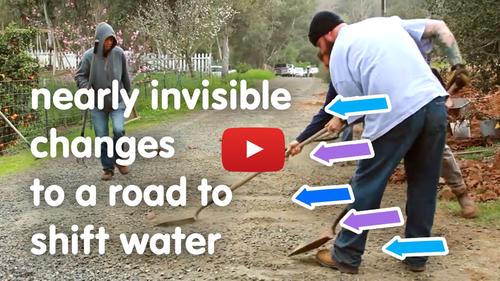
The point of this story is that if you start high in the landscape and look at what the water is doing, it doesn't take much, just like the video says. It doesn't necessarily need to be a big, bold plan. A little tweaking done in the right spots, can reduce or eliminate a problem. In my case, I have to check and maintain it when the rainy season starts, but I also have to prune trees each year, and harvest apples from whatever tree is ripening. Road maintenance can be considered the same way if the road is basically sound to start with and if you look at what nature is doing and nudge it onto a better path.


.png)


 6
6