
• Post Reply Bookmark Topic Watch Topic
  • New Topic
permaculture forums growies critters building homesteading energy monies kitchen purity ungarbage community wilderness fiber arts art permaculture artisans regional education skip experiences global resources cider press projects digital market permies.com pie forums private forums all forums
this forum made possible by our volunteer staff, including ...
master stewards:
  • Carla Burke
  • Nancy Reading
  • John F Dean
  • r ransom
  • paul wheaton
  • Jay Angler
  • Timothy Norton
stewards:
  • Pearl Sutton
  • Tereza Okava
  • Nicole Alderman
master gardeners:
  • Christopher Weeks
gardeners:
  • M Ljin
  • Megan Palmer
  • Pete Podurgiel

Dozens of acres of standing charcoal !?

 
Posts: 147
Location: Nuevo Mexico, Alta California, upland New York, aiming Andalucia
26
forest garden trees greening the desert
  • Likes 12
  • Mark post as helpful
  • send pies
    Number of slices to send:
    Optional 'thank-you' note:
  • Quote
  • Report post to moderator
Good day,

I'm looking for project case studies of using burn-killed timber for soil improvement in forest regeneration, reforestation, agro-forestry, orchard horticulture.  

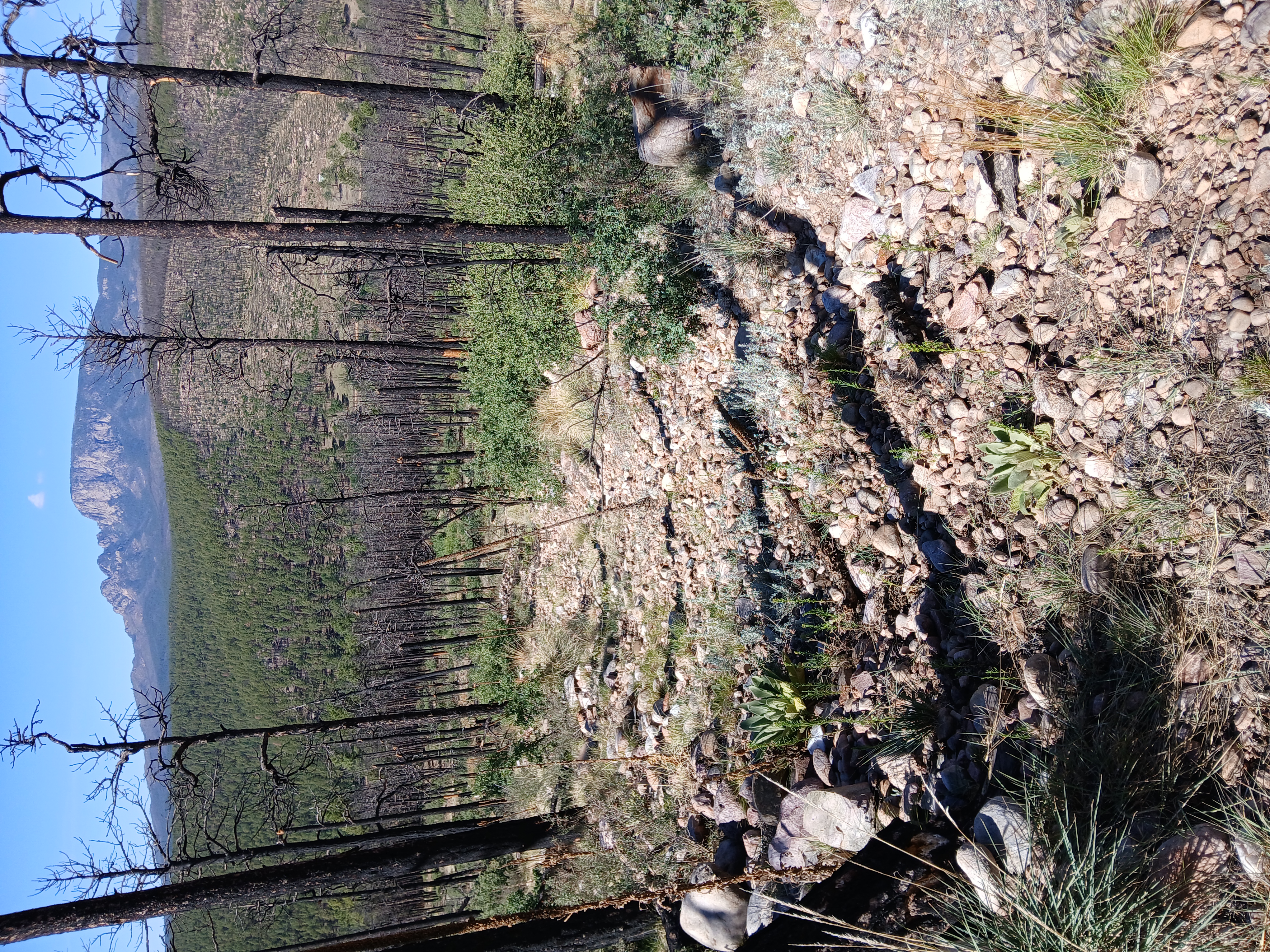
I've started working a site burned over by the Hermit Peak Calf Canyon wildfire, New Mexico's largest ever, in 2022.  The rest was lightly & beneficially burned but 70ac of ponderosa thicket on a level mesa top at 7700' were 100% killed, are starting to keel over & snap in wind, dangerous enough people don't want to go up there, there's some post-fire aerial seeded & weeded + light meadow cover, the fences remain down & cattle wander through.  It's very difficult to near impossible to get heavy equipment up there.  

My proposal is to clear the boundary lines, get the fences back up, in contrast to the extensive grasing outside manage it as an intensive rotation grass bank.  Within that exclose ½ with a wildlife fence to keep out deer/ elk/ rabbit/ bear to compare that regeneration.  Within that plant a seed tree repository of the best genetics most valuable native species.  Within that replicate as a dryland planting the 600-variety collection of high- & dry-land adapted fruit/ nut/ berry we're propagating into the river valley below.  

I'd like to try various side-by-side treatments of the burned trees to soil surface across these different zones.  Thanks for any references & referrals.
20260727_100037.jpg
Standing Biochar?
Standing Biochar?
 
pollinator
Posts: 6277
Location: Bendigo , Australia
593
plumbing earthworks bee building homestead greening the desert
  • Likes 2
  • Mark post as helpful
  • send pies
    Number of slices to send:
    Optional 'thank-you' note:
  • Quote
  • Report post to moderator
An interesting project, good luck with it.
 
master pollinator
Posts: 5968
Location: Canadian Prairies - Zone 3b
1786
  • Likes 11
  • Mark post as helpful
  • send pies
    Number of slices to send:
    Optional 'thank-you' note:
  • Quote
  • Report post to moderator
Hi Patrik. What a wonderful challenge!

I am not in possession of the case studies you are looking for. Perhaps others can chime in.

What I can give you is a few unofficial, unscientific observations from controlled burns in Jasper National Park, Canada. It does not seem the trees that remain upright are standing charcoal. Rather, they have some unfinished charcoal on the outside and a lot of torrified wood. They remain standing for a remarkably long time, suggesting to me that they resist fungal and insect decomposers.

The massively destructive 2024 wildfire in Jasper offers new options for observation. I'm hoping to look more closely at this in the fall.

 
Patrik Schumann
Posts: 147
Location: Nuevo Mexico, Alta California, upland New York, aiming Andalucia
26
forest garden trees greening the desert
  • Likes 8
  • Mark post as helpful
  • send pies
    Number of slices to send:
    Optional 'thank-you' note:
  • Quote
  • Report post to moderator
Thanks Douglas, These trees are charcoal on the exterior only but after four years are already rotting through & coming down.  No sign of that two years ago.  Local salvage loggers have been surprised.  A friend & mentor who's a tree explorer & nurseryman + soil microbial inoculant manufacturer says they have a full spectrum of fungi from exterior to center.  Failing any experimental guidance, collaboration, or support, I'm just going to leave a buffer untouched then fell E-W to get into soil contact + make winter shade lines & snowblow barriers so more lingers to melt in place rather than sublimate away.  Happy to compare notes.
 
steward
Posts: 19533
Location: USDA Zone 8a
4918
dog hunting food preservation cooking bee greening the desert
  • Likes 2
  • Mark post as helpful
  • send pies
    Number of slices to send:
    Optional 'thank-you' note:
  • Quote
  • Report post to moderator
Your project sounds good.

Can you plant mushrooms?

Add wood chips?
 
Posts: 153
Location: Klamath-Siskiyou CA
35
monies trees tiny house
  • Likes 3
  • Mark post as helpful
  • send pies
    Number of slices to send:
    Optional 'thank-you' note:
  • Quote
  • Report post to moderator
Without heavy equipment, options seem rather limited on that scale. Dealing with not just trunks but stumps there is quite a challenge, if you want to convert toward meadow conditions. I'd be inclined to consider large pit burning to further reduce woody material into charcoal, and slowly work through the area in patches. It sounds like it's pretty flat topography, or I'd consider stacking log segments into any gullies or depressions and burying. One more thought is just playing with some creative "snow fence" lines of log poles to create a bunch of minor microclimates and more protected zones (shade and browse) that also catch winter snow drifts for additional hydration.
 
Patrik Schumann
Posts: 147
Location: Nuevo Mexico, Alta California, upland New York, aiming Andalucia
26
forest garden trees greening the desert
  • Likes 4
  • Mark post as helpful
  • send pies
    Number of slices to send:
    Optional 'thank-you' note:
  • Quote
  • Report post to moderator

Anne Miller wrote:Your project sounds good.

Can you plant mushrooms?

Add wood chips?


It's a 500' climb to the top of the mesa on steep rocky hillside with incised drainages, eroded old tracks, loose rock.  Could inoculate with chain oil & spread spores, though what's native is likely already blowing around so better to just foster substrate.  Could possibly eventually get a chipper up there but it would have to eat small-med trees.  
 
Patrik Schumann
Posts: 147
Location: Nuevo Mexico, Alta California, upland New York, aiming Andalucia
26
forest garden trees greening the desert
  • Likes 5
  • Mark post as helpful
  • send pies
    Number of slices to send:
    Optional 'thank-you' note:
  • Quote
  • Report post to moderator

Ben Brownell wrote:Without heavy equipment, options seem rather limited on that scale. Dealing with not just trunks but stumps there is quite a challenge, if you want to convert toward meadow conditions. I'd be inclined to consider large pit burning to further reduce woody material into charcoal, and slowly work through the area in patches. It sounds like it's pretty flat topography, or I'd consider stacking log segments into any gullies or depressions and burying. One more thought is just playing with some creative "snow fence" lines of log poles to create a bunch of minor microclimates and more protected zones (shade and browse) that also catch winter snow drifts for additional hydration.


There's no funding for any of it, though could ask rancher at far back to use his road & lower his fence if we were to obtain use of equipment.  No need to deal with stumps & can simply drop hazards & let everything just decompose in place.  It was a meadow encroached by trees likely historically cleared by fire cycle, called El Valle because same soil as in valley far below, possibly long ago dryland farmed for wheat or beans.  It's as flat as could be, helpful for infiltration of just adequate normal 22" of rain, & 2% slope does fill a stock pond in lowest corner.  The cow trail is more deeply cut than any drainage line.  I do like the snow poles idea.  It's at this sweet spot near highest precip location in NM, getting fairly reliable winter snow & somewhat extended summer monsoon.  Apricot is my dryland benchmark which need the right 8" to survive, 16" to be healthy, 24" to produce.  Having just pounded a 2' hole at center for soil test pit, I'm looking at an auger to drill hundreds if we can line up fencing & rootstock.  
 
Yeah, but is it art? What do you think tiny ad?
building a better world rather than being angry at bad guys
https://wheaton-labs.com/bootcamp
reply
    Bookmark Topic Watch Topic
  • New Topic