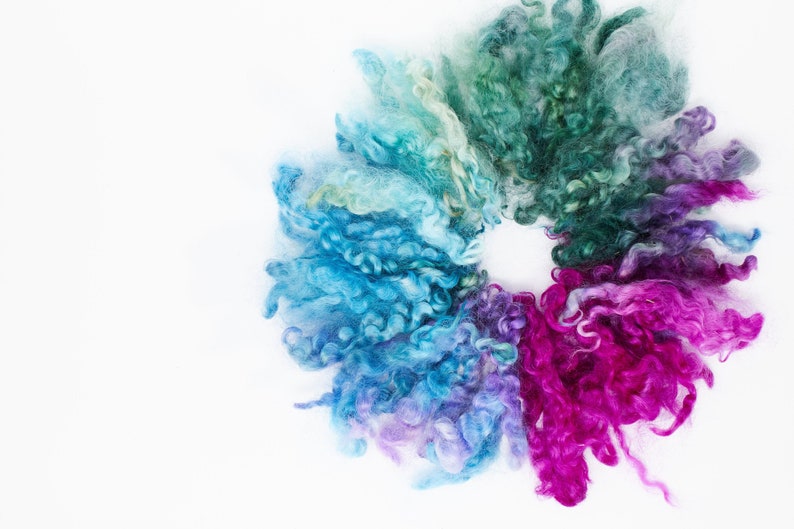
The amazing Raven sent me some lovely jewel locks that she had hand dyed from her sheep. They are just amazing!
Look at those lovely colors!
so pretty!
I've never felted with locks before--let alone handyed ones--but I'm finding them a lot of fun to play with!
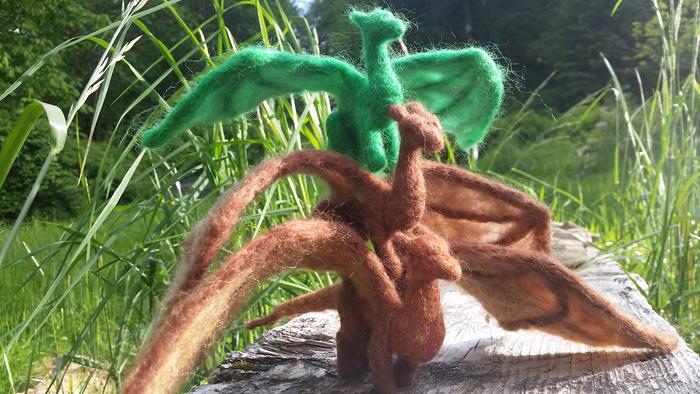
First, I needle-felted a dragon. Those pink locks were so vibrant and lovely and already kind of wing-shaped, so I tried to maintain their shape as much as possible. Since a lot of the locks went from one color to another, it was a fun challenge to arrange them to make the colors blend nicely!
side view
front view
I couldn't resist trying out wetfelting with the locks! I made the dragon for my mother-in-law, and wanted a pouch to safely mail something else to her. I was amazed at how nicely and quickly and beautifully the locks felted up! I was in a hurry, because it was getting dark, so I didn't get any pictures (I like to wet felt outside, so I don't have to deal with splashes of water in my house!). I gently stretched the locks apart and laid a green/blue layer horizontally. Then a blue layer vertically. Then a blue/purple layers diagonally, and then finally a pink-purple layer going the other diagonal. I Put a little more pink in the middle, going horizonally, just because the bottom of pouches like to get thin as I felt them into pouches.
I felted the layers first between bubble wrap. It only took maybe 10 or 15 times between the bubble wrap before it was firm enough to start felting around a wad of bubble wrap. The whole process was done in less than 1.5 hours. Picking and laying out the wool probably took most of that time!
I LOVE how the colors blend from pink-purple on the outside, to a light green/turquoise on the inside. And I love how firm it is, and how some of the curls and texture show up on the edges and surface. So pretty!!
The pouch and dragon match!
The colors look so good together!
If it wasn't raining so much outside, I would have tried to get more pictures of the inside of the pouch. But, I didn't want it to get even more wet, especially when I'm trying to dry it so I can mail to to my mother-in-law for her birthday!
I found out about needle felting last year at a craft fair and I’ve started getting into it! If any of you are in the Southeast, there’s a big fair called the SAFFE Animal Fiber Fair in North Carolina every October.
I don't know if this falls under tips and creations, but it was a fun video to watch and reminded me of this thread.
Jazza is pretty wild the way he approaches learning. He dives in (or in this case, stabs in) and then reads the instructions only if there is a problem he can't solve. It's chaotic, but entertaining.
It also amused me how the number of bandaids kept increasing.
I was so sure that I wouldn't have any critiques while watching his video, as I also took on needle felting by just poking at wool until it looked good. But, then he kept cutting the wool and something inside me screamed each time. It's like cutting off a chunk of roving to spin into yarn. You want those fibers long enough to tangle strongly into the rest of the wool. (I can see cutting it when making the hair, but the other times the wool will just felt in if you poke it well.)
I still end up poking myself on every project I make. When I made your dragon, I somehow managed to poke myself in just the right spot of my finger (the same place that people poke for tiny blood samples) and MAN, it bled so much!
I'm pretty sure no blood got on the dragon...but no guarantees!
I also noticed that he quickly ditched the leather finger guards. Those things take away all the sensation and make it really hard (at least for me) to feel what I'm felting. Bandaids, though, offer enough protection to keep you from getting poked again, and allow for sensation. Honestly, sometimes I think I should just preemptively bandage them, and then I won't poke myself!
I tried needle felting for the first time last week and I'm in love!
The white cat is mine and the other is my husband's. We had fun, but I'm excited to get more wool to make bigger things. Anyone know a good place for wool in central Alberta, Canada?
Those are so cute! I usually order my wool from weircrafts here in the US. Hopefully someone else can chime in where Canadian sources of wool. I would personally avoid merino wool for needle felting. It takes forever to felt because it's so silky! I usually look for Corriedale or Romney wool.
I read that people use merino for doing fine detail work, like mouths and fine lines when you'd want a long done fiber. Would you agree with that? If I want to do fine work at the end, would it be worth it to pick some up for those purposes?
So far I just have a couple cheap kits from Amazon so that I'd have the basic tools and have borrowed a few books from the library about it.
Having merino on the top layer does seem to help with a "smoother" (rather than fuzzy) final look. I don't end up using it much, because I'd rather invest in multi-purpose bulk wool colors I can use for both the body and details.
I'm a bit different from other felters, in that I'd rather make an animal out of one color/type of wool, rather than felting a core out of cheaper white wool, and then covering it with another color of wool. The white likes to poke it's way back out, and isn't very useful in the felting thinner things, like dragons.
The last time I worked with Merino was when I made blue Pern dragon. It was a pain to make, because the merino took so long to felt. But, I already had the blue merino on hand from when I first purchased wool roving years ago. As you can see, it didn't end up very fuzzy:
The relative lack of fuzziness is easier to see when compared to the other dragons of Pern:
The lack of fuzziness is something many people like about merino. And, some people say you can felt it quicker with a fine needle than with a medium or large needle. But, I heard that after I made the blue dragon, so I haven't tested it out for myself.
A friend made this hat with traditional form based felting, then I used needle felting to stiffen and shape the brim, and in the back to fit it to my head.
I love mixing wet felting and needle felting! I often find myself needle-felting a general shape, then wet felting to firm it up, then needle felting to refine it. I love how wool can be worked in so many ways, and that needle felting and wet felting can work so well together.