• Post Reply Bookmark Topic Watch Topic
  • New Topic
permaculture forums growies critters building homesteading energy monies kitchen purity ungarbage community wilderness fiber arts art permaculture artisans regional education skip experiences global resources cider press projects digital market permies.com pie forums private forums all forums
this forum made possible by our volunteer staff, including ...
master stewards:
  • Nancy Reading
  • Carla Burke
  • John F Dean
  • Timothy Norton
  • r ransom
  • Jay Angler
  • Pearl Sutton
stewards:
  • Devaka Cooray
  • Leigh Tate
  • paul wheaton
master gardeners:
  • Christopher Weeks
gardeners:
  • M Ljin
  • thomas rubino
  • Megan Palmer

Irrigation options??

 
Posts: 175
  • Mark post as helpful
  • send pies
    Number of slices to send:
    Optional 'thank-you' note:
  • Quote
  • Report post to moderator


So I just bought a new house and I am trying to get the the scene set up for the garden etc. I am putting gutters on the house so rain barrel collection is an option (asphalt shingles though?)
I also have a small creek/stream running through the property. When I say small, about 2-3 foot wide and a few inches deep. SO I could pump from the stream and run the down spout into the stream??

Any thoughts on this ??

I was also told I have spring heads in a general area but I have no clue what look for or what to do if I found one?
 
gardener
Posts: 1948
Location: PNW Oregon
49
hugelkultur forest garden duck trees books chicken food preservation
  • Mark post as helpful
  • send pies
    Number of slices to send:
    Optional 'thank-you' note:
  • Quote
  • Report post to moderator
I wouldn't run water off my roof into a stream, but that's just my me.

I would deter, slow down and otherwise keep much of the water running in that stream busy on my land.

Watch the entire series of land regeneration Part 1, 2, 3 & 4 to get ideas about what to do with streams  http://www.youtube.com/watch?v=5YMX031weVw&feature=related.

Run your roof water into pounds with foliage to 'clean' that water before moving it on over your land.  There are vids for that too

All the best
 
Tim Canton
Posts: 175
  • Mark post as helpful
  • send pies
    Number of slices to send:
    Optional 'thank-you' note:
  • Quote
  • Report post to moderator
Jamie,

Thanks for the info.    I dont have any ponds on my property as of now.    I live at the foot of a mountain and my property slopes from front to back and the water runs about 15ft off of my house.  I have figured that I get 35000 gallons of water off my roof a year.  Wouldn't I need a huge pond for that??  Also how tuff is it to dig and keep a pond on sloped terrain??      Many thanks.
 
Jami McBride
gardener
Posts: 1948
Location: PNW Oregon
49
hugelkultur forest garden duck trees books chicken food preservation
  • Mark post as helpful
  • send pies
    Number of slices to send:
    Optional 'thank-you' note:
  • Quote
  • Report post to moderator
No not a huge pond as you don't keep the water just run it into the first pond with cattails and then run it over rocks to aerate as it goes to another pond with underwater plants and fish, and then ?  See your processing the water, cleaning it, and enjoying it as you do so.  By the time it reaches the end it is clean enough to use on your plants or run it back into that stream. 

Type in permaculture water at youtube.com for lots of ideas.
 
                        
Posts: 278
Location: Iowa, border of regions 5 and 6
  • Mark post as helpful
  • send pies
    Number of slices to send:
    Optional 'thank-you' note:
  • Quote
  • Report post to moderator

organick wrote:
Jamie,

Thanks for the info.    I dont have any ponds on my property as of now.    I live at the foot of a mountain and my property slopes from front to back and the water runs about 15ft off of my house.   I have figured that I get 35000 gallons of water off my roof a year.   Wouldn't I need a huge pond for that??   Also how tuff is it to dig and keep a pond on sloped terrain??       Many thanks.


Organick, you need to get some kind  of rain barrel system to store that water up and switch it into your toilet system.  Use THAT for flushing.  Maybe find a way to switch it into your shower, in addition to using it to water your garden.  That would REALLY cut down on your water bill.

And the pond thing isn't tough.  You just need to lower one side of the mountain so your terrain doesn't slope...
 
pollinator
Posts: 11856
Location: Central Texas USA Latitude 30 Zone 8
1278
cat forest garden fish trees chicken fiber arts wood heat greening the desert
  • Mark post as helpful
  • send pies
    Number of slices to send:
    Optional 'thank-you' note:
  • Quote
  • Report post to moderator
Here's some more information about storing water in the soil: 

http://www.youtube.com/watch?v=2iQ-FBAmvBw

http://www.harvestingrainwater.com/

Personally I would store the water from your roof in a rain tank to use for irrigation and if you want, flushing toilets or doing laundry.  Asphalt shingles aren't ideal and I would hesitate to use water off them for drinking or cooking.  Washing should be ok.  If you're using the water for irrigation and household, you won't need a huge storage container, since it will refill with as you use it.  A couple thousand gallons or so would probably be sufficient. 

If you want to be water self-sufficient you might also want to look into grey water gardening:  http://oasisdesign.net/
 
pollinator
Posts: 2103
Location: Oakland, CA
29
  • Mark post as helpful
  • send pies
    Number of slices to send:
    Optional 'thank-you' note:
  • Quote
  • Report post to moderator
It should be possible to divert the first flush of water away from your collection tank, if you expect tar (or other stuff) from the roof to become a problem.

There are lots of designs out there.
 
                
Posts: 44
Location: West Coast of Canada
  • Mark post as helpful
  • send pies
    Number of slices to send:
    Optional 'thank-you' note:
  • Quote
  • Report post to moderator

Ludi wrote:
If you're using the water for irrigation and household, you won't need a huge storage container, since it will refill with as you use it.  A couple thousand gallons or so would probably be sufficient.


That is rather climate-dependent!  For irrigation alone, we needed 3500 gallons this year for a quite modest garden, because it didn't refill all summer.
 
pollinator
Posts: 4437
Location: North Central Michigan
59
  • Mark post as helpful
  • send pies
    Number of slices to send:
    Optional 'thank-you' note:
  • Quote
  • Report post to moderator
i agree with those that suggested having your water from your house tempered through a small bog or pond, at least to cool before being used on your garden..for hot water.

i agree with the rain barrels as well..or a collection pond..but try to use gravity as much as possible..from roof, to storage..to garden by gravity
 
Tyler Ludens
pollinator
Posts: 11856
Location: Central Texas USA Latitude 30 Zone 8
1278
cat forest garden fish trees chicken fiber arts wood heat greening the desert
  • Mark post as helpful
  • send pies
    Number of slices to send:
    Optional 'thank-you' note:
  • Quote
  • Report post to moderator

KeithBC wrote:
That is rather climate-dependent!  For irrigation alone, we needed 3500 gallons this year for a quite modest garden, because it didn't refill all summer.


We have about 11,000 gallons storage for our droughty climate.

 
Joel Hollingsworth
pollinator
Posts: 2103
Location: Oakland, CA
29
  • Mark post as helpful
  • send pies
    Number of slices to send:
    Optional 'thank-you' note:
  • Quote
  • Report post to moderator
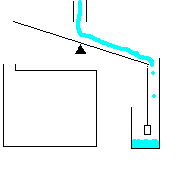
Diverting the first portion of the rain away from the rain barrel should help a lot. The illustration is a cartoon I happened to have sitting around, of an automatic first-flush system: the float on the right pulls down on the section of gutter, tilting it toward a waste container. As the water level in this rises, it lifts up the float, tipping the section of gutter toward the rain barrel on the left. Ideally, the waste container would drain about as fast as the roof became dirty.

Another option might be to set up a rain garden with a mulch pit. Innoculating the mulch pit with oyster mushroom spawn would help to break down anything harmful from the asphalt.

It's probably a better idea in the long term to work with gravity, if possible. If any portion of your growing space sits below the uphill portion of the stream bed, that would be a great irrigation option. If it is a seasonal stream, then a small pond fed by it could be of great value.
first_flush.PNG
automatic first flush system for rainwater catchment
 
gardener
Posts: 866
Location: South Puget Sound, Salish Sea, Cascadia, North America
29
  • Mark post as helpful
  • send pies
    Number of slices to send:
    Optional 'thank-you' note:
  • Quote
  • Report post to moderator
4 diconnected thoughts...

With some kind of hose or pipe in a high point in a stream or diversion pool, you can gain around 2.5 PSI per foot of drop like a siphon and have pressurized water (I have seen mile long hoses in developing country servicing far away neighbors from a single stream.

There are likely patterns of ground water associated with the stream that create a variety of moist microhabitats.  Soil color can indicate the pattern and frequency of soil saturation (research "redoximorphic features")

This is illegal in most states without withdrawal rights.  It is quite possible that you actually don't own the water running across the land rights which you have purchased.

Consider that you and your neighbors are now stewards of running water, the life blood of the earth, and that what you take from the stream and put in the stream has the potential for broad and cumulative effects.  (Soap? Nutrients? Heat? Toxics?).
 
Tim Canton
Posts: 175
  • Mark post as helpful
  • send pies
    Number of slices to send:
    Optional 'thank-you' note:
  • Quote
  • Report post to moderator
Thanks you guys.  I appreciate the info.

Paul  I checked in with the ag extension office and they said if the water runs through my property I can use it for irrigation.  However am I doing damage to the system by taking from it?  Altering the flow in any way is apparently a different story where I need to deal with soil conservancy in the county.  I mean I have well water on the property I can also use as well as potentially rain barrels but I have issue with flow from the house to garden area...  I figured if clean the water would be much healthier and full of nutrients  but I obviously want no harm done.

The house sits about 12-15 up a hill from the water so any flow not contained is gonna enter the water way  and I need to stay at least 10 ft off my house because we already have moisture issues.  I am left with only a few feet and disturbing that would disturb the bank.

Perhaps I just need to sit with land in rain and shine and see what it has to say.
 
Joel Hollingsworth
pollinator
Posts: 2103
Location: Oakland, CA
29
  • Mark post as helpful
  • send pies
    Number of slices to send:
    Optional 'thank-you' note:
  • Quote
  • Report post to moderator

organick wrote:
Thanks you guys.  I appreciate the info.

Paul  I checked in with the ag extension office and they said if the water runs through my property I can use it for irrigation.  However am I doing damage to the system by taking from it?   Altering the flow in any way is apparently a different story where I need to deal with soil conservancy in the county.   I mean I have well water on the property I can also use as well as potentially rain barrels but I have issue with flow from the house to garden area...  I figured if clean the water would be much healthier and full of nutrients  but I obviously want no harm done.

The house sits about 12-15 up a hill from the water so any flow not contained is gonna enter the water way   and I need to stay at least 10 ft off my house because we already have moisture issues.  I am left with only a few feet and disturbing that would disturb the bank.

Perhaps I just need to sit with land in rain and shine and see what it has to say.


From all that, it sounds as though the stream is fed partially by groundwater, and using it for irrigation will mostly tend to even out the flow of it over the course of each year. Slowing storm runoff is typically a very, very good thing. You might like to read up on the topic: depending on your style, I'd recommend either something on the role that beavers played in US ecosystems prior to fur trapping, or the design system of P. A. Yeomans. If you enjoy both nature and technology, you might want to read both.

If you over-fertilize, there could be some harm from nutrients leaching into the groundwater or the stream. Most of the methods advocated on this forum are intended to keep soil organic matter high enough to avoid that sort of problem.

The same sorts of methods that delay water and allow living things to use it, also delay dissolved nutrients/wastes and allow living things to clean them up. Potentially, nitrogen/phosphorus pollution from uphill will be filtered out on your property, benefiting you a little and the stream, a lot.
 
Brenda Groth
pollinator
Posts: 4437
Location: North Central Michigan
59
  • Mark post as helpful
  • send pies
    Number of slices to send:
    Optional 'thank-you' note:
  • Quote
  • Report post to moderator
i suggest always using gravity where ever possible, which means to have your garden down from your water source for gravity to work..which might mean water colleciton off of a roof somewhere.

also i love soaker hoses..they are gentle and don't spread any diseases like sprinklers do when they splash.

i have soaker hoses all over, but try to not have to water.

better to use lots of mulch and organic material that holds water like a hugel bed, etc..which cuts the need for water, but if you have the $ for the soaker hoses, bury them just under the surface of your bed or under your mulch, and you'll be glad you did.
 
Tim Canton
Posts: 175
  • Mark post as helpful
  • send pies
    Number of slices to send:
    Optional 'thank-you' note:
  • Quote
  • Report post to moderator
Thank you all and I wanted to revisit this topic a little with new questions.

Like i said before I have both roof water and some groundwater to work with.  I was thinking about trying to put a rather small pond in as a way of holding it longer before it enters the drainage.  I have a sloped property so that is one issue, the second issue being the area i would like to put it is pretty close to the existing drainage and I dont want a potential huge mess if something didnt work.  There is another spot that already collects a decent amount of water but its the bottom of my property......meaning  its a decent run to get the water there and I have to pump it back up hill if I want to use it  (which is not necessary).

So  2 questions...does anyone have good info or sites for pond building,  specifically on sloped ground if possible.

Second being is this even the best approach  or should I be slowing water higher up in the already existing drainage and just allow a percentage off the roof water to work its way back to the drainage itself?    Any ideas or info on doing this safely/effectively?    Again the water at its highest is a few inches but in runs pretty well and has steady flow.

Blessings
 
                      
Posts: 9
Location: Spearfish SD
  • Mark post as helpful
  • send pies
    Number of slices to send:
    Optional 'thank-you' note:
  • Quote
  • Report post to moderator
How fast does your stream move? Have you looked into a Ram pump? They sell commercial ones, but there are plans out there to build one. I built a paddle wheel to over come my irrigation issues. I live on totally flat ground so I pump my water in to a 500 gal tank about 15 feet in the air. www.youtube.com/watch?v=fZJW8iNOY
The wheel I build for a couple hundred bucks, and will pump water 35ft straight up. Depending on your situation you could build a small wheel to suite you.  Let me know if you have any specific question about the wheel (the video has no narration) www.pangeafarm.com
 
Paul Cereghino
gardener
Posts: 866
Location: South Puget Sound, Salish Sea, Cascadia, North America
29
  • Mark post as helpful
  • send pies
    Number of slices to send:
    Optional 'thank-you' note:
  • Quote
  • Report post to moderator
If you concentrate water at a point (pond), then if it overflows you have concentrated flow... so you need to start managing this to prevent erosion.  Mollison describes back and forth swales slightly off contour with controlled overflow and the down end, so that water moves slowly back and forth across slope percolating the best it can.  I once saw an ingenious down drain, where a gully was stuffed full of willow branches and then partailly buried.  They all rooted and shooted but the spaces between the self-sustaining drain transported water downhill without erosion.  The two ideas could be combined.

Post a picture worth a thousand words...
 
I agree. Here's the link: http://stoves2.com
reply
    Bookmark Topic Watch Topic
  • New Topic