• Post Reply Bookmark Topic Watch Topic
  • New Topic
permaculture forums growies critters building homesteading energy monies kitchen purity ungarbage community wilderness fiber arts art permaculture artisans regional education skip experiences global resources cider press projects digital market permies.com pie forums private forums all forums
this forum made possible by our volunteer staff, including ...
master stewards:
  • Carla Burke
  • Anne Miller
  • Nancy Reading
  • John F Dean
  • r ransom
  • paul wheaton
  • Timothy Norton
stewards:
  • Jay Angler
  • Pearl Sutton
  • Andrés Bernal
master gardeners:
  • Christopher Weeks
gardeners:
  • M Ljin
  • Thekla McDaniels
  • May Lotito

Rocket mass heater in my camper van???

 
Posts: 12
  • Mark post as helpful
  • send pies
    Number of slices to send:
    Optional 'thank-you' note:
  • Quote
  • Report post to moderator
I guess I wanted to throw out there my idea of putting a rocket mass heater in my 1979 dodge camper van. Does this sound way to sketchy? Do-able? I figure I've seen enough buses with wood stoves. Thanks in advance for your considerations. oh and in case its relavent, Im in oregon.
 
pollinator
Posts: 524
Location: Salt Lake Valley, Utah, hardiness zone 6b/7a
8
  • Mark post as helpful
  • send pies
    Number of slices to send:
    Optional 'thank-you' note:
  • Quote
  • Report post to moderator
Many things are doable. Many things shouldn't be done.

Do you plan on moving your camper van after installing an RMH in it? Even taking the M out of the RMH may not make it something that should be done. Someone mentioned that there are some very nice marine woodstoves on the market. Perhaps something like that might be more appropriate?

If you are insistent, a rocket based heater could probably be cobbled together. Look around on the internet for something that has already been done successfully.

If your camper is static sculpture, you might be able to put a conventional RMH in it, but the heated space is so small you would be using a small diameter flue and I understand that anything under 6" dia. can get finicky, but has been done. On the other hand, you could put in a 6" system that puts out so much heat you could keep the windows open and not worry about CO poisoning -- as much.

Just doing a little brainstorming while preparing this response leads me to believe that you could likely be able to do it, but it won't be easy and probably not cheap and maybe not safe -- but it might be fun to try.
 
Rebecca morgan
Posts: 12
  • Likes 3
  • Mark post as helpful
  • send pies
    Number of slices to send:
    Optional 'thank-you' note:
  • Quote
  • Report post to moderator
Thanks for your reply. I think I am realizing a few problems that could happen with the RMH in the van. For one, the cob could get pretty heavy, and once built theres a strong chance that once the van was moving the cob could crack...... I think instead I am now entertaining the idea of a wood stove in a van with an earthen plastered floor, and earth plaster walls or clay straw insulation. What Iam trying to work with is trying to create a warm space in winter thats cozy and not built with weird bad for me stuff. I also need to navigate the problem of moisture that I hope to keep at bay by burning dry heat........... Any ideas.......? Anything fun yall would try?
 
Andrew Parker
pollinator
Posts: 524
Location: Salt Lake Valley, Utah, hardiness zone 6b/7a
8
  • Mark post as helpful
  • send pies
    Number of slices to send:
    Optional 'thank-you' note:
  • Quote
  • Report post to moderator
Rebecca,

How much traveling do think you would be doing in your camper? If you will be be fairly static, just moving once in awhile for short distances at relatively low speeds, what you are envisioning may be doable. You still need to keep the gross weight within the chassis' and tires' specifications.

If you are going to be moving around frequently and/or over long distances at highway speeds, I would go for the lightest solution, even if that means using modern materials. You're in a van, not a cob cottage. You won't be doing the earth, or your pocketbook, any favors lugging around hundreds of extra pounds. You can always give it a funky earthy/rustic veneer.

Have you looked at cotton or wool batt as an insulating option? Closed-cell foam and/or XPS panels are probably the most efficient option. Aluminized bubble insulation can also be very effective if it is installed correctly, especially in conjunction with some kind of batt insulation.

I have no experience with straw-clay, but I have researched it. You can probably get a fairly lightweight, consistent result with some trial and error and lots of practice.

I looked up marine/small stoves. There are a some very nice products available. They aren't particularly cheap. You might be able to look around and find a good used one for a reasonable price. Another option is a tent stove. Quite a variety, but they aren't as pretty.

Good-luck, and remember that just because something is natural doesn't mean it is healthy, or vice versa.
 
Posts: 21
1
  • Mark post as helpful
  • send pies
    Number of slices to send:
    Optional 'thank-you' note:
  • Quote
  • Report post to moderator
Straw/clay slip is very easy to use/make. You take fresh straw and 'toss' it like salad greens in oil dressing, only you use mud slip. Its not like cob. You coat it in the mud slip to help bind it and create a fire barrier. I dont think it would be good in a moving van. Although it is doable, using plastic netting to maintain it. I have several walls of it in my shed.

Story: after mixing up the slip and letting it rest a while (too much water in it), a chicken came in and nested in the straw, leaving me an egg. I have a pic someplace.

You could build a smaller rocket stove and bench, using perlite/vermiculite and no clay for the packing. Something similar to the ones built in the box? Maybe use the light fire bricks for bulk. The vermiculite will hold the heat and some moisture. Ive been searching around for similar ideas for my RV. The only one i found so far was for the 35 foot rv.

Im surprised to not find more infor for smaller homes, like rvs and tiny houses on wheels. I would think something on the line of that stainless steel propane stove shown in some of the tiny home links, but built as a rocket stove for wood instead.
 
Rocket Scientist
Posts: 4838
Location: Upstate NY, zone 5
795
5
  • Likes 2
  • Mark post as helpful
  • send pies
    Number of slices to send:
    Optional 'thank-you' note:
  • Quote
  • Report post to moderator
Old thread I know, but I see nobody has mentioned the obvious: If you want to do mass heat storage in a small and potentially mobile place, water stores more heat by both mass and volume than anything else commonly available. You could even dump the water for traveling and refill at your new location - not practical for a frequent traveler, but no kind of mass storage is going to be good there.
 
steward
Posts: 9500
Location: Colombia - Tropical dry forest
3565
6
forest garden fish fungi trees tiny house earthworks bee solar woodworking greening the desert homestead
  • Likes 5
  • Mark post as helpful
  • send pies
    Number of slices to send:
    Optional 'thank-you' note:
  • Quote
  • Report post to moderator
 
Steward and Man of Many Mushrooms
Posts: 6246
Location: Southern Illinois
2005
transportation cat dog fungi trees building writing rocket stoves woodworking
  • Likes 3
  • Mark post as helpful
  • send pies
    Number of slices to send:
    Optional 'thank-you' note:
  • Quote
  • Report post to moderator
I just tinkered with an idea about having a wood stove with flush containers of sand mounted to the sides and back.  It would still have extra mass to gain heat, but it wouldn’t exactly be a rocket stove.  But I see no reason why the basic design couldn’t be adapted to fit a rocket stove.


Eric
 
master pollinator
Posts: 6090
Location: Canadian Prairies - Zone 3b
1874
  • Likes 4
  • Mark post as helpful
  • send pies
    Number of slices to send:
    Optional 'thank-you' note:
  • Quote
  • Report post to moderator
I think the best way to help heat a van is to have the mass running underneath the van. Park over top and the heat will percolate up.

Another thought is that many RV seasonal parking areas allow a semi-permanent hard structure right beside the van ... sort of a lean-to extension that gives dry storage, a cooking area, sitting room, doghouse, etc. A brick RMH with a cooktop would be brilliant in this situation.
 
gardener
Posts: 566
Location: The Old Northwest, South of Superior
362
books building wood heat
  • Likes 3
  • Mark post as helpful
  • send pies
    Number of slices to send:
    Optional 'thank-you' note:
  • Quote
  • Report post to moderator
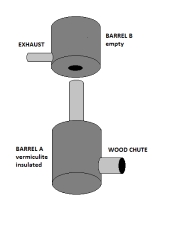
What about Erica Wisner's Caddis Fly design, here (about halfway down the page)?
https://ernieanderica.blogspot.com/2015/10/pyronauts-in-montana.html
or on Archive, in case of future link rot:
https://web.archive.org/web/20231001000000*/https://ernieanderica.blogspot.com/2015/10/pyronauts-in-montana.html
I think it's fair to characterize it as a pocket rocket with thermal mass.  She intended it for just such applications, though I don't know that she did any further development work on it after the initial collab at Wheaton Labs with Peter Van den Berg and others.

This is somewhat akin to a half-pint pönttöuuni, a Finnish heater built of bricks and/or fire bricks fitted inside a cylindrical steel skin, discussed in this thread, among other places:
https://permies.com/t/40876/ntt-uuni-metalcontainer-wood-burning

There were also small masonry heaters of quadrilateral footprint (as compact as 2X2 bricks - perhaps 16 to 18 inches or 400 to 500 mm square, depending on the size of bricks), apparently somewhat common as heaters for upper floor apartments in parts of the Eastern Bloc, which were built of common red bricks and sometimes fire bricks or specially shaped pre-cast refractory blocks, with a steel angle tension frame and having sheet steel skins slipped between the bricks and frame.  Since these were usually single skinned, due to the space constraints, the sheet steel shell gave some additional protection against leaks due to eventual cracks in the mortar joints.  David Lyle shows a plan for one or two of these small stoves in the appendix at the end of his masonry heater book, as I recall.  Some of the Soviet stove building manuals also detail such small masonry heaters, but I don't have the references at my fingertips.  With adequate framing, these might withstand some shifting and shimmying in a van.

Gustaf Edvard Asp also shows several smaller form factor masonry heaters built into steel shells in his book "Uuninmuuraaja" (I have a scan of the 1948 edition), though he does not appear to envision these in mobile applications (!).  There are both two and three pass contraflows shown which aren't far removed from Erica's Caddis Fly, give or take some height and a fuel door.  Erica's version is simpler, smaller, lighter and would be cheaper & easier to build.

 
Men call me Jim. Women look past me to this tiny ad:
Rocket mass heater combo COMBO
https://permies.com/wiki/391869/Rocket-mass-heater-combo-COMBO
reply
    Bookmark Topic Watch Topic
  • New Topic