

• Post Reply Bookmark Topic Watch Topic
  • New Topic
permaculture forums growies critters building homesteading energy monies kitchen purity ungarbage community wilderness fiber arts art permaculture artisans regional education skip experiences global resources cider press projects digital market permies.com pie forums private forums all forums
this forum made possible by our volunteer staff, including ...
master stewards:
  • Carla Burke
  • Nancy Reading
  • John F Dean
  • r ransom
  • Jay Angler
  • Timothy Norton
stewards:
  • paul wheaton
  • Tereza Okava
  • Nicole Alderman
master gardeners:
  • M Ljin
  • Christopher Weeks
gardeners:
  • Jeremy VanGelder
  • thomas rubino
  • Megan Palmer

Oikos Neosinte -- sweet corn + teosinte hybrid

 
master gardener
Posts: 6404
Location: Carlton County, Minnesota, USA: 3b; Dfb; sandy loam; in the woods
3848
8
forest garden trees books chicken food preservation cooking fiber arts seed woodworking homestead ungarbage
  • Likes 7
  • Mark post as helpful
  • send pies
    Number of slices to send:
    Optional 'thank-you' note:
  • Quote
  • Report post to moderator


Early this month, the Oikos monthly email had a piece on the "neosinte" that Kenny's been breeding. It sparked my imagination but I *really* don't need another project, so I let it lie. Well, today I ordered a set of his unselected kernels.

https://oikostreecrops.com/products/neosinte-teosinte-seeds/

It's just 100 seeds, so I'll dedicate a small patch away from where I try to grow corn this year and see what it does!

Has anyone else played with this?

An earlier article he wrote about it: https://oikostreecrops.com/neosinte-teosinte/
 
gardener
Posts: 2208
Location: Zone 6b
1399
forest garden fungi books chicken fiber arts ungarbage
  • Likes 6
  • Mark post as helpful
  • send pies
    Number of slices to send:
    Optional 'thank-you' note:
  • Quote
  • Report post to moderator
Thanks for sharing! I found very little information regarding this breed online so please keep us updated. Does it tiller like teosinte? Does it associate with nitrogen fixing bacteria in the rhizosphere? Teosinte does and the diazotrophs not only help with aquiring nutrient but also increase resistance to stresses in the host. It will be interesting to compare Neisinte with other modern varieties side by side.
 
author & steward
Posts: 7530
Location: Cache Valley, zone 4b, Irrigated, 9" rain in badlands.
3785
  • Likes 7
  • Mark post as helpful
  • send pies
    Number of slices to send:
    Optional 'thank-you' note:
  • Quote
  • Report post to moderator
I haven't grown that exact cross, but I have grown crosses between domestic corn and teosinte. I really like them.

And the name? Oh my! Kudos to whomever invented it.

 
Christopher Weeks
master gardener
Posts: 6404
Location: Carlton County, Minnesota, USA: 3b; Dfb; sandy loam; in the woods
3848
8
forest garden trees books chicken food preservation cooking fiber arts seed woodworking homestead ungarbage
  • Likes 7
  • Mark post as helpful
  • send pies
    Number of slices to send:
    Optional 'thank-you' note:
  • Quote
  • Report post to moderator
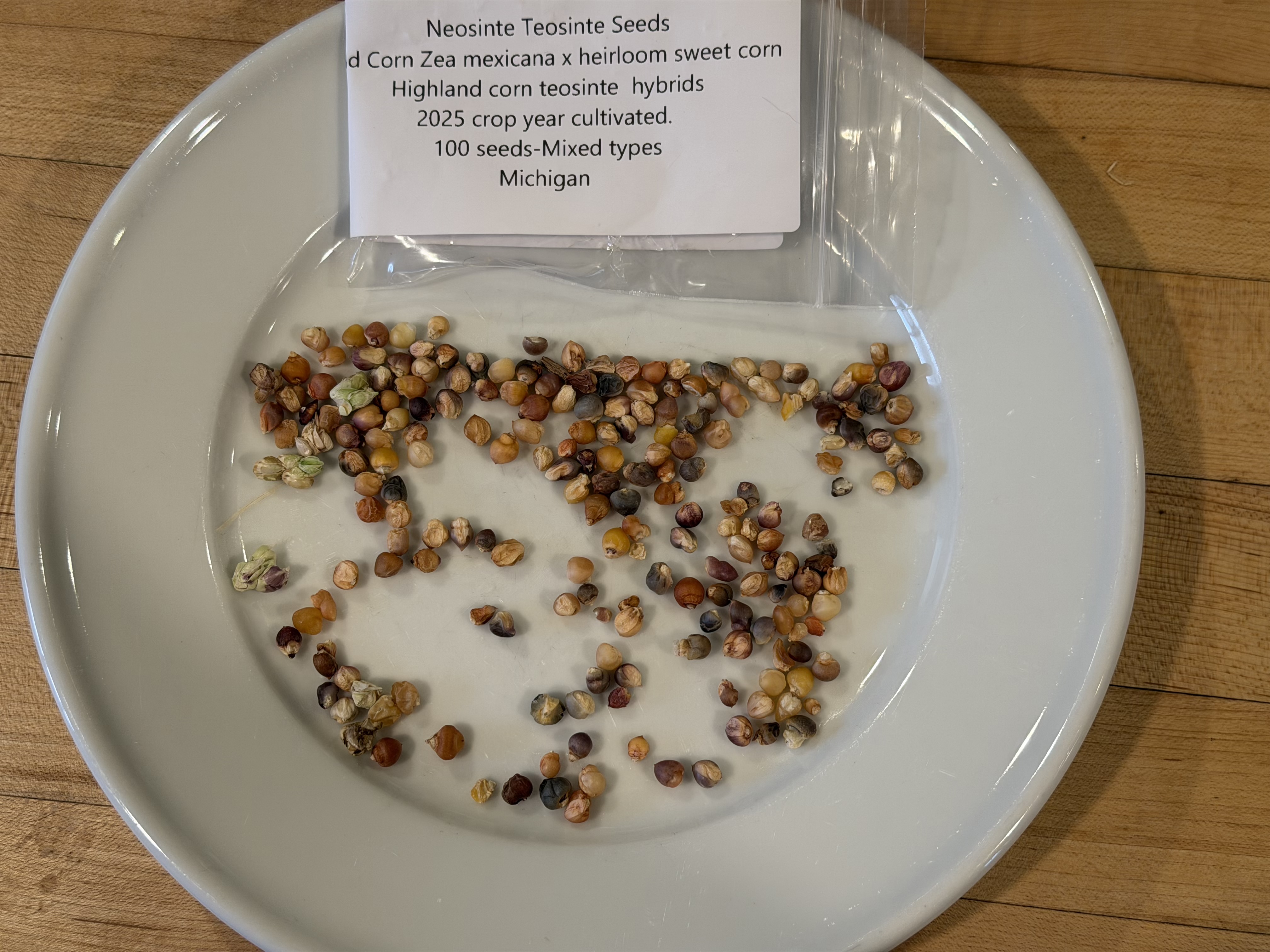
My order arrived a few days ago. There’s a lot of variation in these gnarly little kernels.
IMG_5462.jpeg
Neosinte is in the house!
 
pollinator
Posts: 960
Location: Illinois
226
  • Likes 4
  • Mark post as helpful
  • send pies
    Number of slices to send:
    Optional 'thank-you' note:
  • Quote
  • Report post to moderator
Looking forward to seeing your results.
 
Christopher Weeks
master gardener
Posts: 6404
Location: Carlton County, Minnesota, USA: 3b; Dfb; sandy loam; in the woods
3848
8
forest garden trees books chicken food preservation cooking fiber arts seed woodworking homestead ungarbage
  • Likes 7
  • Mark post as helpful
  • send pies
    Number of slices to send:
    Optional 'thank-you' note:
  • Quote
  • Report post to moderator
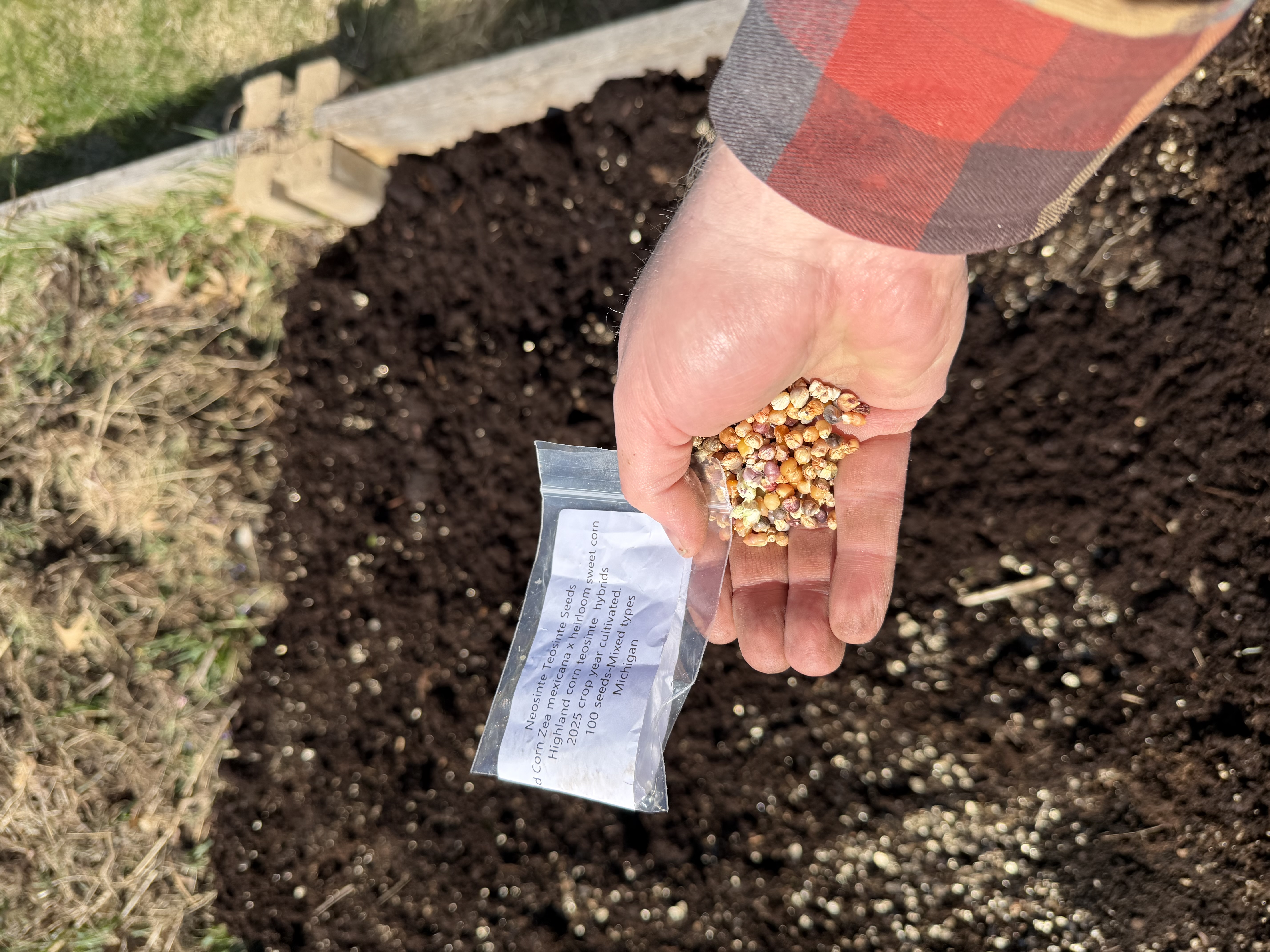
It’s maybe a little early, but I planted them into a 4x4 foot square today.
IMG_5779.jpeg
Planting day
Planting day
 
Thom Bri
pollinator
Posts: 960
Location: Illinois
226
  • Likes 4
  • Mark post as helpful
  • send pies
    Number of slices to send:
    Optional 'thank-you' note:
  • Quote
  • Report post to moderator
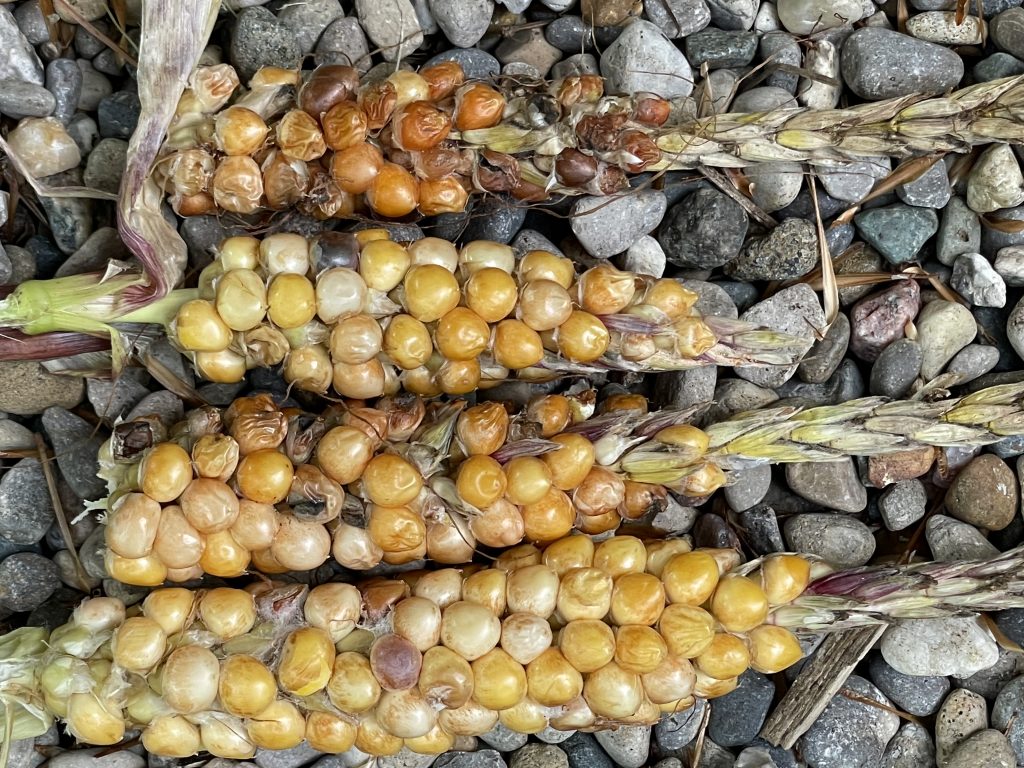
Looking at your very first picture above one more time, I noticed that the seeds are wrinkled, so the sweetness gene is being expressed.

How many seeds did you plant in the 4X4 space? Planning to thin them?
 
Christopher Weeks
master gardener
Posts: 6404
Location: Carlton County, Minnesota, USA: 3b; Dfb; sandy loam; in the woods
3848
8
forest garden trees books chicken food preservation cooking fiber arts seed woodworking homestead ungarbage
  • Likes 4
  • Mark post as helpful
  • send pies
    Number of slices to send:
    Optional 'thank-you' note:
  • Quote
  • Report post to moderator
The bag said it was 100. I’ll play it by ear. I have the impression that the plant is quite a bit smaller than modern maize, so we’ll see.
 
pollinator
Posts: 783
Location: SE Indiana
459
dog fish trees writing
  • Likes 12
  • Mark post as helpful
  • send pies
    Number of slices to send:
    Optional 'thank-you' note:
  • Quote
  • Report post to moderator

Christopher Weeks wrote:The bag said it was 100. I’ll play it by ear. I have the impression that the plant is quite a bit smaller than modern maize, so we’ll see.


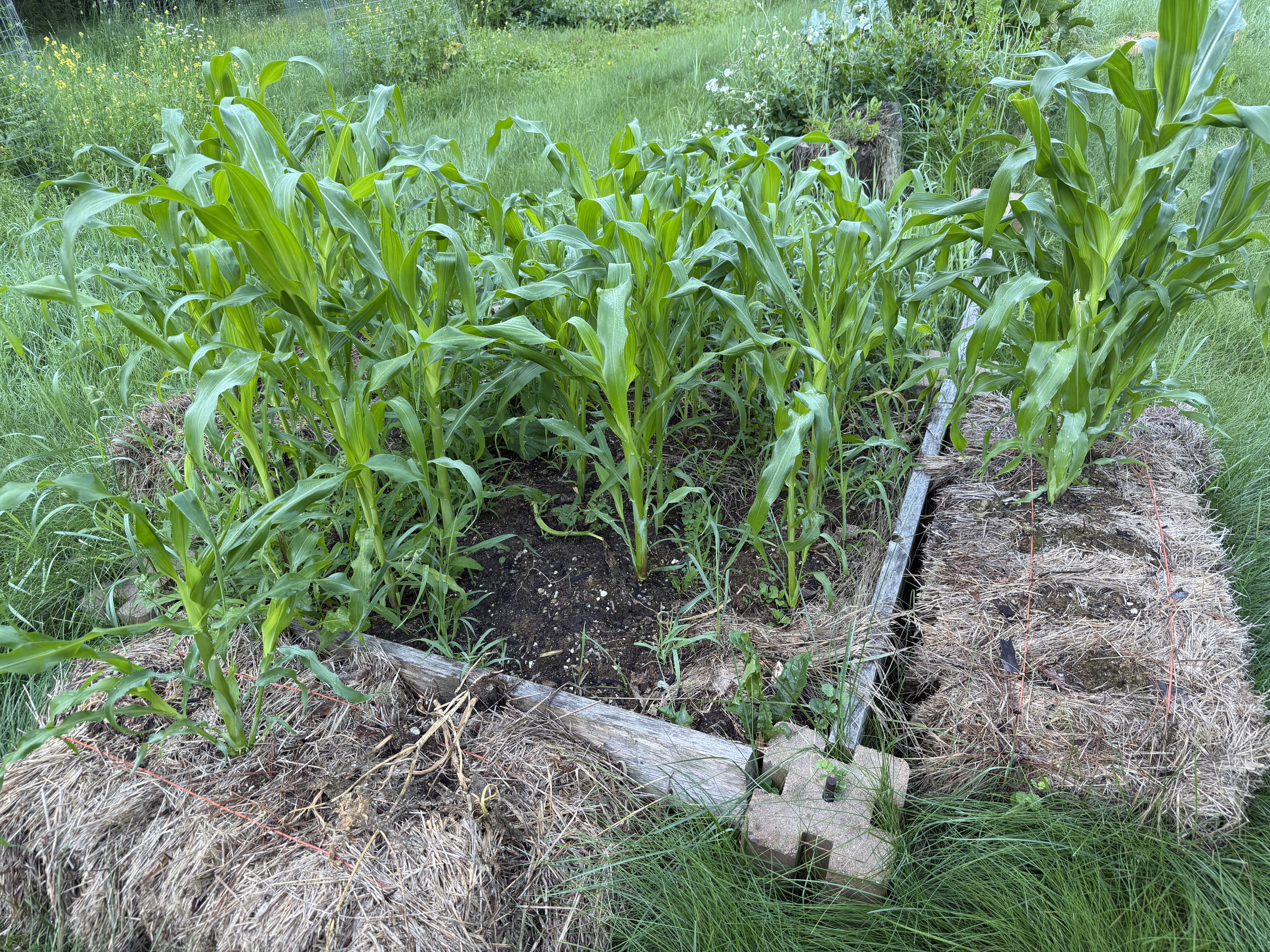
When I grew a similar cross the plants were not smaller. They were not giant in height, probably not more than eight feet or so but they tillered like crazy. I wondered if well-spaced and allowed to do so they might turn into big clumps. They had weak stalks and massive amounts of air roots going feet up the stalk. The plants appeared designed to fall down and root along the stem as a means of spreading and smothering surrounding competition. If they grow like those I had, a four x four spot is only big enough for half a dozen or so plants. They did not set ears and die like modern corn but just kept tillering and blooming until cold weather ended it.

Ear development was all over the place with tassels on ears and ears on tassels and tassels and ears on the tillers. They continued producing more ears all season instead of once and done like modern corn. I wondered if it might be possible to select an indeterminate variety where you could pick the first ears and more came on after.
 
Christopher Weeks
master gardener
Posts: 6404
Location: Carlton County, Minnesota, USA: 3b; Dfb; sandy loam; in the woods
3848
8
forest garden trees books chicken food preservation cooking fiber arts seed woodworking homestead ungarbage
  • Likes 5
  • Mark post as helpful
  • send pies
    Number of slices to send:
    Optional 'thank-you' note:
  • Quote
  • Report post to moderator
That sounds really cool! Maybe I’ll shovel half the soil out and spread it elsewhere.
 
Mark Reed
pollinator
Posts: 783
Location: SE Indiana
459
dog fish trees writing
  • Likes 8
  • Mark post as helpful
  • send pies
    Number of slices to send:
    Optional 'thank-you' note:
  • Quote
  • Report post to moderator

Christopher Weeks wrote:That sounds really cool! Maybe I’ll shovel half the soil out and spread it elsewhere.


If this goes well for you, and you want to continue with it next year I might be able to help out. I'm pretty sure I have seed from when I grew and crossed it to Aunt Mary's sweet corn. Aunt Mary's is an old Ohio area heirloom and my absolute favorite sweet corn as far as flavor. I didn't go on with it because it was taking too much space in my little gardens and I fell in a rabbit hole of sweet potatoes instead, but I think it might have great potential for someone who wants to follow it along for several years.  Aunt Mary's is an early SU corn with very robust stalks that gets about seven or eight feet tall and makes two or three nice ears per stalk.

I detasseled and crossed in both directions, so the seed is 1/2 Aunt Mary's and 1/2 teosinte derived with mothers from both sides instead of one just being the father side. I do that because I remember Carol Deppe saying something along the lines that traits that only come from the mother side are lost if one is just used for pollen. If I still have that seed, it is in my buried seed vault which I'm planning to open this fall.
 
Thom Bri
pollinator
Posts: 960
Location: Illinois
226
  • Likes 2
  • Mark post as helpful
  • send pies
    Number of slices to send:
    Optional 'thank-you' note:
  • Quote
  • Report post to moderator

Mark Reed wrote:

Christopher Weeks wrote:That sounds really cool! Maybe I’ll shovel half the soil out and spread it elsewhere.


I detasseled and crossed in both directions, so the seed is 1/2 Aunt Mary's and 1/2 teosinte derived with mothers from both sides instead of one just being the father side.


Did you ever get it to produce ears after crossing, and if so, how were they?
 
Mark Reed
pollinator
Posts: 783
Location: SE Indiana
459
dog fish trees writing
  • Likes 4
  • Mark post as helpful
  • send pies
    Number of slices to send:
    Optional 'thank-you' note:
  • Quote
  • Report post to moderator

Thom Bri wrote:
Did you ever get it to produce ears after crossing, and if so, how were they?


Yes, lots of them but mostly small the biggest was maybe seven inches long. Individual kernels also small and quite varied in appearance with a lot of sweet and a lot of more flint looking but all small. I think it has potential especially if crossed to Aunt Mary's again, I just didn't have time and space for it. I sent most of the seed to someone else years ago but never heard how it did or if they went on with it.  I think the seed I might still have could be considered the F3 generation.
 
Uh oh. Gotta go. Here, you read this tiny ad. Bye!
grow your own garden and build your own home in the gardening gardeners program
https://wheaton-labs.com/bootcamp
reply
    Bookmark Topic Watch Topic
  • New Topic