• Post Reply Bookmark Topic Watch Topic
  • New Topic
permaculture forums growies critters building homesteading energy monies kitchen purity ungarbage community wilderness fiber arts art permaculture artisans regional education skip experiences global resources cider press projects digital market permies.com pie forums private forums all forums
this forum made possible by our volunteer staff, including ...
master stewards:
  • Carla Burke
  • Anne Miller
  • Nancy Reading
  • John F Dean
  • r ransom
  • paul wheaton
  • Timothy Norton
stewards:
  • Jay Angler
  • Pearl Sutton
  • Andrés Bernal
master gardeners:
  • Christopher Weeks
gardeners:
  • M Ljin
  • Thekla McDaniels
  • May Lotito

Sakiori weaving

 
master gardener
Posts: 7117
Location: Carlton County, Minnesota, USA: 3b; Dfb; sandy loam; in the woods
4562
8
forest garden trees books chicken food preservation cooking fiber arts seed woodworking homestead ungarbage
  • Likes 9
  • Mark post as helpful
  • send pies
    Number of slices to send:
    Optional 'thank-you' note:
  • Quote
  • Report post to moderator
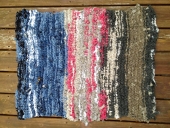
I was reading the wikipedia article on boro (Japanese piece-mending fabric, adjacent to sashiko stitchery) and found at the bottom a paragraph about sakiori woven fabric: Boro_(textile)#Saki-ori

Saki-ori was historically woven from old kimono cut into strips roughly 1 centimetre (0.39 in), with one obi requiring roughly three old kimono to make. Historically, garments, such as vests, might be made from saki-ori. Traditionally an article of thrift, sakiori obi are now quite expensive informal garments.


So I went looking for more info. these were interesting:
- https://www.odamaki-sakiori.com/sakiori/index.html
- https://westernsakiori.com/what-is-western-sakiori-part-1/

It's presented as if strip-weaving used kimono silk with cotton warp is the historical practice and still happens today. But other sources imply at least that cotton rag-stock was woven into new fabric the same way.

So I wondered if Permies had anything to say about it. There's a little -- seems like Raven is or was at least enchanted by it, and mentions it several times with a few other people doing the same. They're mostly passing references, but this thread was worth sharing:
https://permies.com/t/33929/japanese-textiles#442846

But there was no thread dedicated to that technique, so now there is!

Has anyone done this?

I wonder how using non-kimono as the stock would work. If I was using old denim, would I need it cut it much smaller than 1cm? Maybe that's more a matter of the loom. What is the crudest loom I could work with? What about using a big, bulky pin-loom and not having cotton cord as the warp -- just using the fabric for both warp and weft? I think there are pin(ish) looms scaled for rag-rugs, so that's along the same lines.

If you don't already know all about it, what does this make you wonder?

From one of the above sources:
 
gardener
Posts: 2353
Location: Zone 6b
1611
forest garden fungi books chicken fiber arts ungarbage
  • Likes 6
  • Mark post as helpful
  • send pies
    Number of slices to send:
    Optional 'thank-you' note:
  • Quote
  • Report post to moderator
I am seeing the relevance of sakiori weaving to other weaves that the warp and weft are not equivalent. Usually the warp threads are finer and set denser while the weft threads are sturdier or bulkier, giving a general ribbed finish. In some case, the finished surface is warp-faced and the weft is not visible, such as in Grossgrain ribbon and ottoman fabric. Warp threads make up the color and pattern while weft threads, in some case cords are used, provide strength and durability. In the case of sakiori, by using fabric strips and regular threads, the contrast between warp and weft is extreme. The warps are not covering the wefts and instead the technically underlying weft weaves are visually dominant.

If you are using a pin loom, in that case you have equal numbers of pins in both directions, you have have to make adjustment to increase density of warp threads. I don't have experience with that but I imagine you could add additional spacers to hold and separate multiple warp threads. Warp will also have greater length reduction so you will need longer yarns that add to complexity of organizing and tension control.
 
I agree. Here's the link: https://woodheat.net
reply
    Bookmark Topic Watch Topic
  • New Topic