• Post Reply Bookmark Topic Watch Topic
  • New Topic
permaculture forums growies critters building homesteading energy monies kitchen purity ungarbage community wilderness fiber arts art permaculture artisans regional education skip experiences global resources cider press projects digital market permies.com pie forums private forums all forums
this forum made possible by our volunteer staff, including ...
master stewards:
  • Nancy Reading
  • Carla Burke
  • John F Dean
  • Timothy Norton
  • r ransom
  • Jay Angler
  • Pearl Sutton
stewards:
  • Devaka Cooray
  • Leigh Tate
  • paul wheaton
master gardeners:
  • Christopher Weeks
gardeners:
  • M Ljin
  • thomas rubino
  • Megan Palmer

Talk me out of (or into) a ukulele

 
steward & author
Posts: 44794
Location: Left Coast Canada
17398
9
art trees books chicken cooking fiber arts
  • Mark post as helpful
  • send pies
    Number of slices to send:
    Optional 'thank-you' note:
  • Quote
  • Report post to moderator
Here's a short video for my friends enjoying the winter storm of January 2026.


Stay warm y'all
 
r ransom
steward & author
Posts: 44794
Location: Left Coast Canada
17398
9
art trees books chicken cooking fiber arts
  • Likes 2
  • Mark post as helpful
  • send pies
    Number of slices to send:
    Optional 'thank-you' note:
  • Quote
  • Report post to moderator
Still loving ukulele practice

No courage yet to test if the chickens like it

I went to a shop and looked at used musical instruments. The prices were not friendly, but it was interesting to see how small mandolins are in person (one of the other instruments I considered) and to see the different ware pattern and damage to the instruments.  There was a lot wrong.  Except the yamaha guitars that looked and sounded pristine, and suspiciously low priced.  I always thought yamaha were the workhorse guitar at a nag price.   But not one had been played in anger.  Is there something wrong with these guitars?

Although I am glad I didn't buy one as looking up the price of a new yamaha guitars the same model and colour, the used ones in the shop were about the same price as the new one on Amazon.

All of the guitars were far to big for me.  The mandolin were broken,  the ukulele were sold out.  

But all the string instruments had one thing in common, almost no distance between strings and frets.  Some of the better loved ones required just a whisper of pressure to press the string down and fret a note.  

It makes me think it's time to learn about "set up" for my ukulele as the distance between string and fret one is several strings wide.  But I'm afraid of missing a day practice and it's not that hard to press my ukulele strings.

Maybe one day when there is a second instrument, I'll try my hand at adjusting my ukulele string height.
 
Posts: 312
Location: Manotick (Ottawa), Ontario
23
  • Likes 2
  • Mark post as helpful
  • send pies
    Number of slices to send:
    Optional 'thank-you' note:
  • Quote
  • Report post to moderator

r ransom wrote:... I always thought yamaha were the workhorse guitar at a nag price.   But not one had been played in anger.  Is there something wrong with these guitars?
...


I'm not sure what you mean by playing a guitar in anger. Some players are vigorous enough with a flatpick that they scratch their guitar beyond the pick guard, and can even wear a hole through the soundboard after years of such treatment. Yamaha makes/has made a variety of styles and sizes and most are quite respectable. There are Yamaha ukuleles, too.
 
gardener
Posts: 1707
Location: Zone 5
888
ancestral skills forest garden foraging composting toilet fiber arts bike medical herbs seed writing ungarbage
  • Likes 5
  • Mark post as helpful
  • send pies
    Number of slices to send:
    Optional 'thank-you' note:
  • Quote
  • Report post to moderator
The distance from the fretsfretboard to the strings is referred to as the "action" and it is controlled by the shape of the instrument, by the height of the bridge (the place or bar where the vibration is transferred to the soundboard, near the sound hole), the height of the nut (the little bar where the strings touch before going back into the tuning pegs), and the distance between the bridge and the nut. On ukulele, there is not much alteration that can be done without taking apart the instrument, although theoretically you could file down the bridge. I would very much not recommend that though, unless there is something wrong with how it sounds, because the height and placement of the bridge also affects the proper placement of the frets so that the instrument doesn't sound out of tune.

In summary, the higher the bridge (and action), the closer together the frets should be, and the lower it is, the further apart, due to the bending of the strings (which raises the frequency). The further away from the nut that the bridge is, the larger the distance between the frets--you will have noticed how on the guitar they are far apart, and on the mandolin very close together.

On mandolin, banjo, bowed instruments etc., there is something called a "floating bridge" where the bridge of the instrument rests on the sound board, held there by the tension of the strings--but not on a ukulele, whose bridge is pegged to a particular place. The only time I could see you possibly wanting to alter the bridge and/or action of a ukulele is if it goes further out of tune the further towards the soundhole on the fretboard that you play. If the notes became sharper further along the fretboard one might want to file down the saddle (where the strings sit). However the only reason one should need to do this is if the instrument is extremely poorly made.

I have a baglamas (a tiny, mandolin-like Greek instrument) that originally came to me repaired, and something about the sound was off--the higher the note on a string, the more out of tune it would get! I spent a long time trying to move the bridge around and realized that it was too high! So I whittled a new one from dry wood that was lower, the action of the instrument was reduced, and eventually after some more careful whittling it was in tune. It still has a very high action but sounds good and works.

In some old banjos too, the action is very high because of how the instruments are made. My guess is that because ukuleles use nylon strings, their action can be higher, as less pressure is needed as on steel strings, which would have been the guitars, mandolins, etc. that you saw. But even then the baglamas has steel strings and doubled too.
 
r ransom
steward & author
Posts: 44794
Location: Left Coast Canada
17398
9
art trees books chicken cooking fiber arts
  • Likes 5
  • Mark post as helpful
  • send pies
    Number of slices to send:
    Optional 'thank-you' note:
  • Quote
  • Report post to moderator
The library books say the way to test the action on a ukulele is to press the 12 fret and the tuner should read the same letter as the open string.  Mine all read extremely sharp or the next note up the alphabet.

Which is fine for me right now because my skill is poor and i need to learn more how to put my hands than care about perfection. It doesn't seem to make a difference for cords and strumming.

But once I start the classical music fingerstyle, it is probably going to bother me.  Even I can hear the tuning is wrong the further away from the head I get.

Ukulele set up is pretty common, according to the library books.  The music store usually does this, but internet ukulele almost never have the intonation (their word) checked.
 
r ransom
steward & author
Posts: 44794
Location: Left Coast Canada
17398
9
art trees books chicken cooking fiber arts
  • Likes 3
  • Mark post as helpful
  • send pies
    Number of slices to send:
    Optional 'thank-you' note:
  • Quote
  • Report post to moderator
One thing to remember is my ukulele was on the extremely affordable end.  Although it seems much higher sound quality than the price, am i am really happy with it.

I asked at the local shop and set up for an instrument they didn't sell would be about 8 times what was paid for my ukulele.

Changing the strings is a pain, so I can see the value of having a second one...when the time is right.  One for high-g and one for low-G.  The universe will let me know when the time is right.  

When that happens, I might experiment with set up.  It looks pretty easy to do and easier to do wrong,  but these nuts and white-bridge-things seem affordable to buy if things go horribly wrong.
 
David Wieland
Posts: 312
Location: Manotick (Ottawa), Ontario
23
  • Likes 3
  • Mark post as helpful
  • send pies
    Number of slices to send:
    Optional 'thank-you' note:
  • Quote
  • Report post to moderator
Action (the distance between open, unfretted strings  and the fretboard) and intonation (the pitch accuracy of fretted notes) are different but related. Unless you're blessed (or cursed?) with perfect pitch, you likely won't notice  minor intonation errors. It sounds like you have a very playable instrument. A high action is more tolerable with nylon strings than with steel ones and doesn't demand thick calluses.
 
r ransom
steward & author
Posts: 44794
Location: Left Coast Canada
17398
9
art trees books chicken cooking fiber arts
  • Likes 2
  • Mark post as helpful
  • send pies
    Number of slices to send:
    Optional 'thank-you' note:
  • Quote
  • Report post to moderator


A good starting place for adjusting the issues my ukulele has.

But not today.  That's something for much later,
 
M Ljin
gardener
Posts: 1707
Location: Zone 5
888
ancestral skills forest garden foraging composting toilet fiber arts bike medical herbs seed writing ungarbage
  • Likes 3
  • Mark post as helpful
  • send pies
    Number of slices to send:
    Optional 'thank-you' note:
  • Quote
  • Report post to moderator
After hearing this I decided to check my own ukulele's intonation and found it was not perfect, either though not bad enough to have majorly annoyed me. So I took out my file!... It sounds better! I went as far as I could confidently go on the c string but it still was not perfect. I did not want to have buzzing frets because of strings that were too close to the frets.

It also seems to help to file such that it the slope of the bridge is on the other side of the bridge from where the strings tie in as that increases the vibrating length of the string, compensating for the action.

I am not an expert, only an aspiring luthier, so make of this whatever you wish!
 
r ransom
steward & author
Posts: 44794
Location: Left Coast Canada
17398
9
art trees books chicken cooking fiber arts
  • Likes 4
  • Mark post as helpful
  • send pies
    Number of slices to send:
    Optional 'thank-you' note:
  • Quote
  • Report post to moderator
Neat!

I can see the logicof how it would work to change the nut and saddle height as a family member who used to make violins said this part took the longest of any stage.  Most of violin making is math (and tapping on wood), mhe would say, but math can only take one so far before we have to adjust the machine to the person.

 
M Ljin
gardener
Posts: 1707
Location: Zone 5
888
ancestral skills forest garden foraging composting toilet fiber arts bike medical herbs seed writing ungarbage
  • Likes 4
  • Mark post as helpful
  • send pies
    Number of slices to send:
    Optional 'thank-you' note:
  • Quote
  • Report post to moderator
This image shows a guitar saddle from a highly regarded manufacturer (Martin). You can see how when it is made, there is care taken so that each string in the right place based on its thickness.


source: https://massstreetmusic.com/products/martin-acoustic-guitars-000-15e
 
r ransom
steward & author
Posts: 44794
Location: Left Coast Canada
17398
9
art trees books chicken cooking fiber arts
  • Likes 2
  • Mark post as helpful
  • send pies
    Number of slices to send:
    Optional 'thank-you' note:
  • Quote
  • Report post to moderator
I decided that stairway to heaven would be a first good song to learn.  Not because I know if it's hard or easy, but because all my friends with snobby music opinions can't stand it.  Kind of proof that i have no snobby music understanding in me.

Stairway to heaven also has plucking and multi string plucking.  That's the direction I want to go.


It seems a bit difficult.
Also, it's very long.  

Is there perhaps a better song that is between stairway difficulty and "oh, so thaaat's what a ukulele is"?

Also, why are some notes long by reducing the flags or making hollow and other notes long by having a dot?  Aren't they the same as the rest of the notes in the section between the lines make up the 4 beats?

Also, how to go from f cord to g cord,  hand can't make the jump.  I've been practicing this for three evenings (additional shadow playing, not as main practice)

 
M Ljin
gardener
Posts: 1707
Location: Zone 5
888
ancestral skills forest garden foraging composting toilet fiber arts bike medical herbs seed writing ungarbage
  • Likes 2
  • Mark post as helpful
  • send pies
    Number of slices to send:
    Optional 'thank-you' note:
  • Quote
  • Report post to moderator
A dotted note is "that and then a half". So a dotted quarter note equals three eighth notes instead of two. A dotted half note is three quarter notes, and so on.

Could the adagio be good? It doesn't seem too complex.
 
r ransom
steward & author
Posts: 44794
Location: Left Coast Canada
17398
9
art trees books chicken cooking fiber arts
  • Likes 4
  • Mark post as helpful
  • send pies
    Number of slices to send:
    Optional 'thank-you' note:
  • Quote
  • Report post to moderator
https://www.soundslice.com/slices/xHhlc/

This looks like a good song to learn next.  But I cannot figure out how to print the song so i can practice without a gadget.

Maybe I need to start a tab book where I write songs by hand?

I like the cords and how most of the finger picking is the same patern of gCEAEC and I don't have to move my left hand too often.

Here is the video tutorial


The Bernadette class is going well, but it's something of a slog to practice strumming rythms and strum and sing when it's not my interest. But I understand why so I give it some time.

Dummies ukulele book is excellent, but low priority so slow going.

I understand almost a quarter of the Renaissance ukulele book.

I am feeling like I'm at the gateway to a whole new world.  To have music without electricity. The different skills needed to make musical instruments.   It feels so big.  I'm a bit over stimulated and don't know where to look first.  I want to learn how all these stringed creations work!

I'm very glad I made 20 min daily dedicated ukulele practice time away from all the squirls.  I'm looking forward to the time when I won't need my electronic gadgets to learn and practice.  Just me, coffee, ukulele, and a book being bossed about by a metronome.
 
David Wieland
Posts: 312
Location: Manotick (Ottawa), Ontario
23
  • Likes 2
  • Mark post as helpful
  • send pies
    Number of slices to send:
    Optional 'thank-you' note:
  • Quote
  • Report post to moderator

r ransom wrote:...
Also, how to go from f cord to g cord,  hand can't make the jump.  I've been practicing this for three evenings (additional shadow playing, not as main practice) ...


It's taken most of us a lot more than three evenings to master any chord change, especially one that requires repositioning. You seem to be progressing quite well.
If singing isn't your thing, you can just sing or say the word at each chord change -- or you can simply hum the tune, which is what I've heard Glen Gould did with piano.
 
David Wieland
Posts: 312
Location: Manotick (Ottawa), Ontario
23
  • Likes 2
  • Mark post as helpful
  • send pies
    Number of slices to send:
    Optional 'thank-you' note:
  • Quote
  • Report post to moderator

r ransom wrote:https://www.soundslice.com/slices/xHhlc/

This looks like a good song to learn next.  But I cannot figure out how to print the song so i can practice without a gadget.


The tab is downloadable if you subscribe to his Patreon site, linked in the description on YouTube. Otherwise, transcribing it yourself is the option.
 
r ransom
steward & author
Posts: 44794
Location: Left Coast Canada
17398
9
art trees books chicken cooking fiber arts
  • Likes 4
  • Mark post as helpful
  • send pies
    Number of slices to send:
    Optional 'thank-you' note:
  • Quote
  • Report post to moderator
I transcribed the song by hand.  It wasn't fun as it got my dyslexia going extra strong. I didn't end up learning as much as i had hoped.

I tried the youtube tutorial and learned that my instincts to have one finger pluck each string (instead of thumb and index plucking them all like most yout tubers do) is okay.

The website where i found the music works amazingly well with my brain.

I seem stuck where I pause when I mess up a cord change and want to get in the habit of pressing on to the end of the section even if there are mistakes.  I put the song at half speed and looped the first half.  I can almost play some of it.

That site has potential.  

Tonight I will practice the cord shaps and see if I can get my hands to work.  Maybe it will make a difference tomorrow?  
 
pollinator
Posts: 5558
Location: Canadian Prairies - Zone 3b
1553
  • Likes 4
  • Mark post as helpful
  • send pies
    Number of slices to send:
    Optional 'thank-you' note:
  • Quote
  • Report post to moderator

r ransom wrote:  There was a lot wrong.  Except the yamaha guitars that looked and sounded pristine, and suspiciously low priced.  I always thought yamaha were the workhorse guitar at a nag price.   But not one had been played in anger.  Is there something wrong with these guitars?


Yes, Yammies are tough little workhorse guitars. No, there is nothing wrong with them. Yammies have my respect.

Some smaller models are built of pretty tough materials, for use in schools. These get the "plywood" sneer, and the sound is not the best. But I have a 1970s black label laminate 3/4 that kicks ass -- you would not believe it wasn't a solid wood top -- I had to look up the Year of the Emperor to figure out when it was made.

Compared to the disposable dreck that is out there, give me a Yamaha.
 
David Wieland
Posts: 312
Location: Manotick (Ottawa), Ontario
23
  • Likes 4
  • Mark post as helpful
  • send pies
    Number of slices to send:
    Optional 'thank-you' note:
  • Quote
  • Report post to moderator

r ransom wrote:...
Tonight I will practice the cord shaps and see if I can get my hands to work.  Maybe it will make a difference tomorrow?  


Attentive practice is the only route to mastery that I know. I think it applies broadly, including gardening. Getting stuck at some point is normal and just means that part needs more attention and practice, slow practice until memory (muscle and brain memory) can carry you through it. It seems almost magical when you suddenly find that you can now easily do something that was difficult and frustrating at first.
 
r ransom
steward & author
Posts: 44794
Location: Left Coast Canada
17398
9
art trees books chicken cooking fiber arts
  • Likes 4
  • Mark post as helpful
  • send pies
    Number of slices to send:
    Optional 'thank-you' note:
  • Quote
  • Report post to moderator
I understood less than five percent of todays lesson.  Can anyone tell me if this is something I need to know now or if I can store it in my brain as "you can change the key with magic later, but first let's get those fingers moving in the right direction"

 
M Ljin
gardener
Posts: 1707
Location: Zone 5
888
ancestral skills forest garden foraging composting toilet fiber arts bike medical herbs seed writing ungarbage
  • Likes 3
  • Mark post as helpful
  • send pies
    Number of slices to send:
    Optional 'thank-you' note:
  • Quote
  • Report post to moderator
It isn't something you need to know immediately.

What this means essentially is that it is not the particular note you have that matters, but the relationship of the note to all the other notes.

Do you have a capo? That is a very good way to initially illustrate keys. If you put a capo on any fret and then play the same song, it will sound the same, except higher or lower depending on what fret, and if you are singing to it, one position may be better than the other depending on your voice. That is all it means. Without using a capo (which is what the video is explaining) you have to do it by changing the chords. The chords change, but the relationships between the chords stay the same. The roman numerals can refer to any note name at all, sharp, flat or natural, but its relationship to the other chords must stand.

For example I can be C, or it can be F. In the first case ii would be the chord D minor; in the second, G minor chord.

If you play a song in two different keys, they will sound nearly the same except a little higher or lower--like playing a record too fast, which changes the key (and makes the voices sound like mice). The roman numerals or chord numbers will be the same, but the chords will be different.

Does this make sense?
 
r ransom
steward & author
Posts: 44794
Location: Left Coast Canada
17398
9
art trees books chicken cooking fiber arts
  • Likes 2
  • Mark post as helpful
  • send pies
    Number of slices to send:
    Optional 'thank-you' note:
  • Quote
  • Report post to moderator
That helps a lot.  Thank you.

Especially

What this means essentially is that it is not the particular note you have that matters, but the relationship of the note to all the other notes


I have a capo , i think.  It's the scary string clamp thingy?

I can see how useful it could be, but I don't feel anywhere near ready to deal with that.

Although, I'm going to file it in my "ukulele later" mind box, near the "find out why there are dots on the fret board" because i suspect a relationship.

(I tried to build a mind palace, but ended up with a cellar full of musty boxes for a memory)
 
David Wieland
Posts: 312
Location: Manotick (Ottawa), Ontario
23
  • Likes 3
  • Mark post as helpful
  • send pies
    Number of slices to send:
    Optional 'thank-you' note:
  • Quote
  • Report post to moderator

r ransom wrote:...
I have a capo , i think.  It's the scary string clamp thingy?

I can see how useful it could be, but I don't feel anywhere near ready to deal with that.


The main use of a capo is to change the pitch of what is played to better match a singer's vocal range, but without needing to change chord fingerings. Another reason, for guitarists, is to shorten the effective fretboard and enable reaching a fret that is otherwise too big a stretch. The ukulele fretboard is short enough to not need a capo for that.

As for the video lesson, it seems surprisingly advanced for beginners. For playing simple tunes, it's valuable to know the I, IV, and V (1, 4, and 5) chords for the key you're playing in, but you can easily memorize the set -- such as C, F, and G (or G7) -- without knowing any theory. That's how most of us old-timers started.
 
M Ljin
gardener
Posts: 1707
Location: Zone 5
888
ancestral skills forest garden foraging composting toilet fiber arts bike medical herbs seed writing ungarbage
  • Likes 4
  • Mark post as helpful
  • send pies
    Number of slices to send:
    Optional 'thank-you' note:
  • Quote
  • Report post to moderator
Dots!

My ukulele has dots on the fourth (fa), fifth (sol), minor seventh (ta), eighth (do), and minor tenth (me) scale degrees, or the 5th, 7th, 10th, 12th, and 15th frets.

This is because they are important intervals. Almost all scales of all modes include the fourth and fifth degrees. They help the fretboard not look like a featureless expanse.

On the baglamas, there are dots on every note of the minor pentatonic scale (from the open note of course). It's whatever the maker thought were the most important frets. If they're really important they might get two dots, like the octave.

Some instruments have decorative flourishes instead.

As for their relation ship to the key, there is one--just like how the chords are relative to each other, the notes are too. If you only use one string to play a melody and then switch to a different string to play the same melody in a different key it will sound the same just higher or lower. If you take the first string of A in the key of A, and play a melody, then switch to the second, E, and play in the key of E, then the fourth up from there will also be on the dotted fret, fifth, etc.
 
r ransom
steward & author
Posts: 44794
Location: Left Coast Canada
17398
9
art trees books chicken cooking fiber arts
  • Likes 3
  • Mark post as helpful
  • send pies
    Number of slices to send:
    Optional 'thank-you' note:
  • Quote
  • Report post to moderator
It is now established that goose likes ukulele.

Was tired of chasing an eagle away from my birds and couldn't think of a noise worse than someone new to music trying to teach themselves...except maybe violin.   Surely my ukulele and I can scare the sky monsters away. (It worked)

Then one of the geese came up and stood about 2 feet away and watched me play practice.  Then more geese.  13 geese lined up memorized in a tight semicircle around me.  All very quiet (unusual this time of year) and attentive. After a couple of minutes, they started drifting back to their daily tasks, except the first goose.  It was so happy and curious and calm, I've never seen a goose like that.  

So I kept practicing that fingerstyle song i mentioned a few posts ago (because that's the only music I had with me) in a loop and started timing how long the goose would listen.

Just under an hour.

Geese are pro ukulele.

Now, chickens....
 
r ransom
steward & author
Posts: 44794
Location: Left Coast Canada
17398
9
art trees books chicken cooking fiber arts
  • Likes 2
  • Mark post as helpful
  • send pies
    Number of slices to send:
    Optional 'thank-you' note:
  • Quote
  • Report post to moderator
Now I think back on it, sudden changes in humidity aren't kind to wood.  I am thinking of oiling the outside of the ukulele to help protect it as it's definitely going to be an indoor-outdoor instrument.

The finish on it now is just stain.  Some walnut oil aught to do the trick.

You have a few days to talk me out of it if this is a bad idea.
 
r ransom
steward & author
Posts: 44794
Location: Left Coast Canada
17398
9
art trees books chicken cooking fiber arts
  • Likes 2
  • Mark post as helpful
  • send pies
    Number of slices to send:
    Optional 'thank-you' note:
  • Quote
  • Report post to moderator
http://www.ukulaity.com/musictabs.html

Their arrangements for ukulele fingerstyle are lovely.

Concerning hobbits and moon river are high on my list
 
M Ljin
gardener
Posts: 1707
Location: Zone 5
888
ancestral skills forest garden foraging composting toilet fiber arts bike medical herbs seed writing ungarbage
  • Likes 5
  • Mark post as helpful
  • send pies
    Number of slices to send:
    Optional 'thank-you' note:
  • Quote
  • Report post to moderator

r ransom wrote:Now I think back on it, sudden changes in humidity aren't kind to wood.  I am thinking of oiling the outside of the ukulele to help protect it as it's definitely going to be an indoor-outdoor instrument.

The finish on it now is just stain.  Some walnut oil aught to do the trick.

You have a few days to talk me out of it if this is a bad idea.


I do this all the time. And I use olive oil. So far nothing bad had happened!

If you don't oil a string instrument now and then it can become prone to cracking.
 
David Wieland
Posts: 312
Location: Manotick (Ottawa), Ontario
23
  • Likes 2
  • Mark post as helpful
  • send pies
    Number of slices to send:
    Optional 'thank-you' note:
  • Quote
  • Report post to moderator

M Ljin wrote:

r ransom wrote:Now I think back on it, sudden changes in humidity aren't kind to wood.  I am thinking of oiling the outside of the ukulele to help protect it as it's definitely going to be an indoor-outdoor instrument.

The finish on it now is just stain.  Some walnut oil aught to do the trick.

You have a few days to talk me out of it if this is a bad idea.


I do this all the time. And I use olive oil. So far nothing bad had happened!

If you don't oil a string instrument now and then it can become prone to cracking.


I've never heard of oiling stringed instruments, but some humidity control is definitely good for them. I keep mine in their cases when I'm not playing them. A hard case slows humidity changes, which reduces stress, and a sound hole humidifier keeps my indoor-outdoor jamming guitar crack-free even in winter in its soft case.

Sealing only one side of a board or wood panel doesn't help with moisture stress and can even exacerbate it.
 
r ransom
steward & author
Posts: 44794
Location: Left Coast Canada
17398
9
art trees books chicken cooking fiber arts
  • Likes 1
  • Mark post as helpful
  • send pies
    Number of slices to send:
    Optional 'thank-you' note:
  • Quote
  • Report post to moderator
The string instruments I've handled have always had a wax or varnish finish on the outsidd.  I was told never to apply anything inside as it damages the sound.  

I wasn't sure if oil works.
 
David Wieland
Posts: 312
Location: Manotick (Ottawa), Ontario
23
  • Likes 2
  • Mark post as helpful
  • send pies
    Number of slices to send:
    Optional 'thank-you' note:
  • Quote
  • Report post to moderator

r ransom wrote:The string instruments I've handled have always had a wax or varnish finish on the outsidd.  I was told never to apply anything inside as it damages the sound.  

I wasn't sure if oil works.


I definitely wouldn't oil the inside. Luthiers try to minimize the thickness of any coating, so as to not "burden" the wood and dampen its vibration. As far as I can tell, the reason for applying finish is to protect the instrument from dirt. Oil doesn't penetrate varnish, but I suppose it can leave a certain sheen.
 
r ransom
steward & author
Posts: 44794
Location: Left Coast Canada
17398
9
art trees books chicken cooking fiber arts
  • Mark post as helpful
  • send pies
    Number of slices to send:
    Optional 'thank-you' note:
  • Quote
  • Report post to moderator
My current ukulele came stained but without a finish.  That means no varnish or wax layer.

Wax is a pain as it takes ages to cure.  It's already absorbing oils from my skin, but unevenly, so I think I'll put a thin coat of walnut oil on it soon.  
 
r ransom
steward & author
Posts: 44794
Location: Left Coast Canada
17398
9
art trees books chicken cooking fiber arts
  • Mark post as helpful
  • send pies
    Number of slices to send:
    Optional 'thank-you' note:
  • Quote
  • Report post to moderator
How long until I can atempt this and still stay sane?

http://www.ukulaity.com/concerning-hobbits.html

Notes with swoops together seem like sliding or hammering.

But dots on top of notes?  Changing time midway?  

So confused.  But i can't find a tutorial on yt that does this nice version.   All the other ones are too simple it makes my ears sad.
 
M Ljin
gardener
Posts: 1707
Location: Zone 5
888
ancestral skills forest garden foraging composting toilet fiber arts bike medical herbs seed writing ungarbage
  • Likes 4
  • Mark post as helpful
  • send pies
    Number of slices to send:
    Optional 'thank-you' note:
  • Quote
  • Report post to moderator

r ransom wrote:How long until I can atempt this and still stay sane?


It might be a little while before you can expect to learn it in its entirety.

If you can just play the melody and keep it within the right rhythm, that would be a start! That is how I learn a new piece, adding the chord notes on as I gain confidence. Only add as much harmony as you can handle at a time--if it sounds recognizable, even if simple and unaccompanied, then that is a success.


http://www.ukulaity.com/concerning-hobbits.html

Notes with swoops together seem like sliding or hammering.


Sliding is a straight swoop, hammering or pulling off is when it's a curved swoop ("legato"). In this sheet of music, the slides are marked by both a straight and a curved swoop.

But dots on top of notes?  Changing time midway?  

So confused.  But i can't find a tutorial on yt that does this nice version.   All the other ones are too simple it makes my ears sad.


A dot on top means staccato, which is a short little note you don't let to ring out. Changing time midway... is it really doing that? All I am seeing is a 4/4 at the beginning and then another, potentially unnecessary one later on. It seems like it's marking a section. Take the latter point with a grain of salt as I don't read music very often these days.

I hope this helps!
 
r ransom
steward & author
Posts: 44794
Location: Left Coast Canada
17398
9
art trees books chicken cooking fiber arts
  • Likes 2
  • Mark post as helpful
  • send pies
    Number of slices to send:
    Optional 'thank-you' note:
  • Quote
  • Report post to moderator
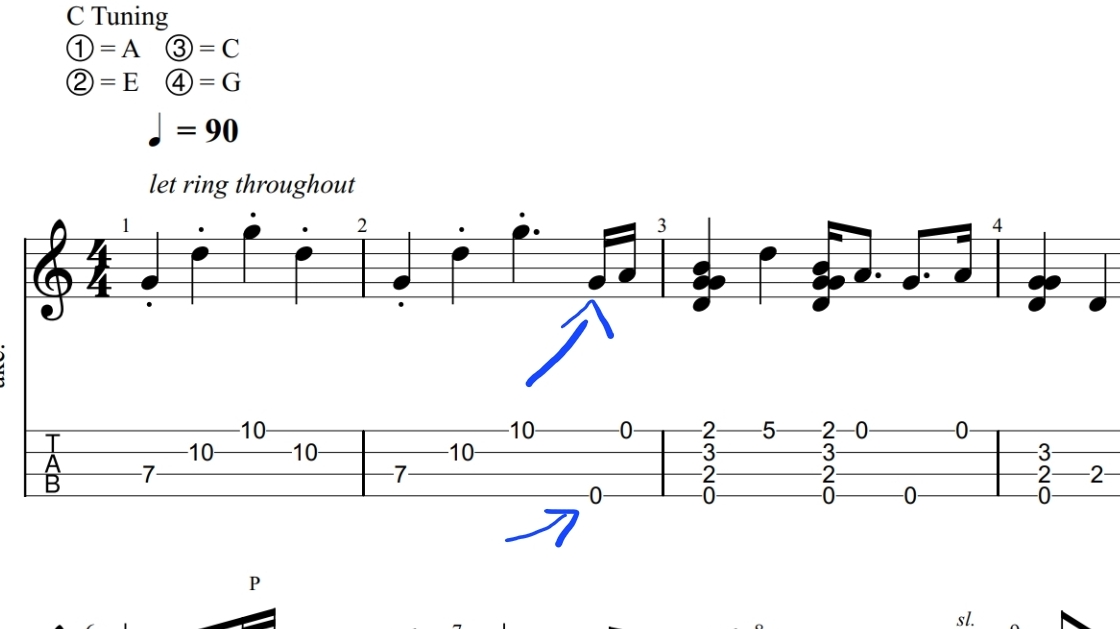
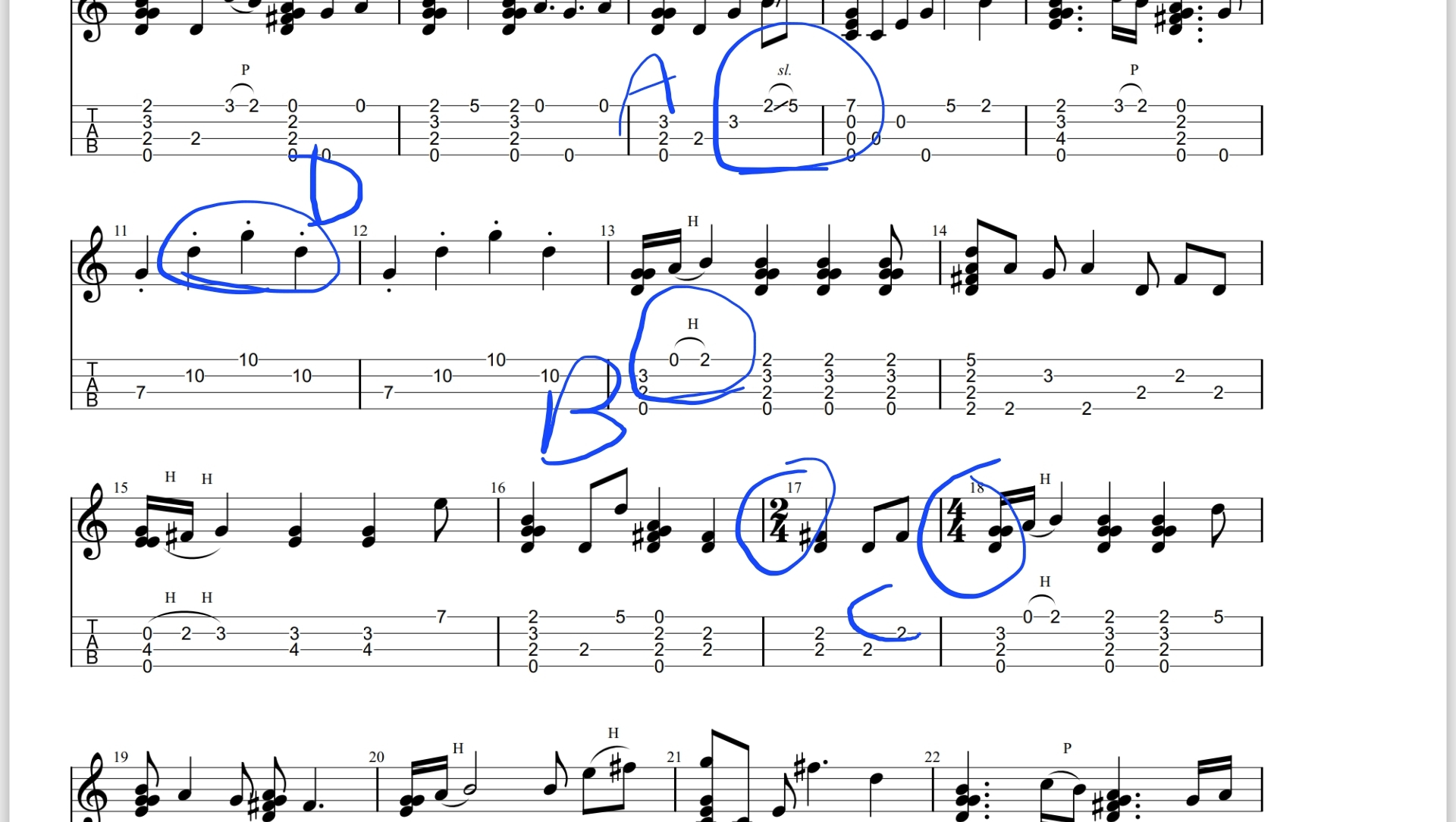
Let's see if this works.

A and B have to do with this

Sliding is a straight swoop, hammering or pulling off is when it's a curved swoop ("legato"). In this sheet of music, the slides are marked by both a straight and a curved swoop.


Solution, drink more coffee and reread.

Note to future self, there are letters h and sl next to the swooping things.  This is probably a clue.  But first, coffee.

C is the change time thing.

D is the staccato thing,  do I touch the strings to stop the note from ringing?

At the top we have words "C tuning " then letters and numbers.  Curious if this is related to the lesson I skipped yesterday.

This looks more complicated than stairway to heaven, so if I can get the first page intro of that smooth, it will be time to try this.  Maybe.

Also, that goose keeps coming up to me and standing very still as if waiting for me to give her something.  She might want cabbage.
Concerning-hobbits-for-ukulele-is-confusing-but-fun.jpg
Concerning hobbits for ukulele is confusing but fun
 
r ransom
steward & author
Posts: 44794
Location: Left Coast Canada
17398
9
art trees books chicken cooking fiber arts
  • Likes 2
  • Mark post as helpful
  • send pies
    Number of slices to send:
    Optional 'thank-you' note:
  • Quote
  • Report post to moderator
I suppose the other question is if this is for high g or low G ukulele.

This is how i can tell.  But still, need coffee.

Mostly I don't want to forget how far i got in the investigation.

Was this the one where every good boy deserves favour?  I remember middle C is one line below the music staff that looks like a backwards ampersand which this music has.... so, my guess is it will be high g.

We will find out after coffee.
Is-this-music-for-high-or-low-g-ukulele-concerning-hobbits.jpg
Is this music for high or low g ukulele concerning hobbits
 
M Ljin
gardener
Posts: 1707
Location: Zone 5
888
ancestral skills forest garden foraging composting toilet fiber arts bike medical herbs seed writing ungarbage
  • Likes 2
  • Mark post as helpful
  • send pies
    Number of slices to send:
    Optional 'thank-you' note:
  • Quote
  • Report post to moderator
sorry, missed extra key signature!

I think it's high G. And the 2/4 just means it's a measure half as long as the rest. It doesn't affect how you play it, just how the notes are grouped.
 
David Wieland
Posts: 312
Location: Manotick (Ottawa), Ontario
23
  • Likes 1
  • Mark post as helpful
  • send pies
    Number of slices to send:
    Optional 'thank-you' note:
  • Quote
  • Report post to moderator

r ransom wrote:...
At the top we have words "C tuning " then letters and numbers.  Curious if this is related to the lesson I skipped yesterday.

This looks more complicated than stairway to heaven, so if I can get the first page intro of that smooth, it will be time to try this.  Maybe.

Also, that goose keeps coming up to me and standing very still as if waiting for me to give her something.  She might want cabbage.


I didn't know until I did a web search just now that C tuning is the name for traditional high G tuning. It's not clear to me why it is so named, perhaps because C is the lowest note, but if your goose likes it you could think of it as cabbage tuning.
 
r ransom
steward & author
Posts: 44794
Location: Left Coast Canada
17398
9
art trees books chicken cooking fiber arts
  • Likes 2
  • Mark post as helpful
  • send pies
    Number of slices to send:
    Optional 'thank-you' note:
  • Quote
  • Report post to moderator
I heard that it's called "reentrant" which seems to mean the strings are out of order for some weird reason.  (not low to high).  Seems to be related to medieval music.

All I know is it  is a goose, a chicken, an emu, and an albatross.  GCEA

And now all music knowledge must be related to birds in my brain for it to be retrievable.  

Example: staccato with the dot on top is now connected to a mark left by a chicken pecking at a piece of corn in a very quick and short peck.


I'm going to need a book on basic "how to read music" to go with this reading tab thing.  Maybe like a phrase book we used to have before pocket computers to talk to people when we travel.  "where is the bathroom" "I need to buy a toothbrush" "one beer please"

Like a music guide but really really really simple for someone like me.  

 
David Wieland
Posts: 312
Location: Manotick (Ottawa), Ontario
23
  • Mark post as helpful
  • send pies
    Number of slices to send:
    Optional 'thank-you' note:
  • Quote
  • Report post to moderator

r ransom wrote:...
I'm going to need a book on basic "how to read music" to go with this reading tab thing.  Maybe like a phrase book we used to have before pocket computers to talk to people when we travel.  "where is the bathroom" "I need to buy a toothbrush" "one beer please"

Like a music guide but really really really simple for someone like me.  


Tab is an abbreviation of tablature, which is stringed instrument music notation that represents the strings as lines and superimposes fret numbers (zero for unfretted) to show the notes played. Supplemental notation similar to standard music scores is often added for more detailed information. It seems that you've been looking mostly at standard notation scores. These days I often see chord names on a line above a line of lyrics being called tab, but in the 60s we knew better and sometimes called that format "fake" sheets.
 
If you live in a cold climate and on the grid, incandescent light can use less energy than LED. Tiny ad:
Learn Permaculture through a little hard work
https://wheaton-labs.com/bootcamp
reply
    Bookmark Topic Watch Topic
  • New Topic