In the latest effort to make bring the shop closer to self heating have added a solar curtain that rolls down over the inside of the south facing shop doors and inflates double wall green house plastic to be the window to stop air interchange. Open the sliding big doors to reveal a 20 foot wide by 15 foot high window. The curtain rolls down from the top. Both layers of greenhouse plastic wrap one way around the 5" pipe at the bottom and the lift ropes wrap the other way around the same pipe. The pipe is a 23 foot length of aluminum sprinkler main line.
Setting the roller ropes up was a real pain. And I think I should have gone really clear plastic rather than the light diffusing as it does not put the heat in/on the floor as good. Makes for great lighting though!! Other mistake in thinking was how much floor space this would take. But it rolls up behind the beam at the top as expected and the roller holds I rigid at the bottom as expected. Originally thought I could do it for a hair over $200 but came out a bit under $400. Will still easily pay for itself in a year if it will knock 1/4 to 1/2 off heating bill. Will only work on sunny, relatively calm days. I know from previous years smaller scale playing that I can get solar gain enough to at least break even down to about 20 below.(maybe even a bit colder once the inflation fan is in to hold the 2 layers apart. )
The curtain runs down the inside of the door frame and rolls down from the top. It is only exposed when the big doors are open and it is rolled down. At night I close the doors over it so it is not leaking heat at night.(actually have to roll it up 5 feet just long enough to latch the doors but I can full close the doors over it before I do so heat lost doing this is minimal) Normal rules of thumb for passive solar say that the south facing window area should equal 20% to 30% of the floor space square footage. The curtain is just 13% so by itself so it can't win. The rest of the usable glazing takes that number to nearly 18%. So likely still not enough. Especially since I can't use this on windy days where a real glass window would be fine reduces my sun days. But I get the gain over the glass window in that the window is covered by the insulated door at night when normal windows are losing heat. I also get the gain in that the curtain can be down at night better sealing the front doors that have always leaked some which should also helps noticeably at night with the inflation fan running
As for life expectancy the green house plastic is rated for 5 years of sun exposure. Since this will be hidden from the sun most of its life either behind the doors or rolled clear up so it is behind the main beam for the door that won't matter. I can see already from the tiny bits of damage done already that likely it will be only good for 2 or 3 years because of physical damage.
To get clearance for some steel on the header beam I had to space the round wood closet rod 1 1/4" x 8' pieces that the plastic wrap clamps over out 2 inches. Because I am hanging over 100 pounds 15 feet over head the spacers are heavily glued and screw to the header beam. At just over 4 feet from the floor that spacer moved out to 4" to clear the door latches. The clamp is 1 1/4 black poly pipe with about a one inch strip cut out out of it, to form a long C shape of snapped over the greenhouse plastic and over the closet rod. Had to add some screw on clamp blocks to keep the pipe clamped tight enough at the top. The original plan was to do the side clamps in 2 steps. Most of the time leave the top 7 feet of the plastic clamped on the sides because most of what I need in and out is short enough to fit in 8 feet height. Then remove the lower 8 feet daily so I can roll the pipe up high enough to reach the latches. The problem is the bottom coming on and off all the time needs a gentler clamp that is ideally faster too. The plastic is taking steady tiny damage. So right I am fudging using a 1"X2" with a piece of foam pool noodle around it tucked back into the fold in the plastic and trapped behind the pipe and the closet rod at the bottom and held by a piece of twine about 6 feet up that is there to limit inflation size.
The plastic is 40 x 25 folded double down to 20 x 25 with the fold at the top. The sides were folded in on both sides to bring it to roughly 20 x 21 and then the bottom end was taped to the pipe and rolled on. Rolled clear down to floor level the plastic makes 2 plus wraps around the pipe that stay on. The pipe turns over just over 10 times to get it rolled to the top so it hides behind the header beam. The ropes run on the ends of the pipe beyond the plastic. Lost 2 days running up and down a ladder adjusting pulley spacing's to get them tracking okay so don't expect this one to be easy.
Problems still to solve.
1. Am I better off with light diffusing plastic or clear plastic?
2. Anchoring the sides without damaging the plastic.(ideally in a really quick form.)
3. Should have painted the roller pipe black where it wasn't taped because the amount of heat coming out the ends of it is amazing as it is.
4. The ropes are slowly letting the plastic unroll from the roller at the bottom. Need to anchor the rope to the pipe so it doesn't slowly slip around it.
5. Would ideally like to automate raising and lowering it. Right now it is heavy to pull on the ropes to roll it up and down. Not a task for someone small. Counter weight, capstan powered by a car electric window motor is the current best idea for this. If I do it right I think I can have it work under both manual and electric.
Country oriented nerd with primary interests in alternate energy in particular solar. Dabble in gardening, trees, cob, soil building and a host of others.
Great idea.
I'm thinking of doing something like this on my bread truck this winter.
I think I saw something in Homepower magazine where they put 4 wood frames outside the door.
Covered them in plastic and had them hinged like bifold doors so they could be opened.
Garage door could be opened from the inside and the plastic sealed outside the door.
Something they had to remove and store in the summertime.
The way this is usually done is placing a translucid lace curtain behind the glass window. The curtain acts as an insulator against the cold air that comes from the cold glass, while at the same time stores heat from the sun rays.
For maximum heat gain, you need two glass windows, mounted in a non conducive frame (plastic, timber). You keep both windows closed for heating. In summer, you keep only one window closed for cooling. Or both opened when the weather is fine.
But it won't cost you under 400 bucks.
1. Clear plastic should allow more radiation, but it could be ugly.
2. Can't you just anchor the bar?
4. Can't you stick it with glue?
5. Use blinds polleys. You will need double length rope, but will need half the strength.
As far as anchoring to the sides just for the day, I have been doing stuff with magnets (set every 12 inches for my purposes) and matching washers they click to. Kind of a poor man's configurable magnet strip :D
Easy technique, mine are working for me, although I'm not doing the same thing. I'm doing curtains and styrofoam shutters that need to go up easy.
Pearl Sutton wrote:As far as anchoring to the sides just for the day, I have been doing stuff with magnets (set every 12 inches for my purposes) and matching washers they click to. Kind of a poor man's configurable magnet strip :D
Easy technique, mine are working for me, although I'm not doing the same thing. I'm doing curtains and styrofoam shutters that need to go up easy.
I had actually looked at magnets. But because of the size of the curtain the magnets need to be really strong to hold in our breezes. Figured I was looking at $60 to $100 in magnets. Looking for a cheaper answer for now. Think of it this way 15'x20' is 43,000 square inches. Just 1 psi is 21 tons pushing on the curtain. So even 1/4 psi is 5 tons which would make it hard to anchor. While only part of that ends up on the sides it is still a significant pull. I may come back to magnets but I would like to find a cheaper easy answer.
Country oriented nerd with primary interests in alternate energy in particular solar. Dabble in gardening, trees, cob, soil building and a host of others.
C. Letellier
pollinator
Posts: 1216
Location: Greybull WY north central WY zone 4 bordering on 3
Well the curtain has now done 3 years and is just starting year 4 and I will have to say it has met nearly all of the reasonable expectations. Now I have a bunch of ways I have accidentally gotten lucky with this so lets start with those. Pillow from here on out will refer to my giant inflated plastic bag of the greenhouse plastic.
1. The light in is very good. Sunny day in, in December or January with light reflection off fresh snow it goes to amazing. The diffusing plastic combined with the light reaching 2/3 the depth of the shop and white walls, ceiling and floor mean the shop is so well lite that I don't hardly need a flashlight even in the dark corners of that room. Still don't know if I will go to clear plastic or back with this diffusing plastic for that reason with the next replacement.
2. Accidental success two was how well this seals the doors with the doors closed. The shop stays way warmer over night. Because the plastic is solidly sealed to the top and sides and fairly well sealed at the bottom it turns the shop into a big heat bell. Loses are way less. I truly never thought about how well it would seal the shop in the planning. And the plastic balloons out forming a giant pillow with the doors open and with them closed it is compressed on one side up against the with only small gaps on the sides and top. I did expect some improvement in sealing but this does better than expected.
3. Another accident here was messing up the plastic and having it pull partially off the pipe when one side came loose and started whipping in the wind and then not getting it rerolled right on the pipe. Instead of a smooth pillow on both sides the plastic now, sort of bulges out on the door side at the floor now. With the inflation fan running this pushes the plastic down to the floor creating a foot wide seal that conforms to the floor in the roughly 1 foot wide zone between the doors and the plastic. Now it is a pain to work around to avoid walking on it while opening and closing the doors. More on that later.
4. And that brings us to the one foot wide zone between the doors and the plastic hanging limp is another accidental success. Originally the plan was just a 6 ½ inch gap. But because of needing to clear the door latches and stuff up top it was moved out into the room a ways so at floor level it is about 1 foot from the doors. First plan was to roll the curtain up enough every time to open and close the big doors and run their latches. Turns out that is a pain in the butt. So now I take the plastic loose at one side and pull the 2 layers apart to act as vent to let air out of my giant plastic pillow and then slide between the plastic and the wall into the gap between the doors and plastic, carefully walking that narrow path. Works well but isn't exactly easy or comfortable. The plan shortly after installation was to put a man door in the big door to get in between. Tried it but without someplace to let the air out of the pillow the plastic drags hard on doors and deflating it thru the 2”x3” fan entry hole even with the fan off takes forever. For the man door to work would need some sort of 3 to 10 square foot vent that was easy to use. For now this is working well enough but takes careful stretching of the plastic while forcing the pillow to deflate to avoid walking on the plastic.
5. Then we will add one final neat accident. Hopefully it will eventually let me run this on way more windy days. Last spring while things were warming up the outside temperatures were nearly equal to indoors so I opened the man door into the tool room and blocked it open figuring the added light heating floor would make up for any tiny losses from it being open. This was a mildly windy day with the wind roughly out of the south and it had the plastic layers smashed flat to each other because my inflation fan wasn't tough enough to hold them apart. About 10 minutes later there was this loud snap(it does it about 1/3 of the time rather than quietly moving and I still don't know why?) and I looked up and noticed the plastic was bulging out rather than in with both layers smashed together. Then over about the next 20 minutes the pillow reinflated in spite of the wind. Close the man door and in 10 or 15 minutes the plastic smashes flat and bulges back in. So if I can hold the inside of the shop at the outdoor pressure my little fan will do it's job in spite of the wind. Hoping this will apply even in high winds. So far it works in all winds I was willing to try it in. But way too drafty for cold weather having that door open with wind blowing in.
Intention is to build / put a collector panel on the south east corner of the shop. Build a scoop up top right at roof line(roughly 14 feet up) to gather the wind up where it is the strongest and run the air down the wall behind the collector. At the bottom turn it around and go up thru the collector heating the air before it goes into the shop. Thus hopefully solving the cold draft problem. It will be slower than opening the door to pressure the shop but as long as it moves more air in than leaks out it should pressure the shop up. Alternate plan instead of the scoop is to go above the roof line and put one of those turbine style roof vents in but rebuild it so the fan blows in, instead of out.(is this possible?) Short term plan is some sort of manual door over the air entry so it doesn't bring cold air in at night. If this works, thinking a wax cylinder greenhouse opener to run it longer term. The collector will have to have an exterior vent door too for summer operation so it doesn't bring heat in. Simply let it thermo-syphon in summer and vent back to the outdoors. Another lucky accident here. The area down low between the corner of the building and the radiator room big doors is 51 inches wide. In the glass salvaging I got more than enough 48 inch glass panes in 51 inch wooden frames to do the whole vertical column of a collector there.
Now lets go back to the previous post and the problems still to solve list,
1. I still don't know whether I want the diffusing plastic or a really clear plastic. The light is amazing on a good day and I haven't figured out yet what my loses are because less sun hits the stuff that will store the heat directly and instead is scattered.
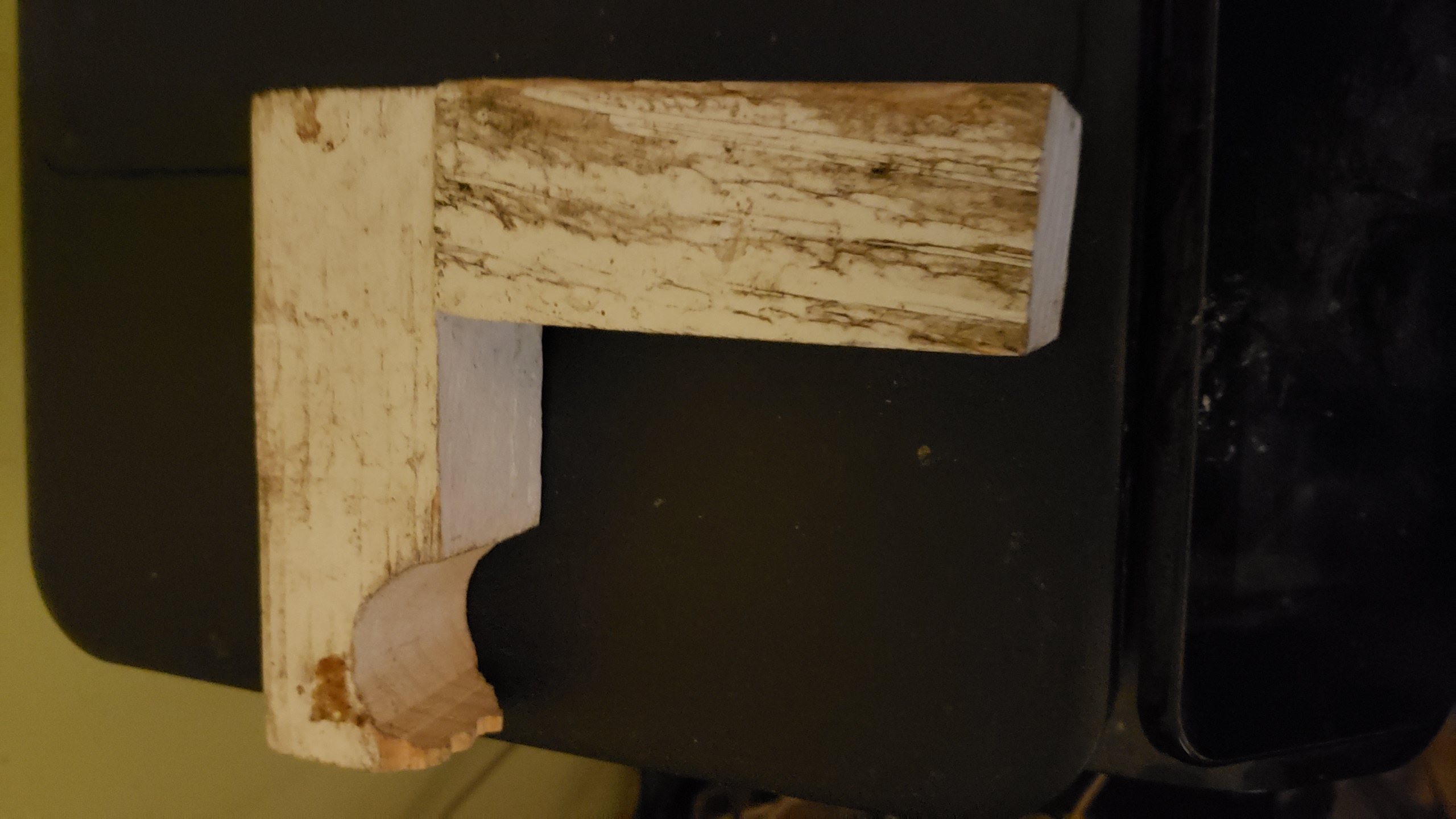
2. Anchoring the sides I have solved but need better answers. The top roughly 8 feet is being held by my C shaped plastic pipe clips. The clips are being held by this wood bracket (see photo) because high winds will cause the plastic to pull the clip off the closet rod. Adding the bracket over the top stops this. This causes 2 problems. Taking those brackets loose involves 2 ladders and 3 screws on each side. So it is slow and work to do. The other problem is every time I put the C shaped clamping pipe back it seems to end up damaging the curtain plastic in small places. I have worked hard with a little plane to get rid of the sharp edges that do the damage but still get some damage even being careful. Most cars and trucks will go under the roller pipe without taking that part down. So I only need to do that upper part when running bigger stuff in and out is the only saving grace. And most of the bigger machines typically come in for a longer/bigger bigger jobs so it doesn't have to happen very often.
Now the bottom 7 feet of the curtain I have been rolling both layers of my plastic flaps around a furring strip with pool noodles on it and tucking it against the wall behind the 2x holding the closet rod. Then I have a 2x4 that levers from the wall to a wall bracket to the roll at the other end pinching it in place. So far the friction of a hard pinch combined with basically 2 complete wraps has mostly held it all in place. Faster to disconnect. Used nearly daily on one side to slide out to latch and unlatch the doors as well as create an air vent to get the air out of the pillow. Still a tad slow but I can open everything run a vehicle in and have it resealed in under 15 minutes at the lower level so still not too bad. And is doing almost no damage over time. The one small spot of damage is protected by a duct tape patch. Would like to do this up high to but haven't found a way to do it from the floor.
I played with magnets but as best I can tell I will need a 60# magnet about every 6 inches on both sides to maybe hold the curtain. They also damage the plastic when it is pulling hard on the localized area of the magnet so for now that idea has been abandoned. Would mean removing 30+ individual magnets and still 2 ladders etc plus $100 of magnets.
3. with the one semi major wreck I had to reroll the plastic on the pipe so I got it painted black On a good day the heat boils out of both ends of that pipe and it feels really warm thru the plastic so likely more to gain there. So this one is completed.
4. Drilled the pipe and went from the rope wrapped around both sides to a single rope threaded thru the hole and anchored inside the pipe so it only wrapped one way instead of two. Works way better. It means half the weight of everything is hanging from the plastic which I don't like. But if it isn't damage somewhere the breaking strength of the plastic is greater than the ropes so that risk is low and the other danger is the plastic coming loose at the top and after I added the clamp brackets to the top that risk is very small. I did pull ups from the pipe and it stays. Also completed.
5. Have done nothing towards automating this.
And that completes the problem list from the previous post.
Now lets look at look at a problem I didn't understand when I built the original clamping pipes out of the black poly pipe. I used a knife to cut the length of the pipe but my cuts wandered like a drunken sailor just off a merry go round. I tried really hard to cut a straight line and it kept wandering one direction and when I tried hard to come back suddenly it was a jagged cut the other way. I blamed that on me.
What I have learned since while doing another project is that poly pipe has a grain to it that spirals slowly around the pipe. The pipe I learned this on made one full revolution about every 6 feet. And cutting straight down the pipe with a knife is nearly impossible. I even made a fancy pull type cutting fixture and the grain was so strong that forcing the cut to stay straight was enough to snap a heavy duty sheet rock knife blade.
So now I know that, I should build a cutting fixture to hold the pipe at both ends and trap it in the middle so I can use a saw or a router to force a straight line cut or cuts.
In the dream world I would like to shape the clamping pipe to look like the #3 cross section in the drawing. So it did less damage putting it on and off over the closet rod. So far not smart enough to figure an easy and cheap answer to do it. Better ideas? Did try using bale twine to create a big net to force it to stay smaller to the inside but way to much work to set up and take down
My other major complaint is the amount of space the pillow takes up in the shop. Still worth it for the gains but big space consumer. This pillow fully inflated is roughly 5 feet thick in the middle tapering to zero at all edges. On smaller doors would be less of a problem
One other problem other than the small bit of damage to the plastic being in a shop environment and a rough clamping system cause is the plastic rubbing against the wood doors. The outside layer of the plastic is getting cloudy with that abrasion. I am sure this is cutting solar gain a bit.
Quick explanation of the drawing. #1 is the as built showing the 2X spacer and the closet rod. #2 shows the closet rod with the clamp pipe around it. But the 2X has 2 small rabbets in it. I would do this if I ever did it again because the clamp pipe hits the 2X in places because I didn't cut a straight line. #3 is the cross section of how I would like to shape the clamping pipe to minimize damage to the plastic taking it on and off. Still no idea how to do that?
Now other future goals not already listed.
A. To do a better job of sealing the edges I would thermal weld both layers of plastic the whole length of the one side and most of the length of the other side leaving around 6 or 7 feet not bonded on the one side so it can be opened to vent air. The filling fan is rated 10 CFM and it takes a bit over 20 minutes to solidly inflate the pillow so it has roughly 200+ cubic feet in it, so to let it out quickly, a big vent is needed. Would also seal the bottom part way in on where it wraps around the pipe based guessing part of the reason the plastic hasn't been staying put on the pipe like expected is that the layers around the pipe are trying to inflate. Found directions for welding the plastic using a household iron and parchment paper to keep it from sticking. The small experiment worked well. Would do that while the curtain was laying flat on the floor for assembly. The iron was slow. The welds may weaken the plastic but I think I can keep them to low strain locations.
B. On a new curtain would add a small rope folded in where it is folded in half to go to the top. Would have to punch it out at each side where the plastic is fold back on itself, but then I would add a cleat on each side to anchor the rope to giving me 2 safeties. The rope would be harder to pull under the clamp pipe and even if it pulled out or off the rope would be inside the plastic providing another protection from something breaking and clomping me on the head.
C. Need to build a pipe anchor system. Started just to build a steel bracket that stuck out from the wall to catch the pipe in a you shape.(can't use the letter) but it sticks so far in the room I has afraid of it being a tripping / falling danger when the curtain is up. So what ever hooks the pipe needs to fold back to the wall for safety.
D. Keeping the ropes tracking. Have had the ropes fall off their rollers and sag in the middle and fall off and snag stuff. Original plan was to always keep the rope tight to prevent this problem. Mostly do but the occasional problem means want to do better. Thinking is to run a small guide pipe across the beam at the top so the rope is trapped up there and some guards at the rollers to the rope can't possibly fall or jump off them.
Now a quick discussion of the big train wreck. Opened it up for solar gain early one spring morning. It was dead calm. Called out on a “quick” service call. When I got home many hours later had a 30 or 40 mph wind out of the south east with huge gusts. The plastic had pulled loose on one side and about a quarter across the top and was flapping in the wind. In the process it was jerking the pipe up in the air on that end. So it pulled the plastic off the pipe a bit too. So had to reroll it on the pipe which meant taking it clear off the pipe and starting over. It was way harder to do with the curtain hanging than it was originally when assembled on the carpeted church gym floor. Given what I have learned since guessing part of what saved me was the shop pressuring up thru my “leak” taking most of the strain off the rest of the plastic. I have since added a bunch of my clamp brackets shown in the photo to hopefully keep that from ever happening again. But the side ones are a pain to install and remove so still want a better system. The top ones stay put nicely and since they only have to on and off while removing the curtain for maintenance being a pain there is not a problem. Since this is probably only once every 3 years or so
I have a very tentative plan to go in 32 inches to grab that stud to be the hinge grab the 16 inch stud to pull to the wall and put a clamp pipe on the far end so this creates big clamping force to the curtain rod. Possible pulls to the wall are a fancy folding cam mechanism and the other answer is pulleys and rope. Still too tentative to call it a goal.
Over all very glad I did this project and certainly worth while but still much room for improvement.
curtain-holder.JPG
20251214_200915-1-.jpg
clamping bracket
Country oriented nerd with primary interests in alternate energy in particular solar. Dabble in gardening, trees, cob, soil building and a host of others.
That is really awesome. I have done some googling because I want inflated roll up side vents on a high tunnel, but have only done inflated hinged doors so far.
They make a ready made bottom pipe for this. It is extruded aluminum, about the same diameter as 2” pvc, and has a greenhouse wiggle wire channel built in. Pricey to ship (12 foot sticks) but if you can find it, it solves a lot of issues.
Most greenhouse doors/vent have huge overlaps on the sides to prevent drafts, some with pockets built to catch the side leaks. If you made the door a couple feet wider it makes sealing the sides simpler
The stick on zippers available for making temporary doors to keep drywall dust out of the rest of the house during renovation allegedly seal well enough to make a deflation vent.
Greenhouse repair tape is cheap on Amazon. I put it on brand new in places I know will wear. Saves lots of frustration.
Some of the commercial doors have a Roman shade style mid bar reinforcement. Helps with wind, hurts your pillow sealing. Maybe it could be installed only on the inside plastic?
"You must be the change you want to see in the world." "First they ignore you, then they laugh at you, then they fight you, then you win." --Mahatma Gandhi
"Preach the Gospel always, and if necessary, use words." --Francis of Assisi.
"Family farms work when the whole family works the farm." -- Adam Klaus
Ooooh boy, just like my struggles to use billboard tarps as end doors on my military truck maintenance tent (great big canvas quonset hut ) that's used as my shop.
I finally gave up other than rolling them down in freezes so I can drag frost sensitive stuff into there.
When it's frosty here it's usually no wind.
As far as stopping the sides flapping, the tent came with large hooks all the way down the sides, like the speed lacing hooks at the top of hiking boots .
It worked to use these and holes punched in the edges of the tarps to lace up the sides against the wind much like you would lace up a shoe. Much work required there every time you do that.
It would make it easier to have put hooks on the tarp also. I did buy some small coat hooks that looked like they might work, but never did try it.
Bigger pulley blocks on the ropes rolling the tarp up and down were a big upgrade.
I'm using the same basic rope lifting setup illustrated here.
I used a long 2x2 with the tarp stapled to it instead of a pipe as a roller. Pipe would have been better.
Nice description here. Love the updates and "wrecks" too.
The longest recorded flight time of a chicken is 13 seconds. But that was done without this tiny ad:
A rocket mass heater is the most sustainable way to heat a conventional home



.png)
-B.png)


 14
14


![[Thumbnail for 263446163_10160719162536789_3085430215533160327_n.jpg]](/t/172576/a/164634/263446163_10160719162536789_3085430215533160327_n.jpg "Filename: 263446163_10160719162536789_3085430215533160327_n.jpg
Description:")
![[Thumbnail for 263483072_10160719162261789_1641613699991574133_n.jpg]](/t/172576/a/164635/263483072_10160719162261789_1641613699991574133_n.jpg "Filename: 263483072_10160719162261789_1641613699991574133_n.jpg
Description:")
![[Thumbnail for 263642335_10160719162591789_8177400506398260001_n.jpg]](/t/172576/a/164636/263642335_10160719162591789_8177400506398260001_n.jpg "Filename: 263642335_10160719162591789_8177400506398260001_n.jpg
Description:")
![[Thumbnail for inflated-curtain-front.jpg]](/t/172576/a/164637/inflated-curtain-front.jpg "Filename: inflated-curtain-front.jpg
Description:")
![[Thumbnail for inflated-curtain-side.jpg]](/t/172576/a/164638/inflated-curtain-side.jpg "Filename: inflated-curtain-side.jpg
Description:")

![[Thumbnail for curtain-holder.JPG]](/t/172576/a/280134/curtain-holder.JPG "Filename: curtain-holder.JPG
Description:")