I have! It seems very nice—dark, fluffy, great smell—but is also quite scant, almost a dusting. It’s amazing how much the chips broke down. Maybe in a year or two of growing in the same spot I might get enough depth to plant into.
The easiest way I found to spread winecaps to friends and neighbors was just to give about a gallons worth of mycelium rich chips for them to put in their garden with lots of new chips for the mycelium to spread into.
In my case, I often had to encourage them to be patient. And place the mycelium impregnated chips in an area that was going to be easy to keep moist. Alkaline and desert conditions are a challenge at the start.
I decided to go check on my mushroom beds as a way of welcoming in 2024. Last summer was not a great time for me to garden—I was terribly busy and I was away from home for much of the season. My beds simply grew fallow with weeds. A couple of weeks ago I went out to clean the beds up by using some hedge trimmers to cut the weeds down at the ground and then haul them out. I had a couple of observations.
1). The bedding was no longer feeling much like chips, but rather felt squishy.
2). The 2x10’s that I worked so hard to paint with a safe coating to delay rot have finally succumb to the inevitable onslaught of fungal invasion. I mean what else could happen? At least I got a few years out of them. I think I will re-establish with cement blocks.
So today I went out and stuck a garden fork in the bedding just to see what the conditions looked like under the surface. When I put these in, the chips were rather large, more like chunks. But the fork easily penetrated and when I turned it over, the bedding really no longer looked like wood at all. The consistency was something between potting soil and coffee grounds.
Interestingly, the top two inches were dark, rich, almost black and seethed with short roots. That section was nice and moist. There were a few spots of fungus, but I bet that there was some healthy bacterial growth in there. Below the top two inches the bedding was more coarse, drier, brown, and looked more like coffee grounds than potting soil.
At this point I am not certain what my next step will be. Next summer will be another busy one and I do need to get some more permanent edging for the raised beds. Perhaps this will be something that I conjure up in the coming weeks. I will keep everyone updated.
what is your climate? Eric.
If you don’t have a harsh winter, you could plant now and harvest as hot weather approaches. The climate I grew up in fava beans were grown over the winter. They withstand some frost, say down to 25° or thereabouts but not a full on cold winter where the ground is frozen.
There are many things that germinate in cold weather, underneath the snow. We have a wild member of the mustard family. I don’t know, genus and species, but we call it little blue mustard. It has very succulent, wonderful leaves, and that germinates under the snow. peas and spinach germinate in cool soil too. The conditions on the back of commercial seed packets are not necessarily what the plants require but more what the company will guarantee.
I am not suggesting you plant sunflowers now, but the seed packets say warm soil, summer temperatures, plant in June (northern hemisphere. would that be December in the southern hemisphere?) and yet I have seen them germinating early very early getting covered by a late snow and surviving that. About the sunflowers, I think those seeds ended up in crevices in the ground not big crevices, just between two wood chips, and in a little divot. So as you mull over what to do next, one possibility is to sow a few things now if you can find appropriate micro climates for them.
I know there is a website that gives germination conditions and requirements for various vegetables. I don’t have it available right now, but that would be somewhere to check. it has great information like different germination, temperatures and lengths of time and what percentages of germination you get, so it’s great information when we are embarking on this kind of experiment! Good luck have fun and keep us posted.
It sounds like you and your mushrooms are off to a great start for 2024!
I like hearing about your mushrooms and that your wood chips no longer resemble wood chips.
Invasive plants are Earth's way of insisting we notice her medicines. Stephen Herrod Buhner
Everyone learns what works by learning what doesn't work. Stephen Herrod Buhner
I actually have a “crop” of weeds growing already. It looks like some type of low growing clover, but I never bothered to precisely identify the exact species. I also have some vining weed that appears to be dead or dormant. I think I will leave these alone on the principle of always leaving a living root in the soil. I am not certain what to do in spring. I might smother with cardboard if I get the time—this will be a very busy semester for me. I might smother and grow tomatoes both for food and as a shade crop. Time will tell.
Eric,
You sad "When I put these in, the chips were rather large, more like chunks. "
Ho big in inches or MM/CM, are you calling chunks I ask because I have not found Hardwood sawdust or hardwood chips. I will use some wheat straw, but I need some hard wood & may have to chop the limbs with an ax, so how big should I start with??? Thanks.
The chunks I am referring to are as large as 3 inches across (75 mm). Sometimes the pieces came out in long strips that were maybe 75 mm at the widest and 300 mm in length. I should add that these were the longest pieces and the majority were well under the 75 mm size I mentioned. Many of the pieces were on the order of 5 mm or less.
The issue was that the chipper that I had rented had TERRIBLY dull chipping blades and therefore did not so much chip the wood as beat it to death. Sometimes it would beat it so much that the wood got really flexible and wound around the chipping apparatus and had to be cleaned manually (engine off of course!). If I had better blades, the chips would be smaller and more uniform in size.
So its another spring and of course I have new plans--this time big ones!!
I have decided that I need to make new garden beds. My current beds are situated too close to my driveway and I can't easily move them away from the driveway due to the gradient. Therefore I am moving my new garden to a new spot on my land where I can fence the whole set of beds in and still have plenty of room to move around.
So of course I am planning on chipping up some woody vegetation to make a huge pile of woodchips in order to get my Wine Caps started again!! This spring I actually have a bumper crop of woody debris owing to an ice storm in January. I dragged off the limbs from the yard and they are awaiting a move to their final resting place. Ultimately they will be moved near to where the new beds will be. I will rent a 12" chipper and chip up all the debris right onto the spot where I want the beds! I want to move the chips as little as possible--just to give my back as much a break as possible! Ultimately, I will get some cinder blocks to use as raised garden edges and fill them with chips just to let the Wine Caps grow and let them do their magic to get a new bed started.
I will post pictures as I get this project underway.
I have been planning this for some time now. As much as I loved my old garden beds--after all, I made their topsoil!--I decided that I need a new set of garden beds and that I need to start from scratch. The reason is simple: deer. We have so much deer pressure that the garden beds MUST be fenced and the previous location was in a place that I could not really fence around the bed. The old beds ran parallel to the driveway and were pretty close--5'? On the other side, the land dropped off quickly. Therefore, I could not really move the bed sideways, and even if I did, I would be fencing in a long, skinny pair of beds which would require a LOT of fence to encircle a fairly small amount of garden bed. My best option then would be to move the whole garden to a place that was relatively flat and out in the sun. There really is only one place on my property that fits this bill.
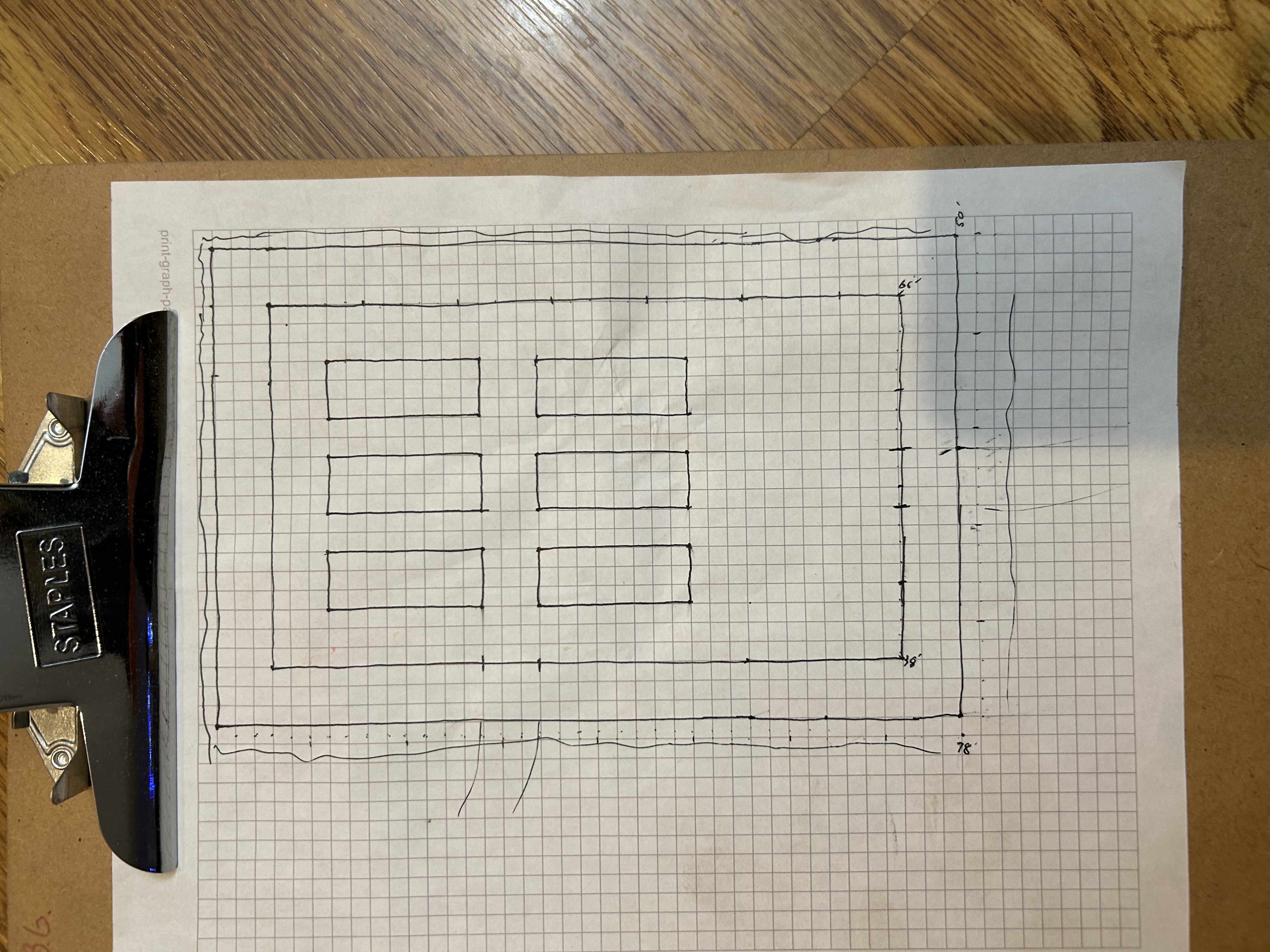
Over the summer I bush hogged the rough area where my new garden bed was going to go, and then periodically mowed it down with the lawn mower--to get the growing grass right to the ground. Last weekend I bush hogged the area and this weekend I went in with the lawn mower and really scalped the grass. After the mowing, I borrowed my neighbor and we plotted out the beds (six 6'x16' beds in 3x2 layout). We then will lay down some cardboard over the winter. We will also rent a huge chipper again and make a gigantic pile of chips and I will let the Wine Caps do their magic over the summer. I don't know if I will plant in all six beds--heck, I might only plant in 2-3 of the beds, but I want to get the beds started anyways.
Each bed is 6' wide and there are 4' walkways between the beds. There is an additional 6' walkway on the outside of the outer beds and between the fence that I will put in (not sure of the fence, but NOT chain link--I just don't like the look!). Additionally, there is a 6' walkway between the two rows of beds. On the one side (far left on the picture), I have left a huge amount of space that will also be fenced in. The exact purpose of this space is of yet not determined, but I thought it prudent to plan in advance.
I hope to see these beds take shape and I will post more pictures when I do.
Eric
Edited to add:
In my sketch, there are two rectangular lines that are notable. The first, inner one that encompasses the six beds is the fence. Outside of that is another line. That line is a bit more imaginary. I plan on having at least a 6' pathway that wraps around the fence, so that line is just the edge of the path. I guess you could call it the beginning of the tall field grass again.
More to add:
The fence line will probably be some type of square or rectangular gauge wire fencing and designed to blend into the background. At the base I was thinking about piling up a whole lot (1' tall x whole length of fence?) of wood chips, maybe inoculate with wine caps, and plant a combination of comfrey, beans/peas (legumes), pollinators, etc. Can anyone think of something else I should put along a fence? I haven't ruled out putting the same line on the inside.
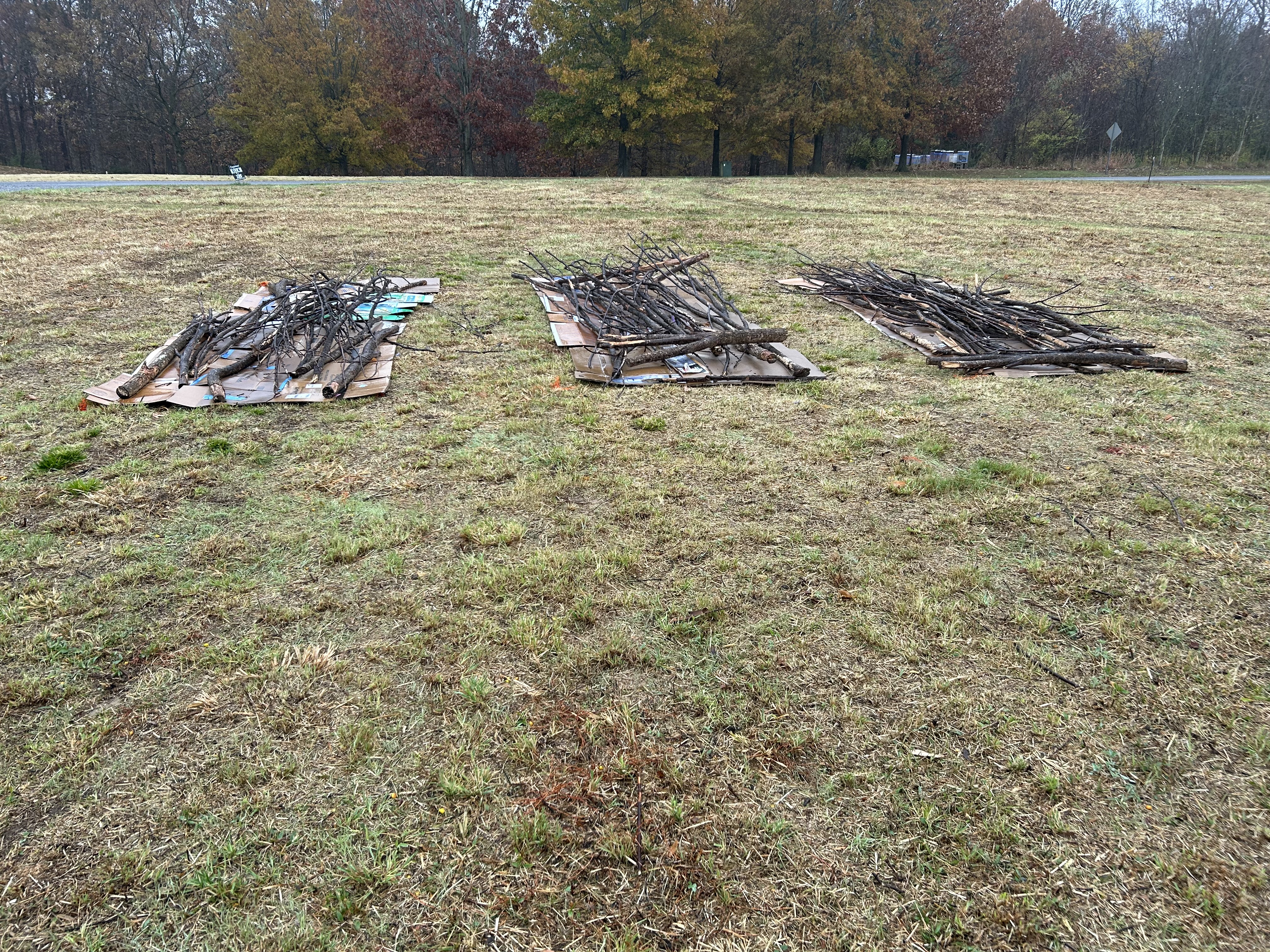
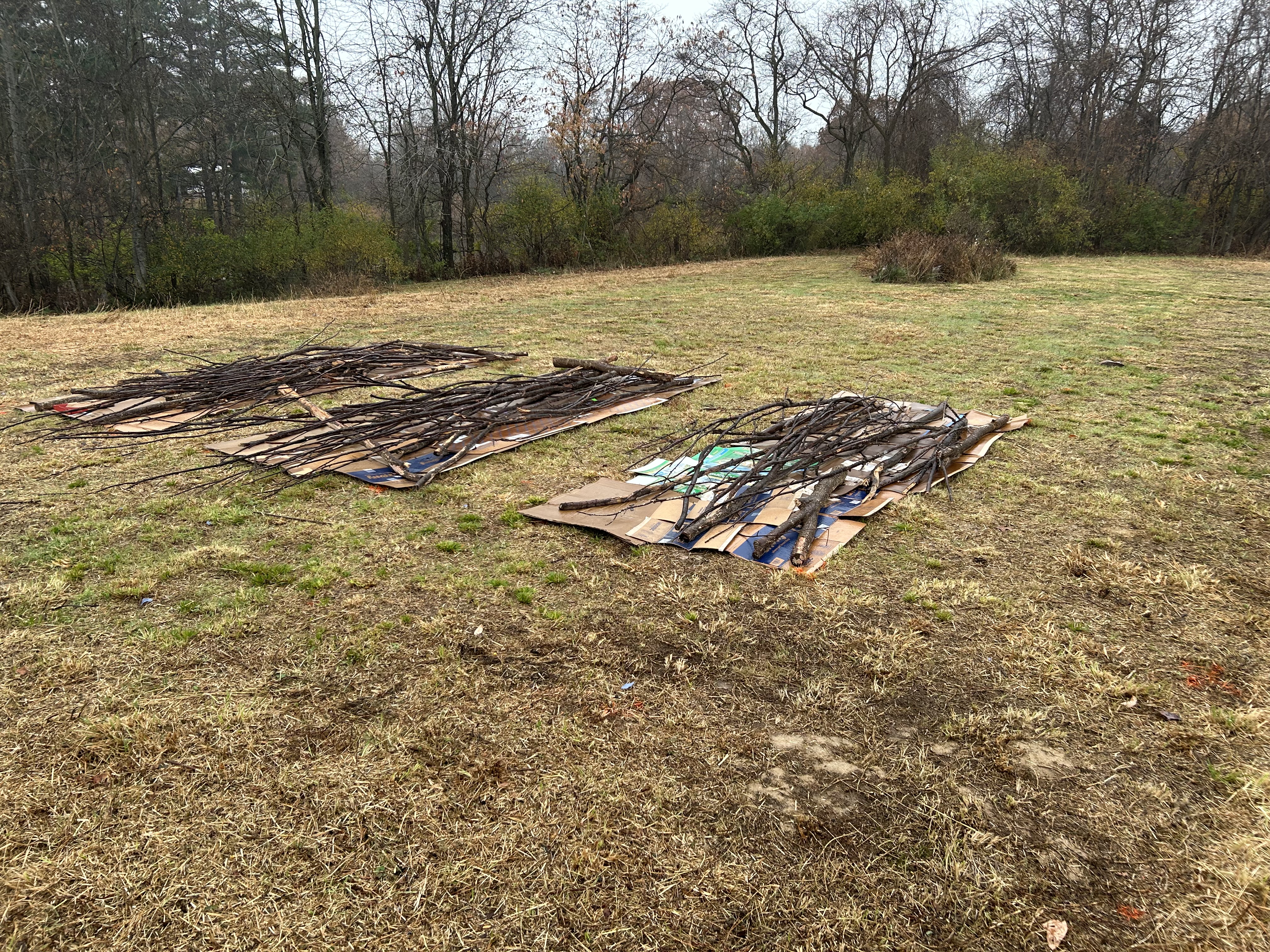
This afternoon my neighbor and I laid down a bunch of cardboard left in my garage (thank you Amazon?). According to my diagram there are six beds—and we did measure out six beds yesterday. But truthfully, I will be happy if I get use of three 6x16’ beds this spring & summer. At the moment, three beds are covered in cardboard to serve as an initial weed barrier. The cardboard is held in place by a bunch of small branches that came from my poor elm tree that died in a severe ice storm last winter.
When the time comes, those branches will be lifted off and chipped up, along with a LOT of additional wood. The chips of course will be laid right back down in the raised garden beds.
I will update when I get another day without rain, but rain is in the forecast for the next several days.
Here is a picture of where my new plots will go, at the moment I have laid down cardboard on three of the six plots. The entire area will be fenced in.
Eric
IMG_3529.jpeg
Future raised garden beds
IMG_3528.jpeg
Branches holding down cardboard in new garden area




-B.png)




 3
3