
• Post Reply Bookmark Topic Watch Topic
  • New Topic
permaculture forums growies critters building homesteading energy monies kitchen purity ungarbage community wilderness fiber arts art permaculture artisans regional education skip experiences global resources cider press projects digital market permies.com pie forums private forums all forums
this forum made possible by our volunteer staff, including ...
master stewards:
  • Devaka Cooray
  • Carla Burke
  • John F Dean
  • Nancy Reading
  • Timothy Norton
  • r ranson
stewards:
  • Jay Angler
  • Pearl Sutton
  • paul wheaton
master gardeners:
  • Christopher Weeks
  • M Ljin
gardeners:
  • thomas rubino
  • Eino Kenttä
  • Jeremy VanGelder

Swale overflow

 
pollinator
Posts: 604
Location: Zone 8A
116
homeschooling kids rabbit tiny house books chicken composting toilet medical herbs composting homestead
  • Likes 4
  • Mark post as helpful
  • send pies
    Number of slices to send:
    Optional 'thank-you' note:
  • Quote
  • Report post to moderator
I have about 400' of swales broken up into 6 swales. They are roughly 16" deep x16" wide and I fill them with wood chips.

We get some torrential rain 6-8 times a year. Yesterday, we got 3" in about an hour and a half. I've seen as much as 5" in that amount of time. My swales overflow and take some mulch with them. I normally just rake it back into the swale end where it was lost. During normal rains, there are not any issues.

Is there anything I can do to the ends to reduce the issue? I have some busted pavers I salvaged and  I thought I could use them for some rubble at the ends.


steward
Posts: 14336
Location: Pacific Wet Coast
8614
duck books chicken cooking food preservation ungarbage
  • Likes 8
  • Mark post as helpful
  • send pies
    Number of slices to send:
    Optional 'thank-you' note:
  • Quote
  • Report post to moderator
Wood floats and you want the water to exit where it's safe to exit, right? So the wood is "floating out the exit"?

Assuming so, you need to makes something sieve-like that will encourage fewer wood chips to leave, while allowing the water to leave at the rate necessary?

Off the top of my head, I'd make something like a loose wattle panel, possibly curved depending on how exactly the water is exiting. Since I grow it, I would likely use bamboo to make it, but any other woody plant that tolerates pruning would l do it, and willow or hazel are classics for this sort of job. If nothing else, this would be proof of concept and help you make more "permanent" design decisions.

If the risk of big storms is seasonal, I would make it removable. It is still likely to slow the exit of water, so you will need to balance reducing your work-load vs keeping the water from choosing another spot to overflow.
 
steward
Posts: 18110
Location: USDA Zone 8a
4615
dog hunting food preservation cooking bee greening the desert
  • Likes 4
  • Mark post as helpful
  • send pies
    Number of slices to send:
    Optional 'thank-you' note:
  • Quote
  • Report post to moderator
What is the purpose of the swales?  Just to catch water or to prevent something?
 
Jackson Bradley
pollinator
Posts: 604
Location: Zone 8A
116
homeschooling kids rabbit tiny house books chicken composting toilet medical herbs composting homestead
  • Likes 4
  • Mark post as helpful
  • send pies
    Number of slices to send:
    Optional 'thank-you' note:
  • Quote
  • Report post to moderator

Jay Angler wrote:Wood floats and you want the water to exit where it's safe to exit, right? So the wood is "floating out the exit"?

Assuming so, you need to makes something sieve-like that will encourage fewer wood chips to leave, while allowing the water to leave at the rate necessary?


The chips are packed in the swale pretty well and so yes, when they separate, they run out with the water.

I like the fence idea. I have some leftover fence.

I should have taken a picture of the amount of water during one of the torrents. Just about any material would try to wash out of the swale.
 
Jackson Bradley
pollinator
Posts: 604
Location: Zone 8A
116
homeschooling kids rabbit tiny house books chicken composting toilet medical herbs composting homestead
  • Likes 5
  • Mark post as helpful
  • send pies
    Number of slices to send:
    Optional 'thank-you' note:
  • Quote
  • Report post to moderator

Anne Miller wrote:What is the purpose of the swales?  Just to catch water or to prevent something?


During the summer drought periods, they help keep the bushes and trees on the downhill side mount from drying out. 360ish days of the year, they are no trouble at all.
 
Anne Miller
steward
Posts: 18110
Location: USDA Zone 8a
4615
dog hunting food preservation cooking bee greening the desert
  • Likes 4
  • Mark post as helpful
  • send pies
    Number of slices to send:
    Optional 'thank-you' note:
  • Quote
  • Report post to moderator
Thanks for the reply, Josh.

The reason I asked is out here where I live we have an abundance of limestone rock so that is what is used inside swales.

I notice when we went to town today some businesses have started doing that too.
 
steward and tree herder
Posts: 11716
Location: Isle of Skye, Scotland. Nearly 70 inches rain a year
5808
5
transportation dog forest garden foraging trees books food preservation woodworking wood heat rocket stoves ungarbage
  • Likes 8
  • Mark post as helpful
  • send pies
    Number of slices to send:
    Optional 'thank-you' note:
  • Quote
  • Report post to moderator
I suppose in time the problem will be reduced as the woodchip breaks down into soil and whatever you have planted in the swales starts to mature. I'm wondering if there is something that you could plant at the edges of the swales that would have the same effect - a clumping grass like vetiver, or a herb like sage or marjoram that has lots of small branches perhaps.
 
Jackson Bradley
pollinator
Posts: 604
Location: Zone 8A
116
homeschooling kids rabbit tiny house books chicken composting toilet medical herbs composting homestead
  • Likes 7
  • Mark post as helpful
  • send pies
    Number of slices to send:
    Optional 'thank-you' note:
  • Quote
  • Report post to moderator

Nancy Reading wrote:I suppose in time the problem will be reduced as the woodchip breaks down into soil and whatever you have planted in the swales starts to mature. I'm wondering if there is something that you could plant at the edges of the swales that would have the same effect - a clumping grass like vetiver, or a herb like sage or marjoram that has lots of small branches perhaps.


I have 2 newish ones and I will try some paver rubble on one and some suitable plant like you suggest on the other.

Thank you for the suggestion!
 
Posts: 51
Location: Southwestern US
22
tiny house urban cooking building composting homestead
  • Likes 6
  • Mark post as helpful
  • send pies
    Number of slices to send:
    Optional 'thank-you' note:
  • Quote
  • Report post to moderator
I wonder if you could have a way that, in the case the swale water-level was too high, it would flow somewhere else? Perhaps a French drain to a pond or dry creek bed?
 
Jackson Bradley
pollinator
Posts: 604
Location: Zone 8A
116
homeschooling kids rabbit tiny house books chicken composting toilet medical herbs composting homestead
  • Likes 8
  • Mark post as helpful
  • send pies
    Number of slices to send:
    Optional 'thank-you' note:
  • Quote
  • Report post to moderator

Lauren Pfaff wrote:I wonder if you could have a way that, in the case the swale water-level was too high, it would flow somewhere else? Perhaps a French drain to a pond or dry creek bed?


The swales are on some gently sloping surfaces that have some collection and run off points down to a wet weather marshy area on my property.

I had considered a 2" or 3" pvc pipe section with ball valve at both ends for the days I know we will have torrential rain. Had I considered this when I placed the swales, I could have made it work better than trying to retrofit it now.
 
Jay Angler
steward
Posts: 14336
Location: Pacific Wet Coast
8614
duck books chicken cooking food preservation ungarbage
  • Likes 7
  • Mark post as helpful
  • send pies
    Number of slices to send:
    Optional 'thank-you' note:
  • Quote
  • Report post to moderator

Josh Hoffman wrote: I had considered a 2" or 3" pvc pipe section with ball valve at both ends for the days I know we will have torrential rain. Had I considered this when I placed the swales, I could have made it work better than trying to retrofit it now.


I'm assuming you also considered making more swales to cope with the bigger storms?
 
Jackson Bradley
pollinator
Posts: 604
Location: Zone 8A
116
homeschooling kids rabbit tiny house books chicken composting toilet medical herbs composting homestead
  • Likes 4
  • Mark post as helpful
  • send pies
    Number of slices to send:
    Optional 'thank-you' note:
  • Quote
  • Report post to moderator

Jay Angler wrote:

Josh Hoffman wrote: I had considered a 2" or 3" pvc pipe section with ball valve at both ends for the days I know we will have torrential rain. Had I considered this when I placed the swales, I could have made it work better than trying to retrofit it now.


I'm assuming you also considered making more swales to cope with the bigger storms?


Yes. Once the mulch is broken down into compost in the existing swales, I will remove it and use it. Maybe I will also increase the existing swale width and depth then.
 
Posts: 71
Location: Central Iowa
4
forest garden hunting bike
  • Likes 3
  • Mark post as helpful
  • send pies
    Number of slices to send:
    Optional 'thank-you' note:
  • Quote
  • Report post to moderator
Are you overflowing at the ends or do you have constructed overflows (lower, compacted, armored)? That protects from washing out the berm in less-than-ideal places.
For the mulch filtration, chunks of limestone can help. We will use some larger stones to some extent but just make sure the trapped mulch won't clog the spillway causing overflows in the wrong places.  
Planting the inner swale will keep mulch more or less in place and we'll use taller grasses or sedges like switchgrass, or palm sedge, near the spillways to filter the water through and slow water moves less mulch around.
If you are getting gushing waterflow you could increase the number of spillways to minimize concentrated flow, or make the swales bigger increasing the holding capacity if you want to infiltrate more water there.
 
Jackson Bradley
pollinator
Posts: 604
Location: Zone 8A
116
homeschooling kids rabbit tiny house books chicken composting toilet medical herbs composting homestead
  • Likes 4
  • Mark post as helpful
  • send pies
    Number of slices to send:
    Optional 'thank-you' note:
  • Quote
  • Report post to moderator
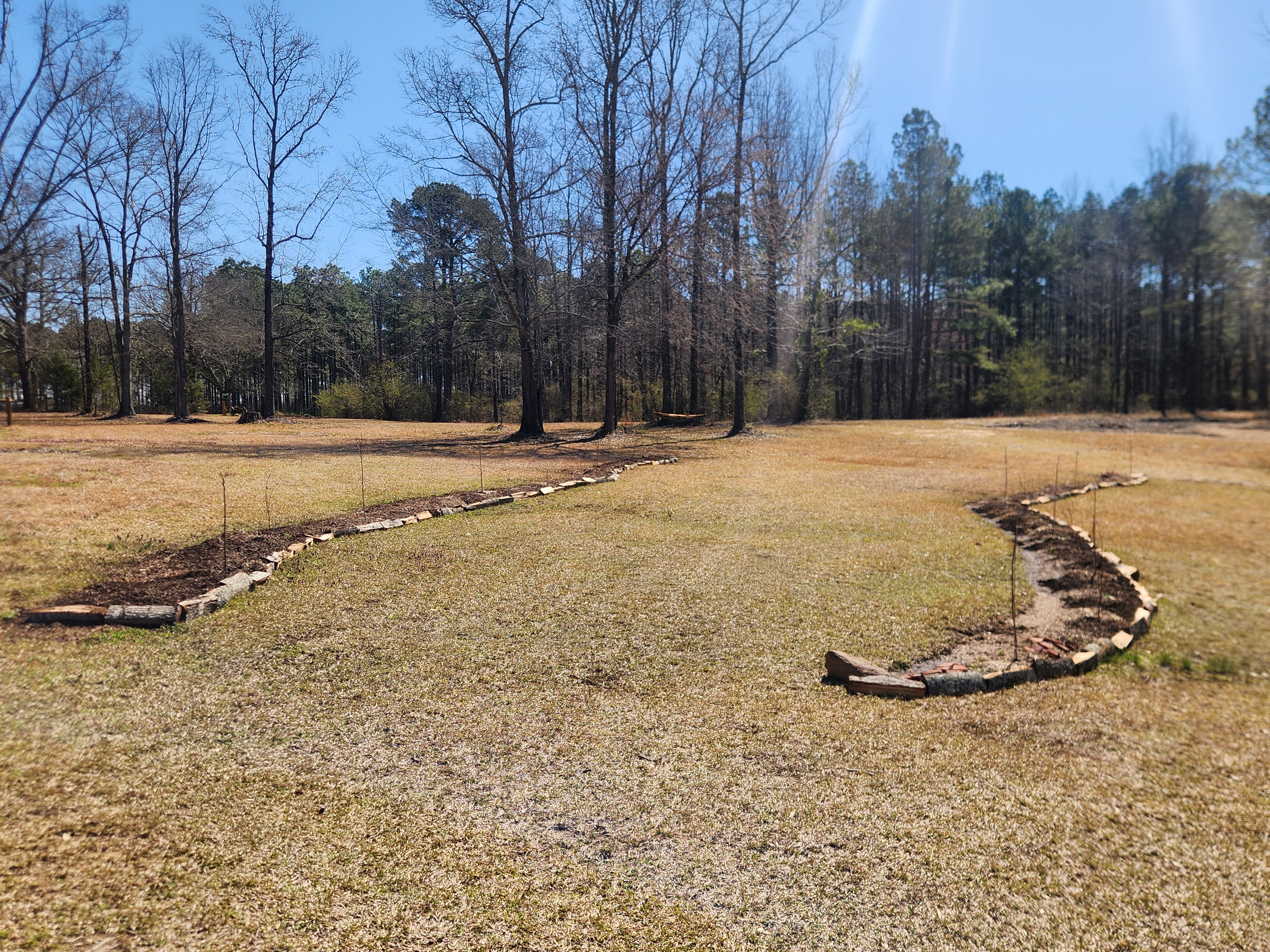
Since posting the original thread, I have tried a few things. We happened to get a 2-1/2" torrent the other night. This is a new area of our property we are starting to work with. These 2 swales are new and I have fruit trees and berry bushes in so far and I divided some comfrey that I also have in place. I'll be adding some other things as I get the time.

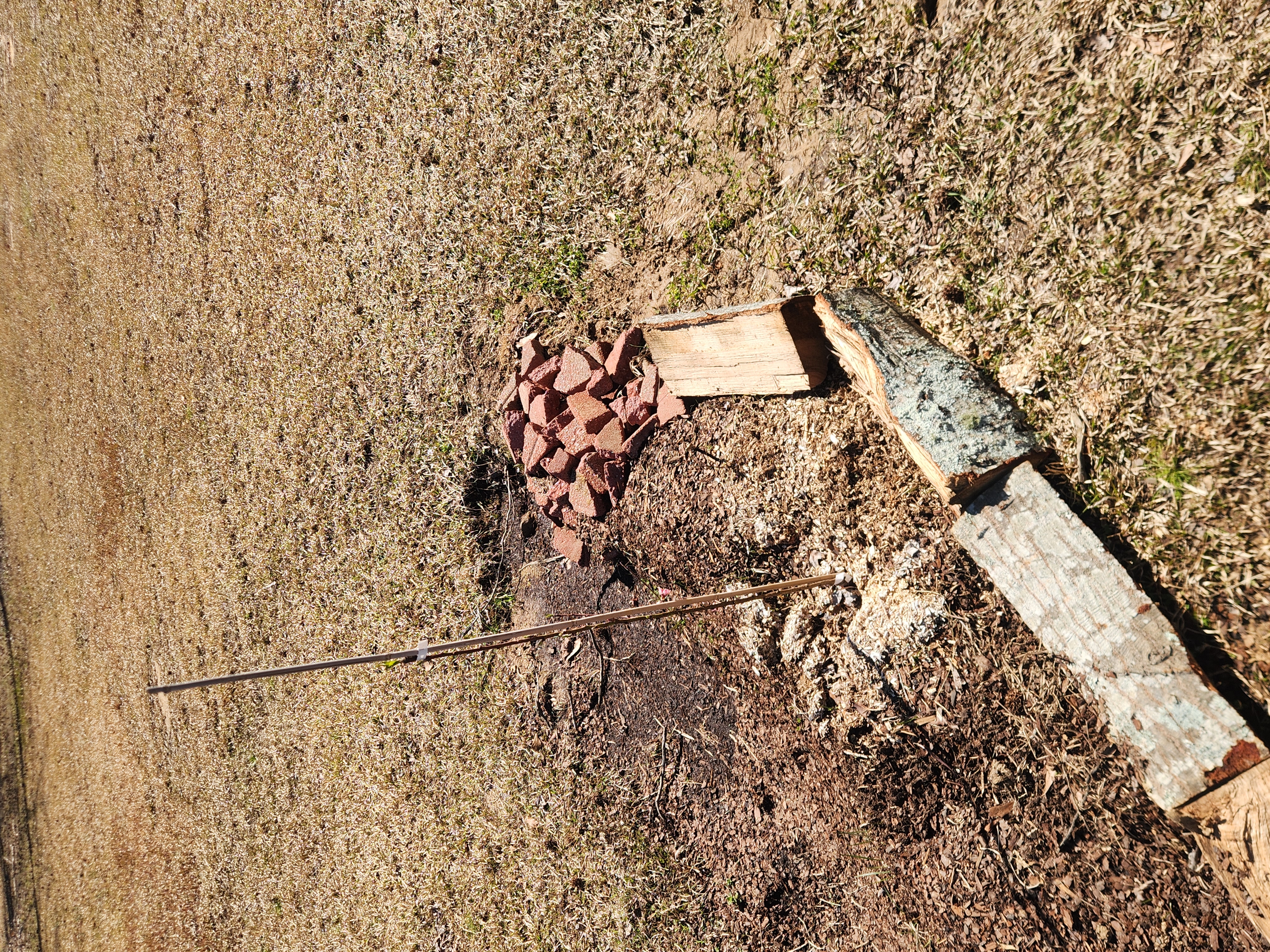
The split oak holds the mulch in place along the swale, which was not much of an issue before, blowouts along the swale did not happen but this will ensure it will not. I put some old busted paver rubble at the ends.

I did not lose any mulch since adding those things. I want to eventually sheet mulch the area between the swales and add one or two more swales above and below. This area catches some of the neighbors runoff and I think that, along with being new, are part of the issues I am having with these ones in particular.

Thank you for the suggestions, I am trying them.
20250311_112757.jpg
Overall
Overall
20250311_112826.jpg
End of Swale
End of Swale
 
Try 100 things. 2 will work out, but you will never know in advance which 2. This tiny ad might be one:
Homestead Pigs Course
https://permies.com/wiki/365748/Homestead-Pigs
reply
    Bookmark Topic Watch Topic
  • New Topic