I imagine the honeymoon phase of homesteading where you are drawing up what your 1-acre homestead will look like ends as soon as the tough work begins.
Ryan Mitchell, author of
Living Off Grid, has some ideas on how you can maximize that acre you've been dreaming about turning into a homestead.
Do you agree with this layout? What would you add or change from this plan?
Designing A One Acre Homestead Layout
My decision to start a mini farm on my own land by designing this 1 acre homestead layout came after I had simplified my belongings and my life to the limits of a tiny home.
I knew I wanted to raise some animals and grow my own food, but I also knew that I’d need to have a carefully laid out plan to follow so that I could keep living the simple way I liked while expanding my homestead.
The homestead design I’m going to show you helped me achieve both the simplicity and the harvests that I was looking for, and it can do the same for you.
1 Acre Homestead Layout
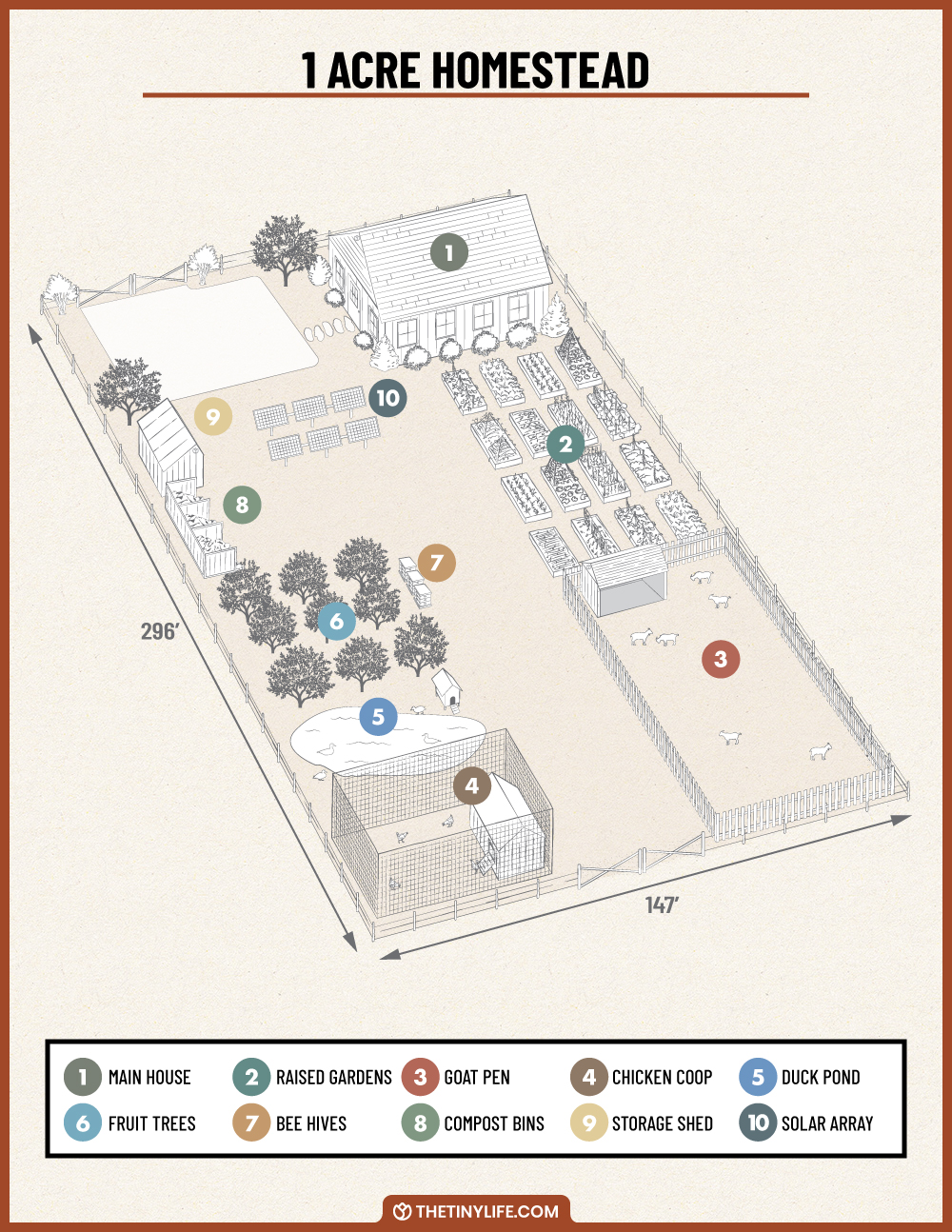
Believe it or not, 1 acre is considerably more land than many homesteaders have at their disposal, and I’m confident that, using this 1 acre homestead layout as a guide, you will be able to produce a significant portion of your household’s food on your own land. Working with your property’s dimensions, this design will give you a good sketch of how to fit 16 4×8 raised garden beds, a roomy goat pen, a chicken coop, a duck pond, nine fruit trees, three bee hives, a three-binned compost pile, a storage shed, and six solar panels.
The solar panels are optional, of course, but many homesteaders — myself included — enjoy the challenge, independence, and other benefits of
living off the grid, so having the space for these solar panels was a game changer for me. If you’re not planning on incorporating these panels into your design, though, you could always fill the space with a few more raised garden beds, some fruit bushes, or a few extra fruit trees.
You can play with the dimensions of your chicken coop, duck pond, and goat pen depending on
how many chickens, ducks, and goats you’d like to own. To keep your flock happy and healthy, aim for an average coop space of 4 square feet and an average run space of 8 square feet per chicken. Ducks require a little more space at 4 to 6 square feet of coop space and 16 square feet of outdoor space per bird.
Goats will definitely take up the most space, as they’ll need around 15 square feet of bedded area, and your pen will need to allow for 200 to 250 square feet per goat.
 How Much Will A 1 Acre Homestead Produce?
A homestead layout for 1 acre can produce more than you might think. Here are some itemized projections.
A 1 Acre Homestead Can Produce the Following
1. Main House
Keep your living space small and designate areas for potted indoor herbs.
2. Raised Beds
Sixteen raised 4×8 beds will produce around 1 to 2 lbs per square foot for a harvest of 512 to 1,024 lbs of produce in a year.
3. Goat Pen
The amount of milk your goats produce in a year will depend on how many you have and what breeds they are, but you should be able to count on an average of over 200 gallons of milk per goat every year.
4. Chicken Coop
The number of chickens you can raise will depend on the size of your coop and run. A 10×10 run could comfortably keep eight to 10 chickens, which in turn could produce up to 2,000 eggs a year if you have the right breeds and conditions. If you’re wanting more chickens, adjust the size of your coop and run.
5.Duck Pond
Your pond will need to be fairly small, probably under 150 square feet, so you’ll need to keep your flock under a half dozen, which could produce up to 1,800 eggs in a year.
6. Fruit Trees
Nine fruit trees could yield approximately 1,350 to 2,700 lbs of fruit in a year.
7. Beehives
With three beehives, you’ll be able to produce an average of 180 to 360 lbs of honey per year.
8.Compost
Your compost bin can help feed your garden and your chickens to keep your homestead self-sufficient, but the output will depend on how many people are in the household and how many fresh foods they consume.
9. Storage Shed
It’s hard to run a homestead without the proper tools and equipment. Storing these necessary items in a sturdy shed will protect them from the elements and keep everything running efficiently.
10. Solar Panels
Six solar panels are generally enough to power a one-bedroom house, so whether or not this number will work for your full homestead will depend on the size of your home and powered workspace as well as the amount of power your household uses.
Can a 1-acre homestead work and really sustain you and your family? I may be skeptical, but read the rest of Ryan's post over at TheTinyLife and let me know what you think. 






 3
3