• Post Reply Bookmark Topic Watch Topic
  • New Topic
permaculture forums growies critters building homesteading energy monies kitchen purity ungarbage community wilderness fiber arts art permaculture artisans regional education skip experiences global resources cider press projects digital market permies.com pie forums private forums all forums
this forum made possible by our volunteer staff, including ...
master stewards:
  • Carla Burke
  • John F Dean
  • r ransom
  • Nancy Reading
  • Timothy Norton
  • Jay Angler
stewards:
  • paul wheaton
  • Pearl Sutton
  • Eric Hanson
master gardeners:
  • Christopher Weeks
  • M Ljin
gardeners:
  • thomas rubino
  • Megan Palmer
  • Benjamin Dinkel

What is "skirting" a fleece?

 
Steward of piddlers
Posts: 6979
Location: Upstate New York, Zone 5b, 43 inch Avg. Rainfall
3639
monies home care dog fungi trees chicken food preservation cooking building composting homestead
  • Likes 9
  • Mark post as helpful
  • send pies
    Number of slices to send:
    Optional 'thank-you' note:
  • Quote
  • Report post to moderator
Hi, It is me again! Tim the fiber noob and I have a question for you all.

What is skirting a fleece anyway?

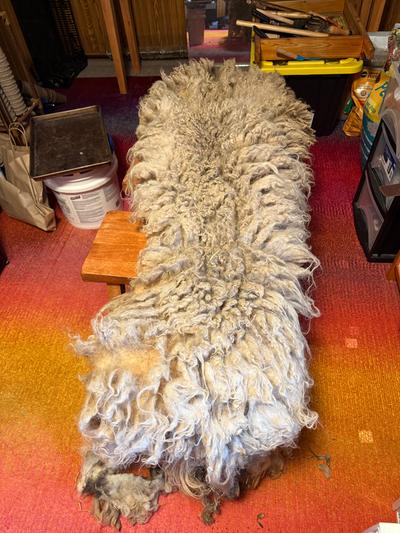
Background: I have made a plan to make some wool dryer balls but I want to make the project as difficult as possible by starting from raw fleece. Through my various connections, I have obtained a raw fleece that is... well... a raw fleece! It has some funk to it, some dirt, and some debris. I plan on laying it out and start the skirting process but I want to make sure I am not missing anything.

Fleece awaiting Skirting


I'm just plucking out the bad bits from the fleece and trimming out any matted sections, yes? Is it better lean towards trimming to much than too little?

Any tips to be as successful as possible?

I'll try and get a photo up in the next couple of days. It is a beautiful Shetland fleece so I'm going to try and do it justice.

I realize that I can get a badge bit for Preparing Wool for Spinning so I may track my process through photos as I go through it for credit.
 
master gardener
Posts: 5523
Location: Carlton County, Minnesota, USA: 3b; Dfb; sandy loam; in the woods
3079
7
forest garden trees books chicken food preservation cooking fiber arts seed woodworking homestead ungarbage
  • Likes 11
  • Mark post as helpful
  • send pies
    Number of slices to send:
    Optional 'thank-you' note:
  • Quote
  • Report post to moderator
It's removing debris from the wool that you don't want in the finished product. In general, the first concern is "tags" (sheep shit). The worst of that should have been left behind at the point of shearing, but there's inevitably a lot of little bits left. So you're picking those out. Also, if you're spinning the wool, there might be sections of the fleece where the fibers were cut wrong or are weak and breaking. You remove those as you identify them. And the last big element is vegetable matter. Sheep roll around in grass and get all manner of VM embedded in their fleece. You definitely want to skirt out all the big pieces. After that though, the amount of VM you want to leave in the fleece is a personal decision. Some people are proud of finished sweaters that still have bits of VM that survived skirting, carding/combing, spinning, and knitting without being picked out. Other people want as close as possible to zero of that junk left in. I wouldn't sweat the tiny bits if I was making dryer balls.

Also, if you're spinning a yarn, you're right about wanting to get any "matted sections" out but maybe not for your project? Those are just blobs of fleece that were felted on the sheep and might be fine to leave for a ball-felting project. But I'm not really really sure of that process, so maybe I'm wrong.

Also, I've done this just a few times so someone like Raven will come along and give you much better info, I'm sure.
 
steward & author
Posts: 44274
Location: Left Coast Canada
17042
9
art trees books chicken cooking fiber arts
  • Likes 13
  • Mark post as helpful
  • send pies
    Number of slices to send:
    Optional 'thank-you' note:
  • Quote
  • Report post to moderator
Skirting is removing and sorting the undesired bits the sheep makes that get on the wool.

It depends on the context and desired use.  There has long been a profession of wool sorters that do this for larger farms.  The professional class level one, takes about 4 days as it can get complicated depending on the desired results - there is a special wool sorter job wich processes hundreds of fleeces a day.  Each fleece is skirted, graded, and sorted inabout 1min, 50 seconds.  It's amazing!  But I only have my level 1 certification.   It takes years to get fully certified...anyway...

In an home environment, skirting involves laying out the fleece in a single layer, removing the muddy shitty bits from around the edge.

That's the minimum and is good to do for shipping as the mills usually charge to do this and it reduces shipping costs by at least 30%

Depending on how the wool will be processed, further removal of undesired fibres like coarse hairs from the legs, sun damaged back, etc. Are done during skirting. But, this is often better left to the person doing the processing as this wool is still useful for some projects.

If it done over a wire frame, it can also achieve some "picking" which is the removal of foreign matter like plants, hay, feed, et.  Picking is the stage for removing  second cuts. Traditionally, it's a separate processing from skirting, often a separate person or machine doing  this.  Although picking isn't technically part of skirting, I've noticed online, it's sometimes included in the skirting description over the last five or ten years.  It's probably because it's easy to do the first stage of picking while at the skirting table when hand processing.

For a starters guide to stuff like this, The Big Book Of Handspinning gives a good overview for hand processing. Most general libraries have it or can interlibray loan it.
 
pollinator
Posts: 441
Location: Oz; Centre South
102
trees books cooking fiber arts writing
  • Likes 10
  • Mark post as helpful
  • send pies
    Number of slices to send:
    Optional 'thank-you' note:
  • Quote
  • Report post to moderator
I always like skirting fleeces - all that lovely woolly stuff spread out on the table. In a shearing shed, the actual belly gets removed and put into a separate bin as the shearer removes it, together with the very short woo on the poll (top of the head). Once the fleece is off and thrown onto the classing table, the the roustabout or the classer removes all the "daggy" bits.  I called my bag of removed bits "bellies, bums and armpits", much to the amusement of the wool buyer who took the fleeces surplus to my requirements.
So, you get the idea - the short bits from the legs, the bits that have matted under the front and back legs, the piece on each side that connected to the belly (very seedy usually) and the area around the tail (less said about that area the better) and anything that is discoloured or second cuts (the very short bits) all go into the "skirtings" bag.
 
Posts: 109
37
  • Likes 7
  • Mark post as helpful
  • send pies
    Number of slices to send:
    Optional 'thank-you' note:
  • Quote
  • Report post to moderator

Christopher Weeks wrote:And the last big element is vegetable matter. Sheep roll around in grass and get all manner of VM embedded in their fleece…  …Other people want as close as possible to zero of that junk left in. I wouldn't sweat the tiny bits if I was making dryer balls


One consideration re dryer balls especially, is that they will be tumbled vigorously with clothing that can easily tear or wear down because of sharper vegetable pieces constantly scratching them in the dryer. Some of the smallest veggie bits are tiny thorns, sharp straw bits, and bristle-y seeds (like tiny burdock seeds).
So unfortunately for me (because it takes more time), for my fleeces and the ones that go to other folks, tiny bits are removed when used for dryer balls, and certainly for sweaters because I like wearing wool next to my skin and  folks who receive my wool expect that, too. I don’t want anything other than softness next to skin.

For weaving rugs and so forth, the tiny veggie bits removal isn’t as important.

We do it any way though. It’s just a better wool product in the end, in my opinion. (Obviously I’m in the “zero bits” camp😏)
If one is sending the fleece to a mill to be processed, the mill will sometimes be able to remove the smaller veggie bits in the carding and spinning process, for an extra price.  They expect shepherds to remove as much as possible on their own, before sending the fleece.

Lastly, re “sheep rolling in grass”:
the way vegetable matter gets in fleeces is from sheep walking or running through tall grass, forbs, and pasture, or laying down w body upright, in the grass to bed down.

Sheep are unlike horses, or dogs, in that if they roll over on their back rather than their body length remaining upright while laying down, it’s difficult for many to right themselves.
In fact being rolled over in a ditch or low spot is something can kill them if someone doesn’t come save them

Even with my very agile primitive breed sheep, in over 20 years of raising and doctoring them and watching them on pasture, I’ve never seen them *voluntarily* roll in the grass.
Rarely, they can fall when rumbling w each other and if actually rolled over, the more fit sheep can usually right themselves, especially if on a hill, but I’ve never seen sheep rolling over on their own in grass or dirt, like horses do.

If they want their backs scratched, they use a shrub or low tree branch or fencing or something overhead like that to do it—sometimes knocking over saplings and young shrubs in the process 😑

 
tuffy monteverdi
Posts: 109
37
  • Likes 7
  • Mark post as helpful
  • send pies
    Number of slices to send:
    Optional 'thank-you' note:
  • Quote
  • Report post to moderator
I agree w many here: skirting fleeces is nice quiet work. I put on an audiobook or story or something and go to it.

I took the 4 day wool classing course and it was great. Totally worth it. Learned so much about wool and what to use it for and how to tell good wool from poor wool. It’s a (great) rabbit hole!

One thing the course I took didn’t teach, is specific details about double-coated wool, for example in the Northern Short-tailed breeds. The general info applies to them of course, but there are specifics I had to learn separately. There are lots of books and resources out there for wool from those breeds too though.

We remove the belly wool, face wool, leg wool if any, and “crutch” area it’s called, while shearing. It goes in separate bags from the rest of the fleece.
We lay the fleeces out on a table and remove the short pieces called “second cuts” (a result of shearing twice over same area)  and weaker locks that have a “break line” in them, and they go with the felting wool bag.

Then when with more time, I sit down and pull out the veggie matter, piece by piece. That’s especially when the audiobooks come in

Since our sheep are on pasture and don’t get diarrhea, the crutch wool isn’t very dirty, and can certainly be included in the wool for dryer balls or some felting projects. We always wash it before working with it, of course. If it’s too stained, or just too raggedy for some reason, it goes in compost.

Any wool we don’t use or that doesn’t go to other folks, we compost for the garden. We bury it under mulch. And sometimes put it around citrus trees under mulch to protect roots from frost.
It is a fantastic slow release nitrogen source with more nitrogen that sheep manure!

 
tuffy monteverdi
Posts: 109
37
  • Likes 5
  • Mark post as helpful
  • send pies
    Number of slices to send:
    Optional 'thank-you' note:
  • Quote
  • Report post to moderator

tuffy monteverdi wrote:
It is a fantastic slow release nitrogen source with more nitrogen that sheep manure!


Here’s info on that:
https://extension.sdstate.edu/wool-natural-bio-enhancement-gardens
 
Posts: 1
  • Likes 2
  • Mark post as helpful
  • send pies
    Number of slices to send:
    Optional 'thank-you' note:
  • Quote
  • Report post to moderator
After getting the undesirable bits off the wool and the long hair's give the fleece a soak in Luke warm water to loosen up dirt. Hot water is more hygienic but will remove more of the lanolin from the fleece. Consider if you want to 'spin in the grease' (lanolin) or not. Poor hygiene could result in disease, infection or mites. Which is why some people prefer not to 'spin in the grease' or 'full grease'. Others love having soft hands and don't mind washing and changing before meal prep.
 
I agree. Here's the link: http://stoves2.com
reply
    Bookmark Topic Watch Topic
  • New Topic