• Post Reply Bookmark Topic Watch Topic
  • New Topic
permaculture forums growies critters building homesteading energy monies kitchen purity ungarbage community wilderness fiber arts art permaculture artisans regional education skip experiences global resources cider press projects digital market permies.com pie forums private forums all forums
this forum made possible by our volunteer staff, including ...
master stewards:
  • Carla Burke
  • Nancy Reading
  • r ransom
  • John F Dean
  • paul wheaton
  • Jay Angler
stewards:
  • Timothy Norton
  • Pearl Sutton
  • Tereza Okava
master gardeners:
  • Christopher Weeks
  • M Ljin
gardeners:
  • Jeremy VanGelder
  • Matt McSpadden
  • thomas rubino

Is colbalt blue worth it? (Expensive oil paint)

 
steward & author
Posts: 45291
Location: Left Coast Canada
17895
10
art trees books chicken cooking fiber arts
  • Likes 4
  • Mark post as helpful
  • send pies
    Number of slices to send:
    Optional 'thank-you' note:
  • Quote
  • Report post to moderator
I am thinking of buying myself a tube of colbalt blue oil paint.  

I'm going for the basic colbalt, PB28, which is a mid to cool blue, vibrant, semi transparent,  lightfast and permanent, with a fast drying time.  Constable used this a lot, and since I am painting a Constable study, it might come in handy.  

Colbalt blue oil paint is also woefully expensive.

As the raw materials come from only a few sources in the world, and stuff is happening there, it's probably going to be more expensive very quickly.   So if I want to give it a go, now is the time.

But do I want to give it a go? I might love it and make it a staple blue. There aren't that many blue paints to choose from. Or maybe think it's a waste of money and wallow in regret.   How do I know if I like it if I haven't tried it?

Well, I bought some student grade colbalt blue.  Well. There is some colbalt in it, but the phthalo seems to overpower.  But maybe it's enough to see if the colour will work out?

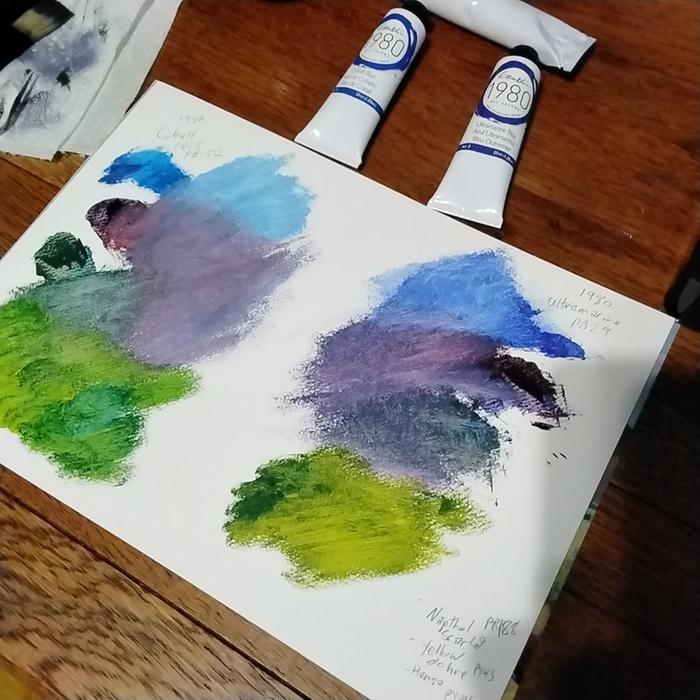
colbalt blue on the left, ultramarine on the right, 1980 student oilcolor


I choose ultramarine as the comparison as it's the blue I use the most these days.

The mixes are deliberately muddy.  White, Napthol red (orange leaning so it won't purple well), yellow ochre, and hansa because it greens well with almost everything.

Although I kept the paint even by volume, the ultramarine had a stronger tinting strength.  I ended up adding more colbalt to the red mix to get it to show up.  Colbalt didn't grey or brown as much with the red as I expected. And looking at all three mixes, I felt as though the colbalt paint had white mixed in. It made creamly chalky mixes.  It could be the calcite used as filler in this line of paint was stronger than normal?  or interacted with the pigments somehow? Or maybe there was an undeclared white in there?  It really felt like white had entered the mix even though I used a new brush for each mix.

The green the colbalt and hansa make (bottom of page) are electrifying.   But I don't often see a colour like that in nature here.  It seems more like a equatorial blue.  Then again, the light Constable was painting in was similar to what we have where I live.  Either the sun is low on the horizon or the summer blanketed in smoke - making it almost golden hour light year round.   And he mostly used colbalt instead of ultramarine (the other bright blue available in his time).


Well, I thought myself into a corrner, so I am curious to hear your thoughts?   Is it a colour you know?  Do you love it? Hate it? Ignore it?  Or maybe have some ideas from seeing my swatch?

Is it worth saving up to buy this colbalt blue paint?
 
Rusticator
Posts: 9582
Location: Missouri Ozarks
5225
7
personal care gear foraging hunting rabbit chicken cooking food preservation fiber arts medical herbs homestead
  • Likes 6
  • Mark post as helpful
  • send pies
    Number of slices to send:
    Optional 'thank-you' note:
  • Quote
  • Report post to moderator
Based purely on what you've shared, I have a preference for the ultramarine. I've seen all the hues and shades of both, in nature, but I'm much more drawn to the 'mud' on the right side of the paper. It's more... well... it's just MORE. So weird, for me, because I tend to love cobalt blue anything...
 
r ransom
steward & author
Posts: 45291
Location: Left Coast Canada
17895
10
art trees books chicken cooking fiber arts
  • Likes 4
  • Mark post as helpful
  • send pies
    Number of slices to send:
    Optional 'thank-you' note:
  • Quote
  • Report post to moderator
I think you're right.  Having lived with the swatch for a day, I don't see many places to use colbalt blue in my painting.

Maybe one day, if it's on sale, but not this time.

Now, smalt, on the other hand...
 
steward
Posts: 22426
Location: Pacific Northwest
13079
13
homeschooling hugelkultur kids art duck forest garden foraging fiber arts sheep wood heat homestead
  • Likes 3
  • Mark post as helpful
  • send pies
    Number of slices to send:
    Optional 'thank-you' note:
  • Quote
  • Report post to moderator
The cobalt seems more of a greenish blue (warm), while the ultramarine is more purplish (cool)...which isn't what I was expecting. But, I guess it makes sense, because ultramarine used to come from ground lapis, and lapis isn't a greenish/warm blue.

It makes sense that you'd get more vibrant greens with the greenish cobalt/pthalo than you do with ultramarine. And, it makes sense that you'd get more vibrant purples with the purpler ultramarine.  

I wonder if anyone has done side-by-sides of quality cobalt with quality pthalo blue? I found this image (from In Search of the Lost Cyan: Manganese Blue):


Honestly, looking at that, cobalt blue seems a lot less vibrant than the pthalo blue. It seems more grey, rather than more green or purple in hue--less saturated overall.


I'm seeing a bunch of pros and cons to buying the paint. My head is a bit full, so I'm just going to list them to see if that helps.

Pros to Buying CobaltCons to Buying Cobalt
Authentic color: easier to paint historical paintingsExpensive
Authentic color: great for learning about historyToxic
Fun and unique Christmas present to selfMight support sad working conditions for people
You only need a little bit of cobalt paint to have a good timeMight be more destructive to the environment than other hues
You can mix a similar hueIt's hard to mix paints the same each time!
 
Nicole Alderman
steward
Posts: 22426
Location: Pacific Northwest
13079
13
homeschooling hugelkultur kids art duck forest garden foraging fiber arts sheep wood heat homestead
  • Likes 2
  • Mark post as helpful
  • send pies
    Number of slices to send:
    Optional 'thank-you' note:
  • Quote
  • Report post to moderator

r ransom wrote:I think you're right.  Having lived with the swatch for a day, I don't see many places to use colbalt blue in my painting.

Maybe one day, if it's on sale, but not this time.

Now, smalt, on the other hand...


I had to look smalt up, because I wasn't sure what it was made of. It looks like it actually has (or at least originally had) cobalt in it! From Pigments through the Ages:

The cobalt ore was roasted and the cobalt oxide obtained was melted together with quartz and potash or added to molten glass. When poured into cold water, the blue melt disintegrated into particles, and there were ground in water mills and elutriated. Several grades of smalt were made according to cobalt content and grain size. In the complex ores in Saxony, as they were first roasted, much of the arsenic was volatilized. The oxides of cobalt, nickel and iron were then melted together with siliceous sand, and the resulting product called Zaffre or Zaffera were, in part, sold to potters and glassmakers.

Another modern recipe is heating of quartz, potassium carbonate and small amount of cobalt(II)-chloride to 1150°C and inserting the still hot product into cold water. The disintegrated glass is then homogenized in a mortar.

The principal source of cobalt used in the preparation of smalt in Europe during the Middle Ages appearing to be the mineral smaltite, one of the skutterudite mineral series. In the seventeenth and eighteenth centuries other associated cobalt minerals were probably used as well (erythrite and cobaltite).

 
r ransom
steward & author
Posts: 45291
Location: Left Coast Canada
17895
10
art trees books chicken cooking fiber arts
  • Likes 2
  • Mark post as helpful
  • send pies
    Number of slices to send:
    Optional 'thank-you' note:
  • Quote
  • Report post to moderator
Smalt looks nifty.  The modern version is a variation of ultramarine violet, but probably more transparent.

The historical versions seem a lot more fun as they often had glass powder added as well as the pigment, so the light would dance around inside the paint to give a different effect to whar we see in modern painting.
 
r ransom
steward & author
Posts: 45291
Location: Left Coast Canada
17895
10
art trees books chicken cooking fiber arts
  • Likes 2
  • Mark post as helpful
  • send pies
    Number of slices to send:
    Optional 'thank-you' note:
  • Quote
  • Report post to moderator
Phthalo blues are bullies on the palette.   Medium to slow drying and overpowered.

Because they are so powerful, they mix well with filler.  It's one of the few colours I like better in student paints than in professional.  I have a red shade and blue shade phthalo in M Graham and they are lovely if I can remember to only use the tiny amount.  

The phthalo pigment can be vibrant green to deep purple.  

I don't know why I don't use it more.  Probably because I need more practice.
 
Posts: 18
3
  • Likes 2
  • Mark post as helpful
  • send pies
    Number of slices to send:
    Optional 'thank-you' note:
  • Quote
  • Report post to moderator
So -- you can use visual descriptors -- chroma, hue, luminosity -- maybe the Munsell color wheel? Or you can analyse more intensively = instrumentally. Maybe use a spectrophotometer to obtain reflectance spectra for dried colors (use a thick enough layer to avoid canvas bleed-through), and then convert to Lab* or other system of choice. That would enable you to build a color-space mix predictor.
You should also note that pigments don't always simulate the visual sensation afforded by pure spectral light. That's due to idiosyncratic observer color perception, different illumination conditions (incident light spectrum and intensity), and maybe other factors as well.
I marvel that there don't seem to be paint pigments available as multilayer reflective coatings on flat-particulate substrates, such as (TiO2/SiO2) x n  on mica? nD TiO2 anatase~2.49, nD SiO2~1.55 as quartz. Typically the base layer would be TiO2 on mica (nD~1.58). Single-layer TiO2/mica is already used in pearlescent cosmetics; it's nicely reflective.
 
r ransom
steward & author
Posts: 45291
Location: Left Coast Canada
17895
10
art trees books chicken cooking fiber arts
  • Likes 2
  • Mark post as helpful
  • send pies
    Number of slices to send:
    Optional 'thank-you' note:
  • Quote
  • Report post to moderator
Yesterday there was a patch of sky pure colbalt blue, for about 40 minutes.

If I was a colourist (and they are wonderful people who paint by matching and focusing on colour), and painting that sky, I would be very sad not to have the correct blue.  But I'm not a colourist and seldom paint what I see. I'm more interested in values and using colour for sharing emotions.

I've been skying (observing the sky closely, with the intention of painting skies) every day for the last 18 months.  It's the first time the sky has been that colour.

When I am painting, I usually avoid bold colours loke cadmium red and opt for earth colours with under tones.  My standard palette just now is white (warm), naples yellow, indian yellow, indian red, and indigo.  If I'm doing a lot of nature, I bring raw umber as a convinced colour.  It's a good spring palette,  colbalt replacing Indigo would brighten things, but not fit the mood I am going for.
 
I was her plaything! And so was this tiny ad:
Our PIE page has been updated, anybody wanna test?
https://permies.com/t/369340/PIE-page-updated-wanna-test
reply
    Bookmark Topic Watch Topic
  • New Topic