• Post Reply Bookmark Topic Watch Topic
  • New Topic
permaculture forums growies critters building homesteading energy monies kitchen purity ungarbage community wilderness fiber arts art permaculture artisans regional education skip experiences global resources cider press projects digital market permies.com pie forums private forums all forums
this forum made possible by our volunteer staff, including ...
master stewards:
  • Carla Burke
  • Nancy Reading
  • John F Dean
  • r ransom
  • Jay Angler
  • Timothy Norton
stewards:
  • paul wheaton
  • Tereza Okava
  • Nicole Alderman
master gardeners:
  • M Ljin
  • Christopher Weeks
gardeners:
  • Jeremy VanGelder
  • thomas rubino
  • Megan Palmer

Persimmon borers

 
gardener
Posts: 2196
Location: Zone 6b
1385
forest garden fungi books chicken fiber arts ungarbage
  • Likes 7
  • Mark post as helpful
  • send pies
    Number of slices to send:
    Optional 'thank-you' note:
  • Quote
  • Report post to moderator
Edit to add 5/1/26:
This thread is split from the peach tree borers thread.

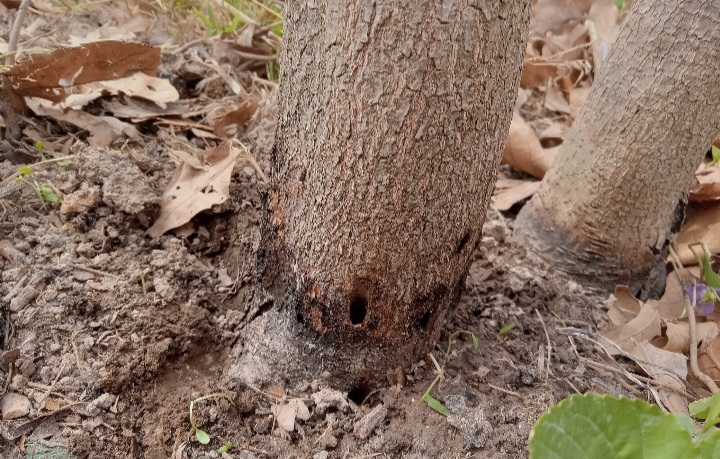
I checked on my trees and was horrified to find borer holes in four of my American persimmon trees. The barks seem discolored all around and the deepest holes are 5 inches at least. I am afraid these trees are gone.
20260331_144958.jpg
American persimmon borer holes
 
Posts: 10293
Location: a temperate, clay/loam spot on planet earth, the universe
3501
4
  • Likes 4
  • Mark post as helpful
  • send pies
    Number of slices to send:
    Optional 'thank-you' note:
  • Quote
  • Report post to moderator
May, I did not think american persimmons would attract borers!
They look like fruit bearing size trees?
It seems like my peaches make it about that big before the real damage shows and then a year or two more.

Maybe they will send up some sprouts you can save?

 
Posts: 104
24
  • Likes 7
  • Mark post as helpful
  • send pies
    Number of slices to send:
    Optional 'thank-you' note:
  • Quote
  • Report post to moderator
That's gutting about the persimmons May. I wouldn't have expected them to go after those either. The chicken idea from Alder is probably the best long term solution if you can manage it, they really do break the cycle. For what it's worth I've had decent results just keeping the base of the trunk clear and checking regularly through winter, you can usually spot the frass before they do serious damage. But once they're deep in like that it's pretty much game over for that trunk.
 
pollinator
Posts: 305
Location: Oregon Coast Range Zone 8A
87
art purity forest garden fungi foraging trees books cooking bee medical herbs seed
  • Likes 9
  • Mark post as helpful
  • send pies
    Number of slices to send:
    Optional 'thank-you' note:
  • Quote
  • Report post to moderator
May, in case you haven't done this already, you might want to dig up the persimmon trees and burn them ASAP. This prevents the borers from transforming into adults, laying more eggs  and killing more of your trees. When I discover irreparable damage on a fruit tree from borers, I burn the tree to ash. Borers really suck!

Recently, I've been using milk paint to paint my tree trunks because it is less toxic than indoor latex paint and is approved for organic growers. The brand I'm using  is called Eco Orchard Paint:

https://milkpaint.com/product-category/eco-orchard-paint

Although it was pricey, I feel better now that I'm using something that is free of nasty chemicals. My fruit trees deserve the best.

Although I like the chicken solution, I've had nothing but problems with chickens digging up the mulch around fruit trees and exposing the roots to drying. So I am bit wary of that solution. However, it might work well with big old fruit trees that have no mulch layer around the base to dig up.


May Lotito
gardener
Posts: 2196
Location: Zone 6b
1385
forest garden fungi books chicken fiber arts ungarbage
  • Likes 6
  • Mark post as helpful
  • send pies
    Number of slices to send:
    Optional 'thank-you' note:
  • Quote
  • Report post to moderator
Thanks, M.K. I will look in to that. My mulberry might need it too. These persimmons are volunteers and the two big ones are both males. There's no financial loss so to speak. I would like to give it a try as some learning experience. I pushed a stiff but flexible plastic tube down each hole as deep as possible and checked each morning until no new ooze showed up.  I think the grubs have been taken care of. I also broadcasted wood ash around the trunks to deter the adult moths if any. So far trees are budding normally.

My local oak and nut trees are bug ridden. There is worm hole in almost every acorn or nut and basically no seedling under the trees. Tannin level is low from my experience with the dyeing and tanning projects using local plant materials. I am wondering if the persimmon trees under attack might have low tannin in the barks or weak defense system, or that proper feeding would make the trees stronger so as not to attract pests in the first place. This thread is about peach borer and the same principle will apply to peach trees as well.
  • Likes 6
  • Mark post as helpful
  • send pies
    Number of slices to send:
    Optional 'thank-you' note:
  • Quote
  • Report post to moderator
What I see reading these posts and what is not understood is that each species of tree has one to several different insect pests associated with it e.g. stone fruit have many moth (clearwing moths) species which deposit ova (eggs) that when the larvae hatch bore into the tree bases and especially the roots.  Those same trees may also have another different clearwing moth species that deposit their ova upon small terminal growing leaf branches, and upon hatching bore into those twig size branches.  Then these same trees may also have different species of (non-clearwing moths) and beetles and moths (larvae) which both eat the leaves of the tree, others bore into the large and small branches and trunks of the tree, these are cerambycidae beetles; adults depending upon size (grain of rice to three to four inches or so).  Adults and larvae bore into branches of the trees.  Consider the array of insect pests doing these same things to persimmon trees are usually a list of entirely different species than the pests attacking stone fruit species.  Here in Louisiana over the past 55 years I have discovered 61 different species of clearwing moths (~25 of the 61 happen to be previously unknown and currently undescribed in scientific literature).  Most all of these insect species are tree/plant specific pests.  In Louisiana I have captured over 200 different species of cerambycidae; these beetles too are mostly found upon different tree/plant species.  My state is no different than the majority of other states in the USA.  

The majority of all insects are nocturnally active.  If I told you that millions of insects are right outside of your home every day/night of much or all of the year, you would say I am BS-ing you.  Well here on my 10 acres we have captured billions upon billions of insects over the past 55 years operating ~500 automatic-capture insect traps (kill type traps using sodium cyanide as the dispatching agent).  In fact, our largest quantity of insects captured in one 24-hour period amounted to 124 million insects.  Our survey traps were never turned off for 55 continuous years and emptied every day and similar capture quantities were logged daily.  Since these captured insects entered my property and were 100% killed daily, they were not available to be recaptured/recounted.  What this means is that in one 24-hour period those 124 million insects were captured right outside of my front and rear door of our home.  We logged 151,000,000 insect trap hours during our 55 continuous years of research.  I am telling these things to you (the readers) so that you may comprehend and understand different posters here are obviously speaking about many different insect pests species and some posters may not realize what they assume to be damage by one insect species may in fact be any of several species. Your property is no different than mine.  Did you see the millions of insects that flew by your home last night and usually most nights of the calendar year?  I can say "No" because the majority of those insects are nocturnally active and you were oblivious to it and were probably sleeping through it all and are uninformed as how to discover them.  Certain species are active flying about for only ~15 minutes each 24 hours.  Also consider, some insects (including agricultural pests) have annual broods of one to 13 annual broods depending upon the species of insect and the tree/plant species.  Our entomological research in Louisiana amounted to 481 entomological publications over 55 years.

Vernon Antoine Brou Jr.


Vernon Antoine Brou Jr.
Posts: 2
  • Likes 6
  • Mark post as helpful
  • send pies
    Number of slices to send:
    Optional 'thank-you' note:
  • Quote
  • Report post to moderator
May Lotito, adult persimmon borers have only one annual brood in North America.  Here in Louisiana ~mid April to mid June.  Two month time period creeps later in the year  as one goes northward.  Here is a picture of that period as it appears on a 12 month phenogram in Louisiana.  Note I published 25 years ago:  free access link to that one page pdf   https://www.academia.edu/145486960/Sannina_uroceriformis_Walker_Sesiidae_in_Louisiana?sm=b&rhid=39442946715

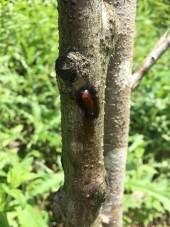
This appears to be this only one moth pest, you will only see adult females around your persimmon trees around 2 month each year.  Infested trees will exude jelly-like substance as ova bores into tree.
 
Judith Browning
Posts: 10293
Location: a temperate, clay/loam spot on planet earth, the universe
3501
4
  • Likes 5
  • Mark post as helpful
  • send pies
    Number of slices to send:
    Optional 'thank-you' note:
  • Quote
  • Report post to moderator
Welcome to the forums Vernon and thank you for your input...great and very useful information!
 
May Lotito
gardener
Posts: 2196
Location: Zone 6b
1385
forest garden fungi books chicken fiber arts ungarbage
  • Likes 4
  • Mark post as helpful
  • send pies
    Number of slices to send:
    Optional 'thank-you' note:
  • Quote
  • Report post to moderator
I bought a grafted Nikita's gift persimmon in 3 gal pot. After I got home and removed the bamboo stake, I found an exact same borer hole in the rootstock right down the center! Does it mean the tree is a goner in the near future? Now I am not sure if I should plant it in ground as it might die from weak roots. What's the best way to save the grafted top?
 
master pollinator
Posts: 2133
Location: Ashhurst New Zealand (Cfb - oceanic temperate)
734
duck forest garden fungi trees chicken cooking solar sheep wood heat woodworking rocket stoves
  • Likes 1
  • Mark post as helpful
  • send pies
    Number of slices to send:
    Optional 'thank-you' note:
  • Quote
  • Report post to moderator
Take a piece of wire, make a small hook at the end and poke it into the borer hole. Push it in as far as you can and give it a couple of twists as you go. When you pull it out, if you succeeded as a mighty hunter there will be pieces of borer on the end of the wire.

With the urgent matter under control, now all that remains is to pack the opening with something that another borer won't chew through. I like a clay tree paste with a bit of cow manure to bind it together.
 
professionalism is finding the perfect flavor of apathy --tiny ad
The official permies.com Book Review Grid with more than 100 books listed
https://permies.com/w/book-reviews
reply
    Bookmark Topic Watch Topic
  • New Topic