Hi all,
I just got a new rainwater tank and I'm looking to install a first flush diverter. I'm using zincalume downpipe rather than pvc so I don't want the usual PVC T style first flush diverter. Instead I was thinking of trying to build a "tipping bucket" style diverter as shown in Bill Mollison's classic “Introduction to Permaculture". I'm wondering has anyone actually built one of these? If so I'd love to hear about it and see some pictures, thanks.
Might be more complex than you really want, and will stop functioning during winter if there is snow or ice.
I was thinking of using an "overflow bucket" style diverter but with a wide tray bottom to promote evaporation to reset it.
Dont forget you need a debris screen upstream of the first flush diverter! Else it will fill with dirt and compost and youll be scooping muck out of it annually!
I also am still in the design phase and would love to hear the thoughts of people who have built one.
That's a wonderfully simple mechanism in the video - good find!
In my ecosystem, even with some sort of screen *and* a first flush diverter, I would say that it's really important to be doing regular maintenance on what ever system you choose. Between pine needle season, yellow pollen season, maple key season... etc there are plenty of things that will clog up the system!
I particularly liked that the bucket was at an easy to reach level. I would be needing to clean it out regularly. Our storms tend to be long whole day pitter-patter affairs rather than the "thunderstorm and done" approach of some ecosystems. For me, the self-drain aspect of the bucket might result in me loosing a lot of rainwater as it would re-set itself during the rain.
How do people feel about the simple overflow style ones with no moving parts at all?
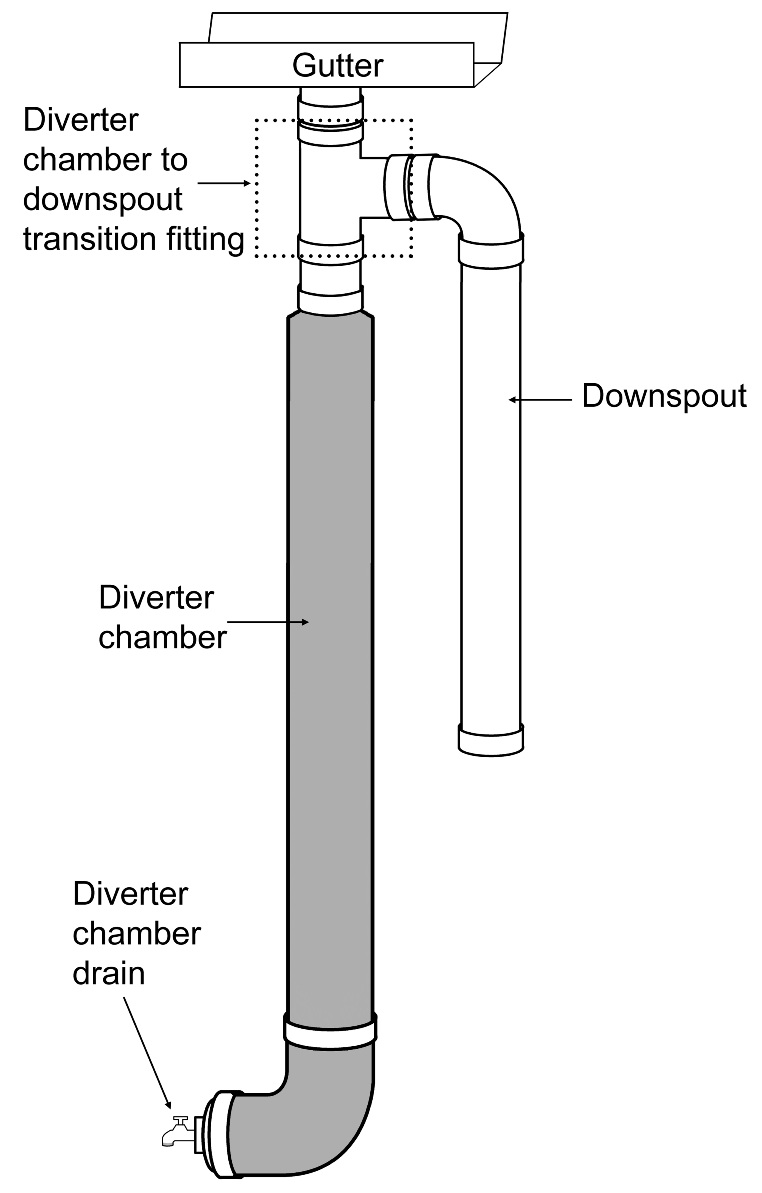
This was going to be my approach, attached. Far lower maintenance. No hinges, strings, ropes, pulleys etc that might fail.
I see a lot of diverter systems with a float valve or the bucket and hinge shown above which totally separate the first flush from any following water.
I guess contamination that tends to float might bypass this type of system? Even then it seems like floating contamination could be trapped with a slight modification. That still leaves you with some things that might come through if they are completely mixed into the water and neither float nor sink? Has anyone seen a detailed comparison?
When I had a dedicated rain water collection system the downspout fed into a tee.
Directly below the tee was a strait length of pipe, plugged at the end , with a weep hole drilled in it.
Once the length of pipe filled up, water diverted into a bucket of sand that fed into an IBC tote.
I tried putting a float under the tee, inside the strait length of pipe, but I couldn't make it make it work, and it was ultimately unneeded.
If I made this again, I would put a 90 at the bottom of the collector leg, a threaded clean out with cap, a hose bib faucet, and maybe a sight glass made of clear tubing.
The hose bib would let me control the drainage rate, and where the drainage went.
first-flush.jpg
This just needs a sight glass and it would be perfect
The nice bit with having the bucket exposed is that despite the weep hole the bucket will remain full from the ongoing rain landing in the bucket. Only after it stops raining and has had some time to drain does it reset, so you arent losing that diverters worth of water as often as the T it would seem.
The holy trinity of wholesomeness: Fred Rogers - be kind to others; Steve Irwin - be kind to animals; Bob Ross - be kind to yourself
Mark Brunnr wrote:The nice bit with having the bucket exposed is that despite the weep hole the bucket will remain full from the ongoing rain landing in the bucket. Only after it stops raining and has had some time to drain does it reset, so you arent losing that diverters worth of water as often as the T it would seem.
I didn't consider the ongoing rain! Whenever I think about diverters like this I have this gut feeling that it's throwing away a few gallons every few minutes, but this is totally untrue so long as the vessel has an adequately large opening compared to the weep hole. Fascinating.