• Post Reply Bookmark Topic Watch Topic
  • New Topic
permaculture forums growies critters building homesteading energy monies kitchen purity ungarbage community wilderness fiber arts art permaculture artisans regional education skip experiences global resources cider press projects digital market permies.com pie forums private forums all forums
this forum made possible by our volunteer staff, including ...
master stewards:
  • Carla Burke
  • Nancy Reading
  • John F Dean
  • r ransom
  • Jay Angler
  • Timothy Norton
stewards:
  • paul wheaton
  • Tereza Okava
  • Nicole Alderman
master gardeners:
  • M Ljin
  • Christopher Weeks
gardeners:
  • Jeremy VanGelder
  • thomas rubino
  • Megan Palmer

Building a ‘Land Binder’: Tracking Everything on My Property

 
gardener
Posts: 596
Location: Wabash, Indiana, Zone 6a
292
hugelkultur monies forest garden foraging trees books food preservation bike bee writing rocket stoves
  • Likes 7
  • Mark post as helpful
  • send pies
    Number of slices to send:
    Optional 'thank-you' note:
  • Quote
  • Report post to moderator
Earlier today I got one of those Big Ideas that won't go to sleep quietly. This is part of my strategy to help Paul Wheaton in his quest for World Domination. Infecting brains with Permaculture.

And it starts with infecting your own brain, systematically.

I started a binder. Part scrapbook, part seed catalog, part history, part reminiscences, really whatever you want it to be. And I expect that it will expand exponentially in the colder months, but today I got started.

A couple of years ago, I went to my county's property tax GIS boundary website. Yes, those things exist. It shows your property, its boundaries, and how much you owe each year for the pleasure of staying where you are.

I printed a couple dozen of them onto letter sized sheets of paper, three-hole puncheced them, and put them in a binder. Then I got to work with a red marker. Drew a circle on my property where a certain plant or project is. And added personal notes and documentation, receipts and pictures. Whatever your heart feels like including.

I'm going to do this for everything. Every project. Every seed that sprouted and thrived. Every tree. Every plant. Every beehive. Every pond. Every perennial plant. Every annual crop. Well...the annuals will have to be updated every year from newest to oldest. But that will tell me what to plant and what NOT to plant in that spot the following year.

I am hoping this will become a keepsake. An instruction manual. A history of the land. A way forward to the person or people who inherit my little permaculture paradise.

Maybe you might think about building your own binder?

I'll keep posting here as I get more involved with the project.

Jim

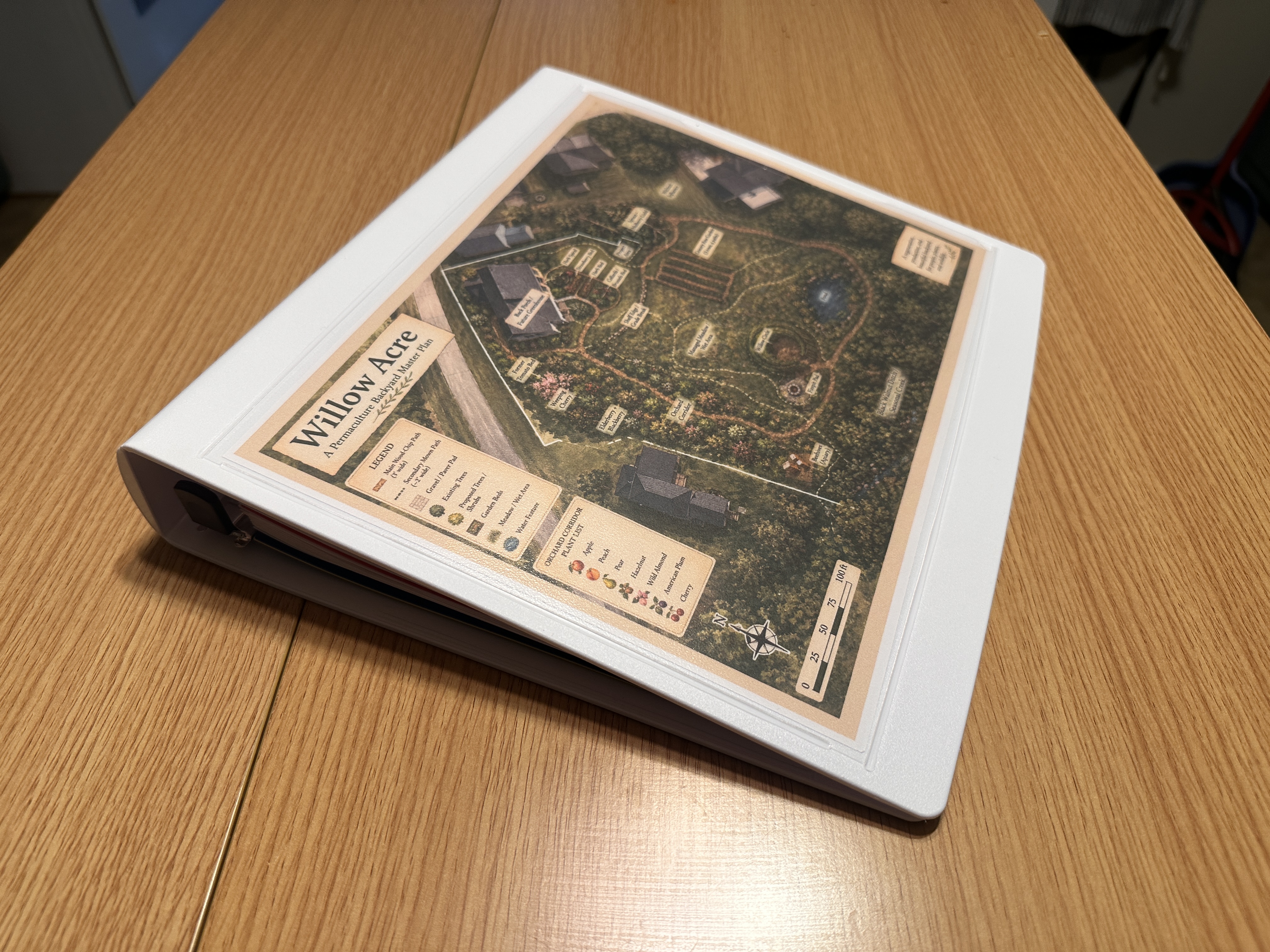
IMG_4757-2.JPG
Permaculture Property Binder
 
Jim Garlits
gardener
Posts: 596
Location: Wabash, Indiana, Zone 6a
292
hugelkultur monies forest garden foraging trees books food preservation bike bee writing rocket stoves
  • Likes 4
  • Mark post as helpful
  • send pies
    Number of slices to send:
    Optional 'thank-you' note:
  • Quote
  • Report post to moderator
I know, I know! Some of y'all have 40 acres or more. I don't know how to do that. But with my pert-near-an-acre, I think it is going to work. Maybe for bigger properties, you break it into a series of maps and go from there.

Jim
 
Posts: 77
16
gear fiber arts building
  • Likes 3
  • Mark post as helpful
  • send pies
    Number of slices to send:
    Optional 'thank-you' note:
  • Quote
  • Report post to moderator
I have a similar project but for my biomes. If im going to build a native food forest I need to know all the native plants and what they're good for, both to other plants and to me.

So ill be listing native plants, whats edible, whats a source of weaving fiber, what fixes nitrogen, what supplies shade, what lives at the ground, what lives as a bush, what becomes a tree, what is good companion planting, what is fire tolerant, etc.

I know almost nothing about plant needs and interactions, so i suspect this list will get a lot longer as a become less uneducated.

Then i do the same with native and current animals.

Then i draw out on your printed GIS maps where they live and what changes I need to make.

If I'm going to own a forest, I'd better know the forest.

This started with some recent things ive learned about fire and how in my area, the douglas fir forests i thought were natural are actually highly unnatural biomes built by our human need to suppress fires. As a result i need to know which trees should be there and how to thin the fir trees the way a fire would, or else I end up with a broken ecosystem that endangers me and the plants i rely on to live.
 
Jim Garlits
gardener
Posts: 596
Location: Wabash, Indiana, Zone 6a
292
hugelkultur monies forest garden foraging trees books food preservation bike bee writing rocket stoves
  • Likes 5
  • Mark post as helpful
  • send pies
    Number of slices to send:
    Optional 'thank-you' note:
  • Quote
  • Report post to moderator
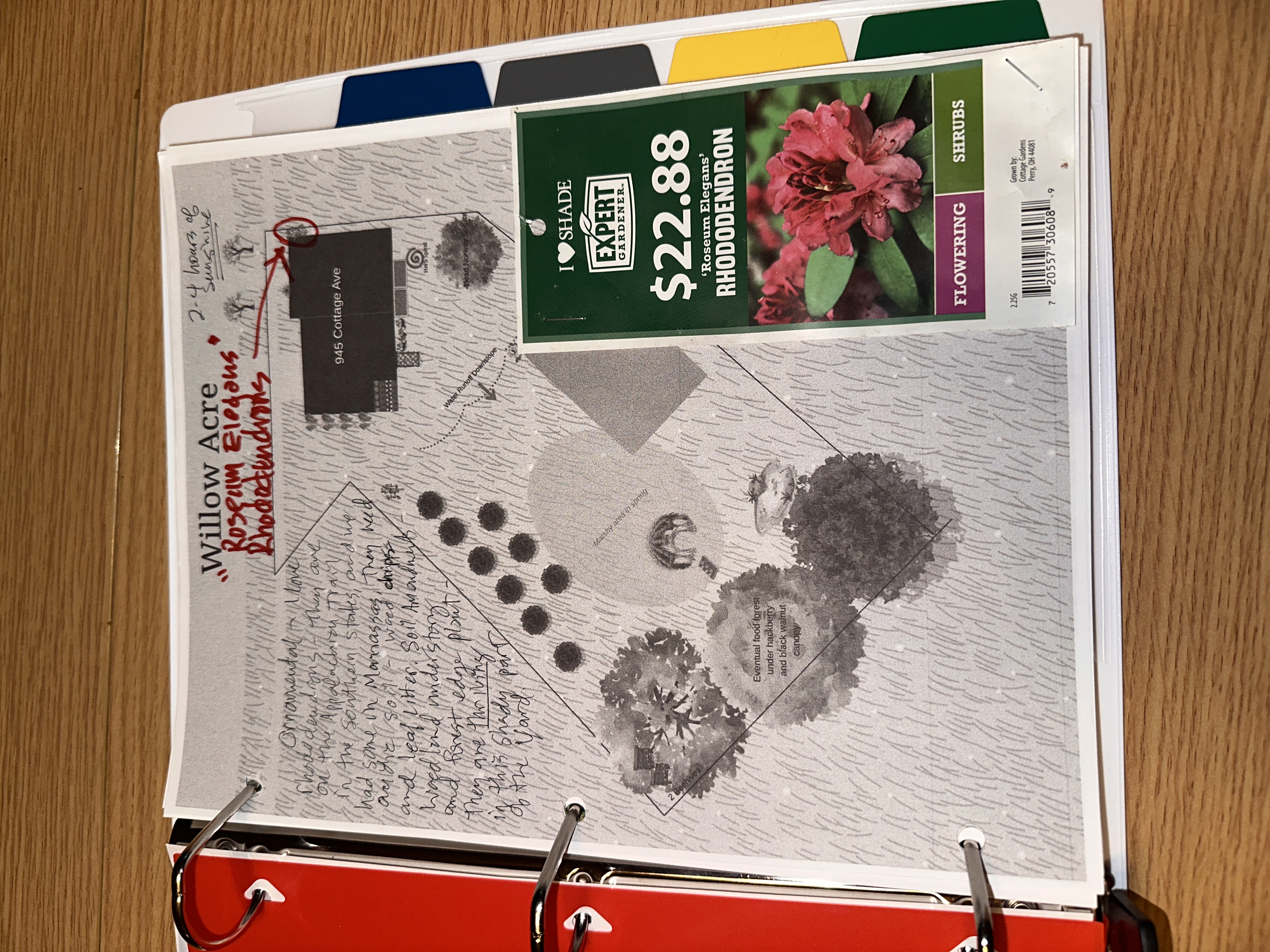
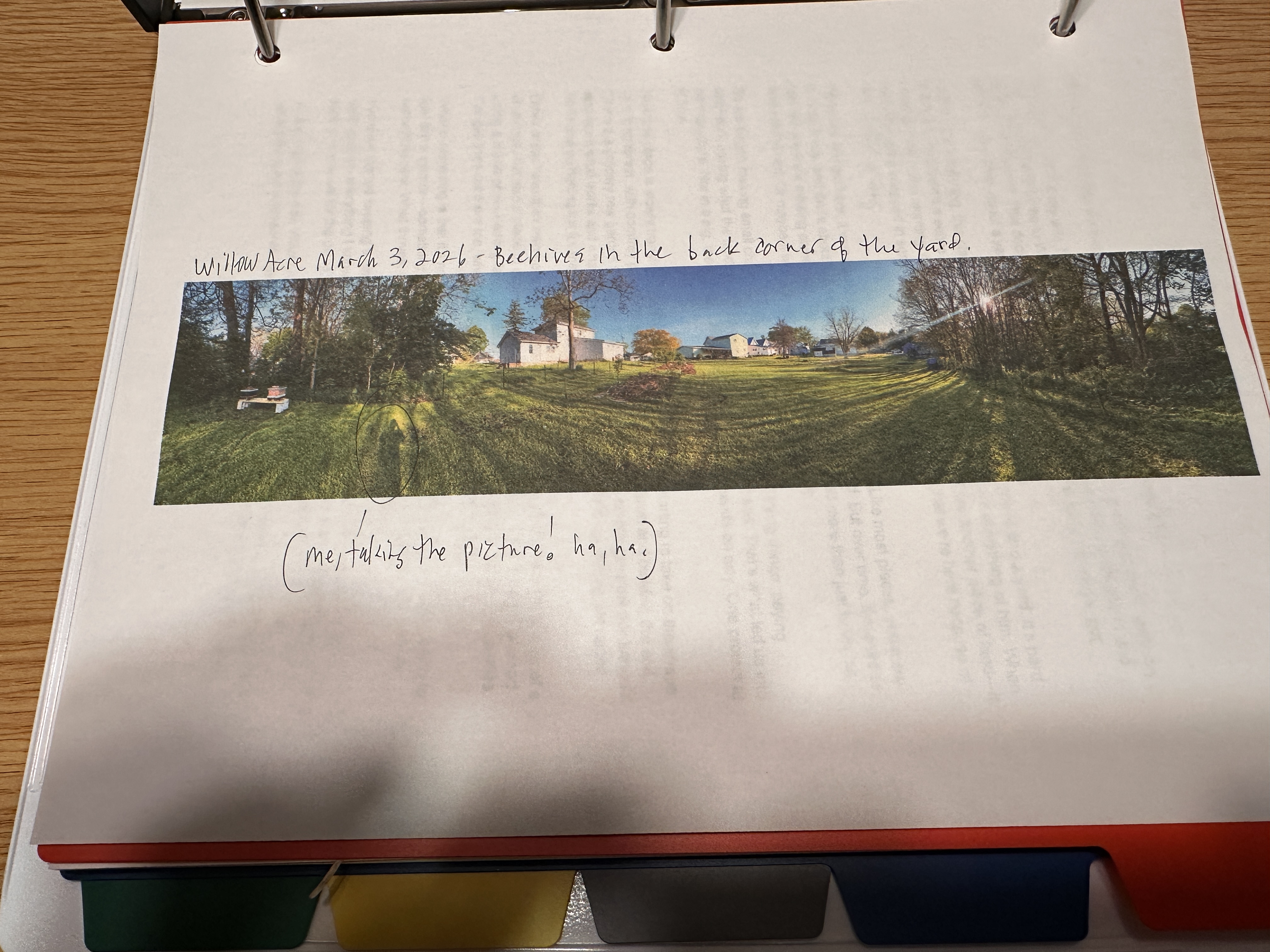
Here are the first few pages I included, after a brief history of the property.

Jim
IMG_4759.JPG
My Rhododendrons
My Rhododendrons
IMG_4758.JPG
Panoramic view of Willow Acre
IMG_4760.JPG
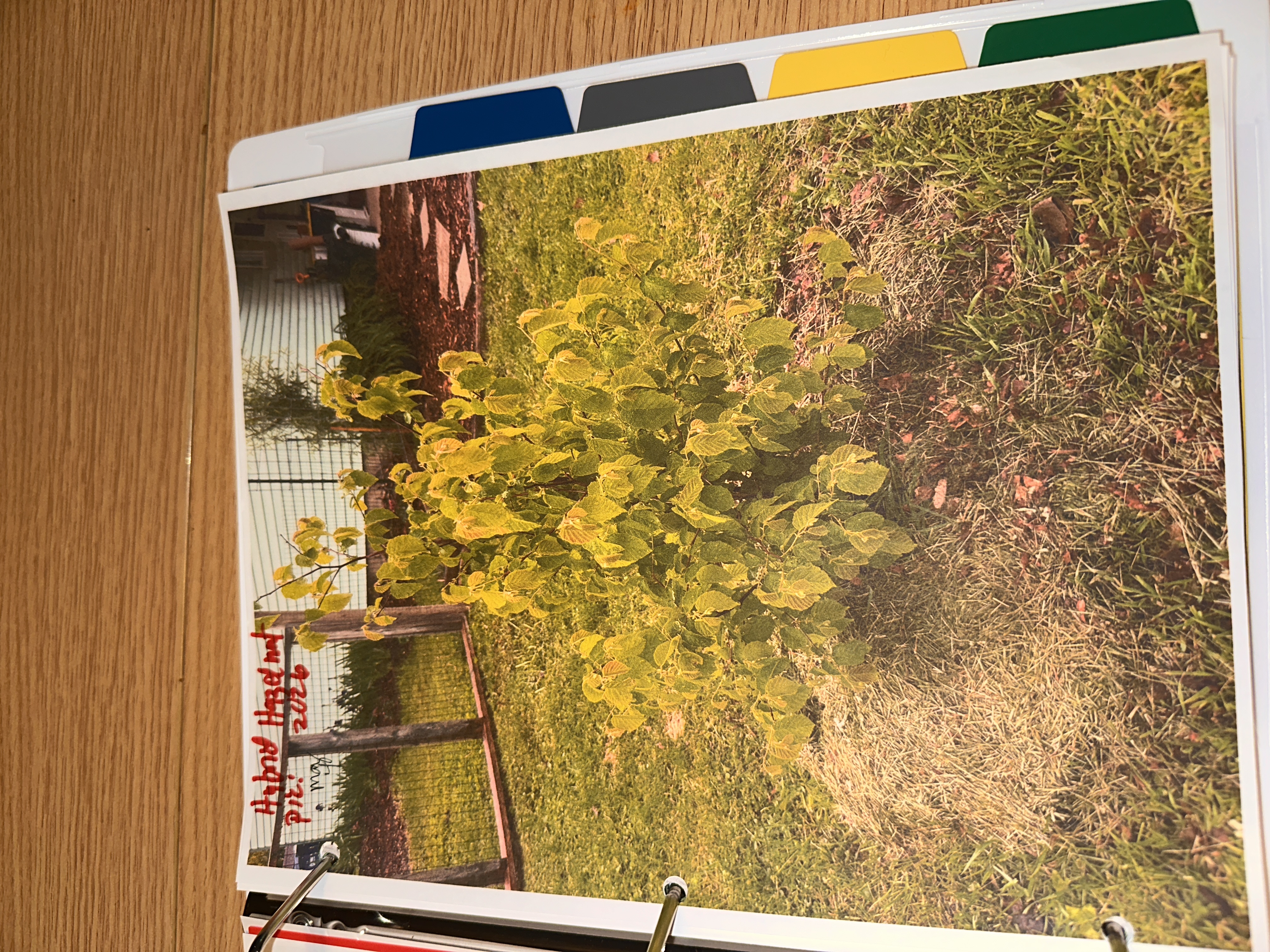
My Hybrid Hazelnut
My Hybrid Hazelnut
 
Jim Garlits
gardener
Posts: 596
Location: Wabash, Indiana, Zone 6a
292
hugelkultur monies forest garden foraging trees books food preservation bike bee writing rocket stoves
  • Likes 4
  • Mark post as helpful
  • send pies
    Number of slices to send:
    Optional 'thank-you' note:
  • Quote
  • Report post to moderator
Outstanding. That's a consideration that wasn't even on my radar. I think binders like this could prove to have a lot of value.

Jim

Daniel Andy wrote:I have a similar project but for my biomes. If im going to build a native food forest I need to know all the native plants and what they're good for, both to other plants and to me.

So ill be listing native plants, whats edible, whats a source of weaving fiber, what fixes nitrogen, what supplies shade, what lives at the ground, what lives as a bush, what becomes a tree, what is good companion planting, what is fire tolerant, etc.

Then i do the same with native and current animals.

Then i draw out on your printed GIS maps where they live and what changes I need to make.

If I'm going to own a forest, I'd better know the forest.

This started with some recent things ive learned about fire and how in my area, the douglas fir forests i thought were natural are actually highly unnatural biomes built by our human need to suppress fires. As a result i need to know which trees should be there and how to thin the fir trees the way a fire would, or else I end up with a broken ecosystem that endangers me and the plants i rely on to live.

 
Posts: 112
25
  • Likes 5
  • Mark post as helpful
  • send pies
    Number of slices to send:
    Optional 'thank-you' note:
  • Quote
  • Report post to moderator
This is basically what got me started building a digital version of the same thing. I kept losing track of what I planted where, when things fruited, which varieties did well in which spots. A physical binder is great for the history and maps side of it, but for the ongoing tracking stuff (pruning dates, harvest notes, what failed and why) I found I needed something I could update on my phone while I was actually out there. Ended up building leaftide.com for exactly that. The combination of both might actually be the sweet spot though, binder for the big picture and reference material, app for the day to day notes you'd forget otherwise.
 
Jim Garlits
gardener
Posts: 596
Location: Wabash, Indiana, Zone 6a
292
hugelkultur monies forest garden foraging trees books food preservation bike bee writing rocket stoves
  • Likes 4
  • Mark post as helpful
  • send pies
    Number of slices to send:
    Optional 'thank-you' note:
  • Quote
  • Report post to moderator
That's great, Joao.

I'm a tactile person, so I lean toward paper. But I've been around enough to know the power spreadsheets, WIKIs, etc. play in the business of keeping everything straight.

Your program reminded me of a joke I heard years ago about the chicken farmer who sent his son to college. He majored in business and when he came home to visit he told his dad he was going to organize his business so he could enter everything into a computer and print reports to keep everything straight, he'd know how much of which supplies to purchase, how productive the chickens were being, and ensure deliveries to customers were on time. "What are you going to call this thing?" Dad asked his son. "Egg Inventory and Orders Input and Output" the son said with a smile.

EIEIO for short...

Jim

Joao Winckler wrote:This is basically what got me started building a digital version of the same thing. I kept losing track of what I planted where, when things fruited, which varieties did well in which spots. A physical binder is great for the history and maps side of it, but for the ongoing tracking stuff (pruning dates, harvest notes, what failed and why) I found I needed something I could update on my phone while I was actually out there. Ended up building leaftide.com for exactly that. The combination of both might actually be the sweet spot though, binder for the big picture and reference material, app for the day to day notes you'd forget otherwise.

 
Do not set lab on fire. Or this tiny ad:
Permaculture Adventure Bundle - 43 digital goods for freaky cheap!
https://permies.com/w/permaculture-adventure
reply
    Bookmark Topic Watch Topic
  • New Topic