

• Post Reply Bookmark Topic Watch Topic
  • New Topic
permaculture forums growies critters building homesteading energy monies kitchen purity ungarbage community wilderness fiber arts art permaculture artisans regional education skip experiences global resources cider press projects digital market permies.com pie forums private forums all forums
this forum made possible by our volunteer staff, including ...
master stewards:
  • paul wheaton
  • Anne Miller
  • Carla Burke
  • Nancy Reading
  • John F Dean
  • Timothy Norton
  • Jay Angler
stewards:
  • r ransom
  • Pearl Sutton
  • Tereza Okava
master gardeners:
  • Christopher Weeks
gardeners:
  • M Ljin
  • Megan Palmer
  • Kate Downham

Tomato characteristics shifting by seed selection

 
steward and tree herder
Posts: 14789
Location: Isle of Skye, Scotland. Nearly 70 inches rain a year
8445
6
transportation dog forest garden foraging trees books food preservation woodworking wood heat rocket stoves ungarbage
  • Likes 14
  • Mark post as helpful
  • send pies
    Number of slices to send:
    Optional 'thank-you' note:
  • Quote
  • Report post to moderator
I know most tomatoes come true to type - if you save seed from a particular tomato, unless you have one with promisciuous parts like Joseph Lofthouse, they will grow new plants that are likely to be the same as the parent plant. Apparently however minor variations can occur. I'm not sure the mechanism, but a local grower to me has been selecting a particular purple beefsteak for flavour and now has one that is apparently nicer than the typical one of that variety.
I could imagine that local bacteria might cause your plants to become used to your soil, but can only assume minor mutations over generations has make some difference in this case, as the plants were grown elsewhere in Scotland for the taste trials.

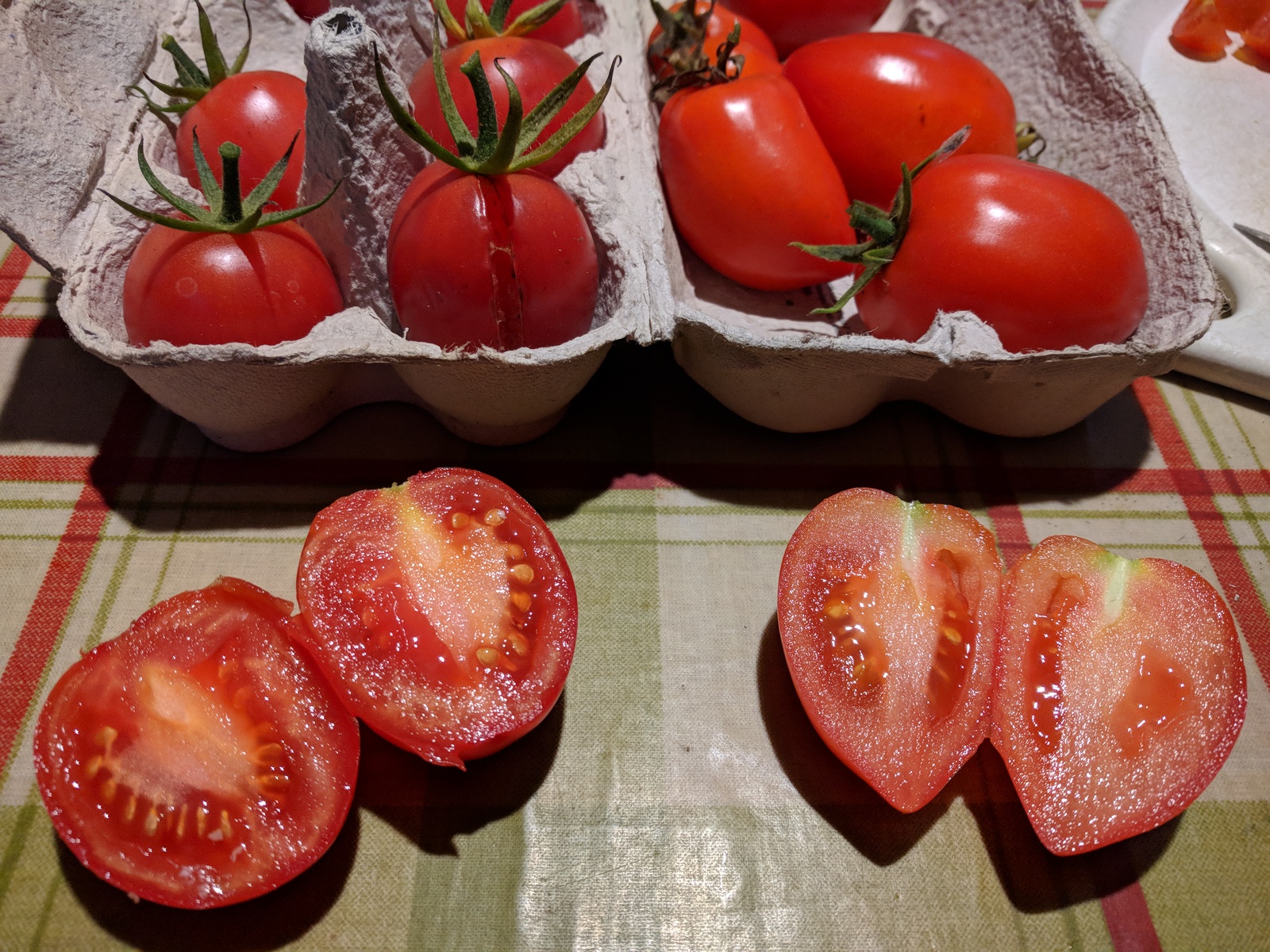
I haven't grown tomatoes for a few years, but have two plum/paste tomatoes this year: 'Amish paste' on the right which grew rather poorly but did make a few tomatoes, and an unknown 'fleshy red plum' which had much more healthy plants. The Amish paste does seem to have more flesh than the other plum variety, but presumably I could select seed from plants that did slightly better or fruits that have more flesh in proportion, and hope to make small improvements in time too.
IMG_20260925_192354.jpg
plum tomato harvest
plum tomato harvest
 
pollinator
Posts: 524
Location: UK
186
kids urban seed
  • Likes 9
  • Mark post as helpful
  • send pies
    Number of slices to send:
    Optional 'thank-you' note:
  • Quote
  • Report post to moderator
Really interesting question. I've noticed my saved Brandywine seeds seem to be getting slightly better adapted to my plot over the years, earlier ripening, handling wet summers better. Never quite knew if I was imagining it or if something was actually shifting.
 
Posts: 525
78
  • Likes 9
  • Mark post as helpful
  • send pies
    Number of slices to send:
    Optional 'thank-you' note:
  • Quote
  • Report post to moderator
The seeds are the sexual progeny of the parent, so there there HAS to be some variation.  During the sexual process, there are two primary mechanisms taking place, the swapping of whole chromosomes, and secondly "crossing over" between chromosomes.

If we are talking about a self-fertile variety, the male pistol of a flower fertilizes the female staman of the same flower.  Since the chromosomes can assort independently of each other, the proportions of each can change from generation to generation.

In "crossing over", segments of what was originally on a female derived chromosome might hop onto the male copy during meiosis, and vice-versa.  A gene sequence that was once on the male copy is now on the female copy, and what was on the female copy is now on the male copy.

If you want to have a guarrantied copy that's identical to the original plant, you need to pinch off branchlets and root them in water.  Only then will the tomatoes be identical to the parent.
 
pollinator
Posts: 415
135
  • Likes 11
  • Mark post as helpful
  • send pies
    Number of slices to send:
    Optional 'thank-you' note:
  • Quote
  • Report post to moderator
Nancy: if you want a faster way to adapt your two varieties, you can cross them. Then you will be able to select the combination you want, and have your own variety (or varieties) within around 7 years.

It is a lot of fun, requires a bit of fine motor skills. I have crossed many, and given away hundreds or thousands of seeds. A few fellow gardeners have bred their own varieties based on my crosses, which is nice to see.

Here some guidelines
https://tgrc.ucdavis.edu/pollinating

Here a video showing the process

There are many other videos, long and short ones.
 
pollinator
Posts: 1133
Location: Illinois
276
  • Likes 9
  • Mark post as helpful
  • send pies
    Number of slices to send:
    Optional 'thank-you' note:
  • Quote
  • Report post to moderator
I rarely buy tomato plants, just use whatever volunteers come up. They vary extremely after a few years and 'varieties' seem to come, stick around a few years, then disappear.
I had a very tiny one with quite nice flavor that lasted several years but a few years ago stopped showing up. Also a really giant lobed tomato that also disappeared one year and never returned.
This year I bought two varieties, a yellow pear mini tomato and a beefsteak, along with my usual cherry volunteers. Wonder what next year will bring.
 
master pollinator
Posts: 3053
Location: RRV of da Nort, USA
1028
  • Likes 6
  • Mark post as helpful
  • send pies
    Number of slices to send:
    Optional 'thank-you' note:
  • Quote
  • Report post to moderator

Nancy Reading wrote:..... 'Amish paste' on the right which grew rather poorly but did make a few tomatoes, and an unknown 'fleshy red plum' which had much more healthy plants. The Amish paste does seem to have more flesh than the other plum variety, but presumably I could select seed from plants that did slightly better or fruits that have more flesh in proportion, and hope to make small improvements in time too.


If the Amish Paste and the other plum were grown fairly close to each other, you may have already shared genomes between them through cross-pollination.  In this case, yes....just begin selecting each year for traits that you value with one twist:  To assist in maintaining *some* diversity over the years, we typically save seed from about 80% of the most desirable fruit that we harvest from the tomatoes with the remaining 20% being fruits of slightly different sizes and shapes.  So far, we have not lost good fruit size over 20+ years of seed saving and by default have been selecting adapted genetics for our region and garden.

Michael Qulek wrote:.....
If you want to have a guarrantied copy that's identical to the original plant, you need to pinch off branchlets and root them in water.  Only then will the tomatoes be identical to the parent.


Just adding a bit of caution with this statement although for the most practical purposes it is correct.  'Somatic mutation' occurs frequently enough in organisms but often goes unnoticed if (a) the mutation is not deleterious or (b) the cell in question harboring the mutation, and within a multicellular organismal context, does not affect the non-mutated cells around it.  But there are documented cases where genetic 'mosaicism' occurs due to mutation occuring within the meristematic cells....those cells that divide to help create an elongating shoot/root or expanding leaf.  If the progeny cells from this one mutant cell divide onward to eventually create the flower tissue....female and male parts, both of which will harbor the mutation.....then a situation can arise where the fruit derived from this flower is actually different from the fruits elsewhere on the same plant, even if it were exclusively self-pollinating.  You can see, therefore, how in rare occasions the excision of a shoot for rooting and transplanting might not guarantee clonality with the donor plant.   As small as such changes are, you can imagine ancient gatherers across time along with myriad gardeners of today all making these selection judgements in their respective time periods and regions around the world and it becomes less surprising as how we ended up with the variation and abundance that exists today.
 
Do NOT activate your jet pack until AFTER you get out of the car! Even this tiny ad knows that:
Permaculture Voices 1, 2 and 3 - all 117 hours of video!
https://permies.com/t/voices123
reply
    Bookmark Topic Watch Topic
  • New Topic