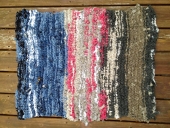
I was reading the wikipedia article on boro (Japanese piece-mending fabric, adjacent to sashiko stitchery) and found at the bottom a paragraph about sakiori woven fabric:
Boro_(textile)#Saki-ori
Saki-ori was historically woven from old kimono cut into strips roughly 1 centimetre (0.39 in), with one obi requiring roughly three old kimono to make. Historically, garments, such as vests, might be made from saki-ori. Traditionally an article of thrift, sakiori obi are now quite expensive informal garments.
So I went looking for more info. these were interesting:
-
https://www.odamaki-sakiori.com/sakiori/index.html
-
https://westernsakiori.com/what-is-western-sakiori-part-1/
It's presented as if strip-weaving used kimono silk with cotton warp is the historical practice and still happens today. But other sources imply at least that cotton rag-stock was woven into new fabric the same way.
So I wondered if Permies had anything to say about it. There's a little -- seems like Raven is or was at least enchanted by it, and mentions it several times with a few other people doing the same. They're mostly passing references, but this thread was worth sharing:
https://permies.com/t/33929/japanese-textiles#442846
But there was no thread dedicated to that technique, so now there is!
Has anyone done this?
I wonder how using non-kimono as the stock would work. If I was using old denim, would I need it cut it much smaller than 1cm? Maybe that's more a matter of the loom. What is the crudest loom I could work with? What about using a big, bulky pin-loom and not having cotton cord as the warp -- just using the fabric for both warp and weft? I think there are pin(ish) looms scaled for rag-rugs, so that's along the same lines.
If you don't already know all about it, what does this make you wonder?
From one of the above sources:









 3