|
.png)
|

|

|
.png)
|

|
|
|
|
|
|
|
|

|

|

|

|

|
 1
1


hi Mike, lots of great advice so far and I've really liked reading it all. If it has anything to do with diesels and energy generation or cogeneration be it diesel, mixes or veggie oil new or used you really must take a look at the micro cogen site. It's mostly dormant now as the drop in solar panel pricing killed off a lot of that part of the alternative energy world but the back catalogue is awesome. I have gleamed countless tips from it. I used to participate a bit in the woodgas and charcoal gasification pages there.Mike Haasl wrote:Hello friends, the google searches have once again left me high and dry. Nothing but crappy articles about something not-quite-related to my search or ads for something similar but clearly not what I want. So I turn again to the best resource on the planet. Permies.com
Background: This past summer at the PTJ I was discussing options to ditch the grid power at my place. I'm aiming to disconnect from the grid fully. The sun is too low in the sky in winter along with the number of trees on my property to make solar possible. The miles of trees around me make wind generation dicey. No running water either. A wonderful gentleman (Jim Juczac) suggested running a generator on veggie oil or biodiesel for all my power. I recently found a free source of 30 gallons a week of used fryer oil. Suddenly this becomes a possibility. I'm going to seek out a few other sources as back-ups before I spend any money on this.
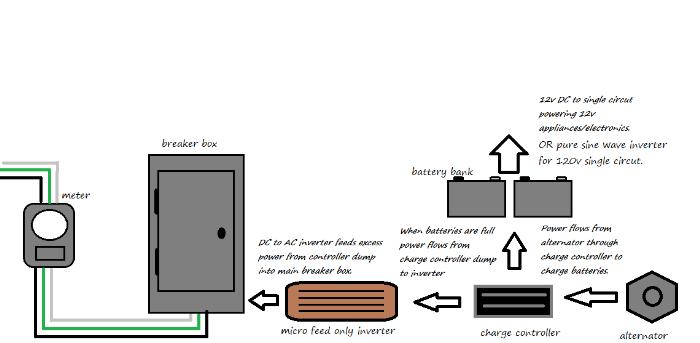
Plan: So my hope is to get a generator that can run on straight filtered waste veggie oil. Have it hooked up to a battery bank in the house. Size the batteries to hold a day's worth of usage. Have the generator come on at 4am every day and run until the batteries are full.
According to some math, I think I need around 18 KWH of juice per day. So a generator in the 6-12 KW range should be a good size. That would use about 1.5 gallons of oil a day. Now for the questions:
Q #1: I found one generator that is designed to run on veggie oil without any tinkering: Organic Mechanic 12KW. That would be awesome but it's kinda pricey. Are there other veggie oil generators out there that I could be considering? I found another one in Germany but I haven't heard back on if they distribute in the US (Heipro)
Q#2: I've seen that you can make "pseudo-biodiesel" by mixing WVO and diesel (50/50), WVO and gasoline (80/20), WVO and kerosene (70/30) or WVO and pure gum turpentine (80/20). That seems a lot better than the official way of adding methanol and lye and getting a 10% waste product of glycerin. Has anyone run one of those mixes in a generator for lengthy periods of time with (or without) success?
Q#3: I could find a cheaper, good, old diesel generator and try to work with it but I'm quite worried about the controls to make it "automatic". I don't want to be starting and stopping it myself every time. Is this easier than I'm thinking? Could I cobble together a nice low rpm generator into a system that will work reliably for me? Keeping in mind that I'm apparently not great at electrical controls. Even the word "relay" worries me...
Q#4: Assuming I get this generator and it runs well, is it easy to tell it to come on in the wee hours of the morning every day?
Q#5: The place where I'd put it is a long way from the house (~300') with an empty conduit between the two (yay). But there is a sub panel near the location (only 20' away) with a 95+ amp supply. But it's not warm there (gets down to 10F once a year). So I assume the batteries need to be in the house. How do I connect the batteries to the generator? Do I need a big ass feeder wire running from the generator all the way to the house batteries and then onto my personal house grid? Or can the generator somehow put juice onto the grid out at that subpanel and then the batteries in the house collect it?
Q#6: I assume there would be a charge controller and inverter somewhere in this chain of hardware. Both of them in the house by the batteries? Would the charge controller be able to tell the generator to come on at 4am?
Q#7: I was assuming I'd want lithium iron phosphate batteries since they'd be in the basement. Since I only need a day's worth of juice it might be a small battery pack (yay). Are those assumptions decent?
Q#8: If the brains of the operation (charge controller, not me) is in the basement, I'm assuming I'd need to run a control wire out to the generator. I only have the one conduit so if I need power and controls running between the house and the generator, I assume I'd have to run that control wire separately in a new trench. Is that right?
Thanks so much for any guidance I can get on this little pipe dream of mine!
Luckily they just have it sitting out back and when their barrels get full, they call someone to haul it away. So they said I can take what I want and it will just delay how often they have to call the hauler.Mike Kenzie wrote:
Mike Haasl wrote:I recently found a free source of 30 gallons a week of used fryer oil. Suddenly this becomes a possibility. I'm going to seek out a few other sources as back-ups before I spend any money on this.
30 gallons of week of used fryer oil is a lot of oil. Be sure that you can commit to collecting, transporting, storing, filtering, de-watering that much oil first. This all takes a significant amount of time, energy, and effort. I would recommend starting with small quantities at first, hone your practices, then build up to that amount.
I make a Maple Syrup instructional movie! Check it out HERE
SKIP books, get 'em while they're hot!!! Skills to Inherit Property
See me in a movie building a massive wood staircase:Low Tech Lab Movie


I make a Maple Syrup instructional movie! Check it out HERE
SKIP books, get 'em while they're hot!!! Skills to Inherit Property
See me in a movie building a massive wood staircase:Low Tech Lab Movie
5
I make a Maple Syrup instructional movie! Check it out HERE
SKIP books, get 'em while they're hot!!! Skills to Inherit Property
See me in a movie building a massive wood staircase:Low Tech Lab Movie
4
5
Mike, when I went down that rabbit hole I came to the conclusion unless you were gifted with large volumes of waste oil it was not worth it. The listers are technically illegal to import, really expensive, and in continuous need of fiddling. If I was doing it I'd filter better and use a modern rig. The difficulties and cost of waste oil led me to the charcoal gasification world but even then the cost of solar panels and drop in price of lithium storage made all of it seem like a fun hobby but not worth the time. Maybe I got too busy, hard to say. If you want to dive in check out Drive on wood They are primarily a wood gasification site but a lot of them do used veg oil, charcoal gasification, stirlings, steam, you name it.Mike Haasl wrote:I hear fossil fuels are getting harder to come by so I figured I'd bump this thread :)
I haven't made any progress but my thoughts have evolved a bit...
If I were to do it today, I'm thinking I'd go with a Lister, put it out in the greenhouse in a sound enclosure. It's heat will help heat the greenhouse. Maybe I could do something with the exhaust heat too. Per at least one video I watched, the Lister could run 24/7/365 and idle when not needed. This would keep the WVO warm and it's so efficient it wouldn't waste much oil. This would also mean I could skip the battery bank :) I would probably want some batteries to give a buffer and handle surge loads but they could be in the warmth near the Lister as well. All of this would go on my personal grid at the 95amp sub panel in the greenhouse. So the cost would just be the Lister, a tiny battery bank and the controller and inverter.
Brilliant? Dumb?
I also have an electrician friend who bought a Lister to use as a back up generator so I may have a local experiment to lean upon. And an electrician to help...
4
Daniel Andy wrote:Mike i have a fuel agnostic generator system that ive been following the development of lately. Could be useful for your needs. Ill try to post an overview in this forum in the coming days. Its not been built to scale yet so could be just a curiosity but has potential to be more.
4
Jackie Lei wrote:From what I’ve seen, veggie oil generators can work, but they usually end up being a bit more hands-on than expected, especially with cold starts, fuel switching, and keeping the oil clean. It’s doable, just not as “set and forget” as people hope.
I make a Maple Syrup instructional movie! Check it out HERE
SKIP books, get 'em while they're hot!!! Skills to Inherit Property
See me in a movie building a massive wood staircase:Low Tech Lab Movie
4
Daniel Andy wrote:Mike i have a fuel agnostic generator system that ive been following the development of lately. Could be useful for your needs. Ill try to post an overview in this forum in the coming days. Its not been built to scale yet so could be just a curiosity but has potential to be more.
I make a Maple Syrup instructional movie! Check it out HERE
SKIP books, get 'em while they're hot!!! Skills to Inherit Property
See me in a movie building a massive wood staircase:Low Tech Lab Movie
6
Mike Haasl wrote:
Daniel Andy wrote:Mike i have a fuel agnostic generator system that ive been following the development of lately. Could be useful for your needs. Ill try to post an overview in this forum in the coming days. Its not been built to scale yet so could be just a curiosity but has potential to be more.
I love the Stirling idea. After watching those videos, I can't really tell where the power is coming from or how it's turned into electricity. I'm kinda surprised no one's come up with a homestead scale Stirling for us to all buy.
4
Mike Haasl wrote:
Jim Webb wrote:Batteries: I'd avoid lithium batteries, not least because of fire risks.
Jim, this is a bit surprising to me. I know phones or small batteries sometimes burst into flames but I thought the bigger packs, especially ones that aren't DIY, were safe. I mean there are two in my wife's prius..
!
![[Thumbnail for water_needed_for_car_fire.jpg]](/t/175392/a/287694/water_needed_for_car_fire.jpg "Filename: water_needed_for_car_fire.jpg
Description:")

|
look out! This tiny ad has a whip!
Permaculture Voices 1, 2 and 3 - all 117 hours of video!
https://permies.com/t/voices123
|