I follow the same cooking method for favas as for other beans. Soak overnight (or more) in water. Change the water about every 4-8 hours. Bring to boiling. Cook about as long as others bean.
As an annual, galinsoga quadriradiata lives a fragile early life. It pulls or rakes out with almost no effort immediately after germination. Shallow disturbance at the right moment—nothing intense, just a light pass with a rake or hoe a day or two after the first sprout—breaks most of the seedlings. With minimal soil disruption, the deeper seeds tend to stay asleep, and the surface seed bank gradually declines.
Timing feels like the real magic with annual weeds. Many of them germinate in one big flush when warmth, moisture, and day length align. If I wait to plant my vegetables until that first flush appears and I sweep it away, the follow-up flushes seem tiny in comparison. The crops rise with much less competition, and I spend far less time fighting nature. Planting much earlier than the annual weeds germinate can shade them out.
I prefer to avoid the heavy work of solarizing or smothering unless I want to reset a bed entirely. Often, simple shallow passes—done early—shift the whole dynamic. Galinsoga grows fast, yes, but it also surrenders easily when dealt with as tiny plants.
Wishing you more joy and less struggle in the garden.
To separate clay from soil, fill a bucket with the soil and add enough water to cover it well. Stir vigorously until the mixture feels fully suspended. Let it rest for a moment or two so rocks and coarse sand settle to the bottom.
Pour off the cloudy slurry at the top into a second container. Allow this slurry to sit for a day or two. As the fine particles settle, gently pour off the clearer water at the top.
Most of the floating organic matter leaves during this step, leaving a dense layer of clay at the bottom.
The attached soil test shows the separation between sand, silt, and clay for one of my gardens. Silt also offers a wonderful base for making seed balls.
Last week, I thought a lot about this topic in regards to content for my upcoming book. Here's a summary.
My Approach to Taming Weedy Grasses by natural means.
I’ve worked with smooth brome and other rhizomatous grasses for years. They can feel overwhelming, but I’ve learned that the easiest solutions tend to come from shifting the ecology, not attacking the grass itself.
Here are the main strategies that helped me turn dense grass patches into diverse, cooperative plant communities—without bought inputs and without back-breaking labor.
You don’t need to kill the grass. You just need to remove its advantage.
Rhizomatous grasses overpower gardens because they love:
full sun
bacterial-dominant soil
constant disturbance
thin litter
bare edges
early spring warmth
If we gently reverse those conditions, the grasses simply lose dominance and other plants step in.
Add logs on-contour (or just laying calmly on the soil)
This is the simplest game-changer I’ve ever found.
A single log creates:
shade at the soil line
fungal habitat
moisture retention
a small duff-catching terrace
a cool root zone that grasses dislike
A whole row of logs—especially under fruit or perennial plantings—acts as a fungal corridor. Grasses relax; forbs and shrubs move in.
You don’t need a pattern. Just place the wood where it feels stable.
Leaf piles as powerful allies
A thick pile of leaves (6–12 inches) in a grassy patch will:
smother the crowns a bit
keep the soil cool and moist
invite fungi
slow the spring green-up of the grass
make planting easier next year
This works even better near shade or fruit trees. If you’ve got autumn leaves—use them where the grass bugs you most.
Plant big-leaf, early-spring perennials
Grasses make their move early. If you plant species that shade the soil in April and May, the grass loses its first-mover advantage.
My favorites:
rhubarb (spectacular competitor once established)
asparagus (surprisingly grass-tolerant)
mullein
oriental poppies
asters
flax (Linum lewisii)
Anything that throws early shade helps.
Radishes and turnips punch right through turf
In cool seasons, I scatter handfuls of old radish or turnip seed.
They:
drill holes through sod
shade the soil
make planting pockets
shift the soil food web
distract flea beetles from tender crops
They’re cheap, fast, and easy.
If you’re dealing with a really aggressive patch: scalp a strip
Sometimes I scalp a 1–2 foot strip of sod and plant a parasite/companion guild:
Logs invite fungi.
Leaves keep moisture and cool roots.
Shade disrupts spring vigor.
Everything else follows.
You don’t need perfect plans. Just gentle, continuous gestures.
I carry logs, leaf piles, and plant starts when the mood strikes. Over time, these slow, soft interventions have turned monoculture grass into a lively polyculture.
You can start with one log, one leaf pile, one rhubarb crown. The system will build itself around your small actions.
In my ecosystem, clay shows up all over. In some cases, the local clays reach hundreds of feet deep. Additional clay gets deposited during every summer thunderstorm. Even my garden soil would make suitable seed balls. Even more suitable if I dig down 8" to get below most of the organic matter.
I test for suitability by making a grape sized square from dampened proposed soil. If it drys hard and sticks together when dropped or thrown then I figure it will work great as a seed ball.
If you’re a regular user and you feel your browser or app is being over-zealous: check whether the block is due to “potentially unwanted program” (PUP) or riskware. There are logs; you can whitelist/exclude if you’re confident it’s safe.
Keep your software up to date — many false positives are introduced during newer “machine learning/heuristic” signature updates and then roll-back after user reports.
My apricots flower at different times, with about a 2 week difference between the first and the last. Just the thing to delay complete frost damage due to frost. In a future generation, I intend to select for later flowering times.
The same diversity shows up in harvest with a 4 week difference in harvest time between the earliest and the latest.
Thanks for the grow report Christopher. May the winter select the hardiest for you.
i love uploading photos from the singles section into something like Google Image Search. Interesting to observe so many fake photos in the singles section...
My sunroots produce seeds every year. (They require an unrelated pollinator, and I grow lots of different varieties.) Some years they yield more prolifically than others. The goldfinches act erratically from year to year. Some years they pounce on the seed heads early and consume them voraciously. Other years they mostly ignore the seeds. And the weather makes a difference.
This year, I pruned the sunroots when they reached chest high. That encouraged them to send out lots of side shoots, which made lots of seeds. Next year, I may aim for pruning them at belly height. This year they still grew over 7 feet tall, even with pruning.
I dug sunroots today. I'm offering to ship them within usa, same conditions as last time. This population sets seed prolifically. They represent the best 15% during three generations of my breeding project, pooled together into a common population.
Joseph Lofthouse wrote:I dug sunroot tubers, I'm making them available for purchase by permies members. Some of the tubers are huge, so I'll be chopping them up into smaller pieces so that I can fit about 10 different varieties into a small flat-rate USPS box. They are unnamed varieties that are the first or second generation of offspring from my breeding project. They are clones that have pleased me a lot. Back when I was keeping track, they got names like Wow!, WTF?, HF!, etc...
Send me a personal message or email if you need my mailing address, or grab it from the image on the bottom of my web site.
Shipping to usa only.
$30 PayPal, Venmo.
Also accepting cash or 1 ounce silver to my po box.
Please send shipping address by email, and notes about connecting you with the payment, since the payment processors don't always share contact information with me.
You may also request sunroot seeds, rich in diversity—some may have crossed with wild Kansas stock. I’ll send whole seed heads in a paper bag for you to finish drying and threshing yourself.
As a bonus, you can receive my radish–tomato-turnip mix—a joyful blend of the Going to Seed radish grex and direct-seeded tomatoes descended from the Profoundly Promiscuous & Totally Tasty Tomatoes project. The seeds come pre-mixed to encourage sowing them together (about 2 weeks before average last frost). The brassicas nurse the young tomatoes, protect from insects, frost, and weeds, and help the tomatoes adapt in your garden.
Mariya Bee wrote:Ah where were they located approximately?
Everywhere.
In my personal travels—California, Missouri, Utah, Arizona, New Mexico, Oregon, Croatia, France, England, Scotland. And I meet off-internet people from lots of other places when I attend seed conferences.
I grow beans sprawling on the ground. The semi-sprawling varieties grow best for me. They sprawl over whatever else grows in the field with them. Bush beans get overpowered by weeds. Vining beans prefer their poles. Peas and grains grow great together.
I used to grow fall-bearing raspberries. After the fall frosts, I would mow the canes. Then I would till the patch, which really knocked back the grass. Maintained it for a decade by that means.
Once you add wood chips to a piece of ground, I recommend against tilling them into the soil. They sap soil fertility.
When I visited France, a family served me chestnuts at a small gathering of farmers. I think they boiled them, in the shell, then we sat at the table, peeled them, and ate them one by one. It slowed the meal remarkably. Gave time for beautiful conversation.
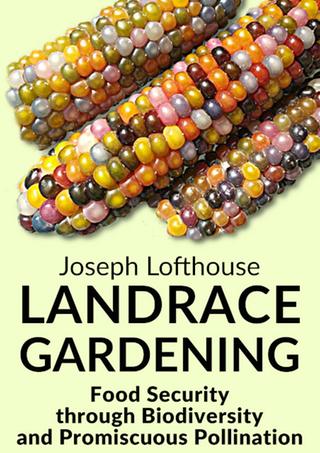
Joseph Lofthouse taught landrace gardening at conferences hosted by the Rocky Mountain Seed Alliance, National Heirloom Expo, Organic Seed Alliance, Northeast Organic Farming Association (NOFA-NY), and Utah Farm & Food Conference. He serves as World Tomato Society ambassador.
“Landrace Gardening is brilliant. It’s a love story! And 2 parts gardening handbook. There are so many revelations I don’t know where to begin? AMAZING. In every way this is a book for the ages. Bravo Joseph.” Dan Barber, Blue Hill At Stone Barns, and Row 7 Seed Company
“There is magic in the way Joseph Lofthouse marries his no-stress approach to gardening with such deep love and passion. This book is as much a gardening manual as it is a reframing of our relationship with each other and the world. Landrace Gardening gives us a roadmap to the kind of joyful food security that we need for healing many of the most important wounds of our time.” Jason Padvorac
“Joseph Lofthouse has a focus upon something that all gardeners should know: Landrace varieties are the way to sustainability. The best part is that everything in his book is adaptable for any gardener. No high level knowledge of botany or chemistry is required. The versatility and diversity of growing landrace plants speaks for themselves.” Jere Gettle— Baker Creek Heirloom Seed Company.
“The western sustainable agriculture movement has long needed its own version of the 'One Straw Revolution'. Joseph Lofthouse provides just that. With revolutionary gusto based on heretical thought and age old human gnosis. In Landrace Gardening, Food Security... Lofthouse steps firmly into the role of Iconoclast and elder seed shaman.” Alan Bishop, Alchemist at Spirits Of French Lick
“Awesome to see this process beginning to work in just one year.” Josh Jamison, HEART Village
“Joseph's book is an eye-opener to a novice seed saver like myself. My growing conditions are not as extreme as Joseph's, but we do have a very short growing season. He has inspired me to start trying to produce my own landrace crops.” Megan Palmer
“Inspiring. Empowering. VERY important work.” Stephanie Genus
“Octavia E. Butler's Earthseed, John Twelve Hawks' Traveler Series, and Orson Scott-Card's Ender Quintet have delivered us to Joseph's fertile gateway. Not a gateway "drug", but yes a door of perception. In this book, Joseph removes from our lexicon Instant, Lite, Diet, Recommended Daily Allowance, Modern, Heirloom, Open Pollinated, Hybrid with just one shattering word: Promiscuous. Under the same condition he was once gifted a guitar, Joseph offers us Abundance for as long as we keep learning to play within it.” Heron Breen, Fedco Seeds
I hope that by making it free for a few days, that you might download it, and/or make a review, and/or love it so much that you buy a paperback later on.
Edit to add: These all went to good homes. Thanks.
-------
I offer 50 seeds from my apricot breeding project. I share them freely, since I don’t sell my children. I ask $50 to honor my labor and cover postage. Available for shipping within the USA.
These seeds come from the two trees I treasure most. Both bear generously and stand strong through my winters. One produces golden fruit as sweet as sunlight, the other deep orange with that classic apricot tang. Both give large, satisfying fruits. Seeds collected and dried immediately from the fresh fruits.
The two trees grow side by side and likely pollinated each other. Some seeds may also carry pollen from a few of my other best performers. The weaker trees had already dropped out before these came into bloom.
Planting suggestions:
Fall: sow outdoors under two inches of weed-free mulch or compost. (Recommended)
Stratification: store in damp media in the fridge until roots appear, then plant.
Direct planting: works well with intact seeds; if cracking, use a c-clamp.
Protection: where rodents abound, guard seeds with netting or hardware cloth.
Contact me by Purple Moosage for payment and shipping details.
I hope these seeds bring you the same delight they bring me.
That type of mega-huge cataclysm seems too big to survive, therefore I don't prepare for it, and don't know of anyone that does. Same way that I don't prepare for a mega-astroid strike, or the sun going super-nova.
Tons of intentional communities prepare for normal disturbances like winter snow, civil-unrest, flood, hurricane, earthquake, drought, etc...
Yes, the seeds fall right through my screen, but the screen holds the seeds in place, so that the shoe can abrade the hull.
I really like planting grains in rows, just wide enough apart that I can weed them easily with my wheel hoe. For self-seeding rye, I run a cultivator through the field to make rows 30" apart and about 4" wide.
I recommend growing a different variety of wheat for next year.
If you really want to grow wheat with tightly adhering hulls, you might try more vigorous threshing methods. One time, I dumped wheat kernels onto a 1/2" screen, sitting on a table top. Then used a rubber-soled shoe to thresh. This avoided damaging the kernels, but got aggressive enough to remove the husks.
I have about 90 frost free days per year. The beans experience blazing hot sunny days. Chilly radiant cooled nights. Super low humidity. We might have a thunderstorm once or twice a summer. Otherwise, no rain falls, and I irrigate regularly during the growing season.
I likewise select for the semi-vining trait. Perhaps more accurately, the beans self-select for the semi-vining trait, because they out-compete the weeds better.
These all descended from one seed. This represents the entire harvest of the F2 generation, grown in 2019. Many of these varieties still grow in my landrace.