• Post Reply Bookmark Topic Watch Topic
  • New Topic
permaculture forums growies critters building homesteading energy monies kitchen purity ungarbage community wilderness fiber arts art permaculture artisans regional education skip experiences global resources cider press projects digital market permies.com pie forums private forums all forums
this forum made possible by our volunteer staff, including ...
master stewards:
  • Carla Burke
  • John F Dean
  • r ransom
  • Nancy Reading
  • Timothy Norton
  • Jay Angler
stewards:
  • paul wheaton
  • Pearl Sutton
  • Eric Hanson
master gardeners:
  • Christopher Weeks
  • M Ljin
gardeners:
  • thomas rubino
  • Megan Palmer
  • Benjamin Dinkel

Discovery of a Plant That Attracts Ants and Protects Legumes from Beetle Attacks

 
Posts: 231
12
  • Likes 10
  • Mark post as helpful
  • send pies
    Number of slices to send:
    Optional 'thank-you' note:
  • Quote
  • Report post to moderator

During my observations in the rainforest, I discovered a plant that forms a fascinating association with ants. The leaves of this plant secrete a substance that attracts ants and other insects, which feed on it. In return, the ants protect the plant and the species growing on it by attacking pests that try to damage them.
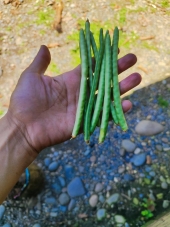
What’s interesting is that a wild legume (Vigna unguiculata) was growing using this ant-associated plant as a support. While other nearby legumes were being attacked by “lady beetles” (vaquitas), the one climbing on this plant showed no visible damage.
This led me to think that the association between the ant-attracting plant and the legume creates a protective relationship, where the ants act as a natural defense against the beetles.
Based on this, I’m experimenting with using this plant as a living support or companion species for other legumes that are more vulnerable to beetle attacks, in order to replicate this ecological defense.
I’d like to ask the community:
Have you seen other examples of similar associations where a plant that attracts ants or protective insects helps defend crops or wild species?
Have you observed cases where plant secretions create this kind of mutualistic alliance in agroforestry systems or food forests?


Cheers

 
pollinator
Posts: 280
Location: Salado, Texas
69
hugelkultur forest garden fungi foraging medical herbs ungarbage
  • Likes 2
  • Mark post as helpful
  • send pies
    Number of slices to send:
    Optional 'thank-you' note:
  • Quote
  • Report post to moderator
My ants attack my okra, after 3 years finally they are saving some for me.  I've also witnessed the ant/aphid thing ...not a fan of that relationship yet either.   Hopefully the insect populations will soon find harmony with my plants as the overall fertility and biodiversity improve.   I will report back when there is better news!
 
steward and tree herder
Posts: 11864
Location: Isle of Skye, Scotland. Nearly 70 inches rain a year
5988
5
transportation dog forest garden foraging trees books food preservation woodworking wood heat rocket stoves ungarbage
  • Likes 2
  • Mark post as helpful
  • send pies
    Number of slices to send:
    Optional 'thank-you' note:
  • Quote
  • Report post to moderator
Interesting observation Ronaldo - I'll have to keep an eye out. I have noticed that elder appear to have extrafloral nectaries on their leaves as do my fava beans.
 
Ronaldo Montoya
Posts: 231
12
  • Likes 3
  • Mark post as helpful
  • send pies
    Number of slices to send:
    Optional 'thank-you' note:
  • Quote
  • Report post to moderator
Another thing i discovered Is that plant the segregate this attracting ants stuff has very superficial roots and it's possible to take the trees down just pushing. And The trees still lives. So this is helpful to create shades in particular places, i mean to adapt shades and this can be useful for example for cucurbits that cannot recibe hard sun directly.
 
This tiny ad is made of adobe
Learn Permaculture through a little hard work
https://wheaton-labs.com/bootcamp
reply
    Bookmark Topic Watch Topic
  • New Topic