posted 5 months ago
Hi all, for the first 48 years of my life, I have lived with a traditional wood-burning stove.
All of them were metal box stoves of different makes.
When getting firewood for these stoves, I looked for the tallest, largest-diameter trees I could find, predominantly Douglas Fir and Western Tamarack (Larch).
In my teen years, we could still find old-growth larch. no bark, no branches, all grey colored, known as Buckskin larch. Usually 2-3' in diameter, easily over 100' tall, with up to two full cords per tree!
Solid dense wood, that was the best of the best! When splitting these rounds, each chunk was split only enough to fit through the wood stove door; the bigger, the better. As with all box stoves, they were run partially shut down, virtually day and night, from September to May. Clouds of noxious smoke and vast amounts of wood are needed.
We also always have had a wood cook stove in the kitchen; its wood needed to be split all the way down to 2-3" chunks to facilitate easy starting and hot burning.
These cook stoves are generally run wide open and require smaller pieces of wood. (not to mention the tiny size of the firebox.)
Wood for the cook stove was split "as needed." No one wanted to pre-split wood that far, until they had to...
Then, in 2013, I built our first J-Tube in Liz's art studio (the Studio dragon). An awesome, incredible stove design that was run wide open at all times.
The wood, of course, needed to be split down to 2-3" to allow the Dragon to roar. Yes, with an 8" J-Tube I could fit a 5-6" round in the feed tube, but the fire performance suffered, and barrel top temps dropped several hundred degrees.
Switch back to the smaller wood, and the Dragon roared
We have two different wood sheds, one is strictly for Liz's art studio. It holds apx 5 cords of wood. All the wood for it is split down to "cook stove" size.
Our other wood shed is much larger, holding 8-10 cords. Its wood is for our house, my shop, and the Walker Black and white oven in our outdoor kitchen (AKA The Smoke Shack)
Until 2024, that wood was left as large as possible because our home still had the original box stove.
My shop stove is a 7" Batchbox; the larger chunks intended for the house needed to be split smaller.
Batchboxes do have a large door, and you can toss larger pieces in than the old J-Tubes could take.
But I quickly noticed that output temps fell if I used larger wood.
In 2024, in my 100-year-old log cabin, Gerry and I built the first Shorty Core Batchbox in the USA.
With her huge viewing window, you can sit and look down the throat of the dragon (an awe-inspiring sight!)
It was glaringly obvious that you wanted only cookstove-sized wood to produce the most heat.
Unlike a box stove, which you never ever load with small wood and run wide open!
Unless you prefer a glowing red stove and chimney pipes with all your heat racing up and out of the chimney.
Having somehow survived, I have now reached the Gilded years (always heard them called the golden years... They lied!)
I no longer go up in the woods to cut firewood. Now I have a long load of logs delivered directly to my field.
12-15 cords per load. My logger offers me a choice: I can get large wood, or I can get the tops.
They smile when I always ask for the little wood, since most folks still believe their $ 3,000 Blaze King stove is the best, but it needs the larger wood so they can run it shut down...
Needless to say, I get a better price on my load than the other guy.
Yes, even with tops, it takes longer to split down for use as Dragon chow.
But when the house's wood consumption drops from 3-plus cords to perhaps 1.5 cords, you do not have nearly as much time involved.
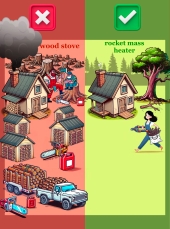
The Bottom line with RMHs: bigger is definitely not better; smaller wood burns hotter and more efficiently.
For all your Montana Masonry Heater parts (also known as) Rocket Mass heater parts.
Visit me at
dragontechrmh.com Once you go brick you will never go back!






 18
18


![[Thumbnail for Screenshot_20260403_085003_Photos.jpg]](/t/370671/a/286845/Screenshot_20260403_085003_Photos.jpg "Filename: Screenshot_20260403_085003_Photos.jpg
Description:")