
• Post Reply Bookmark Topic Watch Topic
  • New Topic
permaculture forums growies critters building homesteading energy monies kitchen purity ungarbage community wilderness fiber arts art permaculture artisans regional education skip experiences global resources cider press projects digital market permies.com pie forums private forums all forums
this forum made possible by our volunteer staff, including ...
master stewards:
  • Carla Burke
  • Anne Miller
  • Nancy Reading
  • John F Dean
  • r ransom
  • paul wheaton
  • Timothy Norton
stewards:
  • Jay Angler
  • Pearl Sutton
  • Andrés Bernal
master gardeners:
  • Christopher Weeks
gardeners:
  • M Ljin
  • Thekla McDaniels
  • May Lotito

Composting in the UAE's hot climate - any tips for a beginner?

 
Posts: 23
1
  • Likes 2
  • Mark post as helpful
  • send pies
    Number of slices to send:
    Optional 'thank-you' note:
  • Quote
  • Report post to moderator
Hi everyone!

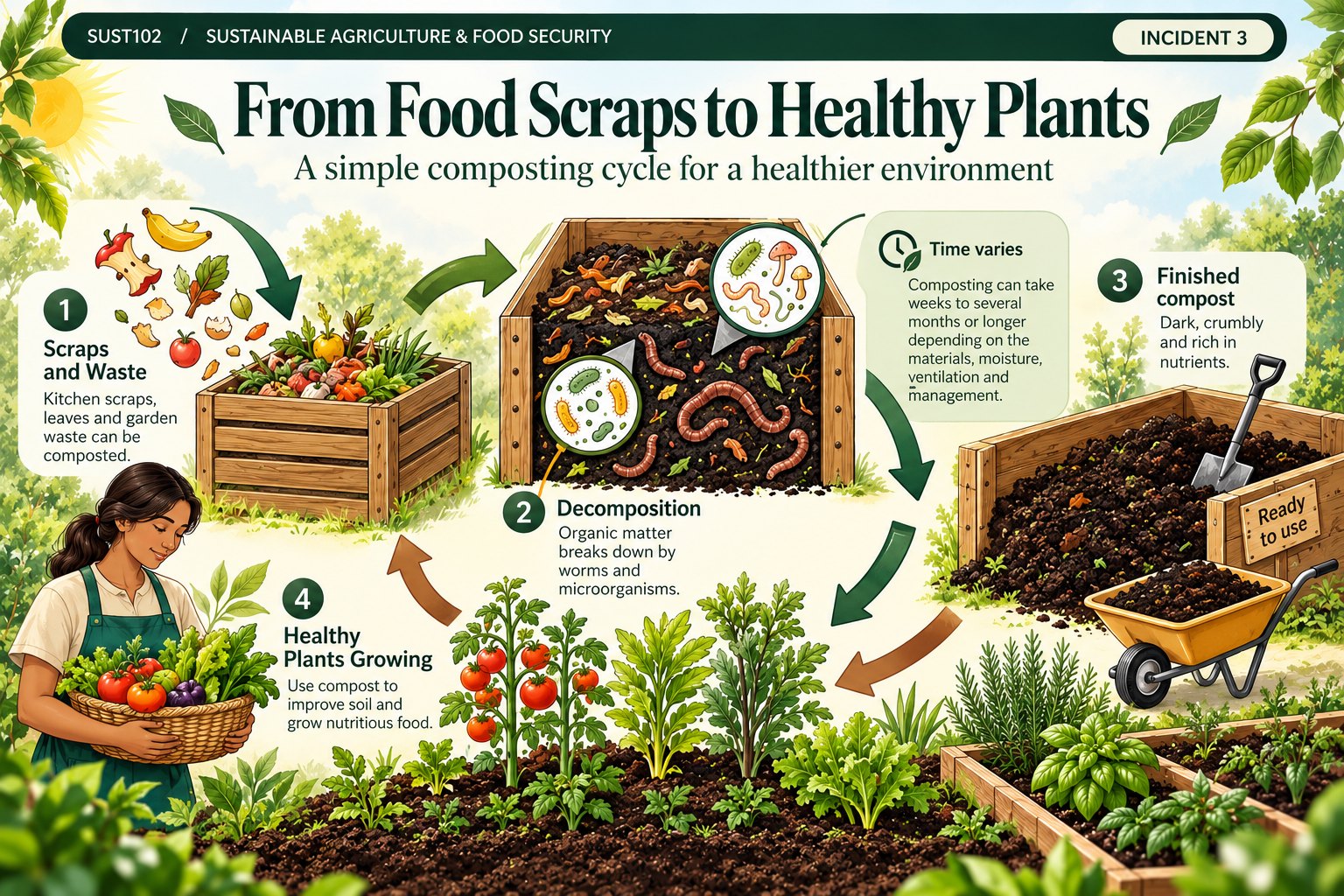
I'm a university student in the UAE studying Sustainable Agriculture and Food Security. I made this AI-assisted infographic about composting but I haven't tried it myself yet.

Since the weather here is extremely hot and dry, I'd love to hear from people who have experience with composting.

I have a few questions:

1. How do you keep compost from drying out in very hot weather?
2. What's the best way to prevent bad smells and insects?
3. Is there anything you'd change or add to my infographic?

I'd really appreciate any advice especially from people who have tried composting in hot climates.

Thanks so much for your help!
From-Food-Scraps-to-Healthy-Plants-2.png
food scraps to compost
 
author & steward
Posts: 7615
Location: Cache Valley, zone 4b, Irrigated, 9" rain in badlands.
3918
  • Likes 4
  • Mark post as helpful
  • send pies
    Number of slices to send:
    Optional 'thank-you' note:
  • Quote
  • Report post to moderator
Incident 3?

In general, active compost heaps create temperatures too hot for worms. Though tossing scraps randomly into the garden could support worms.

In my desert climate, compost tends to stay way too wet for my liking. I dislike it a lot for the creepiness of nasty textures and smells. I feel like I'm risking sickness and disease by touching it, or even being near it.

For these reasons, I don't make active compost piles in my garden. I just scatter organic matter around the garden and let it get incorporated without me providing infrastructure nor labor.

I also like digging holes in the garden, and throw organic matter into them for a day or a week, and then cover it with soil and move to a new location. These don't get any care after I cover them. I particularly like putting bones and animal carcasses in these holes, things people don't normally add to compost piles.

 
pollinator
Posts: 596
Location: UK
197
kids urban seed
  • Likes 4
  • Mark post as helpful
  • send pies
    Number of slices to send:
    Optional 'thank-you' note:
  • Quote
  • Report post to moderator
Honestly I'd second what Joseph says about not building a proper pile out there. A heap in full sun in the UAE would bake dry in a day. Burying scraps in a trench under mulch or a bit of shade sounds a lot less hassle for a beginner, and the smell and flies mostly sort themselves out if it's covered.
 
out to pasture
Posts: 13540
Location: Portugal
4833
goat dog duck forest garden foraging wofati composting toilet bee solar rocket stoves greening the desert
  • Likes 5
  • Mark post as helpful
  • send pies
    Number of slices to send:
    Optional 'thank-you' note:
  • Quote
  • Report post to moderator
I usually do 'Ruth Stout' type composting in place, tucking the food scraps under the mulch around the veggie plants. I don't keep it wet specifically, but it helps maintain the moisture level in the soil underneath and it rots down gradually without any extra work when the rains come or from the drip irrigation set up around the plants.
 
master steward
Posts: 20015
Location: USDA Zone 8a
5017
dog hunting food preservation cooking bee greening the desert
  • Likes 9
  • Mark post as helpful
  • send pies
    Number of slices to send:
    Optional 'thank-you' note:
  • Quote
  • Report post to moderator
Nice infographic though it does not look like it is for a desert climate that is one of the problems using AI.

Worms don't live in my desert as it is too dry.

I don't compost because it is too hot and dry so I give all my veggie scraps to the wildlife.

Best wishes for your composting try.

 
gardener
Posts: 1305
Location: France, Burgundy, parc naturel Morvan
697
forest garden trees food preservation medical herbs building woodworking
  • Likes 6
  • Mark post as helpful
  • send pies
    Number of slices to send:
    Optional 'thank-you' note:
  • Quote
  • Report post to moderator
Do vermicomposting on the north side of a building so the sun has less effect drying out the pile. Shade at all time. Use lots of volume so worms can dive under where it's wetter. Do not harvest too much. Maybe don't use wood and open space between wood, but get it in something a bit less likely to evaporate too much. Don't start from scratch but maybe import a cubic meter of compost from a garden center and start adding to that. In summer i like to throw freshly cut down softer stuff on top as a 'lid'. It usually tightly fits around the pile when dry.
If all this is too much or it still doesn't work, it might be a good thing to look at Geoff Lawton's greening the desert series for inspiration. I think that's in Lebanon or Syria, anyway the other side of where you are, but he does more with abovementioned pits, localized composting and feeding piles of scraps to chickens who scratch through them.
Keep us posted please, it helps get others started over there or in similar climates and we all learn the most from our 'mistakes'.
 
gardener
Posts: 818
Location: 5,000' 35.24N zone 7b Albuquerque, NM
594
hugelkultur forest garden fungi foraging trees cooking food preservation building solar greening the desert homestead
  • Likes 5
  • Mark post as helpful
  • send pies
    Number of slices to send:
    Optional 'thank-you' note:
  • Quote
  • Report post to moderator
It has been a hot dry summer here in New Mexico, USA. Despite the difficult weather, I have an ongoing compost pile that works well for my needs. It is a mound shape about 4' tall now. It is constructed in layers of 1:1 carbon rich: nitrogen rich material plus a bucket of water or compost tea. After adding about 1 - 5 gal bucket of each type of material, I cover the top of the mound with an inch or so of sandy silt OR charcoal bits if available (burning brush piles is possible for only 2 months here in winter) for an odor cap. I repeat this process about 2x weekly - all seasons - using what is available for each bucket: carbon, nitrogen, liquid. Like Anne mentioned, (and your situation in UAE), earthworms would have to be imported and supported so I don't use them. The upper interior of the pile gets very hot from microbial activity with new material plus high altitude sun. I harvest the soil (mix of sand, biochar*, and compost) from the bottom of the pile.
If bioactivity stalls, I add a bucket layer of locally sourced compost before capping to jump start the pile.
To summarize:
1. How do you keep compost from drying out in very hot weather? Cap the moistened new contents with sand &/or tiny charcoal bits (which will become biologically activated over time inside the pile and help hold moisture
2. What's the best way to prevent bad smells and insects? Same as above
3. Is there anything you'd change or add to my infographic? Replace earthworm images with magnified images of soil microbes
Good luck with your hands-in-the-soil learning Maryam!

*When the compost microbes fill (activate) the tiny charcoal bits, the combination is called biochar. Biochar helps retain moisture.
 
master pollinator
Posts: 6139
Location: Canadian Prairies - Zone 3b
1914
  • Likes 4
  • Mark post as helpful
  • send pies
    Number of slices to send:
    Optional 'thank-you' note:
  • Quote
  • Report post to moderator

Anne Miller wrote:Nice infographic though it does not look like it is for a desert climate that is one of the problems using AI.


That was my first impression as well. Are people actually growing food in UAE? I wouldn't be surprised -- humans are adaptable -- it's not like the surface of another planet. If they grow plants, they have plant waste. Do they find a way to recycle it into their growing system? Seek them out, and hear their wisdom. My 2c.
 
Maryam Green
Posts: 23
1
  • Likes 1
  • Mark post as helpful
  • send pies
    Number of slices to send:
    Optional 'thank-you' note:
  • Quote
  • Report post to moderator

Amy Gardener wrote:It has been a hot dry summer here in New Mexico, USA. Despite the difficult weather, I have an ongoing compost pile that works well for my needs. It is a mound shape about 4' tall now. It is constructed in layers of 1:1 carbon rich: nitrogen rich material plus a bucket of water or compost tea. After adding about 1 - 5 gal bucket of each type of material, I cover the top of the mound with an inch or so of sandy silt OR charcoal bits if available (burning brush piles is possible for only 2 months here in winter) for an odor cap. I repeat this process about 2x weekly - all seasons - using what is available for each bucket: carbon, nitrogen, liquid. Like Anne mentioned, (and your situation in UAE), earthworms would have to be imported and supported so I don't use them. The upper interior of the pile gets very hot from microbial activity with new material plus high altitude sun. I harvest the soil (mix of sand, biochar*, and compost) from the bottom of the pile.
If bioactivity stalls, I add a bucket layer of locally sourced compost before capping to jump start the pile.
To summarize:
1. How do you keep compost from drying out in very hot weather? Cap the moistened new contents with sand &/or tiny charcoal bits (which will become biologically activated over time inside the pile and help hold moisture
2. What's the best way to prevent bad smells and insects? Same as above
3. Is there anything you'd change or add to my infographic? Replace earthworm images with magnified images of soil microbes
Good luck with your hands-in-the-soil learning Maryam!

*When the compost microbes fill (activate) the tiny charcoal bits, the combination is called biochar. Biochar helps retain moisture.


Wow thank you for such a detailed explanation, Amy! I really appreciate the time you put into answering all my questions.

I found the part about using sand or charcoal to help retain moisture especially interesting. I hadn't come across that idea before!

Your suggestion about replacing the earthworm illustrations with soil microbes is also a really good point. I can see now how important it is to make the infographic more suitable for desert conditions.

l've learned a lot from your comment.
Thank you again for sharing your knowledge!
 
Maryam Green
Posts: 23
1
  • Likes 1
  • Mark post as helpful
  • send pies
    Number of slices to send:
    Optional 'thank-you' note:
  • Quote
  • Report post to moderator

Anne Miller wrote:Nice infographic though it does not look like it is for a desert climate that is one of the problems using AI.

Worms don't live in my desert as it is too dry.

I don't compost because it is too hot and dry so I give all my veggie scraps to the wildlife.

Best wishes for your composting try.


Thank you for pointing that out, Anne!

You're absolutely right. My infographic shows the general composting process but I hadn't fully considered how different things would be in a desert environment.

I honestly didn't think much about the earthworms when I first made it, so your comment helped me notice something important.

I'll definitely keep this in mind if I update my infographic. I really appreciate your honest feedback!
 
Maryam Green
Posts: 23
1
  • Likes 1
  • Mark post as helpful
  • send pies
    Number of slices to send:
    Optional 'thank-you' note:
  • Quote
  • Report post to moderator

Douglas Alpenstock wrote:

Anne Miller wrote:Nice infographic though it does not look like it is for a desert climate that is one of the problems using AI.


That was my first impression as well. Are people actually growing food in UAE? I wouldn't be surprised -- humans are adaptable -- it's not like the surface of another planet. If they grow plants, they have plant waste. Do they find a way to recycle it into their growing system? Seek them out, and hear their wisdom. My 2c.


Yes, we definitely grow food here in the UAE! Despite the desert climate we have local farms, greenhouses and even people growing vegetables in their home gardens.

We grow crops that can handle our hot climate, like date palms we also grow tomatoes, cucumbers and strawberries, especially during the cooler months or in greenhouses. So even though the heat makes farming challenging, agriculture is still an important part of life here.

I really liked your suggestion about learning from local farmers. I'm curious to know how they manage plant waste and whether they use composting methods that work well in our climate.

Thank you for bringing this up! It's given me another interesting direction to explore for my university project.
 
Maryam Green
Posts: 23
1
  • Likes 1
  • Mark post as helpful
  • send pies
    Number of slices to send:
    Optional 'thank-you' note:
  • Quote
  • Report post to moderator

Joao Winckler wrote:Honestly I'd second what Joseph says about not building a proper pile out there. A heap in full sun in the UAE would bake dry in a day. Burying scraps in a trench under mulch or a bit of shade sounds a lot less hassle for a beginner, and the smell and flies mostly sort themselves out if it's covered.


That actually makes a lot of sense, Joao! I can imagine how quickly a compost pile would dry out under the UAE sun.

I really like the idea of burying food scraps under mulch. It sounds much simpler and more practical for someone who's just starting out.

Thank you for the suggestion! I'II definitely look into this method.
gift
 
PIP Magazine - Issue 19: Ideas and Inspiration for a Positive Future
will be released to subscribers in: soon!
reply
    Bookmark Topic Watch Topic
  • New Topic