|
|

|

|

|

|
|
|
|
|
|
|
|

|
|

|

|

|
 7


 10
6
--
"Whitewashed Hope: A Message from 10+ Indigenous Leaders and Organizations"
https://www.culturalsurvival.org/news/whitewashed-hope-message-10-indigenous-leaders-and-organizations
3
Invasive plants are Earth's way of insisting we notice her medicines. Stephen Herrod Buhner
Everyone learns what works by learning what doesn't work. Stephen Herrod Buhner
7
John Daley Bendigo, Australia The Enemy of progress is the hope of a perfect plan
BENEFITS OF RAINFALL COLLECTION https://permies.com/t/88043/benefits-rainfall-collection
GOOD DEBT/ BAD DEBT. https://permies.com/t/179218/mortgages-good-debt-bad-debt
SOIL REHABILITATION IDEAS https://permies.com/t/392436/farmland-rehabilitation-variety-examples#4005866
8
6
3
--
"Whitewashed Hope: A Message from 10+ Indigenous Leaders and Organizations"
https://www.culturalsurvival.org/news/whitewashed-hope-message-10-indigenous-leaders-and-organizations
1
Annie Collins wrote:A couple of things that come to mind right away:
- instead of using paper towels, use cloth towels. We have a system where we have many cloth towels, and there is always one hanging on the stove handle, and somewhere else in the kitchen, so they are always readily available. They get put in the laundry once they have a not-so-fresh smell to them. When that is, depends on the amount of people using them and what foods get made in the kitchen. We have many so that it is easy to switch them out when necessary.
- instead of paper napkins, cloth napkins. It has gotten to the point that I always have a fresh one even in our car for when we are on the road.
- instead of toilet paper, cloth wipes. I found a perfect size basket to fit on our toilet tank. I made many cloth wipes, all the same size, that fit in the basket beautifully. We also have a sprayer that is attached to the toilet tank. Once the cloth is used, it gets put in a little garbage can that has a swinging lid so that it is very easy to put the used cloths into it. Whenever we do laundry, we automatically toss the cloths in the machine with the rest. We've been using this system for over 5 years now. It's been wonderful! It's also much better for the septic system.
- no plastic bottles for water. We don't use them not only for environmental reasons, but also health reasons. We always use stainless steel or glass that we bring with us when we go on longer drives or outings.
- compost instead of throwing away food scraps. It doesn't have to be complicated or fancy. Just having a dedicated pile a little away from the house is enough. Sooner or later it will turn back to earth and all that food that has turned into rich soil can then be used for outside plantings or mixed in with house plants if one doesn't have any outside planting space. If nothing else, one can always just put it under a bush or tree in a park.
- wear only natural materials so they, too, can be composted when they've truly reached the end of their life and have become completely tattered.
- cook from scratch and meal prep. It is amazing how much packaging goes into convenient, ready-made foods that only need to be heated or boiled, etc.
- And last, but certainly not least, become less of a consumer in general. Have a life with less stuff. It's also been shown to be healthy for mind, body, and soul.
2
Ac Baker wrote:I think the most important lesson I've learned is that avoiding waste takes resources:
You need to have time, energy and/or money to really minimise waste.
I know it can sound counter-intuitive.
But a lot of what goes into minimising waste it me experience is planning - which needs time - plus time & energy to sort potential waste into usable parts - or, if you're short of time & energy, the money to pay for equipment and other people to help with the planning and sorting.
For example, having time & energy to plan and prepare meals, and having the money to pay for good kitchen facilities including refrigerator & freezer, or pay a cook (!) can avoid a lot of food waste!
1
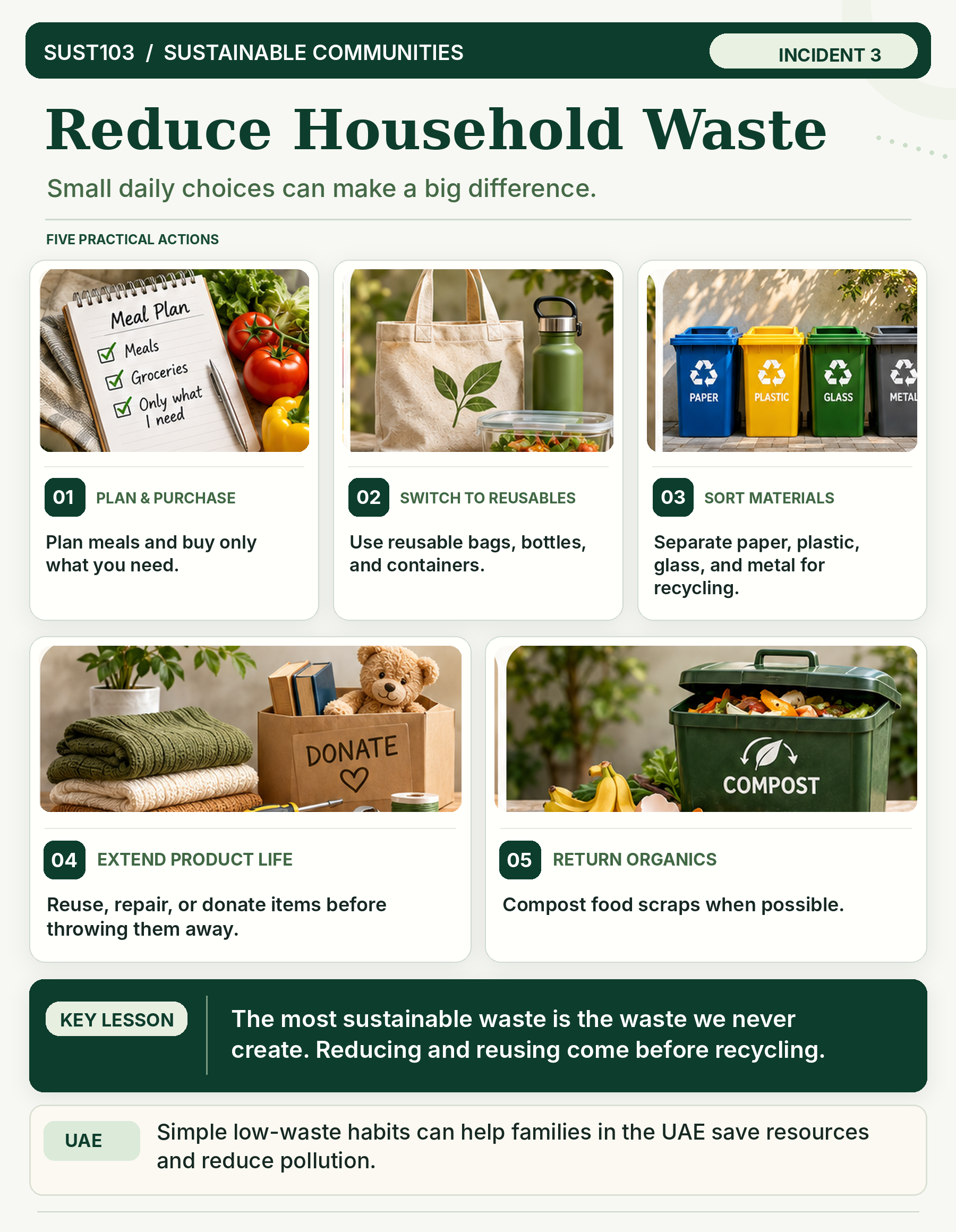
Anne Miller wrote:Your infographic looks concise.
I like the part about never creating waste. What would your advice be on how to do this?
1
Cristobal Cristo wrote:I think that food packaging creates bulk of the waste, because we eat for entire life.
In hot place that I live I need to drink - a lot. If I drank ready made beverages I would create literally tons of waste. I prepare teas, fruit compotes in a large 8 l pot daily.
Purchasing meats generates nasty supply of styrofoam trays and meat "diapers". If I do not have meat from my own animal, I'm trying to always purchase various cuts at the deli, that are packed into plastic bags instead of horrid trays. In my childhood, meat was packed into waxed paper. I hope those times will return.
I never eat outside as I love to cook, so I do not generate unnecessary take-out containers.
When I purchase fruits/vegetables I always take them loose to the cart - not into individual short lifespan bags like most people do.
Dairy products are more difficult with avoiding plastic packaging. In my childhood, most of them were sold in reusable glass containers - also hoping it will come back.
Toilet paper and paper towels are easily avoided by using bidet and reusable sponges/towels.
I never take bags (neither paper nor plastic) from the store as I load everything directly into my car from the shopping cart.
1
Mike Victor wrote:What has helped my family most is clearing out one small area at a time and keeping a box by the door for things to pass on. When we stopped bringing home extras we did not need, the trash shrank on its own. I compost food scraps and yard waste, reuse jars and bags, and fix simple things instead of replacing them. Usable clothes, tools, and household items go to neighbors or a local giveaway spot rather than the bin. It has saved us money and kept our house and garage a lot clearer, and it feels better than throwing good things away. — Mike V.
1
John C Daley wrote:In my experience the issue of waste reduction is really a matter of making the decision to do so, and following through.
I philosophically reduce waste, its not something I need to think about, and I work in the area of teaching it.
BUT if people dont have the same attitude its a chore.
THESE ARE REASONS PEOPLE STATE THEY DONT RECYCLE ETC;
- I dont have time
- my contribution will not help
- its too complex
- Its messy
- I cannot afford the bins
- It all goes to landfill anyway.
- my bin is too small
MY OBSERVATIONS
- They just dont care
- they cannot be bothered to separate recycle from rubbish
- they dont flatten any boxes or cartons, hence bin is overflowing so they put it in rubbish
- they put rubbish in the recycle bin because its closer
I have developed a comment that explains it as I see things;"reducing waste is something other people do",
in other words I do not need to carry that out, I am too busy, working too hard, dealing with issues, dont have time.....
6


 6
No point in crying if you havnt been trying



|
We are the Knights of NEE! And we demand a tiny ad!
Building a Better World in Your Backyard - physical book SIGNED by both authors!
https://permies.com/t/393911/Building-World-Backyard-physical-book
|