Hi! I'm considering developing a solar powered frost guard for greenhouses.
I'm an experienced engineer in Northern Ireland and I'm considering starting up my own business making a few, hopefully useful, things - your feedback will be invaluable in deciding whether to progress this as a product!
The basic idea is this:
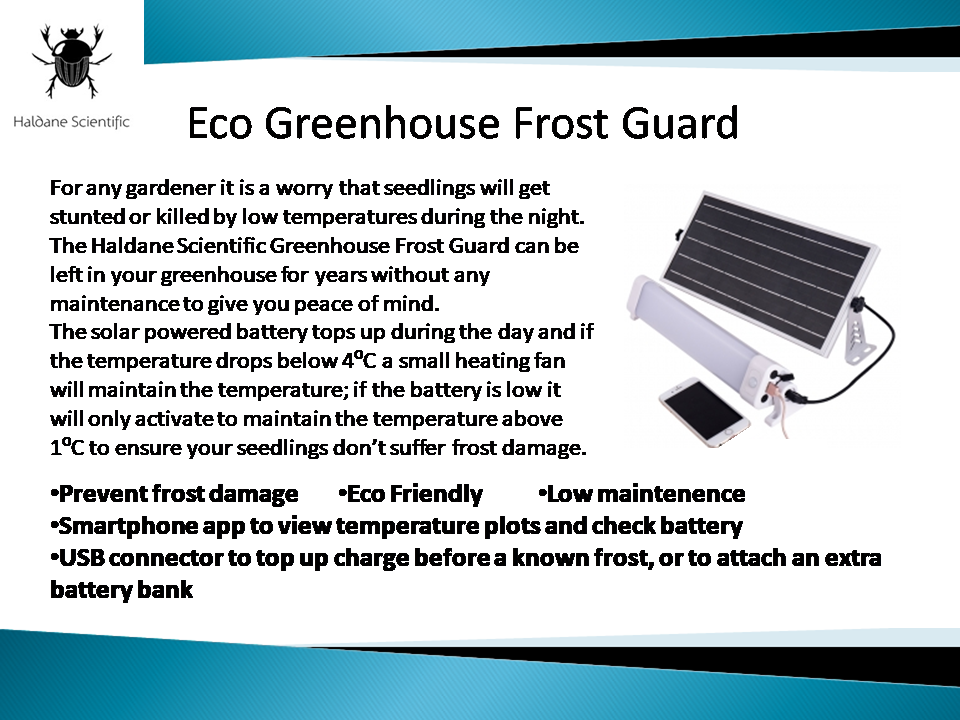
A solar powered battery tops up during the day and if the temperature drops below 4⁰C a small heating fan will maintain the temperature; if the battery is low it will only activate to maintain the temperature above 1⁰C to ensure your seedlings don’t suffer frost damage.
1. would you want one? do you think it would be useful?
2. are there any particular features you'd like to see in it? are there any problems you would anticipate?
3. do you know of any other solution that is already on the market?
4. how much would you pay for it?
5. any other feedback welcome!
Too many unanswered questions. How big if and area will this heat? For how long? How much of a temperature gain will it create? How well will the battery recharge under cloudy conditions? From the information posted, I would not buy it.
Seems non-viable to me. My tiny 10' X 12' greenhouse requires around 15000 BTU to keep warm on a cool night. That's more than 4000 Watts X a 12 hour night is 48 KWhr.
I estimate that a solar electric system to keep my greenhouse above freezing would cost in excess of $20,000.
Thanks for feedback so far - I do have some concerns about how much power would be required. my intended market was people who moved seedlings to the greenhouse when they believed the last frost of the year is over and so this would only be for an emergency where the temperature dipped on only one night infrequently. I also wondered about not incorporating a battery and leaving it up to the customer to add a rechargeable 12V battery eg a cheap car battery.
Joseph - what is the outside temperature when you are using 48kWh? what temp does it try to maintain?
Solar charging setups are widely available now. Not dime a dozen, but there is a variety of different types and features. The solar charging function is easily a self contained module - it's "output" is a charged battery. Do you want to enter that market?
The temperature controlled function is also a self contained module. These may be less common. The most basic output would be an on/off switch. The maybe "temperature on" and "temperature off" which activate and output switch (relay). Various additional controls might be timers, overshoot settings, battery level sensors to control turn-on, stop. And many others. But simple is usually better, both for cheap and for easy user comprehension. A remote sensor might be the first upgrade option or it might be part of the basic package.
Your value added would be mostly in 1) sourcing reliable components and 2) easy-to-use, safe, long lived packaging. The package s/b water resistant at least, wide temperature range (ie. strength doesn't disappear at 15F.) multiple mounting options, excellent, robust electrical connectors. The best item will survive dropping onto hard wood from 10+ feet up and being swung at the end of it's attached electrical wires...
I'm sure a temperature control module could find many applications, the fan control being one of them. There could be many options, temp range, multiple sensors, sensor interaction programming, multiple outputs, and if you really get going, output programming using timers or PWM for various output. But that fancy stuff may actually not be a good idea. It could put you into a completely different market. Remember the VCR or microwave syndrome - clock blinking 12:00 forever. Most people don't RTFM and don't benefit if they do.
Ergo, your value added 3) would be keeping it brain dead simple and teaching your customers how they can use a temperature controlled switch for something useful to them. Just as wild ass guess, important additional options might include low/high temp, or shutdown, alarms (more output switches).
So we're back to your first Q. <GG> I'm afraid your main issue with any business is market savvy and salesmanship. The tech is simple, relatively - the wetware is what drowns you. That's why dirt simple, rock solid might be your best go. Also consider the "user interface". Can the new customer take it out of the box, take one look, instantly see how to do what they want, do it and go to dinner, come back and find they did it right?
If the goal is heat, and the energy source is the sun, it is far far easier, more efficient, cheaper, simpler, and uses much less solar collector area to collect heat from the sun and store it in one way or another. Changing sunlight to electricity has an efficiency of, I forget, but around 10%? And storing electricity in a battery and then getting it out again has a similarly low efficiency. So using that electricity to generate heat will give you a small fraction of the heat that you would have got by directly converting sunlight to heat and storing it. I'm afraid your plan, if it were to generate a significant amount of heat, would require a huge phtovoltaic collector area to heat a much smaller area.
Hi all, thanks for the feedback. I'm thinking at the moment that this probably isn't going to be something I develop. The required battery size, and the issues that rechargeable batteries can have when temperature cycled through low temperatures means this potential project falls further down the priority list to a point where it may not get resurrected. The product would really only be applicable to climates such as here in Ireland where there aren't really well defined seasons and it might be spring/summer for weeks and then actually get a frost one night. not a big enough market.
Not to ding on the product or anything, but you get maybe 20% of the light energy converted to electricity. Then you have a loss storing that electric in a battery, then further loss taking that energy from the battery and turning it into heat and fan power.
The old fashioned black water tanks in your greenhouse would likely be even more efficient at collecting sunlight energy and far more efficient at radiating it more of that energy out as heat through out the night. For what it would cost to set up a solar powered system that would emergency heat even a small to moderate volume sized greenhouse one could pay for cheap electricity to heat it for a far cheaper price.
I would like to try the mulch heating in my greenhouse this year. Mulch will provide heat temps of 120 F to 160 F as the materials rot into mulch, far more efficient and environmentally friendly than solar panel heating systems.
Post by:autobot
Anything worth doing well is worth doing poorly first. Just look at this tiny ad: